An \(\infty\)-operad \(\mathcal O\) is unital if for every color \(X \in \underline{\mathcal O}\), the \(0\)-ary mapping space \(\mathrm{Mul}_{\mathcal O}(\emptyset, X)\) is contractible. We let \(\mathrm{Op}^{\mathrm{un}}\) denote the full subcategory of the \(\infty\)-category of \(\infty\)-operads \(\mathrm{Op}\) on the unital \(\infty\)-operads.
7 Prebraidings and braidings via \(\infty\)-operads[00DK]
In this section, we introduce the operadic machinery we use in our construction of the braiding on \({\mathbf K}^b_{\mathrm{loc}}(\mathrm{Sbim})\). Throughout, we use Lurie’s theory of \(\infty\)-operads developed in [Lur17, § 2]. subsection A.8 contains an introduction to our terminology and notation. We remind the reader that for an \(\infty\)-operad \(\mathcal O\) we denote its \(\infty\)-category of operators by \(\mathcal O^{\otimes} \rightarrow\mathrm{Fin}_*\), and its underlying \(\infty\)-category by \(\underline{\mathcal O}\) and if it is clear from context sometimes also just by \(\mathcal O\). Given another \(\infty\)-operad \(\mathcal P\), we denote the \(\infty\)-operad of \(\mathcal O\)-algebras in \(\mathcal P\) by \(\mathrm{Alg}_{\mathcal O}(\mathcal P)\) with underlying \(\infty\)-category \(\underline{\mathrm{Alg}}_{\mathcal O}(\mathcal P)\) — if clear from context sometimes also just denoted by \(\mathrm{Alg}_{\mathcal O}(\mathcal P)\) — and space of objects \(\underline{\mathrm{Alg}}_{\mathcal O}(\mathcal P)^{\simeq} = \mathrm{Hom}_{\mathrm{Op}}(\mathcal O, \mathcal P)\). Using the left adjoint \(\mathrm{Cat}_{\infty}\rightarrow\mathrm{Op}\) of the underlying-category functor \(\underline{(-)} \colon \mathrm{Op}\rightarrow\mathrm{Cat}_{\infty}\), any \(\infty\)-category \(\mathcal C\) can be considered as an \(\infty\)-operad with empty non-1-ary mapping spaces. Abusing notation, we will also denote this free \(\infty\)-operad on \(\mathcal C\) by \(\mathcal C\).
7.1 Recollections on unital \(\infty\)-operads[00DL]
We recall some facts about \(\infty\)-operads from [Lur17] and [SY19] which we will use throughout.
For all \(n \geq 0\), the \(\infty\)-operads \(\mathbb E_n\) are unital.
For \(\infty\)-operads \(\mathcal O\) and \(\mathcal P\), recall that the \(\infty\)-category \(\underline{\mathrm{Alg}}_{\mathcal O}(\mathcal P)\) of \(\mathcal O\)-algebras in \(\mathcal P\) admits a pointwise operad structure constructed in [Lur17, Ex. 3.2.4.4] and henceforth denoted \(\mathrm{Alg}_{\mathcal O}(\mathcal P)\).
Let \(\mathcal O\) be an \(\infty\)-operad and consider the operad maps \(\mathcal O\rightarrow\mathcal O\otimes \mathbb E_0\) and \(\mathrm{Alg}_{\mathbb E_0}(\mathcal O) \rightarrow\mathcal O\) induced from the operad map \(\mathrm{Triv}\rightarrow\mathbb E_0\). Then the following hold:
The \(\infty\)-operad \(\mathcal O\otimes \mathbb E_0\) is unital. Moreover, \(\mathcal O\) is unital if and only if the operad map \(\mathcal O\rightarrow\mathcal O\otimes \mathbb E_0\) is an isomorphism.
The \(\infty\)-operad \(\mathrm{Alg}_{\mathbb E_0}(\mathcal O)\) is unital. Moreover, \(\mathcal O\) is unital if and only if the operad map \(\mathrm{Alg}_{\mathbb E_0}(\mathcal O) \rightarrow\mathcal O\) is an isomorphism.
Proof.
Part ([00DQ]) follows directly from [Lur17, Prop. 2.3.1.9]. For part ([00DR]), note that for an \(\infty\)-operad \(\mathcal P\), the fiber of \(\mathrm{Hom}_{\mathrm{Op}}(\mathbb E_0, \mathcal P) \rightarrow\mathrm{Hom}_{\mathrm{Op}}(\mathrm{Triv}, \mathcal P) = \underline{ \mathcal P}^{\simeq}\) at a color \(X\in \underline{\mathcal P}\) is the \(0\)-ary mapping space \(\mathrm{Mul}_{\mathcal P}(\emptyset, X)\) and hence that \(\mathcal P\) is unital if and only if \(\mathrm{Hom}_{\mathrm{Op}}(\mathbb E_0, \mathcal P) \rightarrow\mathrm{Hom}_{\mathrm{Op}}(\mathrm{Triv}, \mathcal P)\) is an isomorphism. In particular, evaluating at \(\mathcal P= \mathrm{Alg}_{\mathbb E_0}(\mathcal O)\) for an \(\infty\)-operad \(\mathcal O\), and using that \(\mathrm{Hom}_{\mathrm{Op}}(-, \mathrm{Alg}_{\mathbb E_0}(\mathcal O)) \simeq \mathrm{Hom}_{\mathrm{Op}}(- \otimes \mathbb E_0, \mathcal O)\) and part ([00DQ]), it follows that \(\mathrm{Alg}_{\mathbb E_0}(\mathcal O)\) is unital. If \(\mathcal O\) is moreover unital, let \(\mathcal Q\) be a unital \(\infty\)-operad and consider the map \(\mathrm{Hom}_{\mathrm{Op}^{\mathrm{un}}}(\mathcal Q, \mathrm{Alg}_{\mathbb E_0}(\mathcal O))\rightarrow\mathrm{Hom}_{\mathrm{Op}^{\mathrm{un}}}(\mathcal Q, \mathcal O)\) which is equivalent to \(\mathrm{Hom}_{\mathrm{Op}^{\mathrm{un}}}(\mathcal Q\otimes \mathbb E_0, \mathcal O) \rightarrow\mathrm{Hom}_{\mathrm{Op}^{\mathrm{un}}}(\mathcal Q, \mathcal O)\). Since \(\mathcal Q\) is unital, this is an isomorphism by part ([00DQ]). This completes the proof of part ([00DR]). ◻
Evaluating lemma 7.1.3.([00DQ]) at \(\mathcal O= \mathbb E_0\) shows that \(\mathbb E_0\) is a (unital) idempotent in \(\mathrm{Op}\) (as also follows from Dunn additivity) with image \(\mathrm{Op}^{\mathrm{un}}\).
The following is an immediate consequence of lemma 7.1.3, also see [Lur17, Prop. 2.3.1.9].
The full inclusion \(\mathrm{Op}^{\mathrm{un}}\hookrightarrow \mathrm{Op}\) has left and right adjoints 
Most unital \(\infty\)-operads appearing in this paper arise from the following observation:
It follows from lemma 7.1.3 that for any unital \(\infty\)-operad \(\mathcal O\) and \(\infty\)-operad \(\mathcal P\) the operad \(\mathrm{Alg}_{\mathcal O}(\mathcal P) \simeq \mathrm{Alg}_{\mathcal O\otimes \mathbb E_0}(\mathcal P) \simeq \mathrm{Alg}_{\mathbb E_0}(\mathrm{Alg}_{\mathcal O}(\mathcal P))\) is unital. In particular, since \(\mathbb E_n\) is a unital \(\infty\)-operad for any \(n \geq 0\), it follows that for any \(\infty\)-operad \(\mathcal P\), the \(\infty\)-operads \(\mathrm{Alg}_{\mathbb E_n}(\mathcal P)\) are unital.
The underlying \(\infty\)-operad of a symmetric monoidal \(\infty\)-category \(\mathcal C\) is unital if and only if the tensor unit \(I\) of \(\mathcal C\) is an initial object. An example of such a symmetric monoidal \(\infty\)-category is given by the coCartesian tensor product on an \(\infty\)-category with finite coproducts.
The coCartesian monoidal structure on an \(\infty\)-category with finite coproducts can be generalized to a certain coCartesian unital operad structure on any \(\infty\)-category:
Example 7.1.7. ([Lur17, § 2.4.3]).
For any \(\infty\)-category \(\mathcal C\), there is a unital \(\infty\)-operad \(\mathcal C_{\sqcup}\) with underlying \(\infty\)-category \(\mathcal C\) and multi-ary mapping spaces \[\mathrm{Mul}_{\mathcal C_{\sqcup}}(X_1, \ldots, X_n; Y) \simeq \mathrm{Hom}_{\mathcal C}(X_1, Y) \times \cdots \mathrm{Hom}_{\mathcal C}(X_n, Y)\]
These coCartesian operads have the following universal characterization:
Lemma 7.1.8. ([Lur17, Prop. 2.4.3.9, Cor. 2.4.3.11], [SY19, Lem. 2.2.3]).
The assignment \(\mathcal C\mapsto \mathcal C_{\sqcup}\) induces a fully faithful functor \(\mathrm{Cat}_{\infty}\hookrightarrow \mathrm{Op}^{\mathrm{un}}\) which is right adjoint to the underlying-category functor \(\mathrm{Op}^{\mathrm{un}}\rightarrow\mathrm{Cat}_{\infty}\).
In particular, it follows that the unit of the adjunction is an operad map \(\mathcal O\rightarrow\underline{\mathcal O}_{\sqcup}\) which induces the identity on underlying \(\infty\)-categories \(\underline{\mathcal O} \rightarrow\underline{\underline{\mathcal O}_{\sqcup}} \simeq \underline{\mathcal O}\). Fixing colors \(X_1, \ldots, X_n, Y \in \underline{\mathcal O}\), this induces a map \[ \sigma \colon \mathrm{Mul}_{\mathcal O}(X_1, \ldots, X_n; Y) \rightarrow\mathrm{Hom}_{\underline{\mathcal O}}(X_1, Y) \times \cdots \times \mathrm{Hom}_{\underline{\mathcal O}}(X_n, Y).\] The components \(\mathrm{Mul}_{\mathcal O}(X_1, \ldots, X_n; Y) \rightarrow\mathrm{Hom}_{\underline{\mathcal O}}(X_i, Y)\) of this map may be thought of as inserting units in all but the \(i\)-th slot.
7.2 The operads \(\mathbb A_2\) and \(\mathbb{T}_2\)[00DZ]
For a unital \(\infty\)-operad \(\mathcal O\), we can use the unit-inserting map \[\sigma \colon \mathrm{Mul}_{\mathcal O}(X_1, \ldots, X_n; Y) \rightarrow\mathrm{Hom}_{\underline{\mathcal O}}(X_1, Y) \times \cdots \times \mathrm{Hom}_{\underline{\mathcal O}}(X_n, Y)\] from ([00DY]) to give a quick definition of the well-known notion of a unital \(\mathbb A_2\)-algebra, which encodes a left and right-unital binary multiplication without any associativity requirements:
A unital \(\mathbb A_2\)-algebra in a unital \(\infty\)-operad \(\mathcal O\) is given by a color \(X \in \underline{\mathcal O}\) equipped with an element of the pullback \[\mathrm{Mul}_{\mathcal O}(X,X;X)\times_{\mathrm{Hom}_{\underline{\mathcal O}}(X,X)^{\times 2}} \{(\mathrm{id}_X, \mathrm{id}_X)\},\] i.e. a \(2\)-ary map \(\mu \in \mathrm{Mul}_{\mathcal O}(X, X; X)\) and an identification of its image \((\mu(1,-), \mu(-1))\) under \(\sigma \colon \mathrm{Mul}_{\mathcal O}(X, X; X) \rightarrow\mathrm{Hom}_{\underline{\mathcal O}}(X, X)^{\times 2}\) with \((\mathrm{id}_X, \mathrm{id}_X)\).
A unital \(\mathbb A_2\)-algebra in a (not necessarily unital) \(\infty\)-operad \(\mathcal O\) is a unital \(\mathbb A_2\)-algebra in the unital \(\infty\)-operad \(\mathrm{Alg}_{\mathbb E_0}(\mathcal O)\).
lemma 7.1.3.([00DR]) ensures that definition 7.2.1 is well-defined for non-unital operads and unambigous for unital \(\infty\)-operads.
We will also be concerned with the following relative version:
A \(\mathbb{T}_2\)-algebra in a unital operad \(\mathcal O\) is given by a pair of colors \(X,Y \in \underline{\mathcal O}\) equipped with an element of the pullback \[\mathrm{Mul}_{\mathcal O}(X,X;Y) \times_{\mathrm{Hom}_{\underline{\mathcal O}}(X,Y)^{\times 2}} \mathrm{Hom}_{\underline{\mathcal O}}(X,Y),\] i.e. a \(2\)-ary operation \(\mu \in \mathrm{Mul}_{\mathcal O}(X,X;Y)\) and an identification of the \(1\)-ary operations \(\mu(-, 1)\) and \(\mu(1,-)\) in \(\mathrm{Hom}_{\underline{\mathcal O}}(X,Y)\).
A \(\mathbb T_2\)-algebra in a (not necessarily unital) \(\infty\)-operad \(\mathcal O\) is a \(\mathbb T_2\)-algebra in the unital \(\infty\)-operad \(\mathrm{Alg}_{\mathbb E_0}(\mathcal O)\).
We now construct \(\infty\)-operads which corepresent \(\mathbb{T}_2\) and \(\mathbb A_2\)-algebras. For this purpose, for any \(n \geq 0\), consider the functor \[\nabla_n: \mathrm{Op}\rightarrow\mathcal S, \hspace{0.5cm} \mathcal O\mapsto \mathrm{Hom}_{(\mathrm{Cat}_{\infty})_{/\mathrm{Fin}_*}} \left([1] \xrightarrow{\{\underline{n}_+ \rightarrow\underline{1}_+\}} \mathrm{Fin}_*, ~~\mathcal O^{\otimes} \rightarrow\mathrm{Fin}_* \right),\] which may intuitively be thought of as sending an \(\infty\)-operad \(\mathcal O\) to the space of \((n+1)\)-tuples of colors \(X_1,\ldots, X_n,Y \in \underline{\mathcal O}\) equipped with an \(n\)-ary map \(\mu \in \mathrm{Mul}_{\mathcal O}(X_1, \ldots, X_n; Y)\).
The functor \(\nabla_n \colon \mathrm{Op}\rightarrow\mathcal S\) is corepresented by an \(\infty\)-operad, also denoted \(\nabla_n\).
Proof.
Using Lurie’s combinatorial simplicial model category of \(\infty\)-preoperads [Lur17, § 2.1.4], one can define the \(\infty\)-operad \(\nabla_n\) as a fibrant resolution of the \(\infty\)-preoperad \([1] \xrightarrow{\underline{n}_+ \rightarrow\underline{1}_+} \mathrm{Fin}_*\). ◻
For a unital \(\infty\)-operad \(\mathcal O\) and a \(\nabla_2\)-algebra \((X,Y,Z, \mu \in \mathrm{Mul}_{\mathcal O}(X,Y;Z))\), we may insert units into \(\mu\) to extract morphisms \(X\rightarrow Z\) and \(Y \rightarrow Z\) in \(\underline{\mathcal O}\), This leads to the following:
The \(\infty\)-category \(\underline{\nabla_2 \otimes \mathbb E_0}\) underlying the unital \(\infty\)-operad \(\nabla_2 \otimes \mathbb E_0\) is equivalent to the ‘walking span’  , i.e. the pushout \([1] \sqcup_{[0]} [1]\).
Proof.
By adjunction, for any \(\infty\)-category \(\mathcal C\), we have \[\mathrm{Hom}_{\mathrm{Cat}_{\infty}}(\underline{\nabla_2 \otimes \mathbb E_0}, \mathcal C) \simeq \mathrm{Hom}_{\mathrm{Op}^{\mathrm{un}}}( \nabla_2 \otimes \mathbb E_0, \mathcal C_{\sqcup}) \simeq \mathrm{Hom}_{\mathrm{Op}} (\nabla_2, \mathcal C_{\sqcup}).\] The latter space explicitly unpacks to the space of triples \(X, Y, Z\in \mathcal C\) with maps \(X\rightarrow Y \leftarrow Z\) and hence  . ◻
. ◻
Consider the codiagonal functor  which identifies the two morphisms in the span.
We define the \(\mathbb T_2\)-operad and the \(\mathbb A_2\)-operad as the following pushouts of unital \(\infty\)-operads: 
The definitions together with lemma 7.2.4 immediately imply that algebras of the \(\mathbb{T}_2\)- and \(\mathbb A_2\)-operad are \(\mathbb{T}_2\)- and \(\mathbb A_2\)-algebras in the sense of Definitions 7.2.2 and 7.2.1.
Let \(\mathcal O\) be a (not necessarily unital) \(\infty\)-operad.
Given a map of operads \([1] \otimes \mathbb E_0 \rightarrow\mathcal O\), equivalently a map of operads \([1] \rightarrow\mathrm{Alg}_{\mathbb E_0}(\mathcal O)\) specified by a morphism \(f \colon A \rightarrow B\) in \(\underline{\mathrm{Alg}}_{\mathbb E_0}(\mathcal O)\), the above pushout induces an isomorphism of spaces: \[\mathrm{Hom}_{{\mathrm{Op}_{[1] \otimes \mathbb E_0/}}} \left( \mathbb T_2, \mathcal O\right) \simeq \mathrm{Mul}_{\mathrm{Alg}_{\mathbb E_0}(\mathcal O)}(A,A;B) \times_{\mathrm{Mul}_{\mathrm{Alg}_{\mathbb E_0}(\mathcal O)}(A;B)^2} \{(f,f)\}.\]
Given a map of operads \(\mathbb E_0 \rightarrow\mathcal O\), equivalently an \(A\in \mathrm{Alg}_{\mathbb E_0}(\mathcal O)\), the above pushout induces an isomorphism of spaces \[ \mathrm{Hom}_{\mathrm{Op}_{\mathbb E_0/}}(\mathbb A_2,\mathcal O) \simeq \mathrm{Mul}_{\mathrm{Alg}_{\mathbb E_0}(\mathcal O)}(A,A;A) \times_{\mathrm{Mul}_{\mathrm{Alg}_{\mathbb E_0}(\mathcal O)}(A;A)^2} \{(\mathrm{id}_A,\mathrm{id}_A)\}\]
Using corollary 7.2.6, we may factor the canonical map \(\mathbb E_0 \rightarrow\mathbb E_1\) through an operad map \(\mathbb A_2 \rightarrow\mathbb E_1\) which remembers of an \(\mathbb E_1\)-algebra only the binary multiplication and its unitality structure. This is the first step in the well-known filtration \(\mathbb E_0 = \mathbb A_1 \rightarrow\mathbb A_2 \rightarrow\ldots \rightarrow\mathbb A_{\infty} = \mathbb E_{1}\) of the \(\mathbb E_1\)-operad by the unital \(\mathbb A_n\) operads, encoding higher coherent associativity (see [Lur17, § 4.1.4] for a non-unital version of this filtration in the setting of \(\infty\)-operads). In this paper, we will only need the first stage \(\mathbb E_0 \rightarrow\mathbb A_2\rightarrow\mathbb E_1\).
For an \(\infty\)-operad \(\mathcal O\) and an operad map \([1] \otimes \mathbb E_0 \rightarrow\mathcal O\) corepresenting a morphism \(f \colon A \rightarrow B \in \mathrm{Alg}_{\mathbb E_0}(\mathcal O)\), we write \[\mathbb{T}^{\mathcal O}_2(f) \coloneqq \mathrm{Hom}_{\mathrm{Op}_{[1] \otimes \mathbb E_0/}}(\mathbb{T}_2, \mathcal O) \simeq \mathrm{Mul}_{\mathrm{Alg}_{\mathbb E_0}(\mathcal O)}(A,A;B) \times_{\mathrm{Mul}_{\mathrm{Alg}_{\mathbb E_0}(\mathcal O)}(A;B)^2} \{(f,f)\}.\] for the space of \(\mathbb T_2\)-structures on \(f\).
For an \(\infty\)-operad \(\mathcal O\) and an operad map \(\mathbb E_0 \rightarrow\mathcal O\) corepresenting an \(\mathbb E_0\)-algebra \(A\) in \(\mathcal O\), we write \[\mathbb A^{\mathcal O}_2(A) \coloneqq \mathrm{Hom}_{\mathrm{Op}_{\mathbb E_0/}}(\mathbb A_2, \mathcal O) \simeq \mathrm{Mul}_{\mathrm{Alg}_{\mathbb E_0}(\mathcal O)}(A,A;A) \times_{\mathrm{Mul}_{\mathrm{Alg}_{\mathbb E_0}(\mathcal O)}(A;A)^2} \{(\mathrm{id}_A,\mathrm{id}_A)\}.\] for the space of \(\mathbb A_2\)-structures on \(A\).
If clear from context, we will often drop the superscript \(\mathcal O\) indicating the ambient \(\infty\)-operad and simply write \(\mathbb T_2(f)\) and \(\mathbb A_2(A)\).
A straight-forward, but very useful consequence of the definition is that \(\mathbb T_2\)-structures transport along adjunctions: In an adjunction, \(\mathbb T_2\)-structures on a morphism \(f \colon LA \rightarrow B\) are canonically identified with \(\mathbb T_2\)-structures on its adjunct \(A\rightarrow RB\):
Let \(\mathcal C\) and \(\mathcal D\) be symmetric monoidal \(\infty\)-categories whose monoidal units are initial. Let  be an adjunction with (strongly) symmetric monoidal left adjoint \(L\) and unit denoted by \(\eta \colon \mathrm{id}_{\mathcal C} \Rightarrow RL\). Then, the adjunction isomorphism \[\psi_{A,B}: \mathrm{Hom}_{\mathcal D}(LA, B) \xrightarrow{R(-)} \mathrm{Hom}_{\mathcal C}(RLA, RB) \xrightarrow{- \circ \eta_A } \mathrm{Hom}_{\mathcal C}(A, RB)\] induces via the maps from observation 7.2.10 for every \(f\in \mathrm{Hom}_{\mathcal D}(LA, B)\) an isomorphism \[\mathbb T_2(f) \xrightarrow{R(-)} \mathbb T_2(Rf) \xrightarrow{-\circ \eta_A} \mathbb T_2( Rf \circ \eta_A) = \mathbb T_2(\psi_{A,B}(f)).\]
Proof.
By adjunction and monoidality of \(L\), the horizontal maps in the commuting diagram 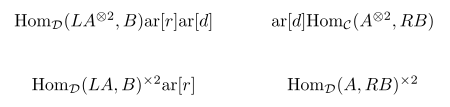 are isomorphisms and hence so is the induced map between the fibers at \(\{(f,f)\} \rightarrow\mathrm{Hom}_{\mathcal D}(LA, B)^{\times 2}\). ◻
The space \(\mathbb T_2(f)\) of \(\mathbb T_2\)-structures on a given \(\mathbb E_0\)-morphism \(f \colon A \rightarrow B\) in \(\mathrm{Alg}_{\mathbb E_0}(\mathcal O)\) is compatible with composition and functorial: Given an operad map \(F \colon \mathcal O\rightarrow\mathcal P\), applying \(F\) induces a map of spaces \[\mathbb T_2(f) \xrightarrow{F(-)} \mathbb T_2(F(f)).\]
Similarly, any \(\mathbb E_0\)-morphism \(g \colon B \rightarrow C\) in \(\mathrm{Alg}_{\mathbb E_0}(\mathcal O)\) induces evident maps of spaces \[ \mathbb T_2(f) \xrightarrow{g \circ -} \mathbb T_2(g \circ f) \hspace{1cm} \mathbb T_2(g) \xrightarrow{- \circ (f,f)} \mathbb T_2(g \circ f) .\]
It will be useful to express this operation in terms of \(\infty\)-operads. Let \([2]\coloneqq \{0 <1<2\}\) denote the \(\infty\)-category (and the free \(\infty\)-operad on that \(\infty\)-category) corepresenting a pair of composable morphisms. Consider the following pushouts of \(\infty\)-operads  corepresenting a pair of \(\mathbb E_0\)-morphisms \(A \xrightarrow{f} B \xrightarrow{g} C\) with a \(\mathbb T_2\)-structure on \(f\), \(g\) or \(g\circ f\), respectively. By Yoneda, the maps of spaces constructed above induce operad maps \[\mathbb T_2\sqcup_{\{1< 2\}} [2] \leftarrow \mathbb T_2\sqcup_{\{0<2\}}[2] \rightarrow\mathbb T_2 \sqcup_{\{0<1\}}[2].\]
7.3 Relative \(\mathbb T_2\)-structures[00EG]
Analogous to (and as we will see later — generalizing) definition 2.4.5, we introduce \(\mathbb T_2\)-structures relative to a given \(\mathbb A_2\)-structure.
As a consequence of observation 7.2.10, given an \(\mathbb E_0\)-morphism \(f \colon A \rightarrow B\) in an \(\infty\)-operad \(\mathcal O\), applying ([00EF]) in the case \(g=\mathrm{id}_B\), we obtain a map of spaces \[\mathbb A_2(B) = \mathbb T_2(\mathrm{id}_B) \xrightarrow{ -\circ (f,f)} \mathbb T_2(f).\] In particular, any \(\mathbb A_2\)-structure on \(B\) (e.g induced by a genuine \(\mathbb E_1\)- or even \(\mathbb E_{\infty}\)-structure) induces a \(\mathbb T_2\)-structure on \(f\).
This allows us to introduce the following notion, analogous to definition 2.4.5.
Let \(\mathcal O\) be an \(\infty\)-operad, \(C\) an \(\mathbb A_2\)-algebra (with \(\mathbb A_2\)-structure denoted by \(\alpha \in \mathbb A_2^{\mathcal O}(C)\)) and let \(A \xrightarrow{f} B \xrightarrow{g}C\) be morphisms of \(\mathbb E_0\)-algebras. We define the space \(\mathbb T_2^{\mathcal O}(f)_{/C}\) of \(\mathbb T_2\)-structures on \(f\) relative to \(C\) as the pullback of the span \[\{ \alpha\} \rightarrow\mathbb A_2^{\mathcal O}(C) = \mathbb T^{\mathcal O}_2(\mathrm{id}_C) \xrightarrow{- \circ (g\circ f, g\circ g)} \mathbb T_2(g\circ f) \xleftarrow{g \circ -}\mathbb T_2(f).\]
In words, a \(\mathbb T_2\)-structure on \(f\) relative to \(C\) is a \(\mathbb T_2\)-structure on \(f\) with an identification of the induced \(\mathbb T_2\)-structure on \(g\circ f\) with the \(\mathbb T_2\)-structure on \(g\circ f\) induced by the \(\mathbb A_2\)-structure \(\alpha\) on \(C\).
Recall from §A.8.6 that for an \(\mathbb E_{\infty}\)-algebra \(C\) in a symmetric monoidal \(\infty\)-category \(\mathcal V\), the over-\(\infty\)-category \(\mathcal V_{/C}\) inherits a symmetric monoidal structure so that for any \(\infty\)-operad \(\mathcal O\), there is an equivalence of \(\infty\)-categories \(\underline{\mathrm{Alg}}_{\mathcal O}(\mathcal V_{/C}) \simeq \underline{\mathrm{Alg}}_{\mathcal O}(\mathcal V)_{/C}\), where for the latter category we consider \(C\) as equipped with the \(\mathcal O\) algebra structure induced by restricting its \(\mathbb E_{\infty}\)-structure along the terminal operad map \(\mathcal O\rightarrow\mathbb E_{\infty}\).
Let \(C\) be an \(\mathbb E_{\infty}\)-algebra in a symmetric monoidal \(\infty\)-category \(\mathcal V\), and consider an \(\mathbb E_0\)-algebra morphism in \(\mathcal V_{/C}\), i.e. equivalently a commuting diagram of \(\mathbb E_0\)-algebra morphisms in \(\mathcal V\) as follows 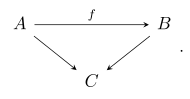 Then, we have an equivalence of spaces \[\mathbb T_2^{\mathcal V_{/C}} (f) \simeq \mathbb T^{\mathcal V}_2(f)_{/C},\] where for the latter space we consider \(C\) as equipped with the \(\mathbb A_2\)-structure induced by its \(\mathbb E_{\infty}\)-structure.
In words: ‘Absolute’ \(\mathbb T_2\)-structures on \(f\) in the sense of notation 7.2.8 seen as a morphism in the symmetric \(\infty\)-category \(\mathcal V_{/C}\) coincide with relative \(\mathbb T_2\)-structures on \(f\) in \(\mathcal V\) in the sense of definition 7.3.1.
Proof.
By definition, the space \(\mathbb T_2^{\mathcal V_{/C}}(f)\) is the fiber of the functor \(\underline{\mathrm{Alg}}_{\mathbb T_2}(\mathcal V_{/C}) \rightarrow\underline{\mathrm{Alg}}_{[1] \otimes \mathbb E_0}(\mathcal V_{/D})\) at \(f\). By the universal property of the symmetric monoidal structure on the over-category \(\mathcal V_{/C}\), this is equivalent to the functor \(\underline{\mathrm{Alg}}_{\mathbb T_2}(\mathcal V)_{/C} \rightarrow\underline{\mathrm{Alg}}_{[1] \otimes \mathbb E_0}(\mathcal V)_{/C}\). Unwinding the definition of morphisms in over-categories, this results in the desired equivalence. ◻
7.4 Centralizers and centers[00EK]
In light of theorem 2.6.4, we recall the \(\infty\)-categorical theory of centers and centralizers developed in [Lur17, § 5.3.1] and relate them to \(\mathbb{T}_2\)- and \(\mathbb A_2\)-algebras.
Definition 7.4.1. ([Lur17, Def. 5.3.1.2]).
Let \(f \colon A \rightarrow B\) be a morphism in a monoidal \(\infty\)-category \(\mathcal C\). A centralizer \(\mathfrak{Z}(f)\) of \(f\) is a final object in the \(\infty\)-category \[\mathcal C_{I/} \times_{\mathcal C_{A/}} \mathcal C_{A// B},\] where the functor \(\mathcal C_{I/} \rightarrow\mathcal C_{A/}\) sends objects \((\alpha \colon I\rightarrow X)\) of \(\mathcal C_{I/}\) to \((A \simeq I \otimes A \xrightarrow{\alpha \otimes \mathrm{id}_A} X\otimes A) \in \mathcal C_{A/}\).
Unpacked, a centralizer is an object \(\mathfrak{Z}(f) \in \mathcal C\) equipped with morphisms \(u \colon I \rightarrow\mathfrak{Z}(f)\) and \(\mathrm{ev}\colon \mathfrak{Z}(f) \otimes A \rightarrow B\), such that the following diagram commutes 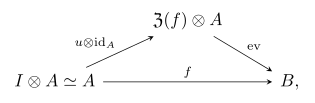 and which is final among such pairs: for any pair of morphisms \(u_X\colon I \rightarrow X\) in \(\mathcal C\) and \(\mathrm{ev}_X\colon X\otimes A \rightarrow B\) making the analog of ([00EM]) commute, there is a unique morphism \(\varphi\colon X \rightarrow\mathfrak{Z}(f)\) such that
 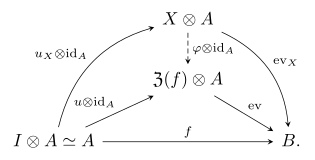 commutes.
Given a functor \(F \colon \mathcal C\rightarrow\mathcal D\) of \(\infty\)-categories, by [Lur17, Rmk. 5.3.1.4] the centralizer in \(\mathrm{Cat}_{\infty}\) exists and is given by the functor category \(\mathrm{Fun}(\mathcal C, \mathcal D)\) with pointing \(u \colon \{F\} \rightarrow\mathrm{Fun}(\mathcal C, \mathcal D)\) and \(\mathrm{ev}\colon \mathrm{Fun}(\mathcal C, \mathcal D) \times \mathcal C\rightarrow\mathcal D\) given by the evaluation functor.
Let \(\mathcal C\) be a presentably symmetric monoidal \(\infty\)-category. For every morphism \(f \colon A \rightarrow B\) in the \(\infty\)-category \(\mathrm{Alg}_{\mathbb E_k}(\mathcal C)\), the centralizer in \(\mathrm{Alg}_{\mathbb E_k}(\mathcal C)\) exists [Lur17, Cor. 5.3.1.15] and will henceforth be denoted by \(Z_k(f)\in\mathrm{Alg}_{\mathbb E_k}(\mathcal C)\).
It is straight-forward to verify that for a monoidal functor \(F \colon \mathcal C\rightarrow\mathcal D\) between ordinary monoidal \(1\)-categories, the centralizer \(Z_1(F) \in \mathrm{Alg}_{\mathbb E_1}(\mathrm{Cat}_1)\) in the \((2,1)\)-category \(\mathrm{Alg}_{\mathbb E_1}(\mathrm{Cat}_1)\) of monoidal \(1\)-categories is given by the category from definition 2.6.1 with unit \(1_{Z(f)}\colon {\sf pt}\rightarrow Z_1(F)\) and \(\mathrm{ev}\colon Z_1(F) \times \mathcal C\rightarrow\mathcal D\) described in definition 2.6.1 and definition 2.6.3.
As with ordinary monoidal categories, the case \(f= \mathrm{id}_A \colon A \rightarrow A\) is of special interest. For \(\mathcal C\) a monoidal \(\infty\)-category, recall from [Lur17, Def. 4.2.1.13] the \(\infty\)-category \(\mathrm{LMod}(\mathcal C)\) of left module objects, whose objects are pairs of an algebra \(A\in \mathrm{Alg}_{\mathbb E_1}(\mathcal C)\) and an \(A\)-module \(M\in \mathrm{LMod}_A(\mathcal C)\), and the functor \(\mathrm{LMod}(\mathcal C) \rightarrow\mathcal C\) which sends a pair of an algebra \(A\) and a module \({}_{A}M\) to the underlying object \(M\).
Definition 7.4.5. ([Lur17, Def. 5.3.1.6]).
Let \(\mathcal C\) be a monoidal \(\infty\)-category and \(M\) an object of \(\mathcal C\). A center \(\mathfrak{Z}(M)\) of \(M\) is a final object of the \(\infty\)-category \(\mathrm{LMod}(\mathcal C) \times_{\mathcal C} \{M\}\).
Unpacked, a center \(\mathfrak{Z}(M)\) is an \(\mathbb E_1\)-algebra \(\mathfrak{Z}(M)\) in \(\mathcal C\) with a left action on \(M\) so that all other left actions of \(\mathbb E_1\)-algebras \(A\) on \(M\) factor through \(\mathfrak{Z}(M)\).
Proposition 7.4.6. ([Lur17, Prop. 5.3.1.8]).
Let \(M\) be an object in a monoidal \(\infty\)-category \(\mathcal C\). If \(\mathrm{id}_M\colon M \rightarrow M\) has a centralizer in \(\mathcal C\), then \(M\) has a center. Furthermore, an \(\mathbb E_1\)-algebra \(A\) with a left-action on \(M\) is a center of \(M\) if and only if the underlying maps \(I \rightarrow A\) and \(A\otimes M \rightarrow M\) exhibit \(A\) as a centralizer of \(\mathrm{id}_M\).
Given a small \(\infty\)-category \(\mathcal C\), the center in \(\mathrm{Cat}_{\infty}\) exists and is given by the monoidal \(\infty\)-category \(\mathrm{Fun}(\mathcal C, \mathcal C) \in \mathrm{Alg}_{\mathbb E_1}(\mathrm{Cat}_{\infty})\).
Let \(\mathcal C\) be a presentably symmetric monoidal \(\infty\)-category. For every \(A\in \mathrm{Alg}_{\mathbb E_k}(\mathcal C)\), the center in \(\mathrm{Alg}_{\mathbb E_k}(\mathcal C)\) exists [Lur17, Cor. 5.3.1.15] and will henceforth be denoted by \[Z_k(A)\in\mathrm{Alg}_{\mathbb E_1}(\mathrm{Alg}_{\mathbb E_k}(\mathcal C)) = \mathrm{Alg}_{\mathbb E_{k+1}}(\mathcal C).\] By proposition 7.4.6, the underlying \(\mathbb E_k\)-algebra of \(Z_k(A)\) agrees with the centralizer \(Z_k(\mathrm{id}_A)\) from notation 7.4.3.
For \(A \in \mathrm{Alg}_{\mathbb E_1}(\mathrm{Cat}_1)\) an ordinary monoidal \(1\)-category, the center is given by the Drinfeld center \(Z_1(A)\in \mathrm{Alg}_{\mathbb E_2}(\mathrm{Cat}_1)\), see [Lur17, Exm. 5.3.1.18].
Let \(\mathcal C\) be a symmetric monoidal \(\infty\)-category whose tensor unit \(I\) is initial and let \(f \colon A \rightarrow B\) be a morphism in \(\mathcal C\) whose centralizer \(\mathfrak{Z}(f) \in \mathcal C\) exists. Then, we define \(\mathrm{ev}_{1_A} \colon \mathfrak{Z}(f) \rightarrow B\) to be the composite \[\mathfrak{Z}(f) \simeq \mathfrak{Z}(f) \otimes I \xrightarrow{\mathrm{id}_{\mathfrak{Z}(f)} \otimes 1_A} \mathfrak{Z}(f) \otimes A \xrightarrow{\mathrm{ev}} B,\] where \(1_A\in \mathrm{Hom}_{\mathcal C}(I, A) \simeq *.\) Below, we will mostly use this morphism in the case that \(\mathcal C= \mathrm{Alg}_{\mathbb E_k}(\mathcal A)\) for a presentably symmetric monoidal \(\infty\)-category \(\mathcal A\), in which case this defines an \(\mathbb E_k\)-algebra map \(Z_k(f) \rightarrow B\) for any \(\mathbb E_k\)-algebra map \(f \colon A \rightarrow B\) in \(\mathrm{Alg}_{\mathbb E_k}(\mathcal A)\).
The relevance of centralizers to this paper arises from the following proposition:
Let \(\mathcal C\) be a symmetric monoidal \(\infty\)-category and \(f\colon A\rightarrow B\) be a morphism in \(\mathrm{Alg}_{\mathbb E_0}(\mathcal C)\). If the centralizer \(Z_0(f)\) in \(\mathrm{Alg}_{\mathbb E_0}(\mathcal C)\) exists, then the space \[\mathbb{T}_2(f)\coloneqq \mathrm{Hom}_{\mathrm{Op}_{[1] \otimes \mathbb E_0/}}(\mathbb{T}_2, \mathcal C) \simeq \mathrm{Hom}_{\mathrm{Alg}_{\mathbb E_0}(\mathcal C)}(A\otimes A, A) \times_{\mathrm{Hom}_{\mathrm{Alg}_{\mathbb E_0}(\mathcal C)}(A,B)^2} \{(f,f)\}\] of \(\mathbb{T}_2\)-structures on \(f\) is equivalent to the following space of (dashed) lifts in \(\mathrm{Alg}_{\mathbb E_0}(\mathcal C)\): 
Proof.
The space of lifts ([00EZ]) is by definition the fiber of \[\mathrm{Hom}_{\mathrm{Alg}_{\mathbb E_0}(\mathcal C)}(A, Z_0(f)) \xrightarrow{\mathrm{ev}_{1_A} \circ -} \mathrm{Hom}_{\mathrm{Alg}_{\mathbb E_0}(\mathcal C)}(A, B)\] at \(f\). By the universal property of the centralizer and since \(I\) is initial in \(\mathrm{Alg}_{\mathbb E_0}(\mathcal C)\), the space \(\mathrm{Hom}_{\mathrm{Alg}_{\mathbb E_0}(\mathcal C)}(A, Z_0(f))\) is equivalent to the space \(\mathrm{Hom}_{\mathrm{Alg}_{\mathbb E_0}(\mathcal C)}(A\otimes A, B)\times_{\mathrm{Hom}_{\mathrm{Alg}_{\mathbb E_0}(\mathcal C)}(A, B)}\{f\}\) of lifts 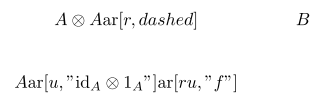 in \(\mathrm{Alg}_{\mathbb E_0}(\mathcal C)\), where \(1_A \colon I \rightarrow A\) denotes the unique morphism in \(\mathrm{Alg}_{\mathbb E_0}(\mathcal C)\). Under this identification, the map \(\mathrm{Hom}_{\mathrm{Alg}_{\mathbb E_0}(\mathcal C)}(A, Z_0(f)) \xrightarrow{\mathrm{ev}_{1_A} \circ -}\mathrm{Hom}_{\mathrm{Alg}_{\mathbb E_0}(\mathcal C)}(A, B)\) unpacks to the composite \[\mathrm{Hom}_{\mathrm{Alg}_{\mathbb E_0}(\mathcal C)}(A\otimes A, B)\times_{\mathrm{Hom}_{\mathrm{Alg}_{\mathbb E_0}(\mathcal C)}(A, B)}\{f\} \rightarrow\mathrm{Hom}_{\mathrm{Alg}_{\mathbb E_0}(\mathcal C)}(A\otimes A, B) \rightarrow\mathrm{Hom}_{\mathrm{Alg}_{\mathbb E_0}(\mathcal C)}(A, B)\] of the projection and the precomposition with \(A\simeq I \otimes A \xrightarrow{1_A \otimes \mathrm{id}_A}A\otimes A\). Hence, the fiber of \(\mathrm{Hom}_{\mathrm{Alg}_{\mathbb E_0}(\mathcal C)}(A, Z_0(f)) \xrightarrow{\mathrm{ev}_{1_A} \circ -}\mathrm{Hom}_{\mathrm{Alg}_{\mathbb E_0}(\mathcal C)}(A, B)\) at \(f\) is equivalent to the space \[\mathrm{Hom}_{\mathrm{Alg}_{\mathbb E_0}(\mathcal C)}(A\otimes A, B)\times_{\mathrm{Hom}_{\mathrm{Alg}_{\mathbb E_0}(\mathcal C)}(A, B)^{\times 2}} \{(f,f)\} =: \mathbb T_2(f). \qedhere\] ◻
Let \(\mathcal C\) be a symmetric monoidal \(\infty\)-category and \(A \in \mathrm{Alg}_{\mathbb E_0}(\mathcal C)\). If the center \(Z_0(A) \in \mathrm{Alg}_{\mathbb E_1}(\mathcal C)\) exists, then the space \[\mathbb A_2(A) \coloneqq \mathrm{Hom}_{\mathrm{Op}_{ \mathbb E_0/}}(\mathbb A_2, \mathcal C) \simeq \mathrm{Hom}_{\mathrm{Alg}_{\mathbb E_0}(\mathcal C)}(A\otimes A, A) \times_{\mathrm{Hom}_{\mathrm{Alg}_{\mathbb E_0}(\mathcal C)}(A,B)^2} \{(\mathrm{id}_A,\mathrm{id}_A)\}\] of \(\mathbb A_2\)-structures on \(A\) is equivalent to the following space of (dashed) lifts in \(\mathrm{Alg}_{\mathbb E_0}(\mathcal C)\): 
Proof.
Apply proposition 7.4.11 for \(f=\mathrm{id}_A\) using that \(Z_0(A) = Z_0(\mathrm{id}_A)\). ◻
Let \(\mathcal C\) be a symmetric monoidal \(\infty\)-category, and \(A\in \mathrm{Alg}_{\mathbb E_1}(\mathcal C)\). Assume the center \(Z_0(A)\in \mathrm{Alg}_{\mathbb E_1}(\mathcal C)\) of the underlying \(\mathbb E_0\)-algebra \(A \in \mathrm{Alg}_{\mathbb E_0}(\mathcal C)\) exists. Since \(A\) has a left action on itself, the universal property of \(Z_0(A) \in \mathrm{Alg}_{\mathbb E_1}(\mathcal C)\) induces an \(\mathbb E_1\)-homomorphism \(A\rightarrow Z_0(A)\). Moreover, since the multiplication of \(A\) is right unital, it follows that the composite \(A\rightarrow Z_0(A)\rightarrow A\) in \(\mathcal C\) is isomorphic to \(\mathrm{id}_A\). Hence, by corollary 7.4.12, this induces an \(\mathbb A_2\)-structure on \(A\). Unpacked, this \(\mathbb A_2\)-structure coincides with the one induced from the operad map \(\mathbb A_2 \rightarrow\mathbb E_1\) from example 7.2.7.
By observation 7.4.13, any \(\mathbb E_1\)-structure on an \(\mathbb E_0\)-algebra \(A\) induces an \(\mathbb E_1\)-monoidal section \(A\rightarrow\mathfrak{Z}(A)\) of the \(\mathbb E_0\)-monoidal \(\mathfrak{Z}(A)\rightarrow A\). We now show that this section and its monoidality can be uniquely recovered from the \(\mathbb E_1\)-structure on \(A\).
Let \(\mathcal C\) be a symmetric monoidal \(\infty\)-category with initial tensor unit and let \(X\) be an object in \(\mathcal C\) whose center \(\mathfrak{Z}(X) \in \mathrm{Alg}_{\mathbb E_1}(\mathcal C)\) exists. Then, the forgetful functor \[ \mathrm{Alg}_{\mathbb E_1}(\mathcal C)_{/\mathfrak{Z}(X)} \times_{\mathcal C_{/X}} \{ \mathrm{id}_X\} \rightarrow\mathrm{Alg}_{\mathbb E_1}(\mathcal C) \times_{\mathcal C} \{X\}\] is an equivalence of \(\infty\)-categories.
Proof.
Since \(\mathrm{Alg}_{\mathbb E_1}(\mathcal C) \rightarrow\mathcal C\) is conservative, the \(\infty\)-categories in ([00F6]) are \(\infty\)-groupoids, and equivalently given by the fibers of the respective maps of maximal subgroupoids.
For an \(\mathbb E_1\)-algebra \(A\) in \(\mathcal C\), it follows from the free-forgetful adjunction  and initiality of the unit of \(\mathcal C\) that the free \(A\)-module \(_{A}A\) is initial in \(\mathrm{LMod}_A(\mathcal C)\). This induces a functor \(\mathrm{LMod}_A(\mathcal C) \simeq \mathrm{LMod}_{A}(\mathcal C)_{{}_{A}A/} \rightarrow\mathcal C_{A/}\) which sends a left \(A\)-module \(M\) to the morphism \[\mathrm{act}_1 \colon A\simeq A \otimes I \xrightarrow{\mathrm{id}_A \otimes !} A \otimes M \xrightarrow{\mathrm{act}} M.\]
Applying this functor \(\mathrm{act}_1 \colon \mathrm{LMod}_A(\mathcal C) \rightarrow\mathcal C_{A/}\) fiberwise induces a commuting diagram of spaces
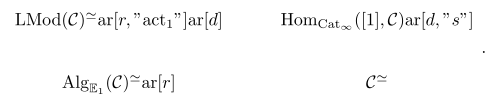
By the universal property of the center, the \(\infty\)-category \(\mathrm{Alg}_{\mathbb E_1}(\mathcal C)_{/\mathfrak{Z}(X)}\) is equivalent to the \(\infty\)-category \(\mathrm{LMod}(\mathcal C) \times_{\mathcal C} \{X\}\), and hence the space \(\underline{\mathrm{Alg}}_{\mathbb E_1}(\mathcal C)_{/\mathfrak{Z}(X)} \times_{\mathcal C_{/X}} \{ \mathrm{id}_X\}\) is equivalent to the fiber of the top horizontal map in ([00F8]) at \(\{ \mathrm{id}_X\} \in \mathrm{Hom}_{\mathrm{Cat}_{\infty}}([1], \mathcal C)\). The functor ([00F6]) is the induced map from the fiber of the top horizontal map of ([00F8]) at \(\mathrm{id}_X\) to the fiber of the bottom horizontal map of ([00F8]) at \(X\).
Let \(\mathrm{Hom}_{\mathrm{Cat}_{\infty}}([1], \mathcal C)^{\mathrm{iso}}\) denote the full subspace of \(\mathrm{Hom}_{\mathrm{Cat}_{\infty}}([1], \mathcal C)\) on the invertible arrows in \(\mathcal C\). In particular, the composite \(\mathrm{Hom}_{\mathrm{Cat}_{\infty}}([1], \mathcal C)^{\mathrm{iso}}\rightarrow\mathrm{Hom}_{\mathrm{Cat}_{\infty}}([1], \mathcal C) \xrightarrow{s}\mathcal C^{\simeq}\) is an equivalence. We now show that the composite map of spaces \[ \mathrm{LMod}(\mathcal C)^{\simeq} \times_{\mathrm{Hom}_{\mathrm{Cat}_{\infty}}([1], \mathcal C)} \mathrm{Hom}_{\mathrm{Cat}_{\infty}}([1], \mathcal C)^{\mathrm{iso}} \rightarrow\mathrm{LMod}(\mathcal C)^{\simeq} \rightarrow\mathrm{Alg}_{\mathbb E_1}(\mathcal C)^{\simeq}\] is an equivalence, which concludes the proof as \(\{ \mathrm{id}_X\} \in \mathrm{Hom}_{\mathrm{Cat}_{\infty}}([1], \mathcal C)\) is an object of the full subspace \(\mathrm{Hom}_{\mathrm{Cat}_{\infty}}([1], \mathcal C)^{\mathrm{iso}}\).
It suffices to verify that all fibers of ([00F9]) are contractible. By definition, for \(A\in \mathrm{Alg}_{\mathbb E_1}(\mathcal C)\) the fiber is the full subspace of \(\mathrm{LMod}_A(\mathcal C)^{\simeq} \simeq \left(\mathrm{LMod}_A(\mathcal C)_{{}_{A}A/}\right)^{\simeq}\) on those modules \(M\) for which the induced map \(\mathrm{act}_1 \colon A \rightarrow M\) is an equivalence. But since \(\mathrm{LMod}_A(\mathcal C) \rightarrow\mathcal C\) is conservative, this is the full subcategory \(\mathrm{LMod}_A(\mathcal C)_{{}_{A}A/^{\mathrm{iso}}}\) on the invertible module functors \({}_{A}A \rightarrow_{A}M\) and hence contractible. ◻
The following corollary finally justifies the presence of \(\mathbb T_2\)-structures in this paper:
Let \(F: \mathcal A\rightarrow\mathcal B\) be an ordinary monoidal functor between ordinary monoidal \(1\)-categories.
A \(\mathbb T_2\otimes \mathbb E_1\)-structure on \(F\) is a prebraiding on \(F\) in the sense of definition 2.4.1. More precisely, the space \(\mathbb T_2(F)\) of \(\mathbb T_2\)-structures on \(F\) is discrete and equivalent to the set \(\mathrm{PreBraid}(F)\) of prebraidings on \(F\) defined in definition 2.4.8.
An \(\mathbb A_2 \otimes \mathbb E_1\)-structure on \(\mathcal A\) is a braiding on the monoidal category \(\mathcal A\), in the usual \(1\)-categorical sense. More precisely, the space \(\mathbb A_2(\mathcal A)\) of \(\mathbb A_2\)-structures on \(\mathcal A\) is discrete and equivalent to the set \(\mathrm{Braid}(\mathcal A)\) of braidings on \(\mathcal A\) defined in definition 2.4.8.
Proof.
By proposition 7.4.11, a \(\mathbb T_2 \otimes \mathbb E_1\)-structure on \(F\) is a lift in \(\mathrm{Alg}_{\mathbb E_1}(\mathrm{Cat}_{({1}, {1})})\): 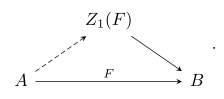 Explicitly, the space of \(\mathbb T_2\otimes \mathbb E_1\)-structures on \(F\) is therefore the \(1\)-groupoid of weak lifts from theorem 2.6.4.([002J]). By theorem 2.6.4, this is equivalent to the set of prebraidings on \(F\) in the sense of definition 2.4.8. This completes the proof of part ([00FB]). Part ([00FC]) follows by applying statement ([00FB]) to the case \(F=\mathrm{id}_{\mathcal A}\). ◻
The operad map \(\mathbb A_2 \rightarrow\mathbb E_1\) induces an operad map \(\mathbb A_2\otimes \mathbb E_1 \rightarrow\mathbb E_1 \otimes \mathbb E_1 \simeq \mathbb E_2\). Hence, any \(\mathbb E_2\)-structure gives rise to an \(\mathbb A_2 \otimes \mathbb E_1\)-structure, but not necessarily vice versa. However, corollary 7.4.15 shows that \(\mathbb A_2 \otimes \mathbb E_1\)-structures on \(1\)-categories agree with braided monoidal structures, which are well-known to coincide with \(\mathbb E_2\)-structures on \(1\)-categories. This hints at a certain connectivity of the operad map \(\mathbb A_2 \otimes \mathbb E_1 \rightarrow\mathbb E_2\) which we will study in the next sections.
7.5 A factorization system on the \(\infty\)-category of operads[00FE]
We introduce the obstruction theoretic machinery at the heart of our main theorem.
For \(n \geq -1\), we say that a morphism of \(\infty\)-operads is \(n\)-surjective if it is surjective-on-objects on \(\infty\)-categories of colors and multi-homwise \((n-1)\)-connected and we say that it is \(n\)-faithful if it is multi-homwise \((n-1)\)-truncated. We extend this to the case that \(n = -2\) by declaring that every morphism of \(\infty\)-operads is \((-2)\)-surjective, and that a morphism of \(\infty\)-operads is \((-2)\)-faithful if and only if it is an equivalence.
In this section, we will show that the \(n\)-faithful and \(n\)-surjective operad maps form a factorization system on the \(\infty\)-category \(\mathrm{Op}\) of \(\infty\)-operads. Recall that by definition, \(\mathrm{Op}\) is a subcategory of \({\mathrm{Cat}_{\infty}}_{/\mathrm{Fin}_*}\).
A morphism of \(\infty\)-operads is \(n\)-surjective (resp. \(n\)-faithful) if and only if its image under the composite functor \(\mathrm{Op}\hookrightarrow(\mathrm{Cat}_\infty)_{/\mathrm{Fin}_*} \xrightarrow{{\textup{fgt}}} \mathrm{Cat}_\infty\) is so (in the sense of definition 5.3.1).
Proof.
The Segal conditions for \(\infty\)-operads imply that surjectivity on underlying functors is equivalent to surjectivity on \(\infty\)-categories of colors. Moreover, the hom-spaces in an \(\infty\)-operad are disjoint unions of (finite) products of multi-hom spaces, and these operations both preserve the class of \((n-1)\)-connected (resp. \((n-1)\)-truncated) morphisms of spaces. (To see that products preserve \((n-1)\)-connectedness (resp. \((n-1)\)-truncatedness), note that this notion is determined fiberwise, that fibers of a product of morphisms of spaces are computed factorwise since limits commute with limits, and that \((n-1)\)-truncated (resp. \((n-1)\)-connected) spaces are stable under products.) ◻
For any \(n \geq -2\), the classes of (\(n\)-surjective, \(n\)-faithful) operad maps defines a factorization system on the \(\infty\)-category \(\mathrm{Op}\) of \(\infty\)-operads.
Proof.
By Observation B.1.19.([00K6]), the (\(n\)-surjective, \(n\)-faithful) factorization system on \(\mathrm{Cat}_\infty\) pulls back to a factorization system on \((\mathrm{Cat}_\infty)_{/\mathrm{Fin}_*}\). By Lemma 7.5.2, the classes of our asserted factorization system are restricted along the inclusion \(\mathrm{Op}\hookrightarrow(\mathrm{Cat}_\infty)_{/\mathrm{Fin}_*}\). So, in order to verify that they indeed define a factorization system on \(\mathrm{Op}\), we verify the equivalent conditions of Observation B.2.1.
In order to proceed, we recall that given two \(\infty\)-operads \(\mathcal O,\mathcal O' \in \mathrm{Op}\), a morphism \(\mathcal O^{\otimes} \rightarrow\mathcal O'^{\otimes}\) in \((\mathrm{Cat}_\infty)_{/\mathrm{Fin}_*}\) lies in \(\mathrm{Op}\) if and only if it is inert-coCartesian (i.e it preserves coCartesian lifts over inert morphisms in \(\mathrm{Fin}_*\)). Moreover, we make the following observation for repeated future use.
Assuming that \(n \geq 0\), if a morphism in \(\mathrm{Op}\) is \(n\)-surjective then it is surjective on inert-coCartesian morphisms.
We now turn to condition ([00KE]) of Observation B.2.1: given a solid commutative diagram 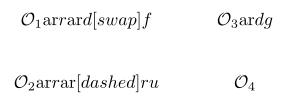 in \(\mathrm{Op}\) in which \(f\) is \(n\)-surjective and \(g\) is \(n\)-faithful, we must show that the dashed lift in \((\mathrm{Cat}_\infty)_{/\mathrm{Fin}_*}\) (which exists and is unique due to its factorization system) also lies in \(\mathrm{Op}\). This is trivial in the case that \(n < 0\), and in the case that \(n \geq 0\) this follows immediately from \((*)\).
We now turn to condition ([00KF]) of Observation B.2.1: given any morphism \(\mathcal O\xrightarrow{h} \mathcal O'\) in \(\mathrm{Op}\), we must show that the factorization  in \((\mathrm{Cat}_\infty)_{/\mathrm{Fin}_*}\) determined by its (\(n\)-surjective, \(n\)-faithful) factorization system in fact lies in \(\mathrm{Op}\). To simplify our notation, we write \(\mathcal F^{\otimes} \coloneqq \mathrm{Fact}(h)\). Additionally, we write \(\mathcal O^{\otimes} \xrightarrow{p} \mathrm{Fin}_*\), \(\mathcal O'^{\otimes} \xrightarrow{p'} \mathrm{Fin}_*\), and \(\mathcal F^{\otimes} \xrightarrow{q} \mathrm{Fin}_*\) for the indicated functors. We note immediately that the claim is trivial both when \(n = -2\) (since then \(\mathcal F^{\otimes} \xrightarrow{r} \mathcal O'^{\otimes}\) is an equivalence) and when \(n = -1\) (since then \(\mathcal F^{\otimes} \xrightarrow{r} \mathcal O'^{\otimes}\) is the inclusion of the full suboperad on the colors in the image of \(\underline{\mathcal O} \xrightarrow{\underline{h}} \underline{\mathcal O'}\)). So, we henceforth assume that \(n \geq 0\).
We first show that the functor \(\mathcal F^{\otimes} \xrightarrow{q} \mathrm{Fin}_*\) admits coCartesian lifts of inert morphisms. For this, fix an object \(X \in \mathcal F^{\otimes}_{\underline{m}_+}\) as well as an inert morphism \(\underline{m}_+ \xrightarrow{\alpha} \underline{n}_+\) in \(\mathrm{Fin}_*\). Because the functor \(\mathcal O^{\otimes} \xrightarrow{l} \mathcal F^{\otimes}\) is surjective, we may choose a lift \(\widetilde{X} \in \mathcal O_{\underline{m}_+}^{\otimes}\) of \(X\). Let \(\widetilde{X} \xrightarrow{\widetilde{\alpha}} Y\) be a \(p\)-coCartesian lift of \(\alpha\). We claim that \(X \simeq l(\widetilde{X}) \xrightarrow{l(\widetilde{\alpha})} l(Y)\) is a \(q\)-coCartesian lift of \(\alpha\). To see this, observe first that \(r(l(\widetilde{\alpha})) \simeq h(\widetilde{\alpha})\) is \(p'\)-coCartesian (since \(h\) is a morphism in \(\mathrm{Op}\)). Now, to check that \(l(\widetilde{\alpha})\) is \(q\)-coCartesian, we must check that the canonical functor  is an equivalence. This fits into a commutative diagram
  in which the two outer vertical functors are equivalences. We do so by showing that it is fully faithful and surjective. Since we have assumed that \(n \geq 0\) (so that \(n-1 \geq -1\)), the lower left horizontal functor is surjective, which implies that the middle vertical functor is surjective. To show that it is fully faithful, given any pair of objects in \(\mathcal F^{\otimes}_{l(Y)/}\), we may lift them to \(\mathcal O^{\otimes}_{Y/}\) (again using that \(n \geq 0\)), and then examine the induced commutative diagram (of the same shape) on hom-spaces. Because its left and right vertical maps are equivalences, both of its left horizontal maps are \((n-1)\)-connected, and both of its right horizontal maps are \((n-1)\)-truncated, its middle vertical map is also an equivalence since factorizations for the (\((n-1)\)-connected, \((n-1)\)-truncated) factorization system on \(\mathcal S\) are unique. So indeed, the middle vertical functor in the above diagram is an equivalence. This proves that \(\mathcal F^{\otimes} \xrightarrow{q} \mathrm{Fin}_*\) admits coCartesian lifts of inert morphisms, as desired.
The same argument proves the Segal conditions for \(\mathcal F^{\otimes}\), which establishes that \(\mathcal F^{\otimes}\) is indeed an \(\infty\)-operad. Moreover, it also proves that \(l\) preserves inert-coCartesian morphisms, and in combination with \((*)\) we find that \(r\) preserves inert-coCartesian morphisms as well. So all in all, the factorization ([00FK]) lies in the subcategory \(\mathrm{Op}\subset (\mathrm{Cat}_\infty)_{/\mathrm{Fin}_*}\), which proves condition ([00KF]) of Observation B.2.1. So indeed, the (\(n\)-surjective, \(n\)-faithful) factorization system on \((\mathrm{Cat}_\infty)_{/\mathrm{Fin}_*}\) restricts to a factorization system on this subcategory. ◻
Similar to the situation with \(\infty\)-categories outlined in warning 5.3.9, we caution the reader that the (\(n\)-surjective, \(n\)-faithful) factorization systems on \(\mathrm{Op}\) differs from the (\(n\)-truncated, \(n\)-connected) factorization systems [GK17, Prop. 4.6] derived from the presentability of \(\mathrm{Op}\). We refer the reader to warning 5.3.9 for an in-depth comparison which also applies here.
Similar to proposition 5.3.15, the orthogonality of \(n\)-surjective and \(n\)-faithful operad maps may be generalized as follows:
Given a (solid) commuting square in \(\mathrm{Op}\)  where \(F\) is \(n\)-surjective and \(G\) is \(m\)-faithful for \(m \geq n \geq -2\), the space of (dashed) lifts is \((m-n-2)\)-truncated.
Proof.
When \(m = n\), the statement follows from proposition 7.5.3. For \(m>n\), consider the commuting square of spaces: 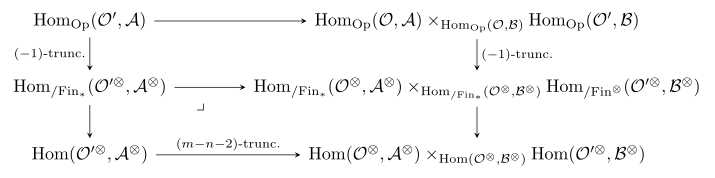 The space of lifts of our original square is by definition a fiber of the top horizontal map; it hence suffices to prove that this top horizontal map is \((m-n-2)\)-truncated.
By lemma 7.5.2, the \((\infty,1)\)-functor \(F^{\otimes} \colon \mathcal O^{\otimes} \rightarrow\mathcal O'^{\otimes}\) is \(n\)-surjective and \(G^{\otimes} \colon \mathcal A^{\otimes} \rightarrow\mathcal B^{\otimes}\) is \(m\)-faithful. Hence, it follows from proposition 5.3.15 that the bottom horizontal map is \((m-n-2)\)-truncated. By definition of the over-category, the bottom square is a pullback square; hence, the middle horizontal map is \((m-n-2)\)-truncated. Since \(\mathrm{Op}\) is a subcategory of \({\mathrm{Cat}_{\infty}}_{/\mathrm{Fin}_*}\), the top vertical maps are \((-1)\)-truncated. . Since \(m-n-2\geq -1\), the composite of the left vertical and the middle horizontal map is \((m-n-2)\)-truncated. It follows from Lemma 5.2.4.([009U]) that the top horizontal map is \((m-n-2)\)-truncated. ◻
7.6 Lifting operadic structure[00FP]
In definition 7.5.1 we introduced the notion of \(n\)-faithful and \(n\)-surjective morphisms of operads and showed in proposition 7.5.3 that they form a factorization system on the \(\infty\)-category \(\mathrm{Op}\). In this section, we show how this can be used to lift \(\mathbb T_2 \otimes \mathbb E_1\)-structures, i.e. prebraidings (see corollary 7.4.15), along certain maps of operads.
The following operad maps are \(0\)-surjective:
\(\underline{\nabla_2 \otimes \mathbb E_0} \otimes \mathbb E_1 \rightarrow\nabla_2 \otimes \mathbb E_0 \otimes \mathbb E_1 \simeq \nabla_2 \otimes \mathbb E_1\), where \(\underline{\nabla_2 \otimes\mathbb E_0}\) denotes the (free \(\infty\)-operad on) the underlying \(\infty\)-category of \(\nabla_2 \otimes \mathbb E_0\);
\([1] \otimes \mathbb E_1\rightarrow\mathbb T_2 \otimes \mathbb E_1\);
\(\mathbb E_1 \rightarrow\mathbb A_2 \otimes \mathbb E_1\).
Proof.
We first prove part ([00FR]). By lemma 7.2.4, the \(\infty\)-category \(\underline{\nabla_2 \otimes \mathbb E_0}\) is equivalent to the walking span and hence the \(\infty\)-operad  corepresents spans of \(\mathbb E_1\)-morphisms.
On underlying categories, the operad map \(\underline{\nabla_2 \otimes \mathbb E_0} \otimes \mathbb E_1 \rightarrow\nabla_2 \otimes \mathbb E_1\) is the identity. It therefore suffices to show that the induced maps on multi-hom spaces are \((-1)\)-connected. Denote the colors of 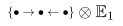 by \(A, C\) and \(B\), the morphisms by
  , the multiplication cells by
  ,
,  and
and  , the unit cells by
  and
and  and use the same notation for their respective images in \(\nabla_2 \otimes \mathbb E_1\). The only generating cell of \(\nabla_2 \otimes \mathbb E_1\) that is not evidently in the image of is the binary multiplication stemming from the \(\nabla_2\)-operad, which we denote by \(\mu \in \mathrm{Mul}_{\nabla_2 \otimes \mathbb E_1}(A,B;C)\). We will now show that this additional generator \(\mu\) is also in the image of
  which concludes the proof that
  induces (-1)-connected maps on all multi-hom spaces.
Since \(\mu\) is a map of \(\mathbb E_1\)-algebras, we have a path in \(\mathrm{Mul}_{\nabla_2 \otimes \mathbb E_1}(A,A, B, B;C)\) (where we abuse notation and write \(- \circ (-\otimes-)\) to denote the evident operadic compositions): \[\mu\circ(\mu_A\otimes \mu_B)\simeq \mu_C\circ (\mu\otimes \mu).\] On the other hand, left and right unitality produce paths in \(\mathrm{Mul}_{\nabla_2\otimes \mathbb E_1}(A;C)\) and \(\mathrm{Mul}_{\nabla_2\otimes \mathbb E_1}(B;C)\), respectively : \[\mu\circ (\mathrm{id}_A\otimes 1_B)\simeq f \hspace{1cm} \mu\circ (1_A \otimes \mathrm{id}_B)\simeq g .\] Composing these, we conclude: \[\mu\simeq \mu\circ(\mu_A\otimes\mu_B)\circ(\mathrm{id}_A \otimes 1_A\otimes 1_B\otimes \mathrm{id}_B)\simeq\mu_C\circ(\mu\otimes \mu)\circ (\mathrm{id}_A \otimes 1_A\otimes 1_B\otimes \mathrm{id}_B)\simeq\mu_C\circ(f\otimes g)\] Hence, \(\mu\) is in the image of 

Since \(\mathrm{Op}\) is a presentably monoidal category, the pushout squares ([00E7]) induce pushout squares  Since left class in a factorization system is preserved under pushouts, so \([1] \otimes \mathbb E_1 \rightarrow\mathbb T_2 \otimes \mathbb E_1\) and \(\mathbb E_1 \rightarrow\mathbb A_2 \otimes \mathbb E_1\) are also \(0\)-surjective. ◻
7.7 From \(\mathbb A_2 \otimes \mathbb E_1\)- to \(\mathbb E_2\)-algebras[00FV]
Considering the filtration \(\mathbb A_1 \otimes \mathbb E_1 \rightarrow\mathbb A_2 \otimes \mathbb E_2 \rightarrow\ldots \mathbb A_{\infty} \otimes \mathbb E_1 = \mathbb E_1 \otimes \mathbb E_1 \simeq \mathbb E_2\), an \(\mathbb A_2\otimes \mathbb E_1\)-structure is less data than a fully coherent \(\mathbb E_2\)-structure. However, as suggested by corollary 7.4.15, \(\mathbb A_2\otimes \mathbb E_1\)-structures on \(1\)-categories already agree with \(\mathbb E_2\)-structures. In this section, we prove a generization that holds for any \(2\)-categorical operad.
For \(n\geq -1\), an \(n\)-operad is an \(\infty\)-operad all of whose multi-hom spaces, i.e. the \(\mathrm{Mul}_{\mathcal O}(X_1,\ldots, X_k; Y)\), are \((n-1)\)-truncated. We extend this to the case \(n=-2\) by declaring the terminal operad to be a \((-2)\)-operad. We denote the full subcategory of \(\mathrm{Op}\) on the \(n\)-operads by \(\mathrm{Op}_n\).
Equivalently, an \(\infty\)-operad is an \(n\)-operad if and only if the terminal operad map \(\mathcal O\rightarrow\mathbb E_{\infty}\) is \(n\)-faithful.
A \(1\)-operad is precisely one that is equivalent to (the nerve of) an ordinary operad.
A symmetric monoidal \((\infty, 1)\)-category \(\mathcal C\), considered as an \(\infty\)-operad, is an \(n\)-operad if and only if its underlying category is an \((n,1)\)-category (also see definition 5.4.1).
The notion of \(n\)-truncated morphism defined in definition 5.2.1 generalizes to any \(\infty\)-category:
For \(n\geq -2\), a morphism \(f \colon A \rightarrow B\) in an \(\infty\)-category \(\mathcal C\) is called \(n\)-truncated if the induced map of spaces \(\mathrm{Hom}_{\mathcal C}(X, A) \rightarrow\mathrm{Hom}_{\mathcal C}(X,B)\) is \(n\)-truncated, see definition 5.2.1, for every object \(X\in \mathcal C\).
In particular, a morphism \(f \colon A \rightarrow B\) in an \(\infty\)-category \(\mathcal C\) is \(0\)-truncated if for every object \(X\in \mathcal C\), the map \(\mathrm{Hom}_{\mathcal C}(X,A) \rightarrow\mathrm{Hom}_{\mathcal C}(X,B)\) is \(0\)-truncated, i.e. all its fibers are discrete sets. For an ordinary monoidal \(1\)-category \(A\), the monoidal functor \(Z_1(A) \rightarrow A\) is faithful, and in particular \(0\)-truncated as a morphism in the \(\infty\)-category \(\mathrm{Alg}_{\mathbb E_1}(\mathrm{Cat}_1)\) (see warning 5.3.9). The following is a generalization of this statement:
Let \(\mathcal C\) be a symmetric monoidal \((2,1)\)-category and \(A\in \mathrm{Alg}_{\mathbb E_1}(\mathcal C)\) whose center \(Z_1(A) \in \mathrm{Alg}_{\mathbb E_2}(\mathcal C)\) exists. Then, the morphism \(Z_1(A) \rightarrow A\) is a \(0\)-truncated morphism in \(\mathrm{Alg}_{\mathbb E_1}(\mathcal C)\).
Proof.
Let \(X\in \mathrm{Alg}_{\mathbb E_1}(\mathcal C)\). Since \(Z_1(A)\) is the centralizer \(\mathfrak{Z}(\mathrm{id}_A)\) of the morphism \(\mathrm{id}_A\) in \(\mathrm{Alg}_{\mathbb E_1}(\mathcal C)\) and the unit of \(\mathrm{Alg}_{\mathbb E_1}(\mathcal C)\) is initial, the universal property of the centralizer implies that the map \(\mathrm{Hom}_{\mathrm{Alg}_{\mathbb E_1}(\mathcal C) }(X, Z_1(A)) \rightarrow\mathrm{Hom}_{\mathrm{Alg}_{\mathbb E_1}(\mathcal C)}(X, A)\) is equivalent to the composite \[\mathrm{Hom}_{\mathrm{Alg}_{\mathbb E_1}(\mathcal C)}(X \otimes A, A) \times_{\mathrm{Hom}_{\mathrm{Alg}_{\mathbb E_1}(\mathcal C)}(A,A)} \{ \mathrm{id}_A\} \rightarrow\mathrm{Hom}_{\mathrm{Alg}_{\mathbb E_1}(\mathcal C)}(X \otimes A, A) \rightarrow\mathrm{Hom}_{\mathrm{Alg}_{\mathbb E_1}(\mathcal C)}(X,A).\] By definition of the \(\infty\)-operad \(\nabla_2\) in lemma 7.2.3, the fiber of this map at an \(f\in \mathrm{Hom}_{\mathrm{Alg}_{\mathbb E_1}(\mathcal C)}(X,A)\) is precisely the space of lifts of the operad map  classified by the span of \(\mathbb E_1\)-morphisms \(X \xrightarrow{f}A \xleftarrow{\mathrm{id}_A}A\), to an operad map \(\nabla_2 \otimes \mathbb E_0 \rightarrow\mathrm{Alg}_{\mathbb E_1}(\mathcal C)\). Equivalently, this is the space of lift
 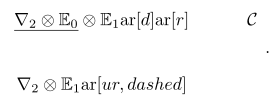 By assumption, \(\mathcal C\) is a symmetric monoidal \((2,1)\)-category, hence a \(2\)-operad and hence the operad map \(\mathcal C\rightarrow*\) is \(2\)-faithful. Since the left vertical operad map is \(0\)-surjective by proposition 7.6.1, it follows from corollary 7.5.5 that this space of lifts is \(0\)-truncated. ◻
Let \(\mathcal C\) be a presentably symmetric monoidal \((2,1)\)-category. Then, the map of spaces \[\mathrm{Hom}_{\mathrm{Op}}(\mathbb E_2, \mathcal C) \rightarrow\mathrm{Hom}_{\mathrm{Op}}(\mathbb A_2 \otimes \mathbb E_1, \mathcal C)\] is an equivalence.
Proof.
Consider the diagram of spaces  To prove that the horizontal map is an equivalence, it suffices to show that for every \(A\in \mathrm{Alg}_{\mathbb E_1}(\mathcal C)\), the induced map between fibers \[\mathrm{Hom}_{\mathrm{Op}}(\mathbb E_2,\mathcal C) \times_{\mathrm{Hom}_{\mathrm{Op}}(\mathbb E_1,\mathcal C)} \{A\} \rightarrow\mathrm{Hom}_{\mathrm{Op}}(\mathbb A_2 \otimes \mathbb E_1,\mathcal C) \times_{\mathrm{Hom}_{\mathrm{Op}}(\mathbb E_1,\mathcal C)} \{A\}\] is an equivalence.
Since \(\mathcal C\) is presentably symmetric monoidal, it follows that centralizers and centers exist [Lur17, Cor. 5.3.1.15] and hence, by applying corollary 7.4.12, that the latter space is equivalent to \[\left(\mathrm{Alg}_{\mathbb E_1}(\mathcal C)_{/Z_1(A)}\right)^{\simeq} \times_{\left(\mathrm{Alg}_{\mathbb E_1}(\mathcal C)_{/A}\right)^{\simeq} } \{\mathrm{id}_A\}.\] Applying lemma 7.4.14 to the \(\infty\)-category \(\mathrm{Alg}_{\mathbb E_1}(\mathcal C)\), we find that the functor \[\mathrm{Alg}_{\mathbb E_2}(\mathcal C)_{/Z_1(A)} \times_{\mathrm{Alg}_{\mathbb E_1}(\mathcal C)/A} \{\mathrm{id}_A\}\rightarrow\mathrm{Alg}_{\mathbb E_2}(\mathcal C) \times_{\mathrm{Alg}_{\mathbb E_1}(\mathcal C)} \{A\}\] is an equivalence. It therefore suffices to show that the forgetful functor \[ \mathrm{Alg}_{\mathbb E_2}(\mathcal C)_{/Z_1(A)} \times_{\mathrm{Alg}_{\mathbb E_1}(\mathcal C)/A} \{\mathrm{id}_A\} \rightarrow\mathrm{Alg}_{\mathbb E_1}(\mathcal C)_{/Z_1(A)} \times_{\mathrm{Alg}_{\mathbb E_1}(\mathcal C)_{/A}} \{\mathrm{id}_A\}\] is an equivalence.
proposition 7.7.5 implies that the map \(Z_1(A) \rightarrow A\) is \(0\)-truncated as a morphism in \(\mathrm{Alg}_{\mathbb E_1}(\mathcal C)\). Hence, any section \(A\rightarrow Z_1(A)\) is \((-1)\)-truncated. Therefore, the map ([00G4]) is equivalent to the map \[\mathrm{Alg}_{\mathbb E_2}(\mathcal C)_{/^{-1}Z_1(A)} \times_{\mathrm{Alg}_{\mathbb E_1}(\mathcal C)/A} \{\mathrm{id}_A\} \rightarrow\mathrm{Alg}_{\mathbb E_1}(\mathcal C)_{/^{-1}Z_1(A)} \times_{\mathrm{Alg}_{\mathbb E_1}(\mathcal C)_{/A}} \{\mathrm{id}_A\}\] where \(- /^{-1} Z_1(A)\) denote full subcategories of \((-1)\)-truncated \(\mathbb E_1\)-maps (see notation 5.5.1). To prove this is an equivalence, it suffices to show that \[\mathrm{Alg}_{\mathbb E_2}(\mathcal C)_{/^{-1}Z_1(A)} \rightarrow\mathrm{Alg}_{\mathbb E_1}(\mathcal C)_{/^{-1} Z_1(A)}\] is an equivalence. But given any \((X\hookrightarrow Z_1(A))\) in \(\mathrm{Alg}_{\mathbb E_1}(\mathcal C)_{/^{-1}Z_1(A)}\), the fiber of ([00G5]) is equivalent to the space of dashed lifts in \(\mathrm{Op}\) 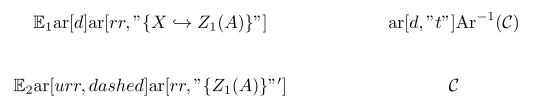 where \(\mathrm{Ar}^{-1}(\mathcal C)\) denotes the full symmetric monoidal subcategory of the arrow category \(\mathrm{Ar}(\mathcal C) \coloneqq \mathrm{Fun}([1], \mathcal C)\) on the \((-1)\)-truncated morphisms.
But since \(\mathbb E_1 \rightarrow\mathbb E_2\) is \(0\)-surjective, i.e. essentially surjective on objects and \((-1)\)-connected on multi-hom spaces \(\mathbb E_1(n)\simeq S_n \rightarrow\mathbb E_2(n) = \mathrm{Conf}(n, \mathbb{R}^2)\), and since \(\mathrm{Ar}^{-1}(\mathcal C) \rightarrow\mathcal C\) is \(0\)-faithful36, it follows from proposition 7.5.3 that the space of lifts ([00G6]) is contractible. ◻
Since an \(\mathbb A_2\otimes \mathbb E_1\)-structure on a given monoidal \(1\)-category is by corollary 7.4.15.([00FC]) precisely the data of a braiding, corollary 7.7.6 in particular implies the well-known observation (see [Lur17, Ex. 5.1.2.4]) that braided monoidal structures and \(\mathbb E_2\)-structures coinicide on ordinary \(1\)-categories.
For any \(2\)-operad \(\mathcal O\), the map of spaces \(\mathrm{Hom}_{\mathrm{Op}}( \mathbb A_2 \otimes \mathbb E_1, \mathcal O) \rightarrow\mathrm{Hom}_{\mathrm{Op}}(\mathbb E_2, \mathcal O)\) is an equivalence.
Proof.
The full inclusion \(\mathrm{Op}_2 \hookrightarrow \mathrm{Op}\) admits a left adjoint \(h_2 \colon \mathrm{Op}\rightarrow\mathrm{Op}_2\) (constructed in [SY20, Thm. 3.12]). Moreover, it follows from [SY19, Prop. 3.2.6(4)] applied to corollary 7.7.6 that the operad map \(h_2(\mathbb A_2\otimes \mathbb E_1) \rightarrow h_2(\mathbb E_2)\) is an equivalence (i.e. that \(\mathbb A_2 \otimes \mathbb E_1 \rightarrow\mathbb E_2\) is a \(1\)-equivalence in the terminology of [SY19]). By adjunction, it follows that for any \(2\)-operad \(\mathcal O\), the map \(\mathrm{Hom}_{\mathrm{Op}}(\mathbb A_2\otimes \mathbb E_1, \mathcal O) \rightarrow\mathrm{Hom}_{\mathrm{Op}}(\mathbb E_2, \mathcal O)\) is an equivalence. ◻
In other words, corollary 7.7.8 shows that \(\mathbb A_2 \otimes \mathbb E_1 \rightarrow\mathbb E_2\) is a \(1\)-equivalence in the sense of [SY19], i.e. it is essentially surjective on the underlying categories and induces an equivalence on the \(0\)-truncations of all the multimapping spaces.
7.8 Lifting maps of algebras[00GB]
We end this section with an elementary, but very useful observation about \(\infty\)-operads.
We recall the following easy fact: Given functors \(F, G: \mathcal A\rightarrow\mathcal B\) and \(H \colon \mathcal B\rightarrow\mathcal C\) of \(\infty\)-categories and assume that for all \(a,a' \in \mathcal A\) the map \[\mathrm{Hom}_{\mathcal B}(Fa, Ga') \xrightarrow{H(-)} \mathrm{Hom}_{\mathcal C}(HFa, HGa')\] is an equivalence of spaces.
We will now prove that this implies that also the map between spaces of natural transformations \[\mathrm{Nat}(F, G) \rightarrow\mathrm{Nat}(HF, HG)\] is an equivalence. Formally, this can be expressed as follows:
Given a functor \(H \colon \mathcal B\rightarrow\mathcal C\) of \(\infty\)-categories and a commuting square of \(\infty\)-categories  Assume that for any \(b_0, b_1 \in \mathcal B\) in the image of \(\{0\} \times \mathcal A\rightarrow S^0 \times \mathcal A\rightarrow\mathcal B\) and \(\{1\} \times \mathcal A\rightarrow S^0 \times \mathcal A\rightarrow\mathcal B\), respectively, and any commuting square
 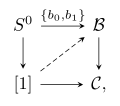 the space of dashed lifts is contractible. Then, the space of lifts of the square ([00GE]) is contractible.
Proof.
Since \({\sf pt}\) and \([1]\) generate \(\mathrm{Cat}_{\infty}\) under colimits, it suffices to show that for every \(a\in \mathcal A\) and every arrow \([1] \xrightarrow{\{f\}} \mathcal A\), the induced total squares  have contractible spaces of lifts. Contractibility of the spaces of lifts of the former square follows immediately from assumption, and for the latter square is a straight-forward computation assuming ([00GC]) is an equivalence. ◻
The goal of this subsection is to prove a generalization of this statement for \(\infty\)-operads.
Let \(\mathcal O, \mathcal P\) be \(\infty\)-operads and let \(b\) and \(c\) be \(\mathcal O\)-algebras in \(\mathcal P\).
Let \(F \colon \mathcal P\rightarrow\mathcal Q\) be an operad map such that for all \(n\geq 0\) and colors \(X_1,\ldots, X_n, Y\) in \(\mathcal O\), the map of spaces \[\mathrm{Mul}_{\mathcal P}(b_{X_1}, \ldots, b_{X_{n}}; c_{Y}) \xrightarrow{F(-)} \mathrm{Mul}_{\mathcal Q}(Fb_{X_1}, \ldots, Fb_{X_{n}}; Fc_{Y})\] is an equivalence. Then, for any \(m \geq 0\), the map of multi-hom spaces \[\mathrm{Mul}_{\mathrm{Alg}_{\mathcal O}(\mathcal P)}(\underbrace{b,\ldots, b}_{m}; c) \xrightarrow{F(-)} \mathrm{Mul}_{\mathrm{Alg}_{\mathcal O}(\mathcal Q)}(\underbrace{Fb,\ldots, Fb}_{m}; Fc)\] is an equivalence.
Let \(f \colon a \rightarrow b\) be a morphism of \(\mathcal O\)-algebras in \(\mathcal P\). Assume that for all \(n \geq 0\) and colors \(X_1, \ldots, X_n, Y\) in \(\mathcal O\), the map of spaces \[\mathrm{Mul}_{\mathcal P}(b_{X_1}, \ldots, b_{X_{n}}; c_{Y}) \xrightarrow{-\circ(f,\ldots, f)} \mathrm{Mul}_{\mathcal P}(a_{X_1}, \ldots, a_{X_{n}}; c_{Y})\] is an equivalence. Then, for any \(m \geq 0\), the map of multi-hom spaces \[\mathrm{Mul}_{\mathrm{Alg}_{\mathcal O}(\mathcal P)}(\underbrace{b,\ldots, b}_m; c) \xrightarrow{- \circ (f,\ldots, f)} \mathrm{Mul}_{\mathrm{Alg}_{\mathcal O}(\mathcal P)}(\underbrace{a, \ldots, a}_m; c)\] is an equivalence for all \(n\).
To prove proposition 7.8.2, we recall the following formula for mapping spaces in \(\mathrm{Alg}_{\mathcal O}(\mathcal P)\):
Given a sequence of objects \((b_1, \ldots, b_n)\) and another object \(c\) in \(\underline{\mathrm{Alg}}_{\mathcal O}(\mathcal P)\), the multi-hom space \(\mathrm{Mul}_{\mathrm{Alg}_{\mathcal O}(\mathcal P)}(b_1, \ldots, b_n; c)\) is explicitly defined, as for any \(\infty\)-operad, as the space of lifts of the square 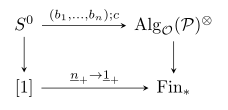 Let \(\mathrm{Fin}_* \times\mathrm{Fin}_* \xrightarrow{\wedge} \mathrm{Fin}_*\) denote the smash product symmetric monoidal structure of \(\mathrm{Fin}_*\) (see [Lur17, Not. 2.2.5.1]). Unwinding the definition of \(\mathrm{Alg}_{\mathcal O}(\mathcal P)^{\otimes}\) from [Lur17, Cons. 3.2.4.1], this space of lifts is equivalent to the full subspace of the space of lifts
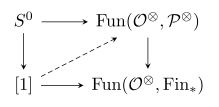
 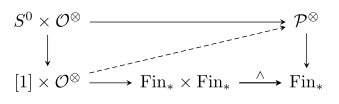 on those lifts with the property that for every vertex \(v\in [1]\), the map \(\mathcal O^{\otimes} \simeq \{v\} \times \mathcal O^{\otimes} \rightarrow[1] \times \mathcal O^{\otimes} \rightarrow\mathcal P^{\otimes}\) sends inert coCartesian morphisms to inert coCartesian morphisms. However, since \(S^0 \rightarrow[1]\) is surjective on objects this condition is automatically satisfied since it is satisfied by the top horizontal map. Thus, the space of lifts of ([00GK]), and hence the multi-hom space \(\mathrm{Mul}_{\mathrm{Alg}_{\mathcal O}(\mathcal P)}(b_1, \ldots, b_n; c)\) is equivalent to the space of lifts of ([00GL]). Hence, after adjunction, it is equivalent to the space of lifts
  More generally, given any functor of \(\infty\)-categories \(X\rightarrow Y\) which is surjective on objects, an \(\infty\)-operad map \(\mathcal P\rightarrow\mathcal Q\) and a commuting square of \(\infty\)-categories
 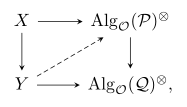 the same argument shows that the space of (dashed) lifts of this square is equivalent to the space of lifts
Proof of proposition 7.8.2.
To prove part ([00GH]), fix an \(n\geq 0\) and consider the functor \(S^0 = \{0, 1\} \rightarrow\mathrm{Alg}_{\mathcal O}(\mathcal P)^{\otimes}\), sending \(0\) to \((b, \ldots, b)\) and \(1\) to \((c)\). Fix a \(\mu \in \mathrm{Mul}_{\mathrm{Alg}_{\mathcal O}(\mathcal Q)}(Fb, \ldots, Fb; Fc)\). This determines a commuting square of \(\infty\)-categories 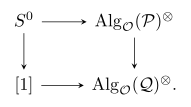 The fiber of \(\mathrm{Mul}_{\mathrm{Alg}_{\mathcal O}(\mathcal P)}(b,\ldots, b; c) \rightarrow\mathrm{Mul}_{\mathrm{Alg}_{\mathcal O}(\mathcal Q)}(Fb,\ldots, Fb; Fc)\) at \(\mu\) is precisely the space of lifts of this square. By observation 7.8.3, this space of lifts is equivalent to the space of lifts
  By lemma 7.8.1, to prove contractibility of this space of lifts, it suffices to verify that for each \(p_0, p_1\in \mathcal P^{\otimes}\) in the image of \(\{0\} \times \mathcal O^{\otimes} \rightarrow S^0 \times \mathcal O^{\otimes} \rightarrow\mathcal P^{\otimes}\) and \(\{1\} \times \mathcal O^{\otimes} \rightarrow S^0 \times \mathcal O^{\otimes} \rightarrow\mathcal P^{\otimes}\), respectively, any square
 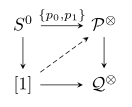 has a contractible space of lifts. Using the Segal condition on \(\infty\)-operads, this precisely unpacks to the condition in the statement of the proposition.
To prove part ([00GI]), fix an \(n\geq 0\) and a point \(h\in \mathrm{Map}_{\mathrm{Alg}_{\mathcal O}(\mathcal P)}(a, \ldots, a; c)\). Let  denote the outer horn. Then, the multi-ary operation \(h\) together with our original operation \(f\in \mathrm{Mul}_{\mathrm{Alg}_{\mathcal O}(\mathcal P)}(a;b)\) assembles into a commutative diagram as on the right:
  The fiber of \(\mathrm{Mul}_{\mathrm{Alg}_{\mathcal O}(\mathcal P)}(b,\ldots, b; c) \rightarrow\mathrm{Mul}_{\mathrm{Alg}_{\mathcal O}(\mathcal P)}(a, \ldots, a; c)\) at \(h\) is precisely the space of lifts of the right square. Since the left square is a pushout, this space is equivalent to the space of lifts of the total square. By observation 7.8.3, this space of lifts is equivalent to the space of lifts of the square
 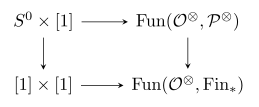 and hence to the space of lifts of the square
 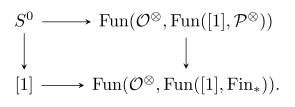 By lemma 7.8.1, a sufficient condition for contractibility of this space is that for all pair of objects \(c_0, c_1 \in \mathrm{Fun}([1], \mathcal P^{\otimes})\) in the image of \(\{0\} \times \mathcal O^{\otimes} \rightarrow S^0 \times \mathcal O^{\otimes} \rightarrow\mathrm{Fun}([1], \mathcal P^{\otimes})\) and \(\{1\} \times \mathcal O^{\otimes} \rightarrow S^0 \times \mathcal O^{\otimes} \rightarrow\mathrm{Fun}([1], \mathcal P^{\otimes})\), respectively, the space of lifts of all commuting squares of the form
  is contractible. Using the Segal condition on \(\mathcal P^{\otimes}\), this is satisfied provided the conditions in the statement of the proposition hold. ◻
Original source: arXiv:2401.02956v2
Original source · 2401.02956v2