3.4 From additive to stable \(\infty\)-categories[0051]
Given an ordinary additive \(1\)-category \(\mathcal A\), one may form a stable \(\infty\)-category \({\mathbf K}^b(\mathcal A)\) of bounded (in both directions) chain complexes, chain homomorphisms, and (higher) chain homotopies between these. In this section, we review this construction and prove that it satisfies a universal property: the stable \(\infty\)-category \({\mathbf K}^b(\mathcal A)\) is the free stable \(\infty\)-category on the additive category \(\mathcal A\).
3.4.1 The \(\infty\)-category of chain complexes[0052]
Given an ordinary additive \(1\)-category \(\mathcal A\), the \(\infty\)-category \({\mathbf K}^b(\mathcal A)\) can be defined, see [Lur17, § 1.3.1], using the technology of dg nerves as follows.
[0053]
Definition 3.4.1. ([Lur17, Cons. 1.3.1.6 and Rem. 1.3.2.2]).
For an ordinary additive \(1\)-category \(\mathcal A\), we let \({\mathbf K}^b(\mathcal A):=N_{\mathrm{dg}}(\mathrm{Ch}^b(\mathcal A))\) denote the dg nerve of the dg category of bounded chain complexes in \(\mathcal A\).
Viewing \(\mathcal A\) as an additive \(\infty\)-category, there is a canonical additive functor \(\mathcal A\rightarrow{\mathbf K}^b(\mathcal A)\) induced from the functor that interprets objects of \(\mathcal A\) as chain complexes concentrated in degree zero.
[0054]
Proposition 3.4.2.
For an ordinary additive \(1\)-category \(\mathcal A\), the dg nerve \({\mathbf K}^b(\mathcal A)= N_{\mathrm{dg}}(\mathrm{Ch}^b(\mathcal A))\) is a stable \(\infty\)-category.
[0055]
Proof.
The dg nerve of the dg category of (unbounded) chain complexes is an \(\infty\)-category by [Lur17, Prop. 1.3.1.10] and stable by [Lur17, Prop. 1.3.2.10]. The full dg subcategory of bounded chain complexes is closed under shifts and formation of mapping cones, and thus its dg nerve \({\mathbf K}^b(\mathcal A)\) is itself a stable \(\infty\)-category, by [Lur17, Lem. 1.1.3.3] and the discussion after [Lur17, Proof of Prop. 1.3.2.10]. ◻
In corollary 3.4.10, we will prove that \({\mathbf K}^b(\mathcal A)\) is the universal stable \(\infty\)-category associated to \(\mathcal A\). To do so, we express \({\mathbf K}^b\) in terms of the functors constructed in the previous sections.
3.4.2 The free stable category on an additive category[0057]
Recall that \(\mathrm{Pr}^{\mathrm{L},\mathrm{cp}}\rightarrow\mathrm{Pr}^{\mathrm{L},\mathrm{c}}\) is a symmetric monoidal subcategory, and hence that \(\mathrm{Sp}_{\geq 0}\in \mathrm{CAlg}(\mathrm{Pr}^{\mathrm{L},\mathrm{cp}})\) may also be considered an algebra in \(\mathrm{CAlg}(\mathrm{Pr}^{\mathrm{L},\mathrm{c}})\). Notice also that the full subcategory inclusion \(\mathrm{Sp}_{\geq 0}\rightarrow\mathrm{Sp}\) is symmetric monoidal, has a right adjoint (namely the \(0\)-th connective cover functor \(\tau_{\geq 0}\)) and sends compact objects in \(\mathrm{Sp}_{\geq 0}\) to compact objects in \(\mathrm{Sp}\), as the sphere spectrum compactly generates \(\mathrm{Sp}_{\geq 0}\) and \(\mathrm{Sp}\).
[0058]
Construction 3.4.4.
Applying proposition 3.1.8.([0033]) and ([0035]) to the full subcategory inclusion \(\mathrm{Sp}_{\geq 0}\rightarrow\mathrm{Sp}\) in \(\mathrm{CAlg}(\mathrm{Pr}^{\mathrm{L},\mathrm{c}})\) and to the subcategory inclusion \(\mathrm{Pr}^{\mathrm{L},\mathrm{cp}}\rightarrow\mathrm{Pr}^{\mathrm{L},\mathrm{c}}\) in \(\mathrm{CAlg}(\mathrm{Pr}^\mathrm{L})\) (see proposition 3.2.10), we construct the following composite morphism in \(\mathrm{CAlg}(\mathrm{Pr}^\mathrm{L})\): \[\mathrm{Pr}^{\mathrm{L}, \mathrm{cp}}_{\mathrm{add}}\simeq \mathrm{Mod}_{\mathrm{Sp}_{\geq 0}}(\mathrm{Pr}^{\mathrm{L},\mathrm{cp}}) \xrightarrow{\mathrm{Mod}_{\mathrm{Sp}_{\geq 0}}\left( \mathrm{Pr}^{\mathrm{L},\mathrm{cp}}\rightarrow\mathrm{Pr}^{\mathrm{L},\mathrm{c}}\right)} \mathrm{Mod}_{\mathrm{Sp}_{\geq 0}}(\mathrm{Pr}^{\mathrm{L},\mathrm{c}}) \xrightarrow{-\otimes_{\mathrm{Sp}_{\geq 0}} \mathrm{Sp}} \mathrm{Mod}_{\mathrm{Sp}}(\mathrm{Pr}^{\mathrm{L},\mathrm{c}}) \simeq \mathrm{Pr}^{\mathrm{L}, \mathrm{c}}_{\mathrm{st}}\]
As \(\mathrm{Sp}_{\geq 0}\) is an idempotent algebra in \(\mathrm{Pr}^\mathrm{L}\), the second functor \(-\otimes_{\mathrm{Sp}_{\geq 0}} \mathrm{Sp}\) here is equivalent to the composite \[
\mathrm{Mod}_{\mathrm{Sp}_{\geq 0}}(\mathrm{Pr}^{\mathrm{L},\mathrm{c}}) \xrightarrow{\mathrm{forget}} \mathrm{Pr}^{\mathrm{L},\mathrm{c}}\xrightarrow{-\otimes \mathrm{Sp}} \mathrm{Mod}_{\mathrm{Sp}}(\mathrm{Pr}^{\mathrm{L},\mathrm{c}}).\]
Recall now the symmetric monoidal left adjoint functor from construction 3.4.4 and the equivalences \({\mathcal P^{\Sigma}}\) and \((-)^{\mathrm{c}}\) from proposition 3.3.4. Then the following holds.
[005A]
Proposition 3.4.5.
The composite \[
(-)^{\mathrm{fin}} \colon \mathrm{add}\xrightarrow{\mathcal P^{\Sigma}} \mathrm{Pr}^{\mathrm{L}, \mathrm{cp}}_{\mathrm{add}}\xrightarrow{\mathrm{Const.}~\href{/tag/0058}{3.4.4}} \mathrm{Pr}^{\mathrm{L}, \mathrm{c}}_{\mathrm{st}}\xrightarrow{(-)^{\mathrm{c}}} \mathrm{st}\] defines a morphism in \(\mathrm{CAlg}(\mathrm{Pr}^\mathrm{L})\) which is the left adjoint to the forgetful functor \(\mathrm{st}\rightarrow\mathrm{add}\).
For \(\mathcal C\in \mathrm{add}\), the unit \(\mathcal C\rightarrow\mathcal C^{\mathrm{fin}}\) of the adjunction is a fully faithful additive functor.
[005C]
Proof.
We show that the composite \((-)^{\mathrm{fin}}\) is indeed left adjoint to the forgetful functor. By construction, we have a commutative diagram in \(\mathrm{CAlg}(\mathrm{Pr}^\mathrm{L})\) 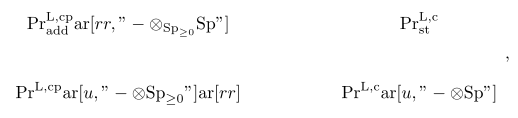 where the top horizontal morphism is the functor from construction 3.4.4, and the bottom horizontal functor is the subcategory inclusion (which is a symmetric monoidal left adjoint by proposition 3.2.10). Taking right adjoints, the middle square of functors in the following diagram commutes:
  The left and right square commute by proposition 3.3.4. By proposition 3.2.8.([003Z]), the bottom horizontal composite is the forgetful functor \(\mathrm{Cat}_{\infty}^{\mathrm{rex}, \mathrm{idem}}\rightarrow\mathrm{Cat}_{\infty}^{\sqcup, \mathrm{idem}}\). The top horizontal functor is the right adjoint to \((-)^{\mathrm{fin}}\) and hence agrees with the forgetful functor \(\mathrm{st}\rightarrow\mathrm{add}\).
We next prove fully faithfulness of the unit: Since both are left adjoints of the forgetful functor, the functor ([005B]) is equivalent to the functor \((-)^{\mathrm{fin}}\colon \mathrm{add}\rightarrow\mathrm{st}\) constructed in [ES22, Def. 2.1.17] which sends an additive, idempotent-complete \(\infty\)-category \(\mathcal C\) to the smallest full stable subcategory of \(\mathrm{Fun}^{\times}(\mathcal C^\mathrm{op}, \mathrm{Sp})\) (the category of functors taking finite coproducts in \(\mathcal C\) to finite products in \(\mathrm{Sp}\)) containing the image of the Yoneda embedding. In [ES22, Cor. 2.1.5], it is shown that the inclusion \(\mathcal C\rightarrow\mathrm{Fun}^{\times}(\mathcal C^{\mathrm{op}}, \mathrm{Sp})\) is fully faithful, and hence so is the inclusion \(\mathcal C\rightarrow\mathcal C^{\mathrm{fin}}\). ◻
3.4.3 \({\mathbf K}^b\) as a left adjoint[005E]
We now show that for an ordinary additive idempotent-complete \(1\)-category \(\mathcal A\), the universal stable \(\infty\)-category \(\mathcal A^{\mathrm{fin}}\) from proposition 3.4.5 is equivalent to \({\mathbf K}^b(\mathcal A)\).
Consider the symmetric monoidal left adjoint \((-)^{\mathrm{fin}} \colon \mathrm{add}\rightarrow\mathrm{st}\) of the forgetful functor from proposition 3.4.5. Categories in the image of \((-)^{\mathrm{fin}}\) carry so-called weight structures, which were originally introduced independently by Bondarko in [Bon10] and (under the name of co-t-structures) by Pauksztello in [Pau08], and afterwards adopted to the \(\infty\)-categorical setting by Elmanto and Sosnilo [ES22], whose exposition we closely follow.
By [ES22, Def. 2.2.1] a weight structure on an idempotent complete stable \(\infty\)-category \(\mathcal D\) is a pair \((\mathcal D_{\leq 0}, \mathcal D_{\geq 0})\) of two full idempotent complete subcategories fulfilling the following conditions:
\(\Sigma \mathcal D_{\geq 0} \subset \mathcal D_{\geq 0}, \Sigma^{-1} \mathcal D_{\leq 0} \subset \mathcal D_{\leq 0}\). We write \(\mathcal D_{\geq n} = \Sigma^n \mathcal D_{\geq 0}\), \(\mathcal D_{\leq n} = \Sigma^n \mathcal D_{\leq 0}\).
For \(x \in \mathcal D_{\leq 0}\) and \(y \in \mathcal D_{\geq 1}\), we have \(\pi_0(\mathrm{Hom}_{\mathcal D}(x,y)) \simeq 0.\)
For any object \(x\), there is a fiber sequence \(x_{\leq 0} \rightarrow x \rightarrow x_{\geq 1}\) with \(x_{\leq 0} \in \mathcal D_{\leq 0}, x_{\geq 1} \in \mathcal D_{\geq 1}\).
Note that condition (3) merely requires the existence of such a fiber sequence, neither is it unique nor functorially associated to \(x\). A weight structure is called bounded if \(\mathcal D= \bigcup_{n}(\mathcal D_{\geq -n} \cap \mathcal D_{\leq n})\). For any weight structure, the weight heart \(\mathcal D^{\heartsuit} \coloneqq \mathcal D_{\geq 0} \cap \mathcal D_{\leq 0}\) is additive and idempotent complete.
Just like t-structures, weight structures only depend on and may be constructed in terms of the underlying (triangulated) homotopy category of \(\mathcal D\).
[005G]
Example 3.4.8.
Given an ordinary additive, idempotent complete \(1\)-category \(\mathcal A\), the \(\infty\)-category \({\mathbf K}^b(\mathcal A)\) has a canonical bounded weight structure with \({\mathbf K}^b(\mathcal A)_{\geq 0}\) the (dg nerve on the) full subcategory of chain complexes supported in non-negative homological degrees. The weight heart \({\mathbf K}^b(\mathcal A)^\heartsuit \simeq \mathcal A\) recovers the original additive \(1\)-category and its inclusion is the canonical functor \(\mathcal A\rightarrow{\mathbf K}^b(\mathcal A)\).
A functor \(F\colon\mathcal C\rightarrow\mathcal D\) between stable, idempotent-complete \(\infty\)-categories with weight structure is weight exact if it is exact and the restriction of \(F\) to the full subcategory \(\mathcal C_{\geq 0} \subseteq \mathcal C\) factors through the full subcategory \(\mathcal D_{\geq 0} \subseteq \mathcal D\) and the restriction of \(F\) to \(\mathcal C_{\leq 0} \subseteq \mathcal C\) factors through \(\mathcal D_{\leq 0} \subseteq \mathcal D\). Weight exact functors \(F \colon \mathcal C\rightarrow\mathcal D\) restrict to additive functors \(F^{\heartsuit}\colon \mathcal C^{\heartsuit} \rightarrow\mathcal D^{\heartsuit}\) between the weight hearts.
[005H]
Notation 3.4.9.
Let \(\mathrm{st}^{bw}\) denote the \(\infty\)-category of idempotent complete stable categories equipped with bounded weight structures and weight exact functors.
A key result of [ES22] is that \((-)^{\mathrm{fin}}\colon\mathrm{add}\rightarrow\mathrm{st}\) factors as an equivalence \(\mathrm{add}\rightarrow\mathrm{st}^{bw}\) followed by the functor \(\mathrm{st}^{bw} \rightarrow\mathrm{st}\) which forgets the weight structure, see [ES22, Const. 2.2.7]. An inverse of this equivalence \(\mathrm{add}\rightarrow
\mathrm{st}^{bw}\) is given by the functor \((-)^{\heartsuit}\colon \mathrm{st}^{bw} \rightarrow\mathrm{add}\) taking the weight heart, see [ES22, Theorem 2.2.9]. The following corollary is a consequence of this theorem:
[005I]
Corollary 3.4.10.
Let \(\mathcal A\) be an ordinary additive, idempotent-complete \(1\)-category. We have an equivalence of \(\infty\)-categories \(\mathcal A^{\mathrm{fin}} \simeq {\mathbf K}^b(\mathcal A)\). In particular, for any stable, idempotent-complete \(\infty\)-category \(\mathcal B\), the inclusion of degree-zero chain complexes \(\mathcal A\rightarrow{\mathbf K}^b(\mathcal A)\) induces an equivalence \[\mathrm{Fun}^{\mathrm{ex}}({\mathbf K}^b(\mathcal A), \mathcal B) \rightarrow\mathrm{Fun}^{\sqcup}(\mathcal A, \mathcal B).\]
[005J]
Proof.
By [ES22, Thm. 2.2.9], for any additive, idempotent complete \(\infty\)-category \(\mathcal A\), the \(\infty\)-category \(\mathcal A^{\mathrm{fin}}\) is uniquely characterized by being a stable, idempotent-complete \(\infty\)-category with bounded weight structure with weight heart \(\mathcal A\). Since for an ordinary, additive, idempotent-complete \(1\)-category \(\mathcal A\), the \(\infty\)-category \({\mathbf K}^b(\mathcal A)\) is a stable, idempotent-complete \(\infty\)-category with weight structure and weight heart \(\mathcal A\), see proposition 3.4.2, example 3.4.8. The result follows. ◻
Extending corollary 3.4.10, we think of \((-)^{\mathrm{fin}}:\mathrm{add}\rightarrow\mathrm{st}\) as the correct generalization of \({\mathbf K}^b(\mathcal A)\) from ordinary additive, idempotent-complete \(1\)-categories to additive, idempotent-complete \(\infty\)-categories \(\mathcal A\).
[005K]
Notation 3.4.11.
Abusing notation, we will henceforth write \({\mathbf K}^b(-) \coloneqq (-)^{\mathrm{fin}}\colon \mathrm{add}\rightarrow\mathrm{st}\) for the left adjoint to the forgetful functor \(\mathrm{st}\rightarrow\mathrm{add}\), even when applied to additive \(\infty\)-categories.