B.1.1 Basics of factorization systems[00JB]
[00JC]
Definition B.1.1. ([Lur09, Def. 5.2.8.1]).
Given morphisms \(a \xrightarrow{l} b\) and \(c \xrightarrow{r} d\) in an \(\infty\)-category, we say that \(l\) is left orthogonal to \(r\) or that \(r\) is right orthogonal to \(l\) if for any solid commutative square 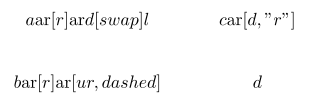 the space of dashed lifts \(b \rightarrow c\) is contractible. In this situation, we may write \(l \bot r\). More broadly, given classes \(\mathcal L\) and \(\mathcal R\) of morphisms in an \(\infty\)-category, we write \(\mathcal L\bot \mathcal R\) to indicate that \(l \bot r\) for every \(l \in \mathcal L\) and every \(r \in \mathcal R\).
[00JE]
Example B.1.2.
A morphism \(f\) in an \(\infty\)-category satisfies the relation \(f \bot f\) if and only if it is an equivalence.
[00JF]
Observation B.1.3.
Given an adjunction  and morphisms \(f\) and \(g\) in \(\mathcal C\) and \(\mathcal D\) respectively, the orthogonality relations \(f \bot G(g)\) and \(F(f) \bot g\) are equivalent. We use this fact without further comment.
[00JG]
Notation B.1.4.
Given a class \(S\) of morphisms in an \(\infty\)-category, we write \(S^\perp\) (resp. \(^\perp S\)) for the class of morphisms that are right (resp. left) orthogonal to those in \(S\).
[00JH]
Definition B.1.5. ([Lur09, Def. 5.2.8.8]).
A factorization system on an \(\infty\)-category \(\mathcal C\) is a pair \((\mathcal L, \mathcal R)\) of classes of morphisms in \(\mathcal C\) satisfying the following conditions.
The classes \(\mathcal L\) and \(\mathcal R\) are stable under the formation of retracts (in \(\mathrm{Fun}([1],\mathcal C)\)).
We have the orthogonality relation \(\mathcal L\perp \mathcal R\).
Every morphism \(c \xrightarrow{f} d\) in \(\mathcal C\) admits a factorization  with \(l \in \mathcal L\) and \(r \in \mathcal R\).
We respectively write \(\mathrm{Cat}_\infty^{\text{f.s.},\mathcal L}\), \(\mathrm{Cat}_\infty^{\text{f.s.},\mathcal R}\), and \(\mathrm{Cat}_\infty^{\text{f.s.},\mathcal L,\mathcal R}\) for the \(\infty\)-categories of \(\infty\)-categories equipped with factorization systems, in which a morphism is a functor that respectively preserves the left class, the right class, or both classes.
[00JM]
Notation B.1.6.
To simplify our notation, we take the following conventions when studying a class \(S\) of morphisms in an \(\infty\)-category \(\mathcal C\).
Assuming that \(S\) consists of precisely the morphisms in a subcategory of \(\mathcal C\) (e.g. both classes in a factorization system on \(\mathcal C\)), we simply write \(S\) to denote this subcategory.
Assuming that \(S\) is stable under homotopy (e.g. both classes in a factorization system on \(\mathcal C\)), we also simply write \(S\) to denote the full subcategory of \(\mathrm{Fun}([1],\mathcal C)\) on the morphisms in \(S\).
We simply write \(\mathcal C^\simeq\) for the class of equivalences in \(\mathcal C\), and we simply write \(\mathcal C\) for the class of all morphisms in \(\mathcal C\).
For any object \(c \in \mathcal C\), we write \({\mathcal C}_{\small{/^{S}}{c}} \subseteq \mathcal C_{/c}\) for the full subcategory on those objects \((d \rightarrow c) \in \mathcal C_{/c}\) that lie in \(S\) (when considered as morphisms in \(\mathcal C\)). In the special case that \(c \simeq {\sf pt}_\mathcal C\) is terminal, we simply write \(\mathcal C^S \coloneqq {\mathcal C}_{\small{/^{S}}{{\sf pt}_{\mathcal C}}}\).
[00JN]
Example B.1.7.
For any \(\infty\)-category \(\mathcal C\), the pairs \((\mathcal C^\simeq,\mathcal C)\) and \((\mathcal C,\mathcal C^\simeq)\) define factorization systems on \(\mathcal C\).
[00JP]
Example B.1.8.
Let \(\mathbb N^\times \coloneqq \{1, 2, 3, \ldots \}^\times\) denote the (commutative) monoid of natural numbers under multiplication. Given two elements \(s,t \in \mathbb N^\times\), their corresponding morphisms in \(B \mathbb N^\times\) satisfy \(s \bot t\) (and thereafter \(t \bot s\)) if and only if \(s\) and \(t\) are coprime. From here, it is easy to check that e.g. the pairs (powers of 2, odds) and (odds, powers of 2) define factorization systems on \(B \mathbb N^\times\). More generally, if \(\{2, 3, 5, \ldots \} = P_1 \sqcup P_2\) denotes a two-element partition of the set of prime numbers, then \[\text{(powers of elements of $P_1$, powers of elements of $P_2$)}\] determines a factorization system on \(B \mathbb N^\times\), and moreover every factorization system on \(B \mathbb N^\times\) arises in this way.
[00JQ]
Observation B.1.9.
A factorization system \((\mathcal L,\mathcal R)\) on an \(\infty\)-category is completely determined by either \(\mathcal L\) or \(\mathcal R\) (since \(\mathcal R= \mathcal L^\bot\) and \(\mathcal L= {}^\bot \mathcal R\)). We use this fact without further comment.
[00JR]
Observation B.1.10.
By [Lur09, Prop. 5.2.8.17], the factorization in part ([00JL]) of Definition B.1.5 is unique. We often use this fact without further comment.
[00JS]
Notation B.1.11.
Justified by Observation B.1.10, given a morphism \(c \xrightarrow{f} d\) in an \(\infty\)-category \(\mathcal C\) equipped with a factorization system \((\mathcal L,\mathcal R)\), we write \(\mathrm{Fact}(f) \coloneqq \mathrm{Fact}_{(\mathcal L,\mathcal R)}(f) \in \mathcal C\) for the unique object through which \(f\) factors via the factorization system.
We introduce the following notion for future use.
[00JT]
Definition B.1.12.
Let \(\mathcal O\) be an \(\infty\)-operad and let \(\mathcal C\) be an \(\mathcal O\)-monoidal \(\infty\)-category. Suppose that for every color \(X \in \underline{\mathcal O}\), the \(\infty\)-category \(\mathcal C_X\) of \(X\)-colored objects in \(\mathcal C\) is equipped with a factorization system \((\mathcal L_X,\mathcal R_X)\). We say that the \(\mathcal O\)-monoidal structure of \(\mathcal C\) is compatible with these factorization systems if for every \(n \geq 0\) and every \(n\)-ary operation \((X_1,\ldots,X_n) \rightarrow X\) in \(\mathcal O\), the corresponding functor \(\mathcal C_{X_1} \times \cdots \times \mathcal C_{X_n} \rightarrow\mathcal C_X\) carries morphisms in \(\mathcal L_{X_1} \times \cdots \times \mathcal L_{X_n}\) to morphisms in \(\mathcal L_X\).