Let \(k \geq 0\) and \(m \geq n \geq -2\). Given a commuting (solid) square in \(\mathrm{Cat}_{(\infty, {k})}\)  where \(F\) is \(n\)-surjective and \(G\) is \(m\)-faithful. Then the space of (dashed) lifts is \((m-n-2)\)-truncated.
Proof.
We induct on \(k \geq 0\). The base case \(k = 0\) is proven in [SY19, Prop. 4.2.8]. For \(k>0\), fix a functor \(G\colon \mathcal C\rightarrow\mathcal D\) which is \(m\)-faithful and let \(S\) be the class of morphisms \(F\) in \(\mathrm{Cat}_{(\infty, {k})}\) for which the space of lifts ([00AK]) against \(G\) is \((m-n-2)\)-truncated. We will now prove that \(S\) contains the \(n\)-surjective functors. Since \(S\) contains equivalences, and is closed under composition, small colimits and cobase change, it forms a saturated class of morphisms (definition B.1.13). By proposition B.1.14, to show that \(S\) contains all \(n\)-surjective morphisms, it suffices to show that it contains the generators of the left class; i.e. by theorem 5.3.7.([00A7]) the functors \(\{\partial c_{i} \rightarrow c_{i}\}_{n+2 \leq i \leq k}\) for \(n +2 < k\) and the functor \(\Sigma^k[S^{n-k+1}] \rightarrow c_k\) for \(n+2 \geq k\).
We first consider the case that \(n + 2 \geq k\), where we need to show that a commuting diagram of \((\infty,k)\)-categories 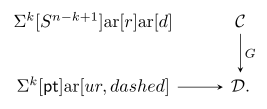 has \((m-n-2)\)-truncated space of lifts. Let \(\alpha\) denote the composite \(\partial c_k = \Sigma^k[\emptyset] \rightarrow\Sigma^k[S^{n-k+1}] \rightarrow\mathcal C\), picking out a pair of parallel \((k-1)\)-morphisms. By observation 5.1.9, the space of lifts of ([00AM]) is equivalent to the space of lift of the following diagram in spaces
 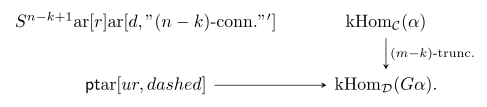 By definition of faithfulness, if \(G\) is \(m\)-faithful, then the right vertical map is \((m-k)\)-truncated for any \(\alpha \colon \partial c_k \rightarrow\mathcal C\). Hence, it follows from [SY19, Prop. 4.2.8] that the space of lifts of ([00AN]) is \((m-n-2)\)-truncated.
Now we consider the case \(n+2 < k\), where we need to show that \(\partial c_i \rightarrow c_i\) is in \(S\) for \(n+2 \leq i \leq k\). For \(i=k\), since \(\partial c_k \rightarrow c_k\) is \((k-2)\)-surjective and \((k-2) +2 \geq k\), it follows from the previous case that the space of lifts of \(\partial c_k \rightarrow c_k\) against \(G\) is \((m-(k-2)-2)\)-truncated, and since \((m-(k-2)-2) \leq (m-n-2)\) also \((m-n-2)\)-truncated. It remains to show that \(\partial c_i \rightarrow c_i\) is in \(S\) for \(n+2 \leq i < k\). As both \(\partial c_i\) and \(c_i\) are \((\infty, k-1)\)-categories, by the \((i_{k},\iota_{k-1})\) adjunction, the two space of lifts are equivalent:  Since \(\iota_{k-1} G\) is a \(n\)-faithful functor between \((\infty, k-1)\)-categories by observation 5.3.10, by induction the space of lifts is \((m-n-2)\)-truncated. ◻
Original source: arXiv:2401.02956v2
Original source · 2401.02956v2