8 The main theorem[00GN]
Throughout this section, we fix a \(\mathbb{Q}\)-algebra \(k\). The goal of this section is to prove our main theorem B and hence to construct a fully coherent \(\mathbb E_2\)-structure on the monoidal \((\infty,2)\)-category \({\mathbf K}^b_{\mathrm{loc}}(\mathrm{Sbim})\) introduced in definition 6.4.1, compatible with its structure as an object of \(\mathrm{Alg}_{\mathbb E_1}(\mathrm{Cat}[\mathrm{st}^{B\mathbb{Z}}_{k}])\) (i.e. compatible with local \(k\)-linearity and \(\mathbb{Z}\)-action) together with an \(\mathbb E_2\)-structure on its monoidal functor \(H_{\mathrm{loc}}\colon {\mathbf K}^b_{\mathrm{loc}}(\mathrm{Sbim}) \rightarrow\mathrm{st}^{B\mathbb{Z}}_{k}\) from notation 6.5.5.
Our proof proceeds by successively rewriting the space of such \(\mathbb E_2\)-structures into spaces of simpler categorical structures; namely \(\infty\)-categorical variants of the prebraidings encountered in §2.4.
8.1 Spaces of braidings and prebraidings[00GP]
[00GQ]
Notation 8.1.1.
Let \(\mathcal V\) be a symmetric monoidal \(\infty\)-category, or more generally an \(\infty\)-operad.
For an \(\mathbb E_1\)-algebra \(A\) in \(\mathcal V\), we write \[\mathrm{Braid}_{\mathcal V}(A):= \mathrm{Hom}_{\mathrm{Op}}(\mathbb E_2, \mathcal V) \times_{\mathrm{Hom}_{\mathrm{Op}}(\mathbb E_1, \mathcal V)} \{A\}\] for the space of \(\mathbb E_2\)-algebra structures on \(A\) compatible with the given \(\mathbb E_1\)-structure and refer to this space as the space of braidings on \(A\).
For an \(\mathbb E_1\)-algebra \(A\) in \(\mathcal V\), we write \[\mathrm{PreBraid}_{\mathcal V}(A):= \mathrm{Hom}_{\mathrm{Alg}_{\mathbb E_1}(\mathcal V)}(A\otimes A, A) \times_{\mathrm{Hom}_{\mathrm{Alg}_{\mathbb E_1}(\mathcal V)}(A, A)^{\times 2}}\{\mathrm{id}_A,\mathrm{id}_A\}\] and refer to this space as the space of prebraidings on \(A\).
For \(f \colon A \rightarrow B\) a morphism of \(\mathbb E_1\)-algebras in \(\mathcal V\), we write \[\mathrm{PreBraid}_{\mathcal V}(f) := \mathrm{Hom}_{\mathrm{Alg}_{\mathbb E_1}(\mathcal V)}(A \otimes A, B) \times_{\mathrm{Hom}_{\mathrm{Alg}_{\mathbb E_1}(\mathcal V)}(A, B)^{\times 2}} \{ f, f\}\] and refer to this space as the space of prebraidings on \(f\).
For an \(\mathbb E_1\)-algebra \(A\), it follows by definition that \(\mathrm{PreBraid}_{\mathcal V}(A) = \mathrm{PreBraid}_{\mathcal V}(\mathrm{id}_A)\). Recall from corollary 7.2.6 that analogous to \(\mathrm{Braid}_{\mathcal V}\), the spaces of prebraidings are also corepresented by certain \(\infty\)-operads: \[\begin{aligned}
\mathrm{PreBraid}_{\mathcal V}(A) & = \mathrm{Hom}_{\mathrm{Op}}( \mathbb A_2 \otimes \mathbb E_1, \mathcal V) \times_{\mathrm{Hom}_{\mathrm{Op}}(\mathbb E_1, \mathcal V)} \{A\}\\
\mathrm{PreBraid}_{\mathcal V}(f:A \rightarrow B) &=\mathrm{Hom}_{\mathrm{Op}}(\mathbb T_2 \otimes \mathbb E_1, \mathcal V) \times_{\mathrm{Hom}_{\mathrm{Op}}([1] \otimes \mathbb E_1, \mathcal V)} \{f\}
\end{aligned}\] Moreover, for any \(\mathbb E_1\)-algebra \(A\), composing with the operad map \(\mathbb A_2 \otimes \mathbb E_1 \rightarrow\mathbb E_1 \otimes \mathbb E_1 \simeq \mathbb E_2\) from example 7.2.7 defines a ‘forgetful’ map of spaces \[
\mathrm{Braid}_{\mathcal V}(A) \rightarrow\mathrm{PreBraid}_{\mathcal V}(A).\]
[00GS]
Example 8.1.2.
For an ordinary monoidal \(1\)-category \(\mathcal A\in \mathrm{Alg}_{\mathbb E_1}(\mathrm{Cat}_{({1}, {1})})\) it follows from corollary 7.7.8 that the map of spaces \[\mathrm{Braid}_{\mathrm{Cat}_{({1}, {1})}}(\mathcal A) \rightarrow\mathrm{PreBraid}_{\mathrm{Cat}_{({1}, {1})}}(\mathcal A).\] is an equivalence. By corollary 7.4.15([00FC]), these spaces are equivalent to the (discrete) set of classical braidings on \(\mathcal A\).
Similarly, it follows from corollary 7.4.15([00FB]) that for monoidal functors \(F \colon \mathcal A\rightarrow\mathcal B\) between ordinary monoidal \(1\)-categories, the spaces \(\mathrm{PreBraid}_{\mathrm{Cat}_{({1}, {1})}}(F)\) are equivalent to the (discrete) set of classical prebraidings on \(F\) in the sense of definition 2.4.8.
[00GT]
Warning 8.1.3.
example 8.1.2 is key to our paper, and is at the heart of an observation already encountered in remark 2.4.4: While braidings and prebraidings on ordinary monoidal \(1\)-categories coincide, the notions already diverge for monoidal \(2\)-categories; the map ([00GR]) is in general far from an equivalence.
As in §2.4, we would also like to consider spaces of prebraidings over a given fixed prebraiding.
The following generalizes definition 2.4.5 to the \(\infty\)-categorical setting.
[00GU]
Definition 8.1.4.
Let \(\mathcal V\) be a symmetric monoidal \(\infty\)-category, \(C\) an \(\mathbb E_2\)-algebra (or merely an \(\mathbb A_2 \otimes \mathbb E_1\)-algebra) and \(A\xrightarrow{f} B \xrightarrow{g}C\) be maps of \(\mathbb E_1\)-algebras. We define the space \(\mathrm{PreBraid}_{\mathcal V}(f)_{/C}\) of prebraidings on \(f\) over \(C\) to be the space \(\mathbb T^{\mathrm{Alg}_{\mathbb E_1}(\mathcal V)}_2(f)_{/C}\) from definition 7.3.1.
Unpacked, a prebraiding on \(f\) over \(C\) is therefore a prebraiding on \(f\) together with an identification of the induced prebraiding on \(g\circ f\) with the one induced by the \(\mathbb E_2\)-structure of \(C\).
[00GV]
Example 8.1.5.
It follows from example 8.1.2 that for an ordinary braided monoidal \(1\)-category \(\mathcal C\), and monoidal \(1\)-functors \(\mathcal A\xrightarrow{F} \mathcal B\xrightarrow{g} \mathcal C\) between ordinary monoidal \(1\)-category, the space \(\mathrm{PreBraid}_{\mathrm{Cat}_{({1}, {1})}}(F)_{/C}\) of prebraidings on \(F\) over \(C\) in the sense of definition 8.1.4 agrees with the set \(\mathrm{PreBraid}_{/C}(F)\) of prebraidings over \(C\) from definition 2.4.8.
Recall from §A.8.6 that for an \(\mathbb E_{\infty}\)-algebra \(C\) in a symmetric monoidal \(\infty\)-category \(\mathcal V\), the over-\(\infty\)-category \(\mathcal V_{/C}\) inherits a symmetric monoidal structure so that for any \(\infty\)-operad \(\mathcal O\), there is an equivalence of \(\infty\)-categories \(\underline{\mathrm{Alg}}_{\mathcal O}(\mathcal V_{/C}) \simeq \underline{\mathrm{Alg}}_{\mathcal O}(\mathcal V)_{/C}\).
[00GW]
Example 8.1.6.
It immediately follows from the defining property of \(\mathcal V_{/C}\), that for a given \(\mathbb E_1\)-algebra in \(\mathcal V_{/C}\), i.e. an \(\mathbb E_1\)-algebra \(A\) equipped with an \(\mathbb E_1\)-algebra map \(A\rightarrow C\), the space \(\mathrm{Braid}_{\mathcal V_{/C}}(A)\) encodes a compatible \(\mathbb E_2\)-structure on \(A\) together with \(\mathbb E_2\)-structure on the \(\mathbb E_1\)-morphism \(A\rightarrow C\).
Following example 8.1.6, to prove theorem B and to study \(\mathbb E_2\)-structures on \({\mathbf K}^b_{\mathrm{loc}}(\mathrm{Sbim})\) together with \(\mathbb E_2\)-structures on its fiber functor \({\mathbf K}^b_{\mathrm{loc}}(\mathrm{Sbim}) \rightarrow\mathrm{st}^{B\mathbb{Z}}_{k}\), we will therefore need to study the space \(\mathrm{Braid}_{\mathrm{Cat}[\mathrm{st}^{B\mathbb{Z}}_{k}]_{/\mathrm{st}^{B\mathbb{Z}}_{k}}}\left({\mathbf K}^b_{\mathrm{loc}}(\mathrm{Sbim}) \right)\) and relate it to certain spaces of prebraidings in certain over-categories. These spaces can be understood in terms of prebraidings over given prebraidings in the sense of definition 8.1.4:
[00GX]
Corollary 8.1.7.
Let \(C\) be an \(\mathbb E_{\infty}\)-algebra in a symmetric monoidal \(\infty\)-category \(\mathcal V\), and let \(F\) be a morphism of \(\mathbb E_1\)-algebras in \(\mathcal V_{/C}\), i.e. equivalently a commuting diagram 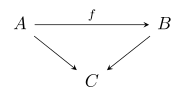 of \(\mathbb E_1\)-algebras in \(\mathcal V\). Then, the spaces \[\mathrm{PreBraid}_{\mathcal V_{/C}}(F) \simeq \mathrm{PreBraid}_{\mathcal V}(F)_{/C}\] are equivalent.
[00GY]
Proof.
Apply proposition 7.3.2 to the symmetric monoidal \(\infty\)-category \(\mathrm{Alg}_{\mathbb E_1}(\mathcal V_{/C}) \simeq \mathrm{Alg}_{\mathbb E_1}(\mathcal V)_{/C}\). ◻
[00GZ]
Example 8.1.8.
Combining corollary 8.1.7 with example 8.1.5 we find that in the setup of example 8.1.5, the space \(\mathrm{PreBraid}_{(\mathrm{Cat}_{(1,1)})_{/C}}(F)\) agrees with the set \(\mathrm{PreBraid}_{/C}(F)\) of prebraidings over \(C\) from definition 2.4.8.
8.2 Statement of the main theorem[00H0]
By example 8.1.6, the space of compatible \(\mathbb E_2\)-structures on \({\mathbf K}^b_{\mathrm{loc}}(\mathrm{Sbim})\) together with compatible \(\mathbb E_2\)-structures on its fiber functor \(H_{\mathrm{loc}}\colon {\mathbf K}^b_{\mathrm{loc}}(\mathrm{Sbim}) \rightarrow\mathrm{st}^{B\mathbb{Z}}_{k}\) is precisely given by the space \[\mathrm{Braid}_{\mathrm{Cat}[\mathrm{st}^{B\mathbb{Z}}_{k}]_{/\mathrm{st}^{B\mathbb{Z}}_{k}}}({\mathbf K}^b_{\mathrm{loc}}(\mathrm{Sbim})),\] where \({\mathbf K}^b_{\mathrm{loc}}(\mathrm{Sbim})\) is seen as an \(\mathbb E_1\)-algebra in \(\mathrm{Cat}[\mathrm{st}^{B\mathbb{Z}}_{k}]_{/\mathrm{st}^{B\mathbb{Z}}_{k}}\) via its \(\mathbb E_1\)-functor \(H_{\mathrm{loc}}\colon {\mathbf K}^b_{\mathrm{loc}}(\mathrm{Sbim}) \rightarrow\mathrm{st}^{B\mathbb{Z}}_{k}\).
Our main theorem will prove that this space is in fact a set, namely the set of prebraidings in the sense of §2.4 on a functor between certain ordinary monoidal \(1\)-categories. The key fact we use is that while the \((\infty,2)\)-‘fiber’-functor \({\mathbf K}^b_{\mathrm{loc}}(\mathrm{Sbim}) \rightarrow\mathrm{st}^{B\mathbb{Z}}_{k}\) is not faithful, the composite \(\mathrm{Sbim}\rightarrow{\mathbf K}^b_{\mathrm{loc}}(\mathrm{Sbim}) \rightarrow\mathrm{st}^{B\mathbb{Z}}_{k}\) is faithful by lemma 6.5.6, i.e. induces fully faithful functors on all hom-categories. Furthermore, \(\mathrm{Sbim}\) is generated by the \((2,2)\)-category \(\mathrm{BSbim}\) from definition 6.1.4, in the sense that the functor \(\mathrm{BSbim}\rightarrow\mathrm{Sbim}\) is surjective on objects and that any \(1\)-morphism in \(\mathrm{Sbim}\) is a retract of a finite coproduct of grading shifts of \(1\)-morphisms in the image of \(\mathrm{BSbim}\) as proven in proposition 6.3.2.
For future applications, we abstract this situation as follows:
[00H1]
Theorem 8.2.1.
Let \(\mathcal C\in \mathrm{Alg}_{\mathbb E_1}(\mathrm{Cat}[\mathrm{add}_{k}^{B\mathbb{Z}}])\), \(\mathcal D\in \mathrm{Alg}_{\mathbb E_{\infty}}(\mathrm{Cat}[\mathrm{st}^{B\mathbb{Z}}_{k}])\) and let \(H \colon \mathcal C\rightarrow\mathcal D\) be a morphism in \(\mathrm{Alg}_{\mathbb E_1}(\mathrm{Cat}[\mathrm{add}_{k}^{B\mathbb{Z}}])\) whose underlying \((\infty,2)\)-functor is faithful, i.e. induces fully faithful functors on hom-categories. Consider the monoidal functor \({\mathbf K}^b_{\mathrm{loc}}(\mathcal C) \rightarrow\mathcal D\), induced by the adjunction ([00D4]), as an object of \(\mathrm{Alg}_{\mathbb E_1}\left(\mathrm{Cat}[\mathrm{st}^{B\mathbb{Z}}_{k}]_{/\mathcal D}\right)\).
Then, the map of spaces (constructed more formally in the proof below) \[
\mathrm{Braid}_{\mathrm{Cat}[\mathrm{st}^{B\mathbb{Z}}_{k}]_{/\mathcal D}}({\mathbf K}^b_{\mathrm{loc}}(\mathcal C)) \rightarrow\mathrm{PreBraid}_{{\mathrm{Cat}_{({1}, {1})}}_{/h_1\mathcal D}}(h_1 \mathcal C\rightarrow h_1{\mathbf K}^b_{\mathrm{loc}}(\mathcal C)),\] which restricts a braiding on \({\mathbf K}^b_{\mathrm{loc}}(\mathcal C)\) to a prebraiding on the subcategory inclusion \(\mathcal C\rightarrow{\mathbf K}^b_{\mathrm{loc}}(\mathcal C)\) and then passes to the homotopy \(1\)-category \(h_1\), is an equivalence. (Here, we leave the evident maps to \(\mathcal D\) and \(h_1\mathcal D\) implicit.)
Further, assume there is a functor \(\iota \colon \mathcal B\rightarrow\mathcal C\) in \(\mathrm{Alg}_{\mathbb E_1}(\mathrm{Cat}_{(\infty,2)})\) which is surjective on objects and such that for every two objects \(b,b' \in \mathcal B\), any object in \(\underline{\mathrm{Hom}}_{\mathcal C}(\iota b, \iota b') \in \mathrm{add}_{k}^{B\mathbb{Z}}\) is a retract of a finite coproduct of \(\mathbb{Z}\)-shifts of objects in the image of \(\underline{\mathrm{Hom}}_{\mathcal B}(b, b') \in \mathrm{Cat}_{(\infty,1)}\). Then, the pre-composition map \[\mathrm{PreBraid}_{{\mathrm{Cat}_{({1}, {1})}}_{/h_1\mathcal D}}(h_1 \mathcal C\rightarrow h_1{\mathbf K}^b_{\mathrm{loc}}(\mathcal C)) \rightarrow\mathrm{PreBraid}_{{\mathrm{Cat}_{({1}, {1})}}_{/h_1\mathcal D}}(h_1 \mathcal B\rightarrow h_1{\mathbf K}^b_{\mathrm{loc}}(\mathcal C))\] is an equivalence of spaces.
In other words, theorem 8.2.1 asserts that the space of pairs of an \(\mathbb E_2\)-structure on \({\mathbf K}^b_{\mathrm{loc}}(\mathcal C)\) and an \(\mathbb E_2\)-structure on the functor \({\mathbf K}^b_{\mathrm{loc}}(\mathcal C) \rightarrow\mathcal D\), compatible with their given \(\mathbb E_1\)-structures, is equivalent to the set of prebraidings on \(h_1\mathcal B\rightarrow h_1 {\mathbf K}^b_{\mathrm{loc}}(\mathcal C)\) over \(h_1\mathcal D\).
In the remainder of section 8, we prove theorem 8.2.1 by factoring ([00H3]) through various other spaces of prebraiding. Before discussing the proof, we immediately record how theorem 8.2.1 implies theorem B from the introduction:
[00H5]
Corollary 8.2.2.
The space of braidings \[
\mathrm{Braid}_{\mathrm{Cat}[\mathrm{st}^{B\mathbb{Z}}_{k}]_{/\mathrm{st}^{B\mathbb{Z}}_{k}}}\left({\mathbf K}^b_{\mathrm{loc}}(\mathrm{Sbim})\right)\] is equivalent to the set of prebraidings \[
\mathrm{PreBraid}_{/h_1\mathrm{DMor}^{\mathrm{poly}, \mathrm{gr-perf}}(\mathrm{mod}_k^{\mathbb{Z}})}(h_1\mathrm{BSbim}\rightarrow h_1 \mathrm{K}^b_{\mathrm{loc}}(\mathrm{Sbim}))\] over \(h_1H_{\mathrm{loc}}\colon h_1 \mathrm{K}^b_{\mathrm{loc}}(\mathrm{Sbim}) \rightarrow h_1 \mathrm{DMor}^{\mathrm{poly}, \mathrm{gr-perf}}(\mathrm{mod}_k^{\mathbb{Z}})\) as defined in definition 2.4.8.
In particular, the space of pairs of an \(\mathbb E_2\)-algebra structure on \({\mathbf K}^b_{\mathrm{loc}}(\mathrm{Sbim}) \in \mathrm{Cat}[\mathrm{st}^{B\mathbb{Z}}_{k}]\) together with an \(\mathbb E_2\)-algebra structure on the functor \(H_{\mathrm{loc}}\colon{\mathbf K}^b_{\mathrm{loc}}(\mathrm{Sbim}) \rightarrow\mathrm{st}^{B\mathbb{Z}}_{k}\), which enhance their monoidal structures, and satisfy the condition that the positive braiding \[\sigma_{1,1} \colon 1 \otimes 1\rightarrow 1 \otimes 1 \in \underline{\mathrm{Hom}}_{{\mathbf K}^b_{\mathrm{loc}}(\mathrm{Sbim})}(1 \otimes 1,1\otimes 1) = {\mathbf K}^b(\mathrm{Sbim}_2)\] agrees up to chain homotopy with the shifted Rouquier complex \(X_{1,1}= F(\sigma_{1,1})\langle -1\rangle\) from definition 2.2.7 and ([000Z]), is contractible.
[00H8]
Proof.
Recall that the functor \({\mathbf K}^b_{\mathrm{loc}}(\mathrm{Sbim}) \rightarrow\mathrm{st}^{B\mathbb{Z}}_{k}\) factors by definition through the small full subcategory \(\mathrm{DMor}^{\mathrm{poly}, \mathrm{gr-perf}}(\mathrm{mod}_k^{\mathbb{Z}})\hookrightarrow \mathrm{DMor}^{\mathrm{flat}, \mathrm{gr-perf}}(\mathrm{mod}_{k}^{\mathbb{Z}})\hookrightarrow \mathrm{st}^{B\mathbb{Z}}_{k}\). Hence, the space ([00H6]) is equivalent to the space \[
\mathrm{Braid}_{\mathrm{Cat}[\mathrm{st}^{B\mathbb{Z}}_{k}]_{/\mathrm{DMor}^{\mathrm{poly}, \mathrm{gr-perf}}(\mathrm{mod}_k^{\mathbb{Z}})}}\left({\mathbf K}^b_{\mathrm{loc}}(\mathrm{Sbim})\right).\] We now invoke theorem 8.2.1 for \(\mathcal C= \mathrm{Sbim}\), \(\mathcal D= \mathrm{DMor}^{\mathrm{poly}, \mathrm{gr-perf}}(\mathrm{mod}_k^{\mathbb{Z}})\), and \(\mathcal B=\mathrm{BSbim}\), the functor \(H_{\mathrm{loc}}\colon \mathrm{Sbim}\rightarrow\mathrm{DMor}^{\mathrm{poly}, \mathrm{gr-perf}}(\mathrm{mod}_k^{\mathbb{Z}})\) from proposition 6.5.2 which is faitfhul by lemma 6.5.6, and the functor \(\iota\colon \mathrm{BSbim}\rightarrow\mathrm{Sbim}\) from ([00CU]) which satisfies the relevant conditions of theorem 8.2.1 by proposition 6.3.2. Thus, the space of braidings ([00H9]) is equivalent to the space of prebraidings \[\mathrm{PreBraid}_{(\mathrm{Cat}_{(1,1)})_{/h_1\mathrm{DMor}^{\mathrm{poly}, \mathrm{gr-perf}}(\mathrm{mod}_k^{\mathbb{Z}})}}(h_1 \mathrm{BSbim}\rightarrow h_1 {\mathbf K}^b_{\mathrm{loc}}(\mathrm{Sbim})).\] Both, \(h_1 \mathrm{BSbim}\rightarrow h_1 {\mathbf K}^b_{\mathrm{loc}}(\mathrm{Sbim})\) and \(h_1{\mathbf K}^b_{\mathrm{loc}}(\mathrm{Sbim}) \rightarrow h_1\mathrm{DMor}^{\mathrm{poly}, \mathrm{gr-perf}}(\mathrm{mod}_k^{\mathbb{Z}})\), agree with the respective functors from section 2, namely with ([001D]) by corollary 6.4.3 and with ([001H]) by corollary 6.5.4 respectively. Hence, it follows from example 8.1.8 that this space ([00HA]) is equivalent to the set \(\mathrm{PreBraid}_{/h_1\mathrm{DMor}^{\mathrm{poly}, \mathrm{gr-perf}}(\mathrm{mod}_k^{\mathbb{Z}})}\left(h_1 \mathrm{BSbim}\rightarrow h_1 \mathrm{K}^b_{\mathrm{loc}}(\mathrm{Sbim})\right)\) from theorem 2.6.4.
The second half of corollary 8.2.2 follows directly from the first: By corollary 2.5.3, the condition on the positive braiding \(\sigma_{1,1}\) fixes an element of the set ([00H7]) and hence a point in the space ([00H6]). Thus, there is a contractible space of braidings on \({\mathbf K}^b_{\mathrm{loc}}(\mathrm{Sbim})\) over \(\mathrm{st}^{B\mathbb{Z}}_{k}\) compatible with the given prebraiding on \(h_1\mathrm{BSbim}\rightarrow h_1\mathrm{DMor}^{\mathrm{poly}, \mathrm{gr-perf}}(\mathrm{mod}_k^{\mathbb{Z}})\). ◻
8.3 From prebraidings to braidings[00HC]
Our proof will proceed by successively simplifying the space of prebraidings and braidings on \({\mathbf K}^b_{\mathrm{loc}}(\mathcal C)\). This subsection contains the operadic heart of our proof, captured by four corollaries of results in section 7.
[00HD]
Definition 8.3.1.
Given a map of spaces \(f \colon A \rightarrow B\), we let \(\mathrm{Im}(f) \subseteq B\) denote the full image of \(f\), i.e. the subspace of \(B\) given by the union of those connected components of \(B\) in the image of \(\pi_0 f\).
In other words, \(A \rightarrow\mathrm{Im}(f) \hookrightarrow B\) is the factorization of \(f\) with respect to the (\((-1)\)-connected, \((-1)\)-truncated)-factorization system on spaces.
[00HE]
Observation 8.3.2.
Recall the (\(0\)-surjective, \(0\)-faithful) factorization system on the \(\infty\)-category \(\mathrm{Op}\) from definition 7.5.1 and proposition 7.5.3.
Given a map of operads \(\mathbb E_1 \rightarrow\mathcal O\), corepresenting an \(\mathbb E_1\)-algebra \(A\) in \(\mathcal O\), we write \(\mathcal O|_{\mathbb E_1}\) for the factorization \(\mathbb E_1 \rightarrow\mathcal O|_{ \mathbb E_1} \rightarrow\mathcal O\) into a \(0\)-surjective followed by a \(0\)-faithful map of operads.
Explicitly, \(\mathcal O|_{\mathbb E_1}\) has one color \(A\) and the only non-empty multi-hom spaces are given by the full images \[\mathrm{Mul}_{\mathcal O|_{\mathbb E_1}}(A, \ldots, A; A) = \mathrm{Im}\left( S_n \rightarrow\mathrm{Mul}_{\mathcal O}(A, \ldots, A; A) \right)\] of the map \(\mathbb E_1(n) = S_n \rightarrow\mathrm{Mul}_{\mathcal O}(A, \ldots, A ; A)\) induced by the \(\mathbb E_1\)-structure on \(A\).
(In other words, \(\mathrm{Im}\left( S_n \rightarrow\mathrm{Mul}_{\mathcal O}(A, \ldots, A; A) \right)\) is precisely the union of those components of \(\mathrm{Mul}_{\mathcal O}(A, \ldots, A ; A)\) which contain the orbit of the \(n\)-ary multiplication of \(A\) under the \(S_n\)-action permuting its inputs.)
Given a map of operads \([1] \otimes \mathbb E_1 \rightarrow\mathcal O\), corepresenting a morphism \(f \colon A \rightarrow B\) of \(\mathbb E_1\)-algebras in \(\mathcal O\), we write \(\mathcal O|_{[1]\otimes \mathbb E_1}\) for the factorization \([1] \otimes \mathbb E_1 \rightarrow\mathcal O|_{[1] \otimes \mathbb E_1} \rightarrow\mathcal O\) into a \(0\)-surjective followed by a \(0\)-faithful map of operads.
Explicitly, \(\mathcal O|_{[1]\otimes \mathbb E_1}\) has (at most) two colors \(A, B\) and multi-hom spaces connecting them, one of them being \[\mathrm{Mul}_{\mathcal O|_{[1] \otimes \mathbb E_1}}(A, \ldots, A; B) = \mathrm{Im}\left(S_n \rightarrow\mathrm{Mul}_{\mathcal O}(A, \ldots, A; B)\right),\]where the map from \(S_n = \mathbb E_1(n)\) is induced by the \(\mathbb E_1\)-structures on \(f\). (In other words, \(\mathrm{Im}\left( S_n \rightarrow\mathrm{Mul}_{\mathcal O}(A, \ldots, A; B) \right)\) is the union of those components of \(\mathrm{Mul}_{\mathcal O}(A, \ldots, A ; B)\) which contain the orbit of \(f \circ \mu_A \simeq \mu_B \circ f\) under the \(S_n\)-action permuting its inputs.)
Given a map of operads \([2] \otimes \mathbb E_1 \rightarrow\mathcal O\), corepresenting a composable pair of \(\mathbb E_1\)-algebra morphisms \(A \rightarrow B \rightarrow C\), we can similarly consider \(\mathcal O|_{[2] \otimes \mathbb E_1}\), which has (at most) three objects \(A, B, C\), and multi-hom spaces connecting them, such as \[\begin{aligned}
\mathrm{Mul}_{\mathcal O|_{[2] \otimes \mathbb E_1}}(A, \ldots, A; B)& = \mathrm{Im}\left(S_n \rightarrow\mathrm{Mul}_{\mathcal O}(A, \ldots, A; B)\right)\\
\mathrm{Mul}_{\mathcal O|_{[2] \otimes \mathbb E_1}}(B, \ldots, B; C) &= \mathrm{Im}\left(S_n \rightarrow\mathrm{Mul}_{\mathcal O}(B, \ldots, B; C)\right),
\end{aligned}\] where the maps from \(S_n = \mathbb E_1(n)\) are induced by the \(\mathbb E_1\)-structure on \(f\) and \(g\), respectively.
Throughout we will repeatedly use the following simple observation, applied to the \(\infty\)-category \(\mathcal V= \mathrm{Op}\) with its (\(0\)-surjective, \(0\)-faithful) factorization system.
[00HF]
Lemma 8.3.3.
In an \(\infty\)-category \(\mathcal V\) with a factorization system \((\mathcal L, \mathcal R)\), consider a commuting square 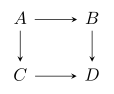 and a further morphism \(Q\rightarrow A\) in \(\mathcal L\) so that also the composite \(Q\rightarrow C\) is in \(\mathcal L\). Let \(Q\rightarrow B|_{Q} \rightarrow B\) and \(Q \rightarrow D|_Q \rightarrow D\) denote the factorizations of the induced morphisms from \(Q\). Then, the map between spaces of (dashed) lifts
 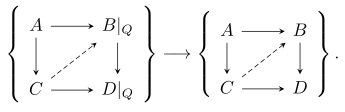 is an equivalence.
[00HG]
Proof.
Let \(\mathcal V_{Q/^{\mathcal L}}\) denote the full subcategory of \(\mathcal V_{Q/}\) on the morphisms \(Q\rightarrow X\) which are in \(\mathcal L\). The factorization system induces a right adjoint of the inclusion \(\mathcal V_{Q/^{\mathcal L}} \hookrightarrow \mathcal V_{Q/}\) which sends \(Q\rightarrow X\) to its factorization \(Q\rightarrow X|_Q\). The statement then follows immediately from adjunction. ◻
The fact that braidings and prebraidings agree on ordinary \(1\)-categories, see example 8.1.2, generalizes to the following observation:
[00HH]
Corollary 8.3.4.
Let \(\mathcal O\) be an \(\infty\)-operad, \(A\) an \(\mathbb E_1\)-algebra in \(\mathcal O\), and assume that the spaces \[\mathrm{Im}\left( S_n \rightarrow\mathrm{Mul}_{\mathcal O}(\underbrace{A, \ldots, A}_{n}; A) \right)\] are \(1\)-truncated (i.e. \(1\)-groupoids) for all \(n\geq 0\), where the map from \(S_n = \mathbb E_1(n)\) is induced by the \(\mathbb E_1\)-structure on \(A\). Then, the map of spaces \[\mathrm{Braid}_{\mathcal O}(A) \rightarrow\mathrm{PreBraid}_{\mathcal O}(A)\] is an equivalence.
[00HI]
Proof.
Fix a prebraiding on \(A\), represented by a lift of the map of \(\infty\)-operads \(\mathbb E_1 \rightarrow\mathcal O\) representing \(A\), to a map of \(\infty\)-operads \(\mathbb A_2 \otimes \mathbb E_1 \rightarrow\mathcal O\). The fiber of \(\mathrm{Braid}_{\mathcal O}(A) \rightarrow\mathrm{PreBraid}_{\mathcal O}(A)\) at this prebraiding is precisely the space of further lifts 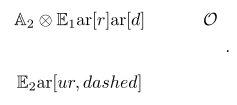 The operad map \(\mathbb E_1 \rightarrow\mathbb A_2 \otimes \mathbb E_1\) is \(0\)-surjective by proposition 7.6.1, and the composite \(\mathbb E_1 \rightarrow\mathbb A_2 \otimes \mathbb E_1 \rightarrow\mathbb E_2\) is \(0\)-surjective since all mapping spaces of \(\mathbb E_2\) are connected and all mapping spaces of \(\mathbb E_1\) are non-empty. Hence, it follows from lemma 8.3.3 applied to the \(\infty\)-category \(\mathrm{Op}\) (with its (\(0\)-surjective, \(0\)-faithful) factorization system) that this space of lifts is equivalent to the space of lifts
 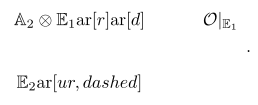 Since all multi-hom spaces of \(\mathcal O|_{\mathbb E_1}\) are by assumption \(1\)-truncated, and hence \(\mathcal O|_{\mathbb E_1}\) is a \(2\)-operad (see definition 7.7.1), it follows from corollary 7.7.8 that this space of lifts is contractible. ◻
[00HJ]
Corollary 8.3.5.
Let \(F \colon \mathcal O\rightarrow\mathcal P\) be a map of \(\infty\)-operads and let \(g \colon b \rightarrow c\) be a morphism of \(\mathbb E_1\)-algebras in \(\mathcal O\). Assume that for all \(n \geq 0\) the map of spaces \[\mathrm{Im}\left(S_n \rightarrow\mathrm{Mul}_{\mathcal O}(\underbrace{b, \ldots, b}_{n}; c) \right) \xrightarrow{F(-)} \mathrm{Im}\left(S_n \rightarrow\mathrm{Mul}_{\mathcal P}(\underbrace{F(b), \ldots, F(b)}_{n} ; F(c)) \right)\] is an equivalence, where the maps from \(S_n\) are induced by the \(\mathbb E_1\)-structure on \(g\) and \(F(g)\). Then, the map of spaces \[\mathrm{PreBraid}_{\mathcal O}(g) \rightarrow\mathrm{PreBraid}_{\mathcal P}(F(g))\] is an equivalence.
[00HK]
Proof.
Consider the map of operads \([1] \otimes \mathbb E_1 \rightarrow\mathcal O\) representing the \(\mathbb E_1\)-algebra map \(f \colon A \rightarrow B\). The fiber of \(\mathrm{PreBraid}_{\mathcal O}(f) \rightarrow\mathrm{PreBraid}_{\mathcal P}(F(f))\) at a prebraiding represented by an operad map \(\mathbb T_2 \otimes \mathbb E_1 \rightarrow\mathcal P\) is precisely the space of (dashed) lifts of the following commuting square of operads: 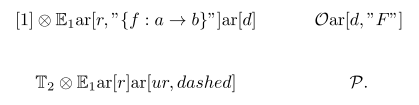 Since \([1] \otimes \mathbb E_1 \rightarrow\mathbb T_2 \otimes \mathbb E_1\) is \(0\)-surjective, it follows from lemma 8.3.3 that this space of lifts is equivalent to the space of lifts
  Hence, replacing \(\mathcal O\) by \(\mathcal O|_{[1] \otimes \mathbb E_1}\) and \(\mathcal P\) by \(\mathcal P|_{[1] \otimes \mathbb E_1}\) with multimapping spaces as in observation 8.3.2, we may without loss of generality assume that the maps \[\mathrm{Mul}_{\mathcal O}(a, \ldots, a; b) \rightarrow\mathrm{Mul}_{\mathcal P}(Fa, \ldots, Fa; Fb)\] are equivalences. It then follows from proposition 7.8.2.([00GH]) that the maps \[\mathrm{Mul}_{\mathrm{Alg}_{\mathbb E_1}(\mathcal O)}(a, \ldots, a; b) \rightarrow\mathrm{Mul}_{\mathrm{Alg}_{\mathbb E_1}(\mathcal P)}(Fa, \ldots, Fa; Fb)\] are equivalences. Hence, \[\begin{aligned}
\mathrm{PreBraid}_{\mathcal O}(g) = &\mathrm{Mul}_{\mathrm{Alg}_{\mathbb E_1}(\mathcal O)}(a,a; b) \times_{\mathrm{Mul}_{\mathrm{Alg}_{\mathbb E_1}(\mathcal O)}(a, b)^{2}} \{g\} \\
&\longrightarrow \mathrm{Mul}_{\mathrm{Alg}_{\mathbb E_1}(\mathcal P)}(Fa,Fa; Fb) \times_{\mathrm{Mul}_{\mathrm{Alg}_{\mathbb E_1}(\mathcal P)}(Fa, Fb)^{2}} \{Fg\} = \mathrm{PreBraid}_{\mathcal O}(Fg)
\end{aligned}\] is an equivalence. ◻
Hence, replacing \(\mathcal O\) by \(\mathcal O|_{[1] \otimes \mathbb E_1}\) and \(\mathcal P\) by \(\mathcal P|_{[1] \otimes \mathbb E_1}\) with multimapping spaces as in observation 8.3.2, we may without loss of generality assume that the maps \[\mathrm{Mul}_{\mathcal O}(a, \ldots, a; b) \rightarrow\mathrm{Mul}_{\mathcal P}(Fa, \ldots, Fa; Fb)\] are equivalences. It then follows from proposition 7.8.2.([00GH]) that the maps \[\mathrm{Mul}_{\mathrm{Alg}_{\mathbb E_1}(\mathcal O)}(a, \ldots, a; b) \rightarrow\mathrm{Mul}_{\mathrm{Alg}_{\mathbb E_1}(\mathcal P)}(Fa, \ldots, Fa; Fb)\] are equivalences. Hence, \[\begin{aligned}
\mathrm{PreBraid}_{\mathcal O}(g) = &\mathrm{Mul}_{\mathrm{Alg}_{\mathbb E_1}(\mathcal O)}(a,a; b) \times_{\mathrm{Mul}_{\mathrm{Alg}_{\mathbb E_1}(\mathcal O)}(a, b)^{2}} \{g\} \\
&\longrightarrow \mathrm{Mul}_{\mathrm{Alg}_{\mathbb E_1}(\mathcal P)}(Fa,Fa; Fb) \times_{\mathrm{Mul}_{\mathrm{Alg}_{\mathbb E_1}(\mathcal P)}(Fa, Fb)^{2}} \{Fg\} = \mathrm{PreBraid}_{\mathcal O}(Fg)
\end{aligned}\] is an equivalence. ◻
[00HL]
Corollary 8.3.6.
Let \(\mathcal O\) be an \(\infty\)-operad and let \[a \xrightarrow{f} b \xrightarrow{g} c\] be morphisms of \(\mathbb E_1\)-algebras in \(\mathcal O\). Assume that for all \(n\geq 0\), the map of spaces \[\mathrm{Im}\left( S_n \rightarrow\mathrm{Mul}_{\mathcal O}(\underbrace{b, \ldots, b}_{n} ; c) \right) \xrightarrow{-\circ (f, \ldots, f)} \mathrm{Im}\left( S_n \rightarrow\mathrm{Mul}_{\mathcal O}(\underbrace{a, \ldots, a}_{n}; c) \right)\] are equivalences, where the maps from \(S_n\) are induced by the \(\mathbb E_1\)-structures on \(g\) and on \(g \circ f\). Then, the map of spaces \[\mathrm{PreBraid}_{\mathcal O}(g) \rightarrow\mathrm{PreBraid}_{\mathcal O}(g \circ f)\] is an equivalence.
[00HM]
Proof.
The pair of composable morphisms of \(\mathbb E_1\)-algebras \(\{f,g\}\) may be corepresented by an operad map \([2] \otimes \mathbb E_1 \rightarrow\mathcal O\). Recall the operad maps \([2] \otimes \mathbb E_0 \rightarrow\mathbb T_2 \sqcup_{\{0<2\}} [2] \rightarrow\mathbb T_2 \sqcup_{\{1<2\}}\) from observation 7.2.10 corepresenting a pair of composable \(\mathbb E_0\)-morphisms with a \(\mathbb T_2\)-structure on \(g\) and on \(g\circ f\), respectively, and the construction of a \(\mathbb T_2\)-structure on \(g\) from a \(\mathbb T_2\)-structure on \(g\circ f\).
Fix a prebraiding on \(g\circ f\), corepresented by a lift of the operad map \([2] \otimes \mathbb E_1 \rightarrow\mathcal O\) to an operad map \(\mathbb T_2 \sqcup_{\{0<2\}}[2] \otimes \mathbb E_1 \rightarrow\mathcal O\). The fiber of \(\mathrm{PreBraid}_{\mathcal O}(g) \rightarrow\mathrm{PreBraid}_{\mathcal O}(g\circ f)\) is given by the space of lifts 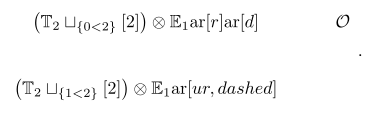 We now claim that both operad maps \[
[2] \otimes \mathbb E_1 \rightarrow\left(\mathbb T_2 \sqcup_{\{0<2\}}{[2]} \right) \otimes \mathbb E_1 \qquad [2] \otimes \mathbb E_1 \rightarrow\left( \mathbb T_2 \sqcup_{\{1<2\}}{[2]} \right) \otimes \mathbb E_1\] are \(0\)-surjective. Indeed, this follows since \([1] \otimes \mathbb E_1 \rightarrow\mathbb T_2 \otimes \mathbb E_1\) is \(0\)-surjective by proposition 7.6.1 and since both operad maps ([00HN]) are by definition given by a pushout of this \(0\)-surjective operad map against the operad maps \([1] \otimes \mathbb E_1 \rightarrow[2] \otimes \mathbb E_1\) induced by the inclusions \(\{0<2\} \rightarrow[2]\) and \(\{1<2\} \rightarrow[2]\), respectively (see observation 7.2.10).
We now claim that both operad maps \[
[2] \otimes \mathbb E_1 \rightarrow\left(\mathbb T_2 \sqcup_{\{0<2\}}{[2]} \right) \otimes \mathbb E_1 \qquad [2] \otimes \mathbb E_1 \rightarrow\left( \mathbb T_2 \sqcup_{\{1<2\}}{[2]} \right) \otimes \mathbb E_1\] are \(0\)-surjective. Indeed, this follows since \([1] \otimes \mathbb E_1 \rightarrow\mathbb T_2 \otimes \mathbb E_1\) is \(0\)-surjective by proposition 7.6.1 and since both operad maps ([00HN]) are by definition given by a pushout of this \(0\)-surjective operad map against the operad maps \([1] \otimes \mathbb E_1 \rightarrow[2] \otimes \mathbb E_1\) induced by the inclusions \(\{0<2\} \rightarrow[2]\) and \(\{1<2\} \rightarrow[2]\), respectively (see observation 7.2.10).
Hence, it follows from lemma 8.3.3 applied to the \(\infty\)-category \(\mathrm{Op}\) that our space of lifts is equivalent to the space of lifts 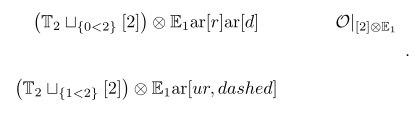 Therefore, without loss of generality, we may replace \(\mathcal O\) by \(\mathcal O|_{[2] \otimes \mathbb E_1}\) and hence with observation 8.3.2, we may assume that \[\mathrm{Mul}_{\mathcal O}(b, \ldots, b; c) \rightarrow\mathrm{Mul}_{\mathcal O}(a, \ldots, a; c)\] are equivalences. It therefore follows from proposition 7.8.2.([00GI]) that \[\mathrm{Mul}_{\mathrm{Alg}_{\mathbb E_1}(\mathcal O)}(b, \ldots, b; c) \rightarrow\mathrm{Mul}_{\mathrm{Alg}_{\mathbb E_1}{\mathcal O}}(a, \ldots, a; c)\] are equivalences, and hence as in the proof of corollary 8.3.5 that \[\mathrm{PreBraid}_{\mathcal O}(g) \rightarrow\mathrm{PreBraid}_{\mathcal O}(g\circ f)\] are equivalences. ◻
Lastly, we record the following special case of lemma 7.2.9 that prebraidings transport along adjunctions:
[00HP]
Corollary 8.3.7.
Consider an adjunction between symmetric monoidal \(\infty\)-categories with (strongly) symmetric monoidal left adjoint \(L\)  and denote the induced adjunction between \(\infty\)-categories of \(\mathbb E_1\)-algebras by
  Then, for any morphism of \(\mathbb E_1\)-algebras \(f \colon L_{\mathbb E_1} a \rightarrow b\) in \(\mathcal W\), the induced map of spaces \[\mathrm{PreBraid}_{\mathcal W}(f) \rightarrow\mathrm{PreBraid}_{\mathcal V}(R_{\mathbb E_1}f) \rightarrow\mathrm{PreBraid}_{\mathcal V}( R_{\mathbb E_1}f \circ \eta_a)\] (constructed as in lemma 7.2.9) is an equivalence, where \(\eta\) denotes the unit of the adjunction.
[00HR]
Proof.
This is an immediate corollary of lemma 7.2.9 applied to the adjunction ([00HQ]). ◻
8.4 Proof of the main theorem[00HS]
We now prove the various truncatedness conditions appearing in Corollaries 8.3.4 – 8.3.5 in the setting of theorem 8.2.1, and assemble the obtained equivalences between spaces of (pre-)braidings into a proof of our main theorem.
We first recall from section 5 that faithful \((\infty,2)\)-functors are completely determined by their induced ordinary functors between homotopy \(1\)-categories, with the following straight-forward corollary:
[00HT]
Corollary 8.4.1.
Let \(n \geq 0\) and consider categories and functors in \(\mathrm{Cat}_{(\infty,2)}\)  with faithfulness properties as indicated. Then, the map induced by applying \(h_1\) \[\mathrm{Hom}_{{\mathrm{Cat}_{(\infty, {2})}}_{/\mathcal W}}\left(\mathcal Y^{\times n}, \mathcal Z\right) \rightarrow\mathrm{Hom}_{{\mathrm{Cat}_{({1}, {1})}}_{/h_1\mathcal W}}\left(h_1 \mathcal Y^{\times n} , h_1 \mathcal Z\right)\] is an equivalence of spaces.
[00HU]
Proof.
Since \(h_1 \colon \mathrm{Cat}_{(\infty, {2})}\rightarrow\mathrm{Cat}_{({1}, {1})}\) is (strongly) symmetric monoidal, this follows directly from corollary 5.5.7. ◻
Moving to locally additive \((\infty,2)\)-categories, recall from notation 6.2.3 that we call a morphism \(F \colon \mathcal X\rightarrow\mathcal Y\) in \(\mathrm{Cat}[\mathrm{add}_{k}^{B\mathbb{Z}}]\) surjective-on-objects-and-dominant-on-1-morphisms if its underlying \((\infty,2)\)-functor is surjective on objects and if for each pair of objects \(x,x' \in \mathcal X\), every object of \(\underline{\mathrm{Hom}}_{\mathcal Y}(Fx,Fx')\) is a retract of an object in the image of \(\underline{\mathrm{Hom}}_{\mathcal X}(x,x') \rightarrow\underline{\mathrm{Hom}}_{\mathcal Y}(Fx,Fx')\). The key technical statement of this section is the following straight-forward application of the (surjective-on-objects-and-dominant-on-1-morphisms, faithful)-factorization system on \(\mathrm{Cat}[\mathrm{add}_{k}^{B\mathbb{Z}}]\) constructed in corollary 6.2.4.
[00HV]
Proposition 8.4.2.
Let \(n \geq 0\) and consider categories and functors in \(\mathrm{Cat}[\mathrm{add}_{k}^{B\mathbb{Z}}]\)  with surjectivity and faithfulness properties as indicated (and where \(\otimes\) denotes the tensor product in \(\mathrm{Cat}[\mathrm{add}_{k}^{B\mathbb{Z}}]\)). Then, the map induced by precomposition with the tensor power \(\mathcal X^{\otimes n} \rightarrow\mathcal Y^{\otimes n}\) \[\mathrm{Hom}_{\mathrm{Cat}[\mathrm{add}_{k}^{B\mathbb{Z}}]_{/\mathcal W}}\left(\mathcal Y^{\otimes n}, \mathcal Z\right) \rightarrow\mathrm{Hom}_{\mathrm{Cat}[\mathrm{add}_{k}^{B\mathbb{Z}}]_{/\mathcal W}}\left( \mathcal X^{\otimes n} , \mathcal Z\right)\] is an equivalence of spaces.
[00HW]
Proof.
Since the (surjective on objects and dominant on 1-morphisms, faithful) factorization system is compatible with the monoidal structure on \(\mathrm{Cat}[\mathrm{add}_{k}^{B\mathbb{Z}}]\), as an \(n\)-fold tensor power of a functor in the left class, the functor \(\mathcal X^{\otimes n} \rightarrow\mathcal Y^{\otimes n}\) remains surjective on objects and dominant on \(1\)-morphisms, and hence the first map is an equivalence as a direct consequence of the orthogonality of surjective-on-objects-and-dominant-on-1-morphisms and faithful functors. ◻
Below, we will repeatedly use the following simple lemma:
[00HX]
Lemma 8.4.3.
Suppose we are given a commuting square of spaces 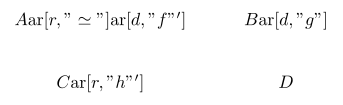 where the top horizontal map is an equivalence and where for every point \(c \in
C\), the induced map of fibers \(\mathrm{fib}_c(f) \rightarrow\mathrm{fib}_{h(c)}(g)\) is an equivalence. Then, the induced map \[\mathrm{Im}(f) \rightarrow\mathrm{Im}(g)\] is an equivalence.
where the top horizontal map is an equivalence and where for every point \(c \in
C\), the induced map of fibers \(\mathrm{fib}_c(f) \rightarrow\mathrm{fib}_{h(c)}(g)\) is an equivalence. Then, the induced map \[\mathrm{Im}(f) \rightarrow\mathrm{Im}(g)\] is an equivalence.
[00HZ]
Proof.
The square ([00HY]) factors as 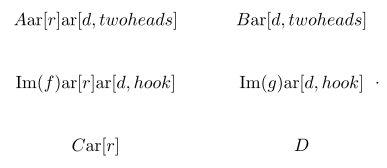 Hence, we may without loss of generality assume that \(\mathrm{Im}(f) = C\) and \(\mathrm{Im}(g) = D\), i.e. that \(f\) and \(g\) are surjective on \(\pi_0\) and prove that in this case \(h\) is an isomorphism. Working fiberwise (and identifying \(A\) with \(B\) via the given equivalence), it suffices to consider the case \(D={\sf pt}\); in other words, given a \((-1)\)-connected map \(f\colon A\twoheadrightarrow C\) so that for all \(c\in C\) the map \(\mathrm{fib}_c(f) \rightarrow A (=\mathrm{fib}_{\sf pt}(A\rightarrow{\sf pt}))\) is an isomorphism, we need to show that \(C\) is contractible. This follows directly from the long exact sequence of homotopy groups associated to the fiber sequence. ◻
Recall from ([00CP]) the adjunction  where the right adjoint forgets additivity, \(k\)-linearity and the \(\mathbb{Z}\)-action and the (strongly) symmetric monoidal left adjoint \(\mathrm{Lin}_{k, \mathrm{loc}}^{\mathbb{Z}} (-)\) sends an \((\infty,2)\)-category \(\mathcal C\) to the locally additive \(k\)-linear \((\infty,2)\)-category with local shifts with the same objects as \(\mathcal C\) and hom-categories given by the linearization \(\mathrm{Lin}_k(\underline{\mathrm{Hom}}_{\mathcal C}(a,b) \times \mathbb{Z})\) with free \(\mathbb{Z}\)-action.
[00I1]
Corollary 8.4.4.
Given categories and functors as in the assumptions of theorem 8.2.1. Then, for each \(n \geq 0\), the following hold:
The space \[\mathrm{Im}\left( S_n \rightarrow\mathrm{Hom}_{\mathrm{Cat}[\mathrm{st}^{B\mathbb{Z}}_{k}]_{/\mathcal D}}\left( {\mathbf K}^b_{\mathrm{loc}}(\mathcal C)^{\otimes n}, {\mathbf K}^b_{\mathrm{loc}}(\mathcal C) \right) \right)\] is \(1\)-truncated, i.e. a \(1\)-groupoid.
The map of spaces \[\begin{aligned}
\mathrm{Im}\left(S_n \rightarrow\vphantom{\mathrm{Hom}_{\mathrm{Cat}[\mathrm{add}_{k}^{B\mathbb{Z}}]_{/\mathcal D}}}\right. & \left. \mathrm{Hom}_{\mathrm{Cat}[\mathrm{add}_{k}^{B\mathbb{Z}}]_{/\mathcal D}} \left( \mathcal C^{\otimes n}, {\mathbf K}^b_{\mathrm{loc}}(\mathcal C)\right)\right) \\
&\longrightarrow \mathrm{Im}\left(S_n \rightarrow\mathrm{Hom}_{\mathrm{Cat}[\mathrm{add}_{k}^{B\mathbb{Z}}]_{/\mathcal D}}\left(\mathrm{Lin}_{k, \mathrm{loc}}^{\mathbb{Z}} (\mathcal B)^{\otimes n}, {\mathbf K}^b_{\mathrm{loc}}(\mathcal C) \right) \right)
\end{aligned}\] is an equivalence.
The map of spaces \[\begin{aligned}
\mathrm{Im}\left( S_n \rightarrow\vphantom{\mathrm{Hom}_{{\mathrm{Cat}_{(\infty, {2})}}_{/\mathcal D}}} \right. & \left. \mathrm{Hom}_{{\mathrm{Cat}_{(\infty, {2})}}_{/\mathcal D}} \left( \mathcal B^{\times n}, {\mathbf K}^b_{\mathrm{loc}}(\mathcal C)\right) \right) \\
&\longrightarrow \mathrm{Im}\left( S_n \rightarrow\mathrm{Hom}_{{\mathrm{Cat}_{({1}, {1})}}_{/h_1\mathcal D}}\left(h_1\mathcal B^{\times n}, h_1 {\mathbf K}^b_{\mathrm{loc}}(\mathcal C) \right) \right)
\end{aligned}\] is an equivalence
We warn the reader that the functor \({\mathbf K}^b_{\mathrm{loc}}(\mathcal C) \rightarrow\mathcal D\) is not faithful, and hence Propositions 8.4.1 and 8.4.2 do not apply directly.
[00I5]
Proof.
We first prove the part ([00I3]). Since the monoidal structure on \(\mathcal C\rightarrow{\mathbf K}^b_{\mathrm{loc}}(\mathcal C)\) arises from adjunction, the relevant maps from \(S_n\) all factor as:  Since \(\mathcal C\rightarrow\mathcal D\) is faithful, it follows from proposition 8.4.2 that the top horizontal map is an equivalence. Moreover, for every \(f\in \mathrm{Hom}_{\mathrm{Cat}[\mathrm{add}^{B \mathbb{Z}}_k]_{/\mathcal D}}(\mathcal C^{\otimes n}, {\mathbf K}^b_{\mathrm{loc}}(\mathcal C))\), the induced map between the fibers of the vertical maps is \[\mathrm{Hom}_{\mathrm{Cat}[\mathrm{add}^{B \mathbb{Z}}_k]_{/{\mathbf K}^b_{\mathrm{loc}}(\mathcal C)}}(\mathcal C^{\otimes n}, \mathcal C) \rightarrow\mathrm{Hom}_{\mathrm{Cat}[\mathrm{add}_{k}^{B\mathbb{Z}}]_{/{\mathbf K}^b_{\mathrm{loc}}(\mathcal C)}}\left(\mathrm{Lin}_{k, \mathrm{loc}}^{\mathbb{Z}} (\mathcal B)^{\otimes n}, \mathcal C\right).\] It follows from proposition 4.3.2 that \(\mathcal C\rightarrow{\mathbf K}^b_{\mathrm{loc}}(\mathcal C)\) is faithful. Hence, this map between fibers is also an equivalence by proposition 8.4.2. Therefore, it follows from lemma 8.4.3 that the induced map between the full images of the vertical maps is an equivalence, and hence so is also the induced map between the full images of \(S_n\).
The proof of part ([00I3]) is entirely analogous: The relevant maps from \(S_n\) all factor as 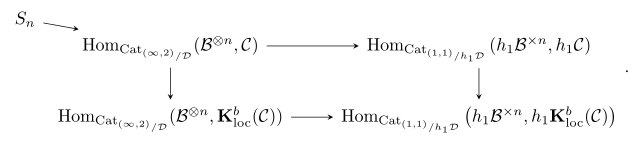 Since \(\mathcal C\rightarrow\mathcal D\) is faithful by assumption, it follows from corollary 8.4.1 that the top horizontal map is an equivalence. The induced map between the fibers of the vertical maps at an \(f\in \mathrm{Hom}_{{\mathrm{Cat}_{(\infty, {2})}}_{/\mathcal D}}(\mathcal B^{\otimes n}, {\mathbf K}^b_{\mathrm{loc}}(\mathcal C))\) is given by \[\mathrm{Hom}_{{\mathrm{Cat}_{(\infty, {2})}}_{/{\mathbf K}^b_{\mathrm{loc}}(\mathcal C)}}(\mathcal B^{\otimes n}, \mathcal C) \rightarrow\mathrm{Hom}_{{\mathrm{Cat}_{({1}, {1})}}_{/h_1{\mathbf K}^b_{\mathrm{loc}}(\mathcal C)}}\left(h_1 \mathcal B^{\times n}, h_1\mathcal C\right)\] and hence is also an equivalence by corollary 8.4.1 since also \(\mathcal C\rightarrow{\mathbf K}^b_{\mathrm{loc}}(\mathcal C)\) is faithful. Therefore, it follows from lemma 8.4.3 that the induced map between the full images of the vertical maps is an equivalence, and hence so is also the induced map between the full images of \(S_n\).
Part ([00I2]) follows from combining parts ([00I3]) and ([00I4]): It follows from adjunction and monoidality of \({\mathbf K}^b_{\mathrm{loc}}(-)\) that \[\mathrm{Hom}_{\mathrm{Cat}[\mathrm{st}^{B\mathbb{Z}}_{k}]_{/\mathcal D}}\left( {\mathbf K}^b_{\mathrm{loc}}(\mathcal C)^{\otimes n}, {\mathbf K}^b_{\mathrm{loc}}(\mathcal C) \right) \simeq \mathrm{Hom}_{\mathrm{Cat}[\mathrm{add}_{k}^{B\mathbb{Z}}]_{/\mathcal D}}\left( \mathcal C^{\otimes n}, {\mathbf K}^b_{\mathrm{loc}}(\mathcal C)\right).\] Similarly, it follows from adjunction and monoidality of \(\mathrm{Lin}_{k, \mathrm{loc}}^{\mathbb{Z}} (-)\) that \[\mathrm{Hom}_{\mathrm{Cat}[\mathrm{add}_{k}^{B\mathbb{Z}}]_{/\mathcal D}}\left( \mathrm{Lin}_{k, \mathrm{loc}}^{\mathbb{Z}} (\mathcal B)^{\otimes n}, {\mathbf K}^b_{\mathrm{loc}}(\mathcal C) \right) \simeq \mathrm{Hom}_{{\mathrm{Cat}_{(\infty, {2})}}_{/\mathcal D}} \left( \mathcal B^{\times n}, {\mathbf K}^b_{\mathrm{loc}}(\mathcal C)\right).\] Hence, combining the second and third statement, we find that \[\mathrm{Im}\left( S_n \rightarrow\mathrm{Hom}_{\mathrm{Cat}[\mathrm{st}^{B\mathbb{Z}}_{k}]_{/\mathcal D}}\left( {\mathbf K}^b_{\mathrm{loc}}(\mathcal C)^{\otimes n}, {\mathbf K}^b_{\mathrm{loc}}(\mathcal C) \right) \right) \simeq \mathrm{Im}\left( S_n \rightarrow\mathrm{Hom}_{{\mathrm{Cat}_{({1}, {1})}}_{/h_1\mathcal D}}\left(h_1\mathcal B^{\times n}, h_1 {\mathbf K}^b_{\mathrm{loc}}(\mathcal C) \right) \right)\] which is — as a mapping space of \(\mathrm{Cat}_{({1}, {1})}\) — a \(1\)-groupoid. ◻
Now we prove the main theorem:
[00I6]
Proof of theorem 8.2.1.
Given categories and functors as in part ([00H4]) of theorem 8.2.1, we will prove that the composite \[\begin{aligned}
\mathrm{Braid}_{\mathrm{Cat}[\mathrm{st}^{B\mathbb{Z}}_{k}]_{/\mathcal D}}({\mathbf K}^b_{\mathrm{loc}}(\mathcal C))
&\rightarrow\mathrm{PreBraid}_{{\mathrm{Cat}_{({1}, {1})}}_{/h_1\mathcal D}}(h_1 \mathcal C\rightarrow h_1{\mathbf K}^b_{\mathrm{loc}}(\mathcal C))
\\
\nonumber
&\rightarrow\mathrm{PreBraid}_{{\mathrm{Cat}_{({1}, {1})}}_{/h_1\mathcal D}}(h_1 \mathcal B\rightarrow h_1{\mathbf K}^b_{\mathrm{loc}}(\mathcal C))
\end{aligned}\] is an equivalence. Note that part ([00H2]) of theorem 8.2.1 then follows by taking \(\mathcal B\rightarrow\mathcal C\) to be the identity \(\mathcal C\rightarrow\mathcal C\) (which clearly satisfies the required conditions). Then, the second statement follows since the first map and the composite in ([00I7]) are equivalences, and hence so is the second map.
To prove that ([00I7]) is an equivalence, note that it follows from lemma 6.3.1 that the condition on \(\mathcal B\rightarrow\mathcal C\) in the statement of theorem 8.2.1.([00H4]) equivalently asserts that \(\mathrm{Lin}_{k, \mathrm{loc}}^{\mathbb{Z}} (\mathcal B) \rightarrow\mathcal C\) is surjective on objects and dominant on \(1\)-morphisms.
We now unpack ([00I7]) as a sequence of equivalences of spaces of (pre-)braidings:
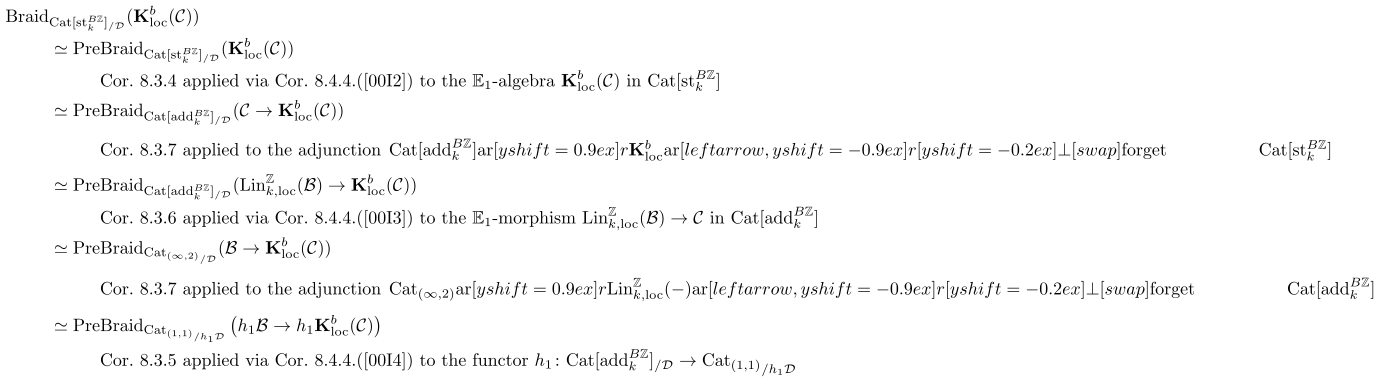 Diagram references: 8.3.4 8.4.4 ([00I2]) 8.3.7 8.3.6 8.4.4 ([00I3]) 8.3.7 8.3.5 8.4.4 ([00I4]) This completes the proof of theorem 8.2.1. ◻