7.2 The operads \(\mathbb A_2\) and \(\mathbb{T}_2\)[00DZ]
For a unital \(\infty\)-operad \(\mathcal O\), we can use the unit-inserting map \[\sigma \colon \mathrm{Mul}_{\mathcal O}(X_1, \ldots, X_n; Y) \rightarrow\mathrm{Hom}_{\underline{\mathcal O}}(X_1, Y) \times \cdots \times \mathrm{Hom}_{\underline{\mathcal O}}(X_n, Y)\] from ([00DY]) to give a quick definition of the well-known notion of a unital \(\mathbb A_2\)-algebra, which encodes a left and right-unital binary multiplication without any associativity requirements:
[00E0]
Definition 7.2.1.
A unital \(\mathbb A_2\)-algebra in a unital \(\infty\)-operad \(\mathcal O\) is given by a color \(X \in \underline{\mathcal O}\) equipped with an element of the pullback \[\mathrm{Mul}_{\mathcal O}(X,X;X)\times_{\mathrm{Hom}_{\underline{\mathcal O}}(X,X)^{\times 2}} \{(\mathrm{id}_X, \mathrm{id}_X)\},\] i.e. a \(2\)-ary map \(\mu \in \mathrm{Mul}_{\mathcal O}(X, X; X)\) and an identification of its image \((\mu(1,-), \mu(-1))\) under \(\sigma \colon \mathrm{Mul}_{\mathcal O}(X, X; X) \rightarrow\mathrm{Hom}_{\underline{\mathcal O}}(X, X)^{\times 2}\) with \((\mathrm{id}_X, \mathrm{id}_X)\).
A unital \(\mathbb A_2\)-algebra in a (not necessarily unital) \(\infty\)-operad \(\mathcal O\) is a unital \(\mathbb A_2\)-algebra in the unital \(\infty\)-operad \(\mathrm{Alg}_{\mathbb E_0}(\mathcal O)\).
lemma 7.1.3.([00DR]) ensures that definition 7.2.1 is well-defined for non-unital operads and unambigous for unital \(\infty\)-operads.
We will also be concerned with the following relative version:
[00E1]
Definition 7.2.2.
A \(\mathbb{T}_2\)-algebra in a unital operad \(\mathcal O\) is given by a pair of colors \(X,Y \in \underline{\mathcal O}\) equipped with an element of the pullback \[\mathrm{Mul}_{\mathcal O}(X,X;Y) \times_{\mathrm{Hom}_{\underline{\mathcal O}}(X,Y)^{\times 2}} \mathrm{Hom}_{\underline{\mathcal O}}(X,Y),\] i.e. a \(2\)-ary operation \(\mu \in \mathrm{Mul}_{\mathcal O}(X,X;Y)\) and an identification of the \(1\)-ary operations \(\mu(-, 1)\) and \(\mu(1,-)\) in \(\mathrm{Hom}_{\underline{\mathcal O}}(X,Y)\).
A \(\mathbb T_2\)-algebra in a (not necessarily unital) \(\infty\)-operad \(\mathcal O\) is a \(\mathbb T_2\)-algebra in the unital \(\infty\)-operad \(\mathrm{Alg}_{\mathbb E_0}(\mathcal O)\).
We now construct \(\infty\)-operads which corepresent \(\mathbb{T}_2\) and \(\mathbb A_2\)-algebras. For this purpose, for any \(n \geq 0\), consider the functor \[\nabla_n: \mathrm{Op}\rightarrow\mathcal S, \hspace{0.5cm} \mathcal O\mapsto \mathrm{Hom}_{(\mathrm{Cat}_{\infty})_{/\mathrm{Fin}_*}}
\left([1] \xrightarrow{\{\underline{n}_+ \rightarrow\underline{1}_+\}} \mathrm{Fin}_*,
~~\mathcal O^{\otimes} \rightarrow\mathrm{Fin}_* \right),\] which may intuitively be thought of as sending an \(\infty\)-operad \(\mathcal O\) to the space of \((n+1)\)-tuples of colors \(X_1,\ldots, X_n,Y \in \underline{\mathcal O}\) equipped with an \(n\)-ary map \(\mu \in \mathrm{Mul}_{\mathcal O}(X_1, \ldots, X_n; Y)\).
[00E2]
Lemma 7.2.3.
The functor \(\nabla_n \colon \mathrm{Op}\rightarrow\mathcal S\) is corepresented by an \(\infty\)-operad, also denoted \(\nabla_n\).
[00E3]
Proof.
Using Lurie’s combinatorial simplicial model category of \(\infty\)-preoperads [Lur17, § 2.1.4], one can define the \(\infty\)-operad \(\nabla_n\) as a fibrant resolution of the \(\infty\)-preoperad \([1] \xrightarrow{\underline{n}_+ \rightarrow\underline{1}_+} \mathrm{Fin}_*\). ◻
For a unital \(\infty\)-operad \(\mathcal O\) and a \(\nabla_2\)-algebra \((X,Y,Z, \mu \in \mathrm{Mul}_{\mathcal O}(X,Y;Z))\), we may insert units into \(\mu\) to extract morphisms \(X\rightarrow Z\) and \(Y \rightarrow Z\) in \(\underline{\mathcal O}\), This leads to the following:
[00E4]
Lemma 7.2.4.
The \(\infty\)-category \(\underline{\nabla_2 \otimes \mathbb E_0}\) underlying the unital \(\infty\)-operad \(\nabla_2 \otimes \mathbb E_0\) is equivalent to the ‘walking span’  , i.e. the pushout \([1] \sqcup_{[0]} [1]\).
[00E5]
Proof.
By adjunction, for any \(\infty\)-category \(\mathcal C\), we have \[\mathrm{Hom}_{\mathrm{Cat}_{\infty}}(\underline{\nabla_2 \otimes \mathbb E_0}, \mathcal C) \simeq \mathrm{Hom}_{\mathrm{Op}^{\mathrm{un}}}( \nabla_2 \otimes \mathbb E_0, \mathcal C_{\sqcup}) \simeq \mathrm{Hom}_{\mathrm{Op}} (\nabla_2, \mathcal C_{\sqcup}).\] The latter space explicitly unpacks to the space of triples \(X, Y, Z\in \mathcal C\) with maps \(X\rightarrow Y \leftarrow Z\) and hence  . ◻
. ◻
Consider the codiagonal functor  which identifies the two morphisms in the span.
[00E6]
Definition 7.2.5.
We define the \(\mathbb T_2\)-operad and the \(\mathbb A_2\)-operad as the following pushouts of unital \(\infty\)-operads: 
The definitions together with lemma 7.2.4 immediately imply that algebras of the \(\mathbb{T}_2\)- and \(\mathbb A_2\)-operad are \(\mathbb{T}_2\)- and \(\mathbb A_2\)-algebras in the sense of Definitions 7.2.2 and 7.2.1.
[00E8]
Corollary 7.2.6.
Let \(\mathcal O\) be a (not necessarily unital) \(\infty\)-operad.
Given a map of operads \([1] \otimes \mathbb E_0 \rightarrow\mathcal O\), equivalently a map of operads \([1] \rightarrow\mathrm{Alg}_{\mathbb E_0}(\mathcal O)\) specified by a morphism \(f \colon A \rightarrow B\) in \(\underline{\mathrm{Alg}}_{\mathbb E_0}(\mathcal O)\), the above pushout induces an isomorphism of spaces: \[\mathrm{Hom}_{{\mathrm{Op}_{[1] \otimes \mathbb E_0/}}} \left( \mathbb T_2, \mathcal O\right) \simeq \mathrm{Mul}_{\mathrm{Alg}_{\mathbb E_0}(\mathcal O)}(A,A;B) \times_{\mathrm{Mul}_{\mathrm{Alg}_{\mathbb E_0}(\mathcal O)}(A;B)^2} \{(f,f)\}.\]
Given a map of operads \(\mathbb E_0 \rightarrow\mathcal O\), equivalently an \(A\in \mathrm{Alg}_{\mathbb E_0}(\mathcal O)\), the above pushout induces an isomorphism of spaces \[
\mathrm{Hom}_{\mathrm{Op}_{\mathbb E_0/}}(\mathbb A_2,\mathcal O) \simeq
\mathrm{Mul}_{\mathrm{Alg}_{\mathbb E_0}(\mathcal O)}(A,A;A) \times_{\mathrm{Mul}_{\mathrm{Alg}_{\mathbb E_0}(\mathcal O)}(A;A)^2} \{(\mathrm{id}_A,\mathrm{id}_A)\}\]
[00EA]
Example 7.2.7.
Using corollary 7.2.6, we may factor the canonical map \(\mathbb E_0 \rightarrow\mathbb E_1\) through an operad map \(\mathbb A_2 \rightarrow\mathbb E_1\) which remembers of an \(\mathbb E_1\)-algebra only the binary multiplication and its unitality structure. This is the first step in the well-known filtration \(\mathbb E_0 = \mathbb A_1 \rightarrow\mathbb A_2 \rightarrow\ldots \rightarrow\mathbb A_{\infty} = \mathbb E_{1}\) of the \(\mathbb E_1\)-operad by the unital \(\mathbb A_n\) operads, encoding higher coherent associativity (see [Lur17, § 4.1.4] for a non-unital version of this filtration in the setting of \(\infty\)-operads). In this paper, we will only need the first stage \(\mathbb E_0 \rightarrow\mathbb A_2\rightarrow\mathbb E_1\).
[00EB]
Notation 7.2.8.
For an \(\infty\)-operad \(\mathcal O\) and an operad map \([1] \otimes \mathbb E_0 \rightarrow\mathcal O\) corepresenting a morphism \(f \colon A \rightarrow B \in \mathrm{Alg}_{\mathbb E_0}(\mathcal O)\), we write \[\mathbb{T}^{\mathcal O}_2(f) \coloneqq \mathrm{Hom}_{\mathrm{Op}_{[1] \otimes \mathbb E_0/}}(\mathbb{T}_2, \mathcal O) \simeq \mathrm{Mul}_{\mathrm{Alg}_{\mathbb E_0}(\mathcal O)}(A,A;B) \times_{\mathrm{Mul}_{\mathrm{Alg}_{\mathbb E_0}(\mathcal O)}(A;B)^2} \{(f,f)\}.\] for the space of \(\mathbb T_2\)-structures on \(f\).
For an \(\infty\)-operad \(\mathcal O\) and an operad map \(\mathbb E_0 \rightarrow\mathcal O\) corepresenting an \(\mathbb E_0\)-algebra \(A\) in \(\mathcal O\), we write \[\mathbb A^{\mathcal O}_2(A) \coloneqq \mathrm{Hom}_{\mathrm{Op}_{\mathbb E_0/}}(\mathbb A_2, \mathcal O) \simeq \mathrm{Mul}_{\mathrm{Alg}_{\mathbb E_0}(\mathcal O)}(A,A;A) \times_{\mathrm{Mul}_{\mathrm{Alg}_{\mathbb E_0}(\mathcal O)}(A;A)^2} \{(\mathrm{id}_A,\mathrm{id}_A)\}.\] for the space of \(\mathbb A_2\)-structures on \(A\).
If clear from context, we will often drop the superscript \(\mathcal O\) indicating the ambient \(\infty\)-operad and simply write \(\mathbb T_2(f)\) and \(\mathbb A_2(A)\).
A straight-forward, but very useful consequence of the definition is that \(\mathbb T_2\)-structures transport along adjunctions: In an adjunction, \(\mathbb T_2\)-structures on a morphism \(f \colon LA \rightarrow B\) are canonically identified with \(\mathbb T_2\)-structures on its adjunct \(A\rightarrow RB\):
[00EC]
Lemma 7.2.9.
Let \(\mathcal C\) and \(\mathcal D\) be symmetric monoidal \(\infty\)-categories whose monoidal units are initial. Let  be an adjunction with (strongly) symmetric monoidal left adjoint \(L\) and unit denoted by \(\eta \colon \mathrm{id}_{\mathcal C} \Rightarrow RL\). Then, the adjunction isomorphism \[\psi_{A,B}: \mathrm{Hom}_{\mathcal D}(LA, B) \xrightarrow{R(-)} \mathrm{Hom}_{\mathcal C}(RLA, RB) \xrightarrow{- \circ \eta_A } \mathrm{Hom}_{\mathcal C}(A, RB)\] induces via the maps from observation 7.2.10 for every \(f\in \mathrm{Hom}_{\mathcal D}(LA, B)\) an isomorphism \[\mathbb T_2(f) \xrightarrow{R(-)} \mathbb T_2(Rf) \xrightarrow{-\circ \eta_A} \mathbb T_2( Rf \circ \eta_A) = \mathbb T_2(\psi_{A,B}(f)).\]
[00ED]
Proof.
By adjunction and monoidality of \(L\), the horizontal maps in the commuting diagram 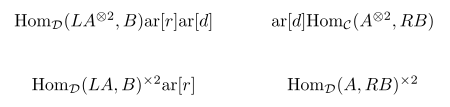 are isomorphisms and hence so is the induced map between the fibers at \(\{(f,f)\} \rightarrow\mathrm{Hom}_{\mathcal D}(LA, B)^{\times 2}\). ◻
[00EE]
Observation 7.2.10.
The space \(\mathbb T_2(f)\) of \(\mathbb T_2\)-structures on a given \(\mathbb E_0\)-morphism \(f \colon A \rightarrow B\) in \(\mathrm{Alg}_{\mathbb E_0}(\mathcal O)\) is compatible with composition and functorial: Given an operad map \(F \colon \mathcal O\rightarrow\mathcal P\), applying \(F\) induces a map of spaces \[\mathbb T_2(f) \xrightarrow{F(-)} \mathbb T_2(F(f)).\]
Similarly, any \(\mathbb E_0\)-morphism \(g \colon B \rightarrow C\) in \(\mathrm{Alg}_{\mathbb E_0}(\mathcal O)\) induces evident maps of spaces \[
\mathbb T_2(f) \xrightarrow{g \circ -} \mathbb T_2(g \circ f)
\hspace{1cm}
\mathbb T_2(g) \xrightarrow{- \circ (f,f)} \mathbb T_2(g \circ f) .\]
It will be useful to express this operation in terms of \(\infty\)-operads. Let \([2]\coloneqq \{0 <1<2\}\) denote the \(\infty\)-category (and the free \(\infty\)-operad on that \(\infty\)-category) corepresenting a pair of composable morphisms. Consider the following pushouts of \(\infty\)-operads  corepresenting a pair of \(\mathbb E_0\)-morphisms \(A \xrightarrow{f} B \xrightarrow{g} C\) with a \(\mathbb T_2\)-structure on \(f\), \(g\) or \(g\circ f\), respectively. By Yoneda, the maps of spaces constructed above induce operad maps \[\mathbb T_2\sqcup_{\{1< 2\}} [2] \leftarrow \mathbb T_2\sqcup_{\{0<2\}}[2] \rightarrow\mathbb T_2 \sqcup_{\{0<1\}}[2].\]