6.2 The monoidal \((2,2)\)-category of Soergel bimodules[00CF]
Having defined \(\mathrm{BSbim}\) together with its inclusion \(\mathrm{BSbim}\rightarrow\mathrm{Mor}^{\mathrm{poly}, \mathrm{gr-proj}}(\mathrm{mod}_k^{\mathbb{Z}})\), we will now define \(\mathrm{Sbim}\) as the homwise completion of \(\mathrm{BSbim}\) under \(\mathbb{Z}\)-shifts, direct sums and splitting of idempotents inside of \(\mathrm{Mor}^{\mathrm{poly}, \mathrm{gr-proj}}(\mathrm{mod}_k^{\mathbb{Z}})\).
To formally implement this, we need to construct a factorization system on the presentably symmetric monoidal \(\infty\)-category \(\mathrm{add}_{k}^{B\mathbb{Z}}\) of additive \(k\)-linear \(\infty\)-categories with a \(\mathbb{Z}\)-action, equipped with the Day convolution monoidal structure, constructed in subsection 4.3.
[00CG]
Definition 6.2.1.
We will use the following terminology:
A functor \(F\colon \mathcal C\rightarrow\mathcal D\) between idempotent-complete \(\infty\)-categories is called dominant if every object in \(\mathcal D\) is a retract of an object in the image of \(F\).
A morphism in \(\mathrm{add}_{k}^{B\mathbb{Z}}\) is dominant, resp. fully faithful, if its underlying functor is.
[00CH]
Proposition 6.2.2.
The (dominant, fully faithful)-functors define a factorization system on \(\mathrm{add}_{k}^{B\mathbb{Z}}\) which is of small generation and compatible with the symmetric monoidal structure.
[00CI]
Proof.
Consider the sequence of morphisms in \(\mathrm{CAlg}(\mathrm{Pr}^\mathrm{L})\) \[\mathrm{Cat}_{\infty}\rightarrow\mathrm{Cat}_{\infty}^{\sqcup} \rightarrow\mathrm{Cat}_{\infty}^{\sqcup, \mathrm{idem}}\rightarrow\mathrm{Mod}_{\mathrm{CProj}_k}(\mathrm{Cat}_{\infty}^{\sqcup, \mathrm{idem}}) \simeq \mathrm{add}_k\] left adjoint to the respective forgetful functors (see proposition 3.1.11 for the first two functors, and observation 4.2.4 for the latter one). We will successively lift the (surjective-on-objects, fully faithful)-factorization system on \(\mathrm{Cat}_{\infty}\) to \(\mathrm{add}_k\).
Step 1: We first show that the (surjective-on-objects, fully faithful)-functors define a factorization system on \(\mathrm{Cat}_{\infty}^{\sqcup}\) which is of small generation and compatible with the symmetric monoidal structure. Given a morphism \(F\colon \mathcal C\rightarrow\mathcal D\) in \(\mathrm{Cat}_{\infty}^{\sqcup}\), i.e. a functor between \(\infty\)-categories with finite coproducts that preserves finite coproducts, we consider its (surjective-on-objects, fully faithful) factorization in \(\mathrm{Cat}_{\infty}\) 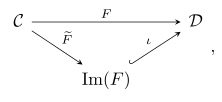 where \(\widetilde{F}\) is surjective on objects and \(\iota\) is fully faithful. Using observation B.2.1 and lemma B.2.2 we can deduce that the factorization system on \(\mathrm{Cat}_{\infty}\) restricts to one on \(\mathrm{Cat}_{\infty}^{\sqcup}\) which is of small generation and compatible with the symmetric monoidal structure, provided we can show that \(\mathrm{Im}(F)\) admits finite coproducts and that \(\widetilde{F}\) and \(\iota\) preserve them. In fact, since \(\iota\) is fully faithful, it is enough to prove that \(\mathrm{Im}(F)\) is closed under finite coproducts in \(\mathcal D\). To this end, let \(S\) be a finite set and \(I\colon S \rightarrow\mathrm{Im}(F)\) a diagram. Since \(\widetilde{F}\colon \mathcal C\rightarrow\mathrm{Im}(F)\) is surjective on objects, we can lift \(I\) to a functor \(\widetilde{I} \colon S \rightarrow\mathcal C\) which has a colimit \(\mathrm{colim}~\widetilde{I}\in \mathcal C\) by assumption. Since \(F\) preserves coproducts and using the factorization, the coproduct \(\mathrm{colim}~\iota \circ I\) agrees with \(F(\mathrm{colim}~\widetilde{I})\) and hence is in the image of \(F\), as required.
Step 2: To lift from \(\mathrm{Cat}_{\infty}^{\sqcup}\) to \(\mathrm{Cat}_{\infty}^{\sqcup, \mathrm{idem}}\), observe that the symmetric monoidal left adjoint \((-)^{\mathrm{idem}}:\mathrm{Cat}_{\infty}^{\sqcup} \rightarrow\mathrm{Cat}_{\infty}^{\sqcup, \mathrm{idem}}\) is a reflective localization, i.e. that the right adjoint is fully faithful. We observe the following:
A morphism in \(\mathrm{Cat}_{\infty}^{\sqcup, \mathrm{idem}}\) is of the form \((F)^{\mathrm{idem}}\) for a fully faithful morphism \(F\) in \(\mathrm{Cat}_{\infty}^{\sqcup}\) if and only if it is fully faithful.
A morphism in \(\mathrm{Cat}_{\infty}^{\sqcup, \mathrm{idem}}\) is of the form \((F)^{\mathrm{idem}}\) for a surjective-on-objects morphism \(F\) in \(\mathrm{Cat}_{\infty}^{\sqcup}\) if and only if it is dominant.
Since the class of dominant functors is stable under retracts in \(\mathrm{Cat}_{\infty}^{\sqcup, \mathrm{idem}}\), it therefore follows from lemma B.2.5 that the (surjective-on-objects, fully faithful)-factorization system on \(\mathrm{Cat}_{\infty}^{\sqcup}\) induces the (dominant, fully faithful)-factorization system on \(\mathrm{Cat}_{\infty}^{\sqcup, \mathrm{idem}}\), and that this factorization system is of small generation and compatible with the monoidal structure on \(\mathrm{Cat}_{\infty}^{\sqcup, \mathrm{idem}}\).
Step 3: Since  is a monadic adjunction, whose underlying monad \(\mathrm{CProj}_k \otimes - \colon \mathrm{Cat}_{\infty}^{\sqcup, \mathrm{idem}}\rightarrow\mathrm{Cat}_{\infty}^{\sqcup, \mathrm{idem}}\) preserves colimits (and in particular geometric realizations), and preserves dominant functors (since \(\otimes\) is compatible with the (dominant, fully faithful)-factorization system on \(\mathrm{Cat}_{\infty}^{\sqcup, \mathrm{idem}}\), as follows from Step 2), it follows fromlemma B.2.7 that the (dominant, fully faithful) functors form a factorization system on \(\mathrm{add}_k\) which is of small generation and compatible with its symmetric monoidal structure.
Step 4: Lastly, by lemma B.2.3, the (dominant, fully faithful)-factorization system induces one on \(\mathrm{Fun}(B\mathbb{Z}, \mathrm{add}_k)\) which is of small generation and compatible with the Day convolution symmetric monoidal structure. ◻
[00CJ]
Notation 6.2.3.
We will use the following terminology:
A morphism \(F\colon \mathcal C\rightarrow\mathcal D\) in \(\mathrm{Cat}[\mathrm{add}_{k}^{B\mathbb{Z}}]\) is called faithful if its underlying \((\infty,2)\)-functor is (see notation 5.3.3). It is called surjective-on-objects-and-dominant-on-1-morphisms if it is surjective on objects and if for each \(c, c'\in \mathcal C\), the induced additive functor \(\underline{\mathrm{Hom}}_{\mathcal C}(c,c') \rightarrow\underline{\mathrm{Hom}}_{\mathcal C}(Fc,Fc')\) is dominant.
A morphism in \(\mathrm{Alg}_{\mathbb E_1}(\mathrm{Cat}[\mathrm{add}_{k}^{B\mathbb{Z}}])\) is called faithful or surjective-on-objects-and-dominant-on-1-morphisms if the underlying morphism in \(\mathrm{Cat}[\mathrm{add}_{k}^{B\mathbb{Z}}]\) is.
Applying the factorization system from proposition 6.2.2 homwise leads to the following corollary.
[00CK]
Corollary 6.2.4.
The (surjective-on-objects-and-dominant-on-1-morphisms, faithful)-functors define factorization systems on \(\mathrm{Cat}[\mathrm{add}_{k}^{B\mathbb{Z}}]\) and \(\mathrm{Alg}_{\mathbb E_1}(\mathrm{Cat}[\mathrm{add}_{k}^{B\mathbb{Z}}])\), respectively, which are of small generation and compatible with the symmetric monoidal structure.
[00CL]
Proof.
This follows immediately from applying theorem B.4.1 and then theorem B.3.1 to the factorization system of proposition 6.2.2. ◻
The forgetful functor \(\mathrm{add}_k \rightarrow\mathrm{Cat}_{\infty}\) has a symmetric monoidal left adjoint ‘linearization functor’ \[\mathrm{Lin}_k\colon \mathrm{Cat}_{\infty}\rightarrow\mathrm{add}_k,\] which is the composite of symmetric monoidal left adjoints \[
\mathrm{Cat}_{\infty}\xrightarrow{(-)^{\sqcup, \mathrm{idem}}}\mathrm{Cat}_{\infty}^{\sqcup, \mathrm{idem}}\xrightarrow{\mathrm{CProj}_k \otimes -} \mathrm{Mod}_{\mathrm{CProj}_k}(\mathrm{Cat}_{\infty}^{\sqcup, \mathrm{idem}}) \simeq \mathrm{add}_k,\] where \((-)^{\sqcup, \mathrm{idem}}\) freely adjoints finite coproducts and splittings of idempotents (see proposition 3.1.11) and \(\mathrm{CProj}_k\otimes -\) constructs free \(\mathrm{CProj}_k\)-modules (see proposition 3.1.8). This induces a symmetric monoidal left adjoint of the forgetful functor \(\mathrm{add}_{k}^{B\mathbb{Z}}\rightarrow\mathrm{Cat}_{\infty}^{B\mathbb{Z}}\) \[\mathrm{Fun}(B\mathbb{Z}, \mathrm{Lin}_k(-))\colon \mathrm{Cat}_{\infty}^{B\mathbb{Z}}\rightarrow\mathrm{add}_{k}^{B\mathbb{Z}},\] which we will also denote by \(\mathrm{Lin}_k(-) \colon \mathrm{Cat}_{\infty}^{B\mathbb{Z}}\rightarrow\mathrm{add}_{k}^{B\mathbb{Z}}\). Unpacking observation 3.5.13, the forgetful functor \(\mathrm{Cat}_{\infty}^{B \mathbb{Z}} \rightarrow\mathrm{Cat}_{\infty}\) (i.e. the functor \(\mathrm{ev}_*\colon \mathrm{Fun}(B\mathbb{Z}, \mathrm{Cat}_{\infty}) \rightarrow\mathrm{Cat}_{\infty}\)) has a left adjoint \[- \times \mathbb{Z}: \mathrm{Cat}_{\infty}\rightarrow\mathrm{Cat}_{\infty}^{B\mathbb{Z}}\] which sends an \(\infty\)-category \(\mathcal C\) to the \(\infty\)-category \(\mathcal C\times \mathbb{Z}\) with free \(\mathbb{Z}\)-action, and which is symmetric monoidal with respect to the Day convolution structure on \(\mathrm{Cat}_{\infty}^{B\mathbb{Z}}\).
Combining these left adjoints, we obtain a symmetric monoidal left adjoint \[
\mathrm{Lin}_k(- \times \mathbb{Z}): \mathrm{Cat}_{\infty}\rightarrow\mathrm{add}_{k}^{B\mathbb{Z}}.\]
Applying \(\mathrm{Lin}_k(-\times \mathbb{Z})\) homwise, this induces by subsection A.10 and subsection A.8.11 symmetric monoidal left adjoints \[
\mathrm{Lin}_{k, \mathrm{loc}}^{\mathbb{Z}}\coloneqq \mathrm{Cat}[\mathrm{Lin}_k(-\times \mathbb{Z})]\colon \mathrm{Cat}_{(\infty, {2})} = \mathrm{Cat}[\mathrm{Cat}_{\infty}] \rightarrow\mathrm{Cat}[\mathrm{add}_{k}^{B\mathbb{Z}}]\] and (abusing notation) \[\mathrm{Lin}_{k, \mathrm{loc}}^{\mathbb{Z}} \coloneqq \mathrm{Alg}_{\mathbb E_1}(\mathrm{Cat}[\mathrm{Lin}_k(-\times \mathbb{Z})])\colon \mathrm{Alg}_{\mathbb E_1}(\mathrm{Cat}_{(\infty, {2})}) \rightarrow\mathrm{Alg}_{\mathbb E_1}(\mathrm{Cat}[\mathrm{add}_{k}^{B\mathbb{Z}}])\] of the respective forgetful functors.
[00CR]
Proposition 6.2.5.
The functor \(\mathrm{BSbim}\rightarrow\mathrm{Mor}^{\mathrm{poly}, \mathrm{gr-proj}}(\mathrm{mod}_k^{\mathbb{Z}})\) of monoidal \((\infty,2)\)-categories from corollary 6.1.3 factors through a monoidal \(\mathrm{add}_{k}^{B\mathbb{Z}}\)-enriched functor \[\mathrm{Lin}_{k, \mathrm{loc}}^{\mathbb{Z}} (\mathrm{BSbim}) \rightarrow\mathrm{Mor}^{\mathrm{poly}, \mathrm{gr-proj}}(\mathrm{mod}_k^{\mathbb{Z}}).\]
[00CS]
Proof.
Since \(\mathrm{Mor}^{\mathrm{poly}, \mathrm{gr-proj}}(\mathrm{mod}_k^{\mathbb{Z}})\) is an object in \(\mathrm{Alg}_{\mathbb E_1} (\mathrm{Cat}[\mathrm{add}_{k}^{B\mathbb{Z}}])\), the statement immediately follows from the adjunction ([00CQ]). ◻
Explicitly, \(\mathrm{Lin}_{k, \mathrm{loc}}^{\mathbb{Z}} (\mathrm{BSbim})\) has objects natural numbers and additive \(k\)-linear hom-categories with \(\mathbb{Z}\)-action given by the \(k\)-linearization \(\mathrm{Lin}_k(\mathrm{BSbim}_n \times \mathbb{Z})\) of the 1-category \(\mathrm{BSbim}_n \times \mathbb{Z}\) with free \(\mathbb{Z}\)-action.
[00CT]
Definition 6.2.6.
Define the monoidal \(k\)-linear (2,2)-category with local shifts \(\mathrm{Sbim}\in \mathrm{Alg}_{\mathbb E_1}(\mathrm{Cat}[\mathrm{add}_{k}^{B\mathbb{Z}}])\), the Soergel \((2,2)\)-category, as the unique factorization  of \(\mathrm{Lin}_{k, \mathrm{loc}}^{\mathbb{Z}} (\mathrm{BSbim}) \rightarrow\mathrm{Mor}^{\mathrm{poly}, \mathrm{gr-proj}}(\mathrm{mod}_k^{\mathbb{Z}})\) with respect to the (surjective-on-objects-and-dominant-on-morphisms, faithful)-factorization system on \(\mathrm{Alg}_{\mathbb E_1}(\mathrm{Cat}[\mathrm{add}_{k}^{B\mathbb{Z}}])\).
We denote the composite monoidal shift-preserving functor \(\mathrm{BSbim}\rightarrow\mathrm{Lin}_{k, \mathrm{loc}}^{\mathbb{Z}} (\mathrm{BSbim}) \rightarrow\mathrm{Sbim}\) by \[
\iota\colon \mathrm{BSbim}\rightarrow\mathrm{Sbim}.\]
Composing with the monoidal \((\infty,2)\)-functor \(\mathrm{BSbim}\rightarrow\mathrm{Lin}_{k, \mathrm{loc}}^{\mathbb{Z}} (\mathrm{BSbim})\) (i.e. the unit of the adjunction ([00CQ])), we can summarize the categories and functors defined so far thus:
[00CV]
Corollary 6.2.7.
The above defined functors assemble into a commuting diagram of monoidal \((2,2)\)-functors  where the top and right diagonal functors are faithful and the right diagonal functor is shift-preserving and \(k\)-linear.
