For any \(k \geq 0\) and any \(n \geq -2\), an \((n,k)\)-category is an \((\infty,k)\)-category \(\mathcal C\) such that the functor \(\mathcal C\rightarrow{\sf pt}\) is \(n\)-faithful. We write \(\mathrm{Cat}_{(n,k)} \subseteq \mathrm{Cat}_{(\infty, {k})}\) for the full subcategory on the \((n,k)\)-categories.
5.4 Homotopy \((n, k)\)-categories of \((\infty, k)\)-categories[00AP]
In this subsection, we define the homotopy \((n,k)\)-category of an \((\infty,k)\)-category.
Unwinding Definition 5.4.1 gives an alternative inductive description: For \(k > 0\) and \(n > -2\), an \((\infty,k)\)-category \(\mathcal C\) is an \((n,k)\)-category if and only if its hom-\((\infty,k-1)\)-categories are in fact \((n-1,k-1)\)-categories. In particular, an \((n,n)\)-category is indeed an \(\infty\)-category that is weakly enriched in \((n-1,n-1)\)-categories (as proposed in Subsection A.1), with a \((0,0)\)-category being a set (i.e. a \(0\)-truncated space).31
For \(n \geq k\), it is immediate from [GH15, Thm. 6.1.8] that \(\mathrm{Cat}_{({n}, {k})}\) coincides with [GH15, Def. 6.1.1]. In particular, \(\mathrm{Cat}_{({n}, {k})}\) is the \(\infty\)-category obtained from applying \(\mathrm{Cat}[-]\) \((n-k)\) times to the \(\infty\)-category of \((n-k)\)-truncated spaces \(\mathcal S_{\leq n-k}\), with its Cartesian presentably symmetric monoidal structure.
We list a few edge cases of Definitions 5.4.1.
For any \(k \geq 0\), there is only one \((-2,k)\)-category, namely \({\sf pt}\).
For any \(k \geq 0\), there are only two \((-1,k)\)-categories, namely \(\emptyset\) and \({\sf pt}\).
For any \(k > 0\), a \((0,k)\)-category is precisely a partially ordered set (i.e. an \(\infty\)-category enriched in \((-1)\)-truncated spaces). In particular, the inclusions \(\mathrm{Cat}_{(0,1)} \hookrightarrow\mathrm{Cat}_{(0,2)} \hookrightarrow\cdots\) are all equivalences.
More generally, for any \(k > n \geq 0\), an \((n,k)\)-category is precisely an \((n+1,n+1)\)-category whose spaces of \((n+1)\)-morphisms are all either empty or contractible. In particular, the inclusions \(\mathrm{Cat}_{(n,n+1)} \hookrightarrow\mathrm{Cat}_{(n,n+2)} \hookrightarrow\cdots\) are all equivalences.
Taking \(k = 1\), for any \(n \geq 1\), an \((n,1)\)-category is precisely an \((\infty,1)\)-category whose hom-spaces are \((n-1)\)-truncated.
By Observation B.1.20.([00K8]), the fully faithful inclusion \(\mathrm{Cat}_{(n,k)} \hookrightarrow \mathrm{Cat}_{(\infty, {k})}\) admits a left adjoint  given by the formula \(\tau_n(\mathcal C) \coloneqq \mathrm{Fact}_n(\mathcal C\rightarrow{\sf pt})\).32 This left adjoint \(\tau_n\) is symmetric monoidal as it preserves products.
Unpacked, the functor \(\tau_n\) can be described as follows, depending on \(n\geq -2\) and \(k \geq 0\).
For any \((\infty,k)\)-category \(\mathcal C\), we have \(\tau_{-2} \mathcal C= {\sf pt}\).
For any \((\infty,k)\)-category \(\mathcal C\), we have \(\tau_{-1} \mathcal C= \emptyset\) if \(\mathcal C\) is empty and \(\tau_{-1} \mathcal C= {\sf pt}\) otherwise.
For \(n \geq k \geq 0\) and any \((\infty,k)\)-category \(\mathcal C\), \(\tau_n \mathcal C\in \mathrm{Cat}_{({n}, {k})}\) is obtained by \((n-k)\)-truncating its \(k\)-morphism spaces (notation 5.1.8), and univalently completing the result. In particular, for an \((\infty,1)\)-category \(\mathcal C\), \(\tau_1\mathcal C\) is its ordinary homotopy category.
For \(k \geq 1\) and any \((\infty,k)\)-category \(\mathcal C\), \(\tau_0 \mathcal C\in \mathrm{Cat}_{({0}, {k})} \simeq \mathrm{Cat}_{({0}, {1})}\) is the posetification of \(\mathcal C\), obtained by applying \(\tau_{-1}\) to its hom-\((\infty,k-1)\)-categories.
For \(k>n \geq 0\) and any \((\infty,k)\)-category \(\mathcal C\), \(\tau_n \mathcal C\in \mathrm{Cat}_{({n}, {k})} \simeq \mathrm{Cat}_{({n}, {n+1})}\) is obtained by \(k\)-homwise applying \(\tau_{-1}\) (and univalently completing the result).
In general, the hom-categories in \(\tau_n \mathcal C\) can be computed by applying \(\tau_{n-1}\) to hom-categories of \(\mathcal C\):
For any \(n\geq -2, k\geq 0\) and any \((\infty,k)\)-category \(\mathcal C\) and objects \(c,c' \in\mathcal C\), the adjunction ([00AV]) induces an equivalence \[\tau_{n-1} \underline{\mathrm{Hom}}_{\mathcal C}(c,c') \xrightarrow{\simeq} \underline{\mathrm{Hom}}_{\tau_n \mathcal C}(c,c').\]
Proof.
Consider the factorization \(\mathcal C\rightarrow\tau_n \mathcal C\rightarrow{\sf pt}\) into an \(n\)-surjective followed by an \(n\)-faithful functor. Since \(n\)-faithfulness/surjectivity implies homwise \((n-1)\)-faithfulness/surjectivity, it follows that for any \(c,c' \in \mathcal C\), in the induced factorization on hom-\((\infty,k-1)\)-categories \[\underline{\mathrm{Hom}}_{\mathcal C}(c,c') \rightarrow\underline{\mathrm{Hom}}_{\tau_n \mathcal C}(c,c') \rightarrow{\sf pt}\] the first functor is \((n-1)\)-surjective and the second functor is \((n-1)\)-faithful, hence exhibiting \(\underline{\mathrm{Hom}}_{\tau_n \mathcal C}(c,c')\) as the unique factorization \(\tau_{n-1} \underline{\mathrm{Hom}}_{\mathcal C}(c,c')\). ◻
Using observation B.1.3, for any \(k\geq 0\) and \(n,m \geq -2\), one can deduce that the functor \(\tau_n\colon \mathrm{Cat}_{(\infty, {k})} \rightarrow\mathrm{Cat}_{({n}, {k})}\) preserves \(m\)-faithful functors since its right adjoint preserves \(m\)-surjective functors.
For any \(j> k \geq 0\) and \(n\geq -2\), since the inclusion \(i_j \colon \mathrm{Cat}_{(\infty, {k})} \hookrightarrow \mathrm{Cat}_{(\infty, {j})}\) preserves \(n\)-factorizations (see observation 5.3.10), the diagram 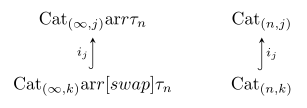 commutes. By adjunction, this induces for any \((\infty,j)\)-category \(\mathcal C\) a canonical functor of \((n,k)\)-categories \[
\tau_n \iota_k \mathcal C\rightarrow\iota_k \tau_n \mathcal C.\]
commutes. By adjunction, this induces for any \((\infty,j)\)-category \(\mathcal C\) a canonical functor of \((n,k)\)-categories \[
\tau_n \iota_k \mathcal C\rightarrow\iota_k \tau_n \mathcal C.\]
For any \(j > k \geq 0\) and any \(n \geq j\) or \(k>n \geq -2\), and an \((\infty,j)\)-category \(\mathcal C\), the canonical functor ([00B1]) is an equivalence.
Proof.
This follows immediately from applying corollary 5.3.13 to the factorization \(\mathcal C\rightarrow\tau_n \mathcal C\rightarrow{\sf pt}\). ◻
lemma 5.4.9 does not hold for \(j > n \geq k\): For instance, for \(j=1\) and \(n=k=0\) and an \((\infty,1)\)-category \(\mathcal C\), the space \(\tau_0 \iota_0 \mathcal C\) is the set of isomorphism classes of objects of \(\mathcal C\). On the other hand, \(\iota_0 \tau_0 \mathcal C\) is the set of connected components of \(\mathcal C\), i.e the quotient of the set of isomorphism classes of object by the equivalence relation that \(c\sim d\) if there exists a zigzag of morphisms between \(c\) and \(d\).
Now we are ready to define the \(n\)-homotopy category functor:
For \(n, k \geq 0\), define the homotopy \(n\)-category functor \[h_n\colon \mathrm{Cat}_{(\infty, {k})} \rightarrow\mathrm{Cat}_{({n}, {n})}\] to be \(\mathrm{Cat}_{(\infty, {k})} \xrightarrow{\tau_n} \mathrm{Cat}_{({n}, {k})} \hookrightarrow \mathrm{Cat}_{({n}, {n})}\) when \(n \geq k\) and to be \(\mathrm{Cat}_{(\infty, {k})} \xrightarrow{\iota_n} \mathrm{Cat}_{(\infty, {n})} \xrightarrow{\tau_n} \mathrm{Cat}_{({n}, {n})}\) when \(n < k\). Note that \(h_n\) is symmetric monoidal as \(\iota_n\) and \(\tau_n\) are symmetric monoidal. For \(\mathcal C\in \mathrm{Cat}_{(\infty, {k})}\), we call \(h_n \mathcal C\) the homotopy \(n\)-category of \(\mathcal C\).
Since \(\iota\) is a right adjoint and \(\tau\) is a left adjoint, there are no natural maps in either direction between \(\mathcal C\) and \(h_n\mathcal C\).
The homotopy \(n\)-category functor \(h_n\) takes a space \(X\) to its \(n\)-truncation \(\tau_{n} X\). Given a \((\infty, 1)\)-category \(\mathcal C\), \(h_0 \mathcal C= \tau_0 \iota_0 \mathcal C\) is the set of isomorphism classes of objects, and \(h_1 \mathcal C\) is its homotopy \(1\)-category [Lur09, Def. 1.1.3.2]. For \(n \geq 1\), \(h_n = \tau_n\) is equivalent to the ‘\(n\)-homotopy category’ of [SY20, Def. 2.9]. Of particular relevance to this paper will be the case of \((\infty,2)\)-categories \(\mathcal C\) where \(h_1\mathcal C= \tau_1 \iota_1 \mathcal C\).
Fix \(n, m \geq 0\), since both \(\iota_n\) and \(\tau_n\) preserves \(m\)-faithfulness by observation 5.3.10 and observation 5.4.8, \(h_n\) also preserves \(m\)-faithfulness.
Original source: arXiv:2401.02956v2
Original source · 2401.02956v2