For \(n, k \geq 0\), we let \(\mathrm{Ar}^{n}(\mathrm{Cat}_{(\infty, {k})}) \subseteq \mathrm{Ar}(\mathrm{Cat}_{(\infty, {k})})\) denote the full subcategory of the arrow category of \(\mathrm{Cat}_{(\infty, {k})}\) on the \(n\)-faithful functors. Moreover, for \(\mathcal D\in \mathrm{Cat}_{(\infty, {k})}\), we write \({(\mathrm{Cat}_{(\infty, {k})})}_{\small{/^{n}}{\mathcal D}} \subseteq {(\mathrm{Cat}_{(\infty, {k})})}_{\small{/^{\phantom{}}}{\mathcal D}}\) for the full subcategory of the over-category on the \(n\)-faithful functors \(\mathcal C\rightarrow\mathcal D\). In particular, \({(\mathrm{Cat}_{(\infty, {k})})}_{\small{/^{n}}{{\sf pt}}} = \mathrm{Cat}_{({n}, {k})}\).
5.5 Faithful functors and homotopy categories[00B9]
For an \((\infty,1)\)-category \(\mathcal C\), the \(\infty\)-category of full subcategories of \(\mathcal C\) is equivalent to the poset of subsets of the set \(h_0(\mathcal C)\) of isomorphism classes of objects in \(\mathcal C\), or equivalently to the \(\infty\)-category of ‘full subcategories’ of the set \(h_0(\mathcal C)\). In the next two subsections, we generalize this to arbitrary \(n, k\geq 0\) and characterizes \((n-1)\)-faithful functors of \((\infty,k)\)-categories into some \((\infty,k)\)-category \(\mathcal C\) in terms of \((n-1)\)-faithful functors of \((n,n)\)-categories into the homotopy \(n\)-category \(h_{n}\mathcal C\).
The goal of the next subsection §5.6 will be to prove the following theorem.
Fix \(n,k \geq 0\). The commuting square of \(\infty\)-categories 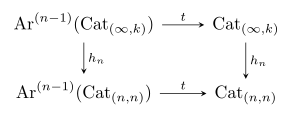 is a pullback square. Note the left map exists by observation 5.4.14.
Before proving theorem 5.5.2 in §5.6, we record a few corollaries. First, taking fibers at a \(\mathcal D\in \mathrm{Cat}_{(\infty, {k})}\) immediately leads to the following corollary:
Let \(n, k \geq 0\) and \(\mathcal D\) an \((\infty, k)\)-category. Then, the \(n\)-homotopy category functor \(h_n\) induces an equivalence of \(\infty\)-categories: \[h_n \colon {(\mathrm{Cat}_{(\infty, {k})})}_{\small{/^{(n-1)}}{\mathcal D}} \rightarrow {(\mathrm{Cat}_{({n}, {n})})}_{\small{/^{(n-1)}}{h_n\mathcal D}}.\]
Hence, corollary 5.5.3 is indeed a generalization of the statement at the beginning of this subsection: The \(\infty\)-category of \((n-1)\)-faithful functors into \(\mathcal D\) is equivalent to the \(\infty\)-category of \((n-1)\)-faithful functors into \(h_n\mathcal D\).
For later use, we need an analogous statement for \(\mathcal O\)-monoidal \(\infty\)-categories for a given \(\infty\)-operad \(\mathcal O\). For any small \(\infty\)-operad \(\mathcal O\) (see subsection A.8 and §7 for definitions and notation), we can extend this to a statement about categories of \(\mathcal O\)-algebras:
Let \(\mathcal O\) be an \(\infty\)-operad and \(k,n\geq -2\). An \(\mathcal O\)-monoidal functor \(F\colon \mathcal C\rightarrow\mathcal D\) of \(\mathcal O\)-monoidal \((\infty,k)\)-categories (i.e. a morphism of \(\mathcal O\)-algebras in the Cartesian symmetric monoidal category \(\mathrm{Cat}_{(\infty, {k})}\)) is called \(n\)-surjective/\(n\)-faithful if for every color \(X\in \underline{\mathcal O}\), the underlying functor \(F_X \colon \mathcal C_X \rightarrow\mathcal D_X\) is \(n\)-surjective/\(n\)-faithful.
Let \(n,k \geq 0\), \(\mathcal O\) an \(\infty\)-operad, and \(\mathcal D\) an \(\mathcal O\)-monoidal \((\infty, k)\)-category. Then the \(n\)-homotopy category functor \(h_n\) induces an equivalence of \(\infty\)-categories: \[{(\mathrm{Alg}_{\mathcal O}(\mathrm{Cat}_{(\infty, {k})}))}_{\small{/^{(n-1)}}{\mathcal D}} \xrightarrow{h_n} {(\mathrm{Alg}_{\mathcal O}(\mathrm{Cat}_{({n}, {n})}))}_{\small{/^{(n-1)}}{h_n\mathcal D}}.\]
Proof.
The full subcategory \(\mathrm{Ar}^{(n-1)}(\mathrm{Cat}_{(\infty, {k})}) \subseteq \mathrm{Ar}(\mathrm{Cat}_{(\infty, {k})})\) is closed under products and hence defines a Cartesian symmetric monoidal subcategory. Since all functors in ([00BC]) preserve products, the pullback square is a pullback square of Cartesian symmetric monoidal \(\infty\)-categories and hence induces a pullback square of \(\infty\)-categories: 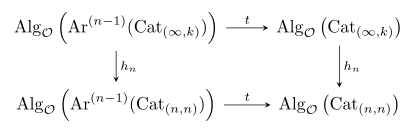 Under the equivalence of \(\infty\)-categories \(\mathrm{Ar}(\mathrm{Alg}_{\mathcal O}(\mathrm{Cat}_{(\infty, {k})})) \simeq \mathrm{Alg}_{\mathcal O}(\mathrm{Ar}(\mathrm{Cat}_{(\infty, {k})}))\), the full subcategory \(\mathrm{Ar}^{(n-1)}(\mathrm{Alg}_{\mathcal O}(\mathrm{Cat}_{(\infty, {k})}))\) on the \(\mathcal O\)-monoidal functors \(F\) whose underlying functors \(F_X\) are \((n-1)\)-faithful becomes identified with \(\mathrm{Alg}_{\mathcal O}\left(\mathrm{Ar}^{(n-1)}(\mathrm{Cat}_{(\infty, {k})})\right)\). Hence, the pullback square ([00BH]) is equivalent to the square
 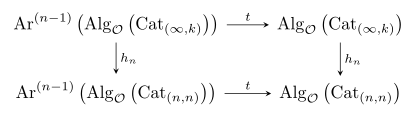 and taking fibers at the \(\mathcal O\)-algebra \(\mathcal D\in\mathrm{Alg}_{\mathcal O} \left(\mathrm{Cat}_{(\infty, {k})}\right)\) induces the desired equivalence. ◻
We record a further straight-forward consequence:
Let \(k, n \geq 0\) and let \(F \colon \mathcal C\rightarrow\mathcal D\) be an \((n-1)\)-faithful functor between \((\infty,k)\)-categories. Then, for every \(\mathcal X\in \mathrm{Cat}_{(\infty, {k})}\), the square 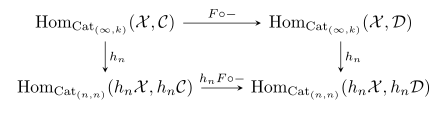 is a pullback square of spaces.
Equivalently, \(F\) is a Cartesian morphism for the functor \(h_n \colon \mathrm{Cat}_{(\infty, {k})} \rightarrow\mathrm{Cat}_{({n}, {n})}\).
Proof.
For any pair of objects in \(\mathrm{Ar}^{(n-1)}(\mathrm{Cat}_{(\infty, {k})})\), the pullback square ([00BC]) of \(\infty\)-categories induces a pullback square between the respective hom-spaces. In particular, for the pair \((\mathrm{id}_{\mathcal X} \colon \mathcal X\rightarrow\mathcal X)\) and (\(F \colon \mathcal C\rightarrow\mathcal D\)) of objects in \(\mathrm{Ar}^{(n-1)}(\mathrm{Cat}_{(\infty, {k})})\), we note that \[\mathrm{Hom}_{\mathrm{Ar}(\mathrm{Cat}_{(\infty, {k})})}(\mathrm{id}_{\mathcal X}, F) \simeq \mathrm{Hom}_{\mathrm{Cat}_{(\infty, {k})}}(\mathcal X, \mathcal C) \quad \mathrm{Hom}_{ \mathrm{Ar}(\mathrm{Cat}_{({n}, {n})})}(\mathrm{id}_{h_k \mathcal X}, h_k F) \simeq \mathrm{Hom}_{\mathrm{Cat}_{({n}, {n})}}(h_k\mathcal X, h_k\mathcal C),\] and hence that the resulting pullback square of hom-spaces precisely results in the square ([00BJ]). ◻
Taking fibers at some \(G\in \mathrm{Hom}_{\mathrm{Cat}_{(\infty, {k})}}(\mathcal X, \mathcal D)\), corollary 5.5.6 immediately implies the following corollary which will play a key role in the proof of our main theorem:
Let \(k, n \geq 0\), let \(F\colon \mathcal C\rightarrow\mathcal D\) and \(G\colon \mathcal X\rightarrow\mathcal D\) be functors between \((\infty,k)\)-categories and assume that \(F\) is \((n-1)\)-faithful. Then, the map of spaces \[\mathrm{Hom}_{(\mathrm{Cat}_{(\infty, {k})})_{/\mathcal D}}(\mathcal X, \mathcal C) \rightarrow\mathrm{Hom}_{(\mathrm{Cat}_{({n}, {n})})_{/h_n\mathcal D}}(h_n\mathcal X, h_n\mathcal C)\] is an equivalence.
Original source: arXiv:2401.02956v2
Original source · 2401.02956v2