Let \(\mathcal O\) be an \(\infty\)-operad, \(C\) an \(\mathbb A_2\)-algebra (with \(\mathbb A_2\)-structure denoted by \(\alpha \in \mathbb A_2^{\mathcal O}(C)\)) and let \(A \xrightarrow{f} B \xrightarrow{g}C\) be morphisms of \(\mathbb E_0\)-algebras. We define the space \(\mathbb T_2^{\mathcal O}(f)_{/C}\) of \(\mathbb T_2\)-structures on \(f\) relative to \(C\) as the pullback of the span \[\{ \alpha\} \rightarrow\mathbb A_2^{\mathcal O}(C) = \mathbb T^{\mathcal O}_2(\mathrm{id}_C) \xrightarrow{- \circ (g\circ f, g\circ g)} \mathbb T_2(g\circ f) \xleftarrow{g \circ -}\mathbb T_2(f).\]
7.3 Relative \(\mathbb T_2\)-structures[00EG]
Analogous to (and as we will see later — generalizing) definition 2.4.5, we introduce \(\mathbb T_2\)-structures relative to a given \(\mathbb A_2\)-structure.
As a consequence of observation 7.2.10, given an \(\mathbb E_0\)-morphism \(f \colon A \rightarrow B\) in an \(\infty\)-operad \(\mathcal O\), applying ([00EF]) in the case \(g=\mathrm{id}_B\), we obtain a map of spaces \[\mathbb A_2(B) = \mathbb T_2(\mathrm{id}_B) \xrightarrow{ -\circ (f,f)} \mathbb T_2(f).\] In particular, any \(\mathbb A_2\)-structure on \(B\) (e.g induced by a genuine \(\mathbb E_1\)- or even \(\mathbb E_{\infty}\)-structure) induces a \(\mathbb T_2\)-structure on \(f\).
This allows us to introduce the following notion, analogous to definition 2.4.5.
In words, a \(\mathbb T_2\)-structure on \(f\) relative to \(C\) is a \(\mathbb T_2\)-structure on \(f\) with an identification of the induced \(\mathbb T_2\)-structure on \(g\circ f\) with the \(\mathbb T_2\)-structure on \(g\circ f\) induced by the \(\mathbb A_2\)-structure \(\alpha\) on \(C\).
Recall from §A.8.6 that for an \(\mathbb E_{\infty}\)-algebra \(C\) in a symmetric monoidal \(\infty\)-category \(\mathcal V\), the over-\(\infty\)-category \(\mathcal V_{/C}\) inherits a symmetric monoidal structure so that for any \(\infty\)-operad \(\mathcal O\), there is an equivalence of \(\infty\)-categories \(\underline{\mathrm{Alg}}_{\mathcal O}(\mathcal V_{/C}) \simeq \underline{\mathrm{Alg}}_{\mathcal O}(\mathcal V)_{/C}\), where for the latter category we consider \(C\) as equipped with the \(\mathcal O\) algebra structure induced by restricting its \(\mathbb E_{\infty}\)-structure along the terminal operad map \(\mathcal O\rightarrow\mathbb E_{\infty}\).
Let \(C\) be an \(\mathbb E_{\infty}\)-algebra in a symmetric monoidal \(\infty\)-category \(\mathcal V\), and consider an \(\mathbb E_0\)-algebra morphism in \(\mathcal V_{/C}\), i.e. equivalently a commuting diagram of \(\mathbb E_0\)-algebra morphisms in \(\mathcal V\) as follows 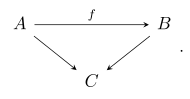 Then, we have an equivalence of spaces \[\mathbb T_2^{\mathcal V_{/C}} (f) \simeq \mathbb T^{\mathcal V}_2(f)_{/C},\] where for the latter space we consider \(C\) as equipped with the \(\mathbb A_2\)-structure induced by its \(\mathbb E_{\infty}\)-structure.
In words: ‘Absolute’ \(\mathbb T_2\)-structures on \(f\) in the sense of notation 7.2.8 seen as a morphism in the symmetric \(\infty\)-category \(\mathcal V_{/C}\) coincide with relative \(\mathbb T_2\)-structures on \(f\) in \(\mathcal V\) in the sense of definition 7.3.1.
Proof.
By definition, the space \(\mathbb T_2^{\mathcal V_{/C}}(f)\) is the fiber of the functor \(\underline{\mathrm{Alg}}_{\mathbb T_2}(\mathcal V_{/C}) \rightarrow\underline{\mathrm{Alg}}_{[1] \otimes \mathbb E_0}(\mathcal V_{/D})\) at \(f\). By the universal property of the symmetric monoidal structure on the over-category \(\mathcal V_{/C}\), this is equivalent to the functor \(\underline{\mathrm{Alg}}_{\mathbb T_2}(\mathcal V)_{/C} \rightarrow\underline{\mathrm{Alg}}_{[1] \otimes \mathbb E_0}(\mathcal V)_{/C}\). Unwinding the definition of morphisms in over-categories, this results in the desired equivalence. ◻
Original source: arXiv:2401.02956v2
Original source · 2401.02956v2