2.6 Centralizers and prebraidings[002C]
In the following, given a monoidal \(1\)-category \(\mathcal C\), we will identify \(1\boxtimes x\) and \(x\boxtimes 1\) with \(x\) for any object \(x\in\mathcal C\), see [Eti+15, Rk. 2.2.9], and will suppress writing associators, as they can be recovered from context.
[002D]
Definition 2.6.1.
Let \(\mathcal A\) and \(\mathcal B\) be monoidal \(1\)-categories and let \(F\colon\mathcal A\rightarrow\mathcal B\) be a monoidal functor. The centralizer \(Z(F)\) of \(F\) is the following category:
Its objects are pairs \((b,\gamma)\) of an object \(b\in\mathcal B\) and a natural isomorphism \[\gamma=\gamma_-\colon b\boxtimes F(-)\rightarrow F(-)\boxtimes
b\] of functors from \(\mathcal A\) to \(\mathcal B\), called half-braiding, which satisfies the following two compatibility conditions with respect to the monoidal structure of \(\mathcal A\). Firstly, for any \(a_1,a_2\in\mathcal A\), the isomorphism \(\gamma_{a_1 \boxtimes a_2} \colon b \boxtimes F(a_1 \boxtimes a_2) \rightarrow F(a_1 \boxtimes a_2) \boxtimes b\) equals the composite \[b\boxtimes F(a_1\boxtimes a_2)\xrightarrow{\simeq}
b\boxtimes F(a_1)\boxtimes F(a_2)\xrightarrow{(\mathrm{id}\boxtimes \gamma_{a_2})\circ
(\gamma_{a_1}\boxtimes\mathrm{id})} F(a_1)\boxtimes F(a_2)\boxtimes
b\xrightarrow{\simeq} F(a_1\boxtimes a_2) \boxtimes b,\] and secondly \[\gamma_{1_{\mathcal A}} = \left(b\boxtimes
F(1_{\mathcal A})\xrightarrow{\simeq} b\boxtimes 1_{\mathcal B}=1_{\mathcal B}\boxtimes b\xrightarrow{\simeq}F(1_{\mathcal A})\boxtimes b\right).\]
Its morphisms are morphisms in \(\mathcal B\) that are compatible with the half-braidings as follows: \[\mathrm{Hom}_{Z(F)}((b,\gamma),(b',\gamma'))=\{f\in\mathrm{Hom}_{\mathcal B}(b,b')\mid \gamma'_a\circ (f\boxtimes\mathrm{id})=(\mathrm{id}\boxtimes f)\circ\gamma_a
\colon b\boxtimes F(a)\rightarrow F(a)\boxtimes b\}.\]
The composition is inherited from \(\mathcal B\).
The category \(Z(F)\) is monoidal with \((b,\gamma)\boxtimes (b,\gamma')\coloneqq (b\boxtimes b',\gamma\boxtimes\mathrm{id}\circ\mathrm{id}\boxtimes\gamma')\) on objects, and with the tensor product from \(\mathcal B\) on morphisms. The unit object \(1_{Z(F)}\in Z(F)\) is \((1_{\mathcal B}\in\mathcal B, \gamma)\) with \(\gamma_a\colon 1\boxtimes F(a)=F(a)=F(a)\boxtimes 1\). We leave the coherence isomorphisms and their compatibility to the reader.
[002F]
Definition 2.6.3.
For a monoidal functor \(F\colon \mathcal A\rightarrow\mathcal B\), we define the monoidal evaluation functor \[\mathrm{ev}\colon Z(F) \times \mathcal A\rightarrow\mathcal B\] to send an object \(((b,\gamma),a)\) to \(b\boxtimes F(a)\), and a morphism \((f,g)\) to \(f\boxtimes F(g)\). The monoidal structure isomorphisms \[\mathrm{ev}\left(((b,\gamma),a)\boxtimes((b',\gamma'),a')\right)\simeq
\mathrm{ev}\left((b,\gamma),a\right)\boxtimes \mathrm{ev}\left((b',\gamma'),a')\right) \quad(\text{for } a,a'\in\mathcal A,(b,\gamma),(b',\gamma')\in Z(F))\] are given by \(b\boxtimes b'\boxtimes F(a\boxtimes a')\simeq b\boxtimes b'\boxtimes F(a)\boxtimes F(a')
\xrightarrow{\mathrm{id}\boxtimes\gamma'_a\boxtimes\mathrm{id}}
b\boxtimes F(a)\boxtimes b'\boxtimes F(a')\). The defining properties of \(\gamma'\) and the monoidality of \(F\) ensure that the necessary compatibilities hold, so that we indeed get a monoidal functor.
Together with the unit \(1_{Z(F)} \in Z(F)\) and \(F \colon \mathcal A\rightarrow\mathcal B\), the evaluation functor fits into the following commuting diagram of monoidal functors: 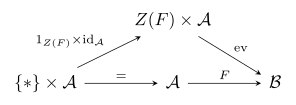
In example 7.4.4, we will discuss the universal property satisfied by \(Z(F)\) with its monoidal evaluation functor.
The functor \(\mathrm{ev}\) is completely determined by the monoidal functor \[\mathrm{ev}_{1_{\mathcal A}} \coloneqq \mathrm{ev}(-, 1_{\mathcal A}) \colon Z(F) \rightarrow\mathcal B,\] which sends an object \((b, \gamma)\in Z(F)\) to the underlying object \(b\) and a morphism in \(Z(F)\) to the underlying morphism in \(\mathcal B\). In these terms, \(\mathrm{ev}(-, ?) = \mathrm{ev}_{1_{\mathcal A}}(-) \boxtimes F(?)\).
We obtain a classification of prebraidings on a monoidal functor \(F\), Definitions 2.4.1 and 2.4.8, in terms of the centralizer \(Z(F)\) of \(F\):
[002G]
Theorem 2.6.4.
Let \(F\colon \mathcal A\rightarrow\mathcal B\) be a monoidal functor between monoidal \(1\)-categories. Then the following are equivalent:
the set \(\mathrm{PreBraid}(F)\) of prebraidings on \(F\);
the set of strict monoidal factorizations of \(F\) through \(\mathrm{ev}_{1_{\mathcal A}} \colon Z(F) \rightarrow\mathcal B\), i.e. the set of monoidal functors \(s\colon \mathcal A\rightarrow Z(F)\) such that \(\mathrm{ev}_{1_{\mathcal A}} \circ s=F\).
the 1-groupoid of weak monoidal factorizations of \(F\) through \(\mathrm{ev}_{1_{\mathcal A}} \colon Z(F) \rightarrow\mathcal B\), i.e. the groupoid whose objects are pairs \((s,\eta)\) of a monoidal functor \(s \colon \mathcal A\rightarrow Z(F)\) and a monoidal natural isomorphism \(\eta \colon \mathrm{ev}_{1_{\mathcal A}} \circ s \Rightarrow F\) and whose morphisms \((s, \eta) \rightarrow(s', \eta')\) are monoidal natural isomorphisms \(\mu \colon s\Rightarrow s'\) such that \[\left( \mathrm{ev}_{1_{\mathcal A}} \circ s \xRightarrow{\mathrm{ev}_{1_{\mathcal A}} \circ \mu} \mathrm{ev}_{1_{\mathcal A}} \circ s' \xRightarrow{\eta'} F \right)=\left( \mathrm{ev}_{1_{\mathcal A}} \circ s \xRightarrow{\eta}F\right).\]
[002K]
Proof.
For the equivalence between ([002H]) and ([002I]), note that a factorization \(s\) must send, on the level of objects, \(x\) to \((F(x),\gamma)\) for some \(\gamma\), and on the level of morphisms \(f\) to \(F(f)\). The isomorphisms used for a prebraiding \(\beta\) uniquely define the isomorphisms encoded in a possible \(\gamma\). The second hexagon axiom from prebraidings ([001L]) translates into the required properties of \(\gamma\), whereas the first hexagon translates into the monoidality of \(s\).
The equivalence between ([002I]) and ([002J]) follows from abstract-nonsense: Recall that a monoidal functor \(F:\mathcal X\rightarrow\mathcal Z\) between monoidal \(1\)-categories is called an isofibration if for all isomorphisms \(\gamma \colon z \rightarrow z'\) in \(\mathcal Z\) and \(x \in \mathcal X\) with \(F(x) = z\), there exists an isomorphism \(\mu \colon x\rightarrow x'\) with \(F(\mu) = \gamma\). It is then an exercise to show that if \(F \colon \mathcal X\rightarrow\mathcal Z\) is a monoidal functor which is a faithful isofibration and \(G\colon \mathcal Y\rightarrow\mathcal Z\) is another monoidal functor, the groupoid of weak monoidal factorizations, i.e. of pairs \((s, \eta)\) of a monoidal functor \(s \colon \mathcal Y\rightarrow\mathcal X\) and a monoidal natural isomorphism \(F \circ s \simeq G\) is equivalent to a discrete groupoid isomorphic to the set of strict monoidal factorizations, i.e. the set of monoidal functors \(s\) such that \(F \circ s = G\). The equivalence between ([002I]) and ([002J]) then follows since \(\mathrm{ev}_{1_{\mathcal A}} \colon Z(f) \rightarrow\mathcal B\) is indeed a faithful isofibration. ◻
[002L]
Corollary 2.6.5.
The special case \(F=\mathrm{id}_\mathcal A\) for a monoidal category \(\mathcal A\) gives a bijection \[\begin{aligned}
\mathrm{Braid}(\mathcal A)
&\simeq&
\{\text{Monoidal sections }\mathcal A\rightarrow Z(\mathcal A) \text{ of }\mathrm{ev}_{1_{\mathcal A}}\colon Z(\mathcal A)\rightarrow\mathcal A\}.
\end{aligned}\]