Given a (solid) commuting square in \(\mathrm{Op}\)  where \(F\) is \(n\)-surjective and \(G\) is \(m\)-faithful for \(m \geq n \geq -2\), the space of (dashed) lifts is \((m-n-2)\)-truncated.
Proof.
When \(m = n\), the statement follows from proposition 7.5.3. For \(m>n\), consider the commuting square of spaces: 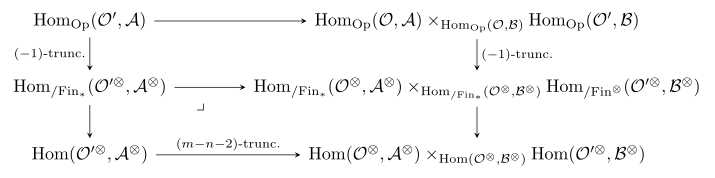 The space of lifts of our original square is by definition a fiber of the top horizontal map; it hence suffices to prove that this top horizontal map is \((m-n-2)\)-truncated.
By lemma 7.5.2, the \((\infty,1)\)-functor \(F^{\otimes} \colon \mathcal O^{\otimes} \rightarrow\mathcal O'^{\otimes}\) is \(n\)-surjective and \(G^{\otimes} \colon \mathcal A^{\otimes} \rightarrow\mathcal B^{\otimes}\) is \(m\)-faithful. Hence, it follows from proposition 5.3.15 that the bottom horizontal map is \((m-n-2)\)-truncated. By definition of the over-category, the bottom square is a pullback square; hence, the middle horizontal map is \((m-n-2)\)-truncated. Since \(\mathrm{Op}\) is a subcategory of \({\mathrm{Cat}_{\infty}}_{/\mathrm{Fin}_*}\), the top vertical maps are \((-1)\)-truncated. . Since \(m-n-2\geq -1\), the composite of the left vertical and the middle horizontal map is \((m-n-2)\)-truncated. It follows from Lemma 5.2.4.([009U]) that the top horizontal map is \((m-n-2)\)-truncated. ◻
Original source: arXiv:2401.02956v2
Original source · 2401.02956v2