3 Stable linear algebra[002M]
This section introduces the \(\infty\)-categorical foundations of our work. Throughout, we adopt standard conventions and notations in higher category theory, which we recall in detail in section A. We follow [Lur09] and use Grothendieck universes — here called small, large, and huge — to deal with set-theoretic issues (see subsection A.6 for more details). In particular, we write \(\mathrm{Cat}_{\infty}\) for the large \(\infty\)-category of small \(\infty\)-categories and \(\mathcal S\) for the (large) \(\infty\)-category of small spaces, both of which are objects of the huge \(\infty\)-category \(\widehat{\mathrm{Cat}}_{\infty}\) of large \(\infty\)-categories.
3.1 Completions of \(\infty\)-categories[002N]
3.1.1 The Yoneda embedding[002P]
Any small \(\infty\)-category \(\mathcal C\) has a Yoneda embedding into its \(\infty\)-category of (\(\mathcal S\)-valued) presheaves \(\mathcal P(\mathcal C)=\mathrm{Fun}(\mathcal C^\mathrm{op}, \mathcal S)\), [Lur09, Prop. 5.1.3.1], see also [Cis19]. It is characterized by the universal property that \(\mathcal P(\mathcal C)\) has all small colimits (i.e. is cocomplete) [Lur09, Cor. 5.1.2.4], and that for any cocomplete \(\infty\)-category \(\mathcal D\) the restriction along the Yoneda embedding induces an equivalence \[
\mathrm{Fun^L}(\mathcal P(\mathcal C),\mathcal D) \rightarrow\mathrm{Fun}(\mathcal C,\mathcal D)\] where \(\mathrm{Fun^L}\) denotes the full subcategory of the \(\infty\)-category of functors on those functors which preserve all small colimits (i.e. the cocontinuous functors) [Lur09, Thm. 5.1.5.6], see also [Cis19, Thm. 6.3.13]. An \(\infty\)-category \(\mathcal C\) is called idempotent complete if its image under the Yoneda embedding \(\mathcal C\rightarrow\mathcal P(\mathcal C)\) is closed under retracts (see [Lur09, Proof of Prop. 5.1.4.2]). We refer to [Lur09, § 4.4.5] for a discussion of retracts and idempotents in \(\infty\)-categories.
[002R]
Notation 3.1.1.
We write
\(\mathrm{Cat}_{\infty}^\mathrm{idem}\) for the full subcategory of \(\mathrm{Cat}_{\infty}\) on the idempotent complete small \(\infty\)-categories,
\(\mathrm{Cat}_{\infty}^{\sqcup, \mathrm{idem}}\) for the subcategory of \(\mathrm{Cat}_{\infty}^\mathrm{idem}\) on the idempotent complete small \(\infty\)-categories that admit finite coproducts and functors which preserve finite coproducts, and
\(\mathrm{Cat}_{\infty}^{\mathrm{rex}, \mathrm{idem}}\) for the subcategory of \(\mathrm{Cat}_{\infty}^{\sqcup, \mathrm{idem}}\) on the idempotent complete small \(\infty\)-categories that admit finite colimits and functors which preserve finite colimits.
3.1.2 Presentable \(\infty\)-categories[002S]
In general, the presheaf category \(\mathcal P(\mathcal C)\) of a small \(\infty\)-category \(\mathcal C\) is a large category. The sense in which \(\mathcal P(\mathcal C)\) is nevertheless still controlled by a small amount of data is formalized by the notion of a presentable \(\infty\)-category. We recall the definition and some basic facts from [Lur09, Sec. 5.4 and 5.5].
[002T]
Definition 3.1.2.
Let \(\mathcal D\) be a (possibly large) \(\infty\)-category.
Let \(\mathcal K\) be a collection of \(\infty\)-categories and \(S\) a small set of objects of \(\mathcal D\). Then \(\mathcal D\) is generated by \(S\) under \(\mathcal K\)-indexed colimits if \(\mathcal D\) has all colimits indexed by categories in \(\mathcal K\) and is the smallest full subcategory of \(\mathcal D\) which contains the objects in \(S\) and is closed under \(\mathcal K\)-indexed colimits.
Let \(\kappa\) be an infinite regular cardinal and assume \(\mathcal D\) admits \(\kappa\)-filtered colimits. Then an object \(d\in \mathcal D\) is called \(\kappa\)-compact if the functor \(\mathrm{Hom}_{\mathcal D}(d,-)\colon \mathcal D\rightarrow\mathcal S\) preserves \(\kappa\)-filtered colimits.
The \(\infty\)-category \(\mathcal D\) is called accessible if it is locally small and there exists a regular cardinal \(\kappa\) and a small set \(S\) of \(\kappa\)-compact objects in \(\mathcal C\) that generates \(\mathcal C\) under \(\kappa\)-filtered colimits.
The \(\infty\)-category \(\mathcal D\) is called presentable if it has all small colimits and is accessible.
[002U]
Example 3.1.3.
By Simpson’s characterisation of presentable \(\infty\)-categories as localizations of presheaf categories, [Lur09, Thm. 5.5.1.1], we obtain presentability of \(\mathcal P(\mathcal C)\) for any small \(\infty\)-category \(\mathcal C\) [Lur09, Ex. 5.4.2.7, Ex. 5.5.1.8.], and more generally the presentability of \(\mathrm{Fun}(\mathcal C, \mathcal D)\) for a small \(\infty\)-category \(\mathcal C\) and a presentable \(\infty\)-category \(\mathcal D\).
A main application of the notion of presentable \(\infty\)-category is the adjoint functor theorem:
[002V]
Proposition 3.1.4. ([Lur09, Cor. 5.5.2.9 and Rem. 5.5.2.10]).
A functor from a presentable \(\infty\)-category to a locally small \(\infty\)-category preserves small colimits if and only if it is a left adjoint.
[002W]
Notation 3.1.5.
We denote by
\(\mathrm{Pr}^\mathrm{L}\) the \(\infty\)-category of presentable \(\infty\)-categories and small colimit preserving functors, i.e left adjoint functors by the adjoint functor theorem.
\(\mathrm{Fun^L}(\mathcal C,\mathcal D)\), for \(\mathcal C, \mathcal D\in \mathrm{Pr}^\mathrm{L}\), the full subcategory of \(\mathrm{Fun}(\mathcal C, \mathcal D)\) of left adjoint (equivalently cocontinuous) functors. Dually, full subcategories of right adjoint functors will be denoted \(\mathrm{Fun^R}(-,-)\).
When denoting an adjunction
between \(\infty\)-categories, we use the convention that the top arrow is the left adjoint and the bottom arrow the right adjoint.
For more details, we refer to [Lur09, § 5.5.3] and [Cis19, § 7].
3.1.3 The monoidal structure on \(\mathrm{Pr}^\mathrm{L}\) and presentably symmetric monoidal categories[002X]
[002Y]
Proposition 3.1.6. ([Lur17, Prop. 4.8.1.15, Prop. 4.8.1.10]).
The \(\infty\)-category \(\mathrm{Pr}^\mathrm{L}\) can be equipped with a symmetric monoidal structure for which the Yoneda embedding defines a symmetric monoidal functor \[\mathcal P\colon \mathrm{Cat}_{\infty}\rightarrow\mathrm{Pr}^\mathrm{L}\] where \(\mathrm{Cat}_{\infty}\) is equipped with its Cartesian symmetric monoidal structure.
The tensor unit of this symmetric monoidal structure is given by the presentable \(\infty\)-category \(\mathcal S\) of spaces. The tensor product \(\mathcal C_1\otimes \mathcal C_2\) of two presentable \(\infty\)-categories \(\mathcal C_1, \mathcal C_2\) comes equipped with a functor \(\mathcal C_1 \times \mathcal C_2 \rightarrow\mathcal C_1\otimes \mathcal C_2\) which preserves small colimits separately in both variables and is characterized by the universal property that for any presentable \(\infty\)-category \(\mathcal D\), the induced functor \[\mathrm{Fun^L}(\mathcal C_1\otimes \mathcal C_2, \mathcal D) \rightarrow\mathrm{Fun^{L \times L}}(\mathcal C_1 \times \mathcal C_2, \mathcal D)\] is an equivalence. Here, \(\mathrm{\mathrm{Fun}^{L \times L}}(\mathcal C_1 \times \mathcal C_2,\mathcal D)\) denotes the full subcategory of \(\mathrm{Fun}(\mathcal C_1\times \mathcal C_2, \mathcal D)\) on those functors which preserve small colimits separately in both variables. Abusing notation, given objects \(c_1\in \mathcal C_1\) and \(c_2\in \mathcal C_2\) we denote the image of \((c_1, c_2) \in \mathcal C_1 \times \mathcal C_2\) under the functor \(\mathcal C_1\times \mathcal C_2 \rightarrow\mathcal C_1\otimes \mathcal C_2\) by \(c_1\boxtimes c_2\in \mathcal C_1 \otimes \mathcal C_2\) and call it their external tensor product.
It follows from [Lur17, Prop. 4.8.1.17, Prop. 4.8.1.16] after taking adjoints, that the tensor product of presentable \(\infty\)-categories can be expressed as the following functor category (which is in particular presentable): \[
\mathcal C\otimes \mathcal D\simeq \mathrm{Fun^L}(\mathcal D, \mathcal C^\mathrm{op})^\mathrm{op}= \mathrm{Fun^R}(\mathcal C^\mathrm{op}, \mathcal D)\]
The symmetric monoidal structure on \(\mathrm{Pr}^\mathrm{L}\) allow us to study (commutative) algebras therein, see subsection A.8.4.
[0030]
Definition 3.1.7.
A presentably symmetric monoidal \(\infty\)-category is a commutative algebra object in \(\mathrm{Pr}^\mathrm{L}\).
More explicitly, a presentably symmetric monoidal \(\infty\)-category is a symmetric monoidal \(\infty\)-category whose underlying \(\infty\)-category \(\mathcal C\) is presentable and so that the tensor product functor \(-\otimes-\colon \mathcal C\times \mathcal C\rightarrow\mathcal C\) preserves small colimits separately in both variables.
If \(A\) is a commutative algebra object in a symmetric monoidal \(\infty\)-category \(\mathcal C\), consider the \(\infty\)-category \(\mathrm{Mod}_A(\mathcal C)\) of left \(A\)-modules in \(\mathcal C\) (see subsection A.9).
[0031]
Proposition 3.1.8.
Given \(\mathcal C, \mathcal D\in \mathrm{CAlg}(\mathrm{Pr}^\mathrm{L})\), together with \(A, B \in \mathrm{CAlg}(\mathcal C)\).
The relative tensor product \(-\otimes_A - \colon \mathrm{Mod}_A(\mathcal C) \times \mathrm{Mod}_A(\mathcal C) \rightarrow\mathrm{Mod}_A(\mathcal C)\) defines a presentably symmetric monoidal structure on \(\mathrm{Mod}_A(\mathcal C)\). Moreover, there is an equivalence \(\mathrm{CAlg}(\mathrm{Mod}_A(\mathcal C)) \simeq \mathrm{CAlg}(\mathcal C)_{A/}\).
Any algebra homomorphism \(f\colon A\rightarrow B\) in \(\mathrm{CAlg}(\mathcal C)\) induces a symmetric monoidal induction functor \(-\otimes_A B\colon \mathrm{Mod}_A(\mathcal C) \rightarrow\mathrm{Mod}_B(\mathcal C)\) that is left adjoint to the restriction functor along \(f\), and hence a morphism in \(\mathrm{CAlg}(\mathrm{Pr}^\mathrm{L})\).
For any algebra homomorphism \(A\rightarrow B\), it follows from (2) that we can view \(B\) as an object in \(\mathrm{CAlg}(\mathrm{Mod}_A(\mathcal C))\). Forgetting the \(A\)-action induces a symmetric monoidal equivalence: \[\mathrm{Mod}_B(\mathrm{Mod}_A(\mathcal C)) \xrightarrow{\simeq} \mathrm{Mod}_B(\mathcal C)\]
Any functor \(F \colon \mathcal C\rightarrow\mathcal D\) in \(\mathrm{CAlg}(\mathrm{Pr}^\mathrm{L})\) induces a functor \(\mathrm{CAlg}(\mathcal C) \rightarrow\mathrm{CAlg}(\mathcal D)\) on commutative algebra objects, which we will also simply denote by \(F\). Moreover, it induces a functor \[\mathrm{Mod}_A(F) \colon \mathrm{Mod}_A(\mathcal C) \rightarrow\mathrm{Mod}_{F(A)}(\mathcal D)\] in \(\mathrm{CAlg}(\mathrm{Pr}^\mathrm{L})\).
Any functor \(F \colon \mathcal C\rightarrow\mathcal D\) in \(\mathrm{CAlg}(\mathrm{Pr}^\mathrm{L})\) induces an equivalence in \(\mathrm{CAlg}(\mathrm{Pr}^\mathrm{L})\) \[\mathcal D\otimes_{\mathcal C}(\mathrm{Mod}_A(\mathcal C)) \simeq \mathrm{Mod}_{F(A)}(\mathcal D),\] where \(-\otimes_{\mathcal C}-\) denotes the pushout in \(\mathrm{CAlg}(\mathrm{Pr}^\mathrm{L})\), whose underlying presentable \(\infty\)-category is given by the relative tensor product in \(\mathrm{Pr}^\mathrm{L}\) [Lur17, Prop. 3.2.4.10], hence the notation.
[0037]
Proof.
The first two statements follow from [Lur17, Prop. 3.4.1.3, Cor. 4.2.3.7, Thm. 4.5.3.1], the third statement follows from [Lur17, Cor. 3.4.1.9]. The existence of the symmetric monoidal functor \(\mathrm{Mod}_A(F)\) in part ([0035]) follows from the functoriality of the \(\mathrm{Mod}\) construction in [Lur17, § 3.3.3]. Furthermore, \(\mathrm{Mod}_A(F)\) preserves colimits by [Lur17, Cor. 4.2.3.5]. Functoriality of the construction of modules induces a commuting square in \(\mathrm{CAlg}(\mathrm{Pr}^\mathrm{L})\) 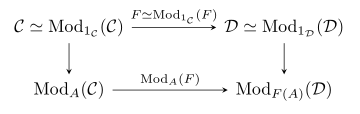 and hence a morphism in \(\mathrm{CAlg}(\mathrm{Pr}^\mathrm{L})\) from the pushout \(\mathcal D\otimes_{\mathcal C} \mathrm{Mod}_{A}(\mathcal C) \rightarrow\mathrm{Mod}_{F(A)}(\mathcal D)\). This is an equivalence in \(\mathrm{CAlg}(\mathrm{Pr}^\mathrm{L})\) because its underlying functor is one by [Lur17, Thm. 4.8.4.6]. ◻
Since \(\mathcal S\) is the tensor unit of the symmetric monoidal structure on \(\mathrm{Pr}^\mathrm{L}\), it is initial in \(\mathrm{CAlg}(\mathrm{Pr}^\mathrm{L})\) and any \(\mathcal C\in \mathrm{CAlg}(\mathrm{Pr}^\mathrm{L})\) comes equipped with a unique symmetric monoidal left adjoint functor \(\iota_{\mathcal C} \colon \mathcal S\rightarrow\mathcal C\).
[0038]
Corollary 3.1.9.
For \(\mathcal Z\in \mathrm{CAlg}(\mathcal S)\), proposition 3.1.8.([0036]) implies that there is an equivalence in \(\mathrm{CAlg}(\mathrm{Pr}^\mathrm{L})\): \[\mathcal C\otimes \mathrm{Mod}_\mathcal Z(\mathcal S)
\simeq
\mathcal C\otimes_{\mathcal S}\mathrm{Mod}_{\mathcal Z}(\mathcal S)
\simeq
\mathrm{Mod}_{\iota_{\mathcal C}(\mathcal Z)}(\mathcal C\otimes_\mathcal S\mathcal S)
\simeq
\mathrm{Mod}_{\iota_{\mathcal C}(\mathcal Z)}(\mathcal C).\]
3.1.4 Adjoining colimits[0039]
[003A]
Notation 3.1.10.
For a small set \(\mathcal K\) of simplicial sets, let \(\mathrm{Cat}_{\infty}^{\mathcal K}\) denote the subcategory of \(\mathrm{Cat}_{\infty}\) on those small \(\infty\)-categories which admit colimits of diagrams indexed by elements of \(\mathcal K\), and those functors which preserve such colimits.
The \(\infty\)-categories \(\mathrm{Cat}_{\infty}^\mathrm{idem}, \mathrm{Cat}_{\infty}^{\sqcup, \mathrm{idem}}\) and \(\mathrm{Cat}_{\infty}^{\mathrm{rex}, \mathrm{idem}}\) from notation 3.1.1 are instances of \(\mathrm{Cat}_{\infty}^\mathcal K\) for \(\mathcal K\) consisting of the ‘walking idempotent’ of [Lur09, § 4.4.5], or the walking idempotent together with the set of finite (discrete) sets or the set of finite simplicial sets, respectively.
Just like the presheaf \(\infty\)-category \(\mathcal P(\mathcal C)\) is the free completion of a small \(\infty\)-category \(\mathcal C\) under small colimits, we may complete under other classes of colimits. The following combines [Lur17, Lem. 4.8.4.2, Rem. 4.8.1.8] and [Lur09, Cor. 5.3.6.10]:
[003B]
Proposition 3.1.11.
Let \(\mathcal K\) be a small set of simplicial sets.
The \(\infty\)-category \(\mathrm{Cat}_{\infty}^{\mathcal K}\) is presentable and admits a presentably symmetric monoidal structure, which can be characterized as follows: If \(\mathcal C, \mathcal D\in \mathrm{Cat}_{\infty}^{\mathcal K}\), the tensor product \(\mathcal C\otimes \mathcal D\) is equipped with a functor \(\mathcal C\times \mathcal D\rightarrow\mathcal C\otimes \mathcal D\) which preserves \(\mathcal K\)-colimits separately in both variables and which induces for all \(\mathcal E\in \mathrm{Cat}_{\infty}^{\mathcal K}\) an equivalence \[\mathrm{Fun}^{\mathcal K}(\mathcal C\otimes \mathcal D, \mathcal E) \rightarrow\mathrm{\mathrm{Fun}^{\mathcal K\times \mathcal K}}(\mathcal C\times \mathcal D, \mathcal E),\] where \(\mathrm{Fun}^{\mathcal K}(\mathcal C\otimes \mathcal D, \mathcal E)\) denotes the full subcategory of \(\mathrm{Fun}(\mathcal C\otimes \mathcal D,\mathcal E)\) on those functors which preserve \(\mathcal K\)-colimits and where \(\mathrm{Fun}^{\mathcal K\times \mathcal K}(\mathcal C\times \mathcal D, \mathcal E)\) denotes the full subcategory of \(\mathrm{Fun}(\mathcal C\times \mathcal D, \mathcal E)\) on those functors which preserve \(\mathcal K\)-colimits separately in both variables.
Let \(\mathcal K'\) be a small set of simplicial sets with containing \(\mathcal K\). Then the subcategory inclusion \(\mathrm{Cat}_{\infty}^{\mathcal K'} \rightarrow\mathrm{Cat}_{\infty}^{\mathcal K}\) admits a symmetric monoidal left adjoint \[\mathcal P_{\mathcal K}^{\mathcal K'}\colon \mathrm{Cat}_{\infty}^{\mathcal K} \rightarrow\mathrm{Cat}_{\infty}^{\mathcal K'}\] whose unit \(\mathcal C\rightarrow\mathcal P_{\mathcal K}^{\mathcal K'}(\mathcal C)\) for \(\mathcal C\in \mathrm{Cat}_{\infty}^{\mathcal K'}\) is a fully faithful functor.
The second statement of proposition 3.1.11 implies that \(\mathcal C\hookrightarrow \mathcal P_{\mathcal K}^{\mathcal K'}(\mathcal C)\) may be thought of as a generalized Yoneda embedding: It is the free cocompletion of \(\mathcal C\) under \(\mathcal K'\)-shaped colimits subject to the relation that \(\mathcal K\)-shaped colimits in \(\mathcal C\) are preserved.
3.2 Compact generation and ind-completion[003E]
3.2.1 Compact and projectively generated \(\infty\)-categories[003F]
Many presentable \(\infty\)-categories are generated by \(\omega\)-compact objects, where \(\omega\) is the cardinality of the natural numbers. We will henceforth refer to \(\omega\)-filtered diagrams simply as filtered diagrams and to \(\omega\)-compact objects as compact objects. Hence, an object \(c\) of an \(\infty\)-category \(\mathcal C\) with filtered colimits is compact if \(\mathrm{Hom}_{\mathcal C}(c,-)\colon \mathcal C\rightarrow\mathcal S\) preserves filtered colimits.
Similarly, we recall the following definitions:
[003G]
Definition 3.2.1.
An object \(c\) of an \(\infty\)-category \(\mathcal C\) with geometric realizations (i.e. colimits indexed by \(\Delta^{\mathrm{op}}\)) is called projective [Lur09, Def. 5.5.8.18] if \(\mathrm{Hom}_{\mathcal C}(c,-) \colon \mathcal C\rightarrow\mathcal S\) preserves geometric realizations.
An object \(c\) of an \(\infty\)-category \(\mathcal C\) with sifted colimits [Lur09, Def. 5.5.8.1] is called compact-projective if \(\mathrm{Hom}_{\mathcal C}(c,-) \colon \mathcal C\rightarrow\mathcal S\) preserves sifted colimits [Lur09, Rem. 5.5.8.20].
[003H]
Observation 3.2.2.
Since sifted colimits are generated by filtered colimits and geometric realizations [Lur09, Cor. 5.5.8.17], an object is compact-projective if and only if it is compact and projective.
We refer to definition 3.6.1 and example 3.6.3 for a comparison with classical notions of compactness and projectivity in ordinary (abelian) categories.
[003I]
Definition 3.2.3.
We will use the following terminology.
A compactly generated \(\infty\)-category is an \(\infty\)-category with small colimits, for which there exists a small set of compact objects which generates \(\mathcal C\) under small colimits.
A projectively generated \(\infty\)-category is an \(\infty\)-category with small colimits, for which there exists a small set of compact-projective objects which generates \(\mathcal C\) under small colimits.
[003J]
Notation 3.2.4.
Let \(\mathrm{Pr}^{\mathrm{L},\mathrm{c}}\) (resp. \(\mathrm{Pr}^{\mathrm{L},\mathrm{cp}}\)) denote the subcategory of \(\mathrm{Pr}^\mathrm{L}\) on the compactly (resp. projectively) generated presentable \(\infty\)-categories and the cocontinuous functors which preserve compact (resp. compact-projective) objects.
[003K]
Lemma 3.2.5.
Consider an adjunction between \(\infty\)-categories 
If \(\mathcal C\) is compactly generated and \(\mathcal D\) has filtered colimits, then the left adjoint \(L\) preserves compact objects if and only if the right adjoint \(R\) preserves filtered colimits.
If \(\mathcal C\) is projectively generated and \(\mathcal D\) has sifted colimits, then the left adjoint \(L\) preserves compact-projective objects if and only if the right adjoint \(R\) preserves sifted colimits.
[003N]
Proof.
We prove the first statement; the proof of the second statement is analogous. Suppose \(R\) preserves filtered colimits and \(c\in \mathcal C\) is compact. Then, for every filtered diagram \(d\colon I \rightarrow\mathcal D\) we have \[\begin{gathered}
\mathrm{Hom}_{\mathcal C}(Lc, \mathrm{colim}_i d_i) \simeq \mathrm{Hom}_{\mathcal D}(c, R\mathrm{colim}_i d_i) \simeq \mathrm{Hom}_{\mathcal D}(c,\mathrm{colim}_i Rd_i)
\\ \hspace{3cm}\simeq \mathrm{colim}_i \mathrm{Hom}_{\mathcal D}(c, Rd_i) \simeq \mathrm{colim}_i \mathrm{Hom}_{\mathcal D}(Lc, d_i)
\end{gathered}\] and hence \(Lc\) is compact. Conversely, suppose that \(L\) preserves compact objects. It follows that for a compact object \(c\in \mathcal C\) and a filtered diagram \(d\colon I
\rightarrow\mathcal D\), we have \[\begin{gathered}
\mathrm{Hom}_{\mathcal C}(c, R(\mathrm{colim}_i d_i))\simeq \mathrm{Hom}_{\mathcal D}(Lc, \mathrm{colim}_i d_i) \simeq \mathrm{colim}_i \mathrm{Hom}_{\mathcal D}(Lc, d_i)
\\
\hspace{3cm}
\simeq \mathrm{colim}_i \mathrm{Hom}_{\mathcal C}(c, Rd_i)\simeq
\mathrm{Hom}_{\mathcal C}(c, \mathrm{colim}_i Rd_i).
\end{gathered}\] Since \(\mathcal C\) is compactly generated, every object in \(\mathcal C\) is a small colimit of compact objects, and thus \(\mathrm{colim}_i Rd_i \simeq R\mathrm{colim}_i d_i\). ◻
[003P]
Corollary 3.2.6.
The \(\infty\)-category \(\mathrm{Pr}^{\mathrm{L},\mathrm{cp}}\) is a subcategory of \(\mathrm{Pr}^{\mathrm{L},\mathrm{c}}\).
[003Q]
Proof.
A projectively generated presentable \(\infty\)-category is also compactly generated since compact-projective objects are in particular compact. Thus, we only need to show that a left adjoint functor \(L\) between projectively generated presentable \(\infty\)-categories, which preserves compact-projective objects, also preserves compact objects. Indeed, by lemma 3.2.5.([003M]), \(L\) has a right adjoint which preserves sifted colimits and hence preserves filtered colimits. Applying the reverse direction of lemma 3.2.5.([003L]) now shows that \(L\) preserves compact objects. ◻
[003R]
Observation 3.2.7.
Let \(\mathcal C\) be a cocomplete \(\infty\)-category.
The full subcategory \(\mathcal C^{\mathrm{c}}\) of compact objects is closed under retracts and finite colimits [Lur09, Cor. 5.3.4.15 and Rem. 5.3.4.16] and hence yields an object \(\mathcal C^\mathrm{c}\in \mathrm{Cat}_{\infty}^{\mathrm{rex}, \mathrm{idem}}\). This defines a functor \((-)^{\mathrm{c}} \colon \mathrm{Pr}^{\mathrm{L},\mathrm{c}}\rightarrow\mathrm{Cat}_{\infty}^{\mathrm{rex}, \mathrm{idem}}\).
The full subcategory \(\mathcal C^{\mathrm{cp}}\) of compact-projective objects is closed under retracts and finite coproducts [Lur09, Rem. 5.5.8.19] and hence defines an object \(\mathcal C^{\mathrm{cp}} \in \mathrm{Cat}_{\infty}^{\sqcup, \mathrm{idem}}\). This defines a functor \((-)^{\mathrm{cp}} \colon \mathrm{Pr}^{\mathrm{L},\mathrm{cp}}\rightarrow\mathrm{Cat}_{\infty}^{\sqcup, \mathrm{idem}}\).
In proposition 3.2.8 we will show that these functors are in fact equivalences.
3.2.2 Ind-completion[003U]
The ind-completion \(\operatorname{Ind}(\mathcal C)\) of a small \(\infty\)-category \(\mathcal C\) is defined to be the smallest full subcategory of \(\mathcal P(\mathcal C)\) which contains the image of the Yoneda embedding and is closed under filtered colimits, [Lur09, Rem. 5.3.5.2, Prop. 5.3.5.3]. Then, \(\operatorname{Ind}(\mathcal C)\) has filtered colimits and the inclusion \(\mathcal C\rightarrow\operatorname{Ind}(\mathcal C)\) is characterized by the universal property that for any \(\infty\)-category \(\mathcal D\) with filtered colimits, it induces an equivalence \[
\mathrm{Fun}^{\omega}(\operatorname{Ind}(\mathcal C),\mathcal D) \rightarrow\mathrm{Fun}(\mathcal C,\mathcal D),\] where \(\mathrm{Fun}^{\omega}\) denotes the full subcategory of functors which preserve filtered colimits.
If \(\mathcal C\) moreover has finite colimits, then \(\operatorname{Ind}(\mathcal C)\) is equivalent to the full subcategory of \(\mathcal P(\mathcal C)\) on those functors \(\mathcal C^{\mathrm{op}} \rightarrow\mathcal S\) which send finite colimits in \(\mathcal C\) to finite limits of spaces by [Lur09, Cor. 5.3.5.4]. In this case, \(\operatorname{Ind}(\mathcal C)\) is presentable, the inclusion \(\mathcal C\rightarrow\operatorname{Ind}(\mathcal C)\) preserves finite colimits, and for any presentable \(\infty\)-category \(\mathcal D\), the induced functor \[\mathrm{Fun^L}(\operatorname{Ind}(\mathcal C),\mathcal D) \rightarrow\mathrm{Fun}^{\mathrm{rex}}(\mathcal C, \mathcal D)\] is an equivalence by [Lur09, Cor. 5.3.5.10], where \(\mathrm{Fun}^{\mathrm{rex}}\) denotes the full subcategory of functors which preserve finite colimits. For more details see [Lur09, Section 5.3].
Similarly, the \(\mathcal P^{\Sigma}\)-completion \(\mathcal P^{\Sigma}(\mathcal C)\) of a small \(\infty\)-category \(\mathcal C\) is the smallest full subcategory of \(\mathcal P(\mathcal C)\) that contains the image of the Yoneda embedding and is closed under sifted colimits. The \(\infty\)-category \(\mathcal P^{\Sigma}(\mathcal C)\) has sifted colimits and the inclusion \(\mathcal C
\rightarrow\mathcal P^{\Sigma}(\mathcal C)\) is characterized by the universal property that for any \(\infty\)-category \(\mathcal D\) with sifted colimits, it induces an equivalence \[\mathrm{Fun}^{\Sigma}(\mathcal P^{\Sigma}(\mathcal C),\mathcal D) \rightarrow\mathrm{Fun}(\mathcal C,\mathcal D),\] where \(\mathrm{Fun}^{\Sigma}\) denotes the full subcategory of functors which preserve sifted colimits, [Lur09, Prop. 5.5.8.15].
If \(\mathcal C\) moreover has finite coproducts, then \(\mathcal P^{\Sigma}(\mathcal C)\) is equivalent to the full subcategory of \(\mathcal P(\mathcal C)\) on those functors \(\mathcal C^{\mathrm{op}} \rightarrow\mathcal S\) which send finite coproducts in \(\mathcal C\) to finite products of spaces [Lur09, Def. 5.5.8.8 and Rem. 5.5.8.16.(1)]. In this case, \(\mathcal P^{\Sigma}(\mathcal C)\) is presentable, the inclusion \(\mathcal C\rightarrow\mathcal P^{\Sigma}(\mathcal C)\) preserves finite coproducts and for any presentable \(\infty\)-category \(\mathcal D\), the induced functor \[\mathrm{Fun^L}(\mathcal P^{\Sigma}(\mathcal C), \mathcal D) \rightarrow\mathrm{Fun}^{\sqcup}(\mathcal C, \mathcal D)\] is an equivalence, where \(\mathrm{Fun}^{\sqcup}\) denotes the full subcategory of functors which preserve finite coproducts [Lur09, Rem. 5.5.8.16(iii)], see [Lur09, § 5.5.8] for details.
[003W]
Proposition 3.2.8.
The following hold.
The \(\operatorname{Ind}\)-completion restricts to an equivalence \(\operatorname{Ind}\colon \mathrm{Cat}_{\infty}^{\mathrm{rex}, \mathrm{idem}}\rightarrow
\mathrm{Pr}^{\mathrm{L},\mathrm{c}}\) inverse to the functor \((-)^{\mathrm{c}}\) from observation 3.2.7.([003S]).
The \(\mathcal P^{\Sigma}\)-completion restricts to an equivalence \(\mathcal P^{\Sigma}\colon
\mathrm{Cat}_{\infty}^{\sqcup, \mathrm{idem}}\rightarrow\mathrm{Pr}^{\mathrm{L},\mathrm{cp}}\) inverse to the functor \((-)^{\mathrm{cp}}\) from observation 3.2.7.([003T]).
The composite \(\mathrm{Cat}_{\infty}^{\sqcup, \mathrm{idem}}\simeq \mathrm{Pr}^{\mathrm{L},\mathrm{cp}}\rightarrow\mathrm{Pr}^{\mathrm{L},\mathrm{c}}\simeq
\mathrm{Cat}_{\infty}^{\mathrm{rex}, \mathrm{idem}}\) is left adjoint to the subcategory inclusion \(\mathrm{Cat}_{\infty}^{\mathrm{rex}, \mathrm{idem}}\rightarrow\mathrm{Cat}_{\infty}^{\sqcup, \mathrm{idem}}\).
The \(\infty\)-categories \(\mathrm{Pr}^{\mathrm{L},\mathrm{c}}\) and \(\mathrm{Pr}^{\mathrm{L},\mathrm{cp}}\) are presentable and the inclusion functor \(\mathrm{Pr}^{\mathrm{L},\mathrm{cp}}\rightarrow\mathrm{Pr}^{\mathrm{L},\mathrm{c}}\) is cocontinuous, i.e. a morphism in \(\mathrm{Pr}^\mathrm{L}\).
[0041]
Proof.
The first statement is [Lur17, Lem. 5.3.2.9] for \(\kappa=\omega\), also see [Lur09, Prop. 5.5.7.8].
To prove the second statement, we note that [Lur09, Cor. 5.3.6.10, Rem. 5.5.8.16] implies that \(\mathcal P^{\Sigma}(-)\) defines a functor from \(\mathrm{Cat}_{\infty}^{\sqcup, \mathrm{idem}}\) to the huge \(\infty\)-category \(\widehat{\mathrm{Cat}}_{\infty}^{\mathrm{cocpl}}\) of large \(\infty\)-categories which admit all small colimits and colimit preserving functors. By [Lur09, Prop. 5.5.8.10], \(\mathcal P^{\Sigma}(\mathcal C)\) is an accessible localization of \(\mathcal P(\mathcal C)\) and hence is presentable, so that \(\mathcal P^{\Sigma}\) factors through the full subcategory \(\mathrm{Pr}^\mathrm{L}\) of \(\widehat{\mathrm{Cat}}_{\infty}^{\mathrm{cocpl}}\). By [Lur09, Prop. 5.5.8.22], every object in the image of the Yoneda embedding \(\mathcal C\hookrightarrow
\mathcal P^{\Sigma}(\mathcal C)\) is compact-projective, and since \(\mathcal P^{\Sigma}(\mathcal C)\) is a localization of \(\mathcal P(\mathcal C)\), it is generated under small colimits by objects in \(\mathcal C\); hence \(\mathcal P^{\Sigma}(\mathcal C)\) is projectively generated. Moreover, by [Lur09, Prop. 5.5.8.25], the compact-projective objects of \(\mathcal P^{\Sigma}(\mathcal C)\) are precisely the objects in (the essential image of) \(\mathcal C\) (note: this uses that \(\mathcal C\) is idempotent complete). Therefore, for any morphism \(f\colon \mathcal C\rightarrow\mathcal D\) in \(\mathrm{Cat}_{\infty}^{\sqcup, \mathrm{idem}}\) the cocontinuous functor \(\mathcal P^{\Sigma}(f)\colon
\mathcal P^{\Sigma}(\mathcal C) \rightarrow\mathcal P^{\Sigma}(\mathcal D)\) preserves compact-projectives; hence \(\mathcal P^{\Sigma}\colon \mathrm{Cat}_{\infty}^{\sqcup, \mathrm{idem}}\rightarrow\mathrm{Pr}^\mathrm{L}\) factors through the subcategory \(\mathrm{Pr}^{\mathrm{L},\mathrm{cp}}\rightarrow
\mathrm{Pr}^\mathrm{L}\). To show that it factors as an equivalence, notice that it is fully faithful since for \(\mathcal C, \mathcal D\in \mathrm{Cat}_{\infty}^{\sqcup, \mathrm{idem}}\), \[\mathrm{Fun}^{\sqcup}(\mathcal C, \mathcal D) \simeq
\mathrm{Fun}^{\sqcup}(\mathcal C, \mathcal P^{\Sigma}(\mathcal D)^{\mathrm{cp}}) \simeq\mathrm{\mathrm{Fun}^{L, cp}} (\mathcal P^{\Sigma}(\mathcal C),
\mathcal P^{\Sigma}(\mathcal D))\] where the first equivalence uses that \(\mathcal D\simeq
\mathcal P^{\Sigma}(\mathcal D)^{\mathrm{cp}}\) and the second equivalence uses that for any presentable \(\mathcal E\), the map \(\mathrm{Fun^L}(\mathcal P^{\Sigma}(\mathcal C), \mathcal E) \rightarrow\mathrm{Fun}^{\sqcup}(\mathcal C, \mathcal E)\) is an isomorphism (this follows e.g. from [Lur09, Prop. 5.5.8.10]) and the fact that \(\mathcal C\simeq \mathcal P^{\Sigma}(\mathcal C)^{\mathrm{cp}}\). Lastly, surjectivity on objects follows since by [Lur09, Prop. 5.5.8.25] any projectively generated presentable \(\infty\)-category \(\mathcal D\) is equivalent to \(\mathcal P^{\Sigma}(\mathcal C)\) where \(\mathcal C\) is the smallest full subcategory of \(\mathcal D\) spanned by finite coproducts of objects in the set \(S\) of compact-projective generators.
The third statement follows since the induced composite \(\mathrm{Cat}_{\infty}^{\sqcup, \mathrm{idem}}\rightarrow\mathrm{Cat}_{\infty}^{\mathrm{rex}, \mathrm{idem}}\) sends \(\mathcal C\) to \(\mathcal P^{\Sigma}(\mathcal C)^{\mathrm{c}}\), which in the notation of proposition 3.1.11 is equivalent to \(\mathcal P_{\mathcal K}^{\mathcal K'}(\mathcal C)\) for \(\mathcal K\) the collection of finite sets together with the ‘walking idempotent’ \(\mathrm{Idem}\) of [Lur09, Sec. 4.4.5] and \(\mathcal K'\) the collection of finite categories together with \(\mathrm{Idem}\). Hence, by proposition 3.1.11.([003D]) this functor \(\mathrm{Cat}_{\infty}^{\sqcup, \mathrm{idem}}\rightarrow\mathrm{Cat}_{\infty}^{\mathrm{rex}, \mathrm{idem}}\) is left adjoint to the forgetful functor \(\mathrm{Cat}_{\infty}^{\mathrm{rex}, \mathrm{idem}}\rightarrow
\mathrm{Cat}_{\infty}^{\sqcup, \mathrm{idem}}\). The fourth statement then follows from the previous ones and proposition 3.1.11.([003C]), since \(\mathrm{Cat}_{\infty}^{\sqcup, \mathrm{idem}}\) and \(\mathrm{Cat}_{\infty}^{\mathrm{rex}, \mathrm{idem}}\) are presentable and since the functor \(\mathrm{Pr}^{\mathrm{L},\mathrm{cp}}\rightarrow\mathrm{Pr}^{\mathrm{L},\mathrm{c}}\) is equivalent to \(\mathrm{Cat}_{\infty}^{\sqcup, \mathrm{idem}}\rightarrow\mathrm{Cat}_{\infty}^{\mathrm{rex}, \mathrm{idem}}\) and hence a left adjoint. ◻
Given a presentable \(\infty\)-category projectively/compactly generated by a small set \(S\) of objects, then the objects in this set also generate the full subcategories \(\mathcal C^{\mathrm{cp}}\), or \(\mathcal C^\mathrm{c}\), respectively:
[0042]
Lemma 3.2.9.
The following hold.
Let \(\mathcal C\in \mathrm{Pr}^{\mathrm{L},\mathrm{cp}}\) and \(S\) a small set of compact-projective generators. Then the set \(S\subseteq \mathcal C^{\mathrm{cp}}\) generates the full subcategory \(\mathcal C^{\mathrm{cp}}\) under retracts and finite coproducts. In particular, every compact-projective object in \(\mathcal C\) is a retract of a finite coproduct of objects in \(S\).
Let \(\mathcal C\in \mathrm{Pr}^{\mathrm{L},\mathrm{c}}\) and \(S\) a small set of compact generators. Then the set \(S\subseteq \mathcal C^{c}\) generates the full subcategory \(\mathcal C^{c}\) under retracts and finite colimits. In particular, every compact object in \(\mathcal C\) is a retract of an iterated finite colimit of objects in \(S\).
[0045]
Proof.
The first statement is [Lur09, Prop. 5.5.8.25.(2).(iii)], the proof of the second statement is analogous. ◻
[0046]
Proposition 3.2.10.
The symmetric monoidal structure of \(\mathrm{Pr}^\mathrm{L}\) restricts to presentably symmetric monoidal structures on the subcategories \(\mathrm{Pr}^{\mathrm{L},\mathrm{cp}}\) and \(\mathrm{Pr}^{\mathrm{L},\mathrm{c}}\) of \(\mathrm{Pr}^\mathrm{L}\).
Together with the symmetric monoidal left adjoint of the forgetful functor \(\mathrm{Cat}_{\infty}^{\mathrm{rex}, \mathrm{idem}}\rightarrow\mathrm{Cat}_{\infty}^{\sqcup, \mathrm{idem}}\) from proposition 3.1.11.([003D]), the symmetric monoidal subcategory inclusion \(\mathrm{Pr}^{\mathrm{L},\mathrm{cp}}\rightarrow\mathrm{Pr}^{\mathrm{L},\mathrm{c}}\) assemble into a commutative diagram in \(\mathrm{CAlg}(\mathrm{Pr}^\mathrm{L})\): 
[0048]
Proof.
Recall from proposition 3.1.11 the functor \(\mathrm{Cat}_{\infty}^{\sqcup, \mathrm{idem}}\rightarrow\mathrm{Cat}_{\infty}^{\mathrm{rex}, \mathrm{idem}}\) in \(\mathrm{CAlg}(\mathrm{Pr}^\mathrm{L})\) which is left adjoint to the forgetful functor. By proposition 3.2.8.([003Z]), this functor is equivalent to the composite \(\mathrm{Cat}_{\infty}^{\sqcup, \mathrm{idem}}\simeq \mathrm{Pr}^{\mathrm{L},\mathrm{cp}}\rightarrow\mathrm{Pr}^{\mathrm{L},\mathrm{c}}\simeq \mathrm{Cat}_{\infty}^{\mathrm{rex}, \mathrm{idem}}\) for the subcategory inclusion \(\mathrm{Pr}^{\mathrm{L},\mathrm{cp}}\rightarrow\mathrm{Pr}^{\mathrm{L},\mathrm{c}}\). Hence, this induces presentably symmetric monoidal structures on \(\mathrm{Pr}^{\mathrm{L},\mathrm{cp}}\) and \(\mathrm{Pr}^{\mathrm{L},\mathrm{c}}\) and on the inclusion \(\mathrm{Pr}^{\mathrm{L},\mathrm{cp}}\rightarrow\mathrm{Pr}^{\mathrm{L},\mathrm{c}}\).
It remains to show that the subcategory inclusion \(\mathrm{Pr}^{\mathrm{L},\mathrm{c}}\rightarrow\mathrm{Pr}^\mathrm{L}\) is symmetric monoidal which follows since the composite \(\mathrm{Cat}_{\infty}^{\mathrm{rex}, \mathrm{idem}}\xrightarrow{\operatorname{Ind}} \mathrm{Pr}^{\mathrm{L},\mathrm{c}}\rightarrow
\mathrm{Pr}^\mathrm{L}\) is [Lur17, Lem. 5.3.2.11]. ◻
Recall that any presentably symmetric monoidal \(\infty\)-category \(\mathcal C\) comes equipped with a unique symmetric monoidal left adjoint functor \(\iota_{\mathcal C}\colon \mathcal S\rightarrow\mathcal C\). We now show that the unique symmetric monoidal left adjoint \(\iota_{\mathrm{Pr}^{\mathrm{L},\mathrm{cp}}} \colon \mathcal S\rightarrow\mathrm{Pr}^{\mathrm{L},\mathrm{cp}}\) sends a space \(X\) to the presheaf category \(\mathcal P(X)\).
[0049]
Lemma 3.2.11.
The symmetric monoidal functor \(\mathcal P(-)\colon \mathcal S\hookrightarrow \mathrm{Cat}_{\infty}\rightarrow\mathrm{Pr}^\mathrm{L}\) factors through the symmetric monoidal subcategory \(\mathrm{Pr}^{\mathrm{L},\mathrm{cp}}\rightarrow\mathrm{Pr}^\mathrm{L}\). The induced symmetric monoidal functor \(\mathcal S\rightarrow\mathrm{Pr}^{\mathrm{L},\mathrm{cp}}\) is a left adjoint, and hence is the unit \(\iota_{\mathrm{Pr}^{\mathrm{L},\mathrm{cp}}}\colon \mathcal S\rightarrow\mathrm{Pr}^{\mathrm{L},\mathrm{cp}}\) of the presentably symmetric monoidal \(\infty\)-category \(\mathrm{Pr}^{\mathrm{L},\mathrm{cp}}\).
[004A]
Proof.
For any small \(\infty\)-category \(\mathcal C\), the presheaf category \(\mathcal P(\mathcal C)\) is generated by a small set of tiny objects, i.e. objects \(c\in \mathcal C\) for which \(\mathrm{Hom}_{\mathcal C}(c,-)\colon \mathcal C\rightarrow\mathcal S\) preserves all small colimits; such a small set of tiny objects is for example provided by the objects of \(\mathcal C\) itself. Moreover, any functor \(F\colon \mathcal C\rightarrow\mathcal D\) induces a left adjoint functor \(\mathcal P(F)\colon \mathcal P(\mathcal C) \rightarrow\mathcal P(\mathcal D)\) which preserves tiny objects. By an argument entirely analogous to the proof of corollary 3.2.6, it follows that \(\mathcal P(\mathcal C)\) is in particular projectively generated, and that \(\mathcal P(F)\) preserves compact-projectives. Hence, the symmetric monoidal functor \(\mathcal P\colon \mathrm{Cat}_{\infty}\rightarrow\mathrm{Pr}^\mathrm{L}\) factors through the symmetric monoidal subcategory \(\mathrm{Pr}^{\mathrm{L},\mathrm{cp}}\) from proposition 3.2.10. Moreover, the functor \(\mathrm{Cat}_{\infty}\rightarrow\mathrm{Pr}^{\mathrm{L},\mathrm{cp}}\) is a left adjoint since after composing with the equivalence \(\mathrm{Pr}^{\mathrm{L},\mathrm{cp}}\simeq \mathrm{Cat}_{\infty}^{\sqcup, \mathrm{idem}}\) from proposition 3.2.8 it becomes equivalent to the left adjoint \(\mathrm{Cat}_{\infty}\rightarrow\mathrm{Cat}_{\infty}^{\sqcup, \mathrm{idem}}\) of the forgetful functor. Since moreover \(\mathcal S\rightarrow\mathrm{Cat}_{\infty}\) is a left adjoint, so is the composite \(\mathcal S\rightarrow\mathrm{Cat}_{\infty}\rightarrow\mathrm{Pr}^{\mathrm{L},\mathrm{cp}}\). ◻
It follows from lemma 3.2.9 that for \(\mathcal C, \mathcal D\in \mathrm{CAlg}(\mathrm{Pr}^{\mathrm{L},\mathrm{c}})\) (resp. in \(\mathrm{CAlg}(\mathrm{Pr}^{\mathrm{L},\mathrm{cp}})\)), the compact (resp. compact-projective) objects of the tensor product \(\mathcal C\otimes \mathcal D\) are retracts of iterated finite colimits (retracts of finite coproducts) of external tensor products of compact (resp. compact-projective) objects.
Explicitly, a commutative algebra \(\mathcal C\in \mathrm{CAlg}(\mathrm{Pr}^{\mathrm{L},\mathrm{c}})\) (and analogously for \(\mathrm{Pr}^{\mathrm{L},\mathrm{cp}}\)) therefore amounts to a presentably symmetric monoidal \(\infty\)-category \(\mathcal C\), whose underlying presentable \(\infty\)-category is compactly generated, so that its unit is compact, and if \(c,
d\) are compact objects in \(\mathcal C\), then \(c\otimes d\) is also compact.
[004B]
Lemma 3.2.12.
Given \(\mathcal C\in \mathrm{CAlg}(\mathrm{Pr}^{\mathrm{L},\mathrm{cp}})\) and \(A \in \mathrm{Alg}(\mathcal C)\), the following hold:
The \(\infty\)-category \(\mathrm{RMod}_A(\mathcal C)\) of right \(A\)-modules (see subsection A.9.1) is in \(\mathrm{Pr}^{\mathrm{L},\mathrm{cp}}\).
The action functor \(\mathcal C\otimes \mathrm{RMod}_A(\mathcal C) \rightarrow\mathrm{RMod}_A(\mathcal C)\) is in \(\mathrm{Pr}^{\mathrm{L},\mathrm{cp}}\), thus \(\mathrm{RMod}_A(\mathcal C) \in \mathrm{Mod}_{\mathcal C}(\mathrm{Pr}^{\mathrm{L},\mathrm{cp}})\).
If \(S\) is a set of compact projective generators of \(\mathcal C\), then the free modules \(\{c \otimes A_A\}_{c \in S}\) are compact projective generators of \(\mathrm{RMod}_A(\mathcal C)\).
Furthermore, if \(\mathcal C\in \mathrm{CAlg}(\mathrm{Pr}^{\mathrm{L},\mathrm{cp}})\), then \(\mathrm{Mod}_A(\mathcal C)\) together with its symmetric monoidal relative tensor product is in \(\mathrm{CAlg}(\mathrm{Pr}^{\mathrm{L},\mathrm{cp}})\).
Given \(\mathcal C\in \mathrm{CAlg}(\mathrm{Pr}^{\mathrm{L},\mathrm{c}})\) and \(A \in \mathrm{Alg}(\mathcal C)\), the following hold:
The \(\infty\)-category \(\mathrm{RMod}_A(\mathcal C)\) of right \(A\)-modules (see subsection A.9.1) is in \(\mathrm{Pr}^{\mathrm{L},\mathrm{c}}\).
The action functor \(\mathcal C\otimes \mathrm{RMod}_A(\mathcal C) \rightarrow\mathrm{RMod}_A(\mathcal C)\) is in \(\mathrm{Pr}^{\mathrm{L},\mathrm{c}}\), thus \(\mathrm{RMod}_A(\mathcal C) \in \mathrm{Mod}_{\mathcal C}(\mathrm{Pr}^{\mathrm{L},\mathrm{c}})\).
If \(S\) is a set of compact generators of \(\mathcal C\), then the free modules \(\{c \otimes A_A\}_{c \in S}\) are compact generators for \(\mathrm{RMod}_A(\mathcal C)\).
Furthermore, if \(A \in \mathrm{CAlg}(\mathcal C)\), then \(\mathrm{Mod}_A(\mathcal C)\) together with its symmetric monoidal relative tensor product is in \(\mathrm{CAlg}(\mathrm{Pr}^{\mathrm{L},\mathrm{c}})\).
[004K]
Proof.
Statements ([004C]) to ([004E]) are proven in [Lur17, Cor. 7.1.4.14], statement ([004F]) is an immediate consequence. Statements ([004G]) to ([004J]) can be proven analogously (and also follow from the proof of [Lur17, Lem. 5.3.2.12 (3)]). ◻
3.3 Additive and stable \(\infty\)-categories[004L]
Here, we briefly review the theory of additive and stable \(\infty\)-categories. For more details, we refer to [Lur17], [BFN10] and [GGN15].
3.3.1 Definitions[004M]
An \(\infty\)-category is called zero-pointed if it has an initial and a terminal object and if the unique morphism from the initial to the terminal object is an isomorphism. In this case, we call the initial/terminal object a zero object. A zero-pointed \(\infty\)-category is called semi-additive if it furthermore has finite products and finite coproducts and if the canonical morphism \(x\sqcup y \rightarrow x \times y\) is an isomorphism. In this case, we write the product/coproduct as \(x\oplus y\) and refer to it as a direct sum. A semi-additive \(\infty\)-category is called additive if furthermore the shear map \(( \pi_1, \nabla)\colon x\oplus x
\rightarrow x \oplus x\) is an isomorphism, where \(\pi_1\colon x \oplus x \rightarrow x\) denotes the projection to the first factor (using that \(x \oplus x\) is a product) and \(\nabla\colon x \oplus x \rightarrow x\) is the fold map (using that \(x \oplus x\) is a coproduct). A functor between additive \(\infty\)-categories is called additive if it preserves finite coproducts. We denote the \(\infty\)-category of additive functors between two additive \(\infty\)-categories \(\mathcal A, \mathcal B\) by \(\mathrm{Fun}^{\sqcup}(\mathcal A,\mathcal B)\). This \(\infty\)-category is itself an additive \(\infty\)-category [GGN15, Cor. 2.9]. The notion of an additive \(\infty\)-category is a direct generalization of the ordinary \(1\)-categorical notion, and indeed an ordinary \(1\)-category is additive in the usual sense if and only if it(s nerve) is additive in the \(\infty\)-categorical sense. Conversely, a semi-additive \(\infty\)-category \(\mathcal C\) is additive if and only if its homotopy category \(h_1\mathcal C\) is additive as an ordinary \(1\)-category [GGN15, Prop. 2.8].
A zero-pointed \(\infty\)-category is called stable if it admits finite colimits and if any square is a pullback square if and only if it is a pushout square. A functor between stable \(\infty\)-categories is called exact if it preserves finite colimits. Given two stable \(\infty\)-categories \(\mathcal C, \mathcal D\), we denote the \(\infty\)-category of exact functors between them by \(\mathrm{Fun}^{\mathrm{ex}}(\mathcal C,\mathcal D)\). This \(\infty\)-category \(\mathrm{Fun}^{\mathrm{ex}}(\mathcal C,\mathcal D)\) is itself stable since it is a full subcategory of \(\mathrm{Fun}(\mathcal C, \mathcal D)\) (which is stable by [Lur17, Prop. 1.1.3.1]) that contains the zero object and is stable under forming fibers and cofibers, as a straightforward computation shows. In what follows, we will only consider idempotent complete stable categories.
[004N]
Notation 3.3.1.
We use the following notation:
\(\mathrm{add}\) for the full \(\infty\)-subcategory of \(\mathrm{Cat}_{\infty}^{\sqcup, \mathrm{idem}}\) consisting of additive, idempotent complete, small \(\infty\)-categories.
\(\mathrm{st}\) for the full \(\infty\)-subcategory of \(\mathrm{Cat}_{\infty}^{\mathrm{rex}, \mathrm{idem}}\) consisting of stable, idempotent complete, small \(\infty\)-categories.
Since stable \(\infty\)-categories are additive and exact functors preserve finite coproducts, there is a forgetful functor \(\mathrm{st}\rightarrow\mathrm{add}\).
[004P]
Warning 3.3.2.
All additive and stable \(\infty\)-categories will be implicitly assumed to be idempotent complete. In particular, we have defined \(\mathrm{add}\) and \(\mathrm{st}\) as full subcategories of \(\mathrm{Cat}_{\infty}^{\sqcup, \mathrm{idem}}\) and \(\mathrm{Cat}_{\infty}^{\mathrm{rex}, \mathrm{idem}}\).
As in subsection 3.1 (in particular proposition 3.2.8), it will be useful to characterize small additive or stable \(\infty\)-categories in terms of projectively resp. compactly generated presentable \(\infty\)-categories.
[004Q]
Notation 3.3.3.
Following definition 3.2.3, we use the following notations:
\({\mathrm{Pr}^{\mathrm{L}}_{\mathrm{st}}}\) for the full subcategory of \(\mathrm{Pr}^\mathrm{L}\) on the stable, presentable \(\infty\)-categories and \({\mathrm{Pr}^{\mathrm{L}}_{\mathrm{add}}}\) for the full subcategory on the additive, presentable \(\infty\)-categories.
\(\mathrm{Pr}^{\mathrm{L}, \mathrm{c}}_{\mathrm{st}}\) for the full subcategory of \(\mathrm{Pr}^{\mathrm{L},\mathrm{c}}\) on the stable presentable \(\infty\)-categories which are compactly generated as \(\infty\)-categories, and \(\mathrm{Pr}^{\mathrm{L}, \mathrm{cp}}_{\mathrm{add}}\) for the full subcategory of \(\mathrm{Pr}^{\mathrm{L},\mathrm{cp}}\) on the additive presentable \(\infty\)-categories which are projectively generated as \(\infty\)-categories.
[004R]
Proposition 3.3.4.
The following hold.
The equivalence \(\mathcal P^{\Sigma}\colon \mathrm{Cat}_{\infty}^{\sqcup, \mathrm{idem}}\rightarrow\mathrm{Pr}^{\mathrm{L},\mathrm{cp}}\) restricts to an equivalence between full subcategories \[\mathcal P^{\Sigma}\colon\mathrm{add}\xrightarrow{\simeq} \mathrm{Pr}^{\mathrm{L}, \mathrm{cp}}_{\mathrm{add}}.\] Its inverse is \((-)^{\mathrm{cp}}\) which takes a projectively generated additive presentable \(\infty\)-category \(\mathcal C\) to its full subcategory \(\mathcal C^{\mathrm{cp}}\) on the compact-projective objects.
The equivalence \(\operatorname{Ind}\colon \mathrm{Cat}_{\infty}^{\mathrm{rex}, \mathrm{idem}}\rightarrow\mathrm{Pr}^{\mathrm{L},\mathrm{c}}\) restricts to an equivalence between full subcategories \[\operatorname{Ind}\colon\mathrm{st}\xrightarrow{\simeq}\mathrm{Pr}^{\mathrm{L}, \mathrm{c}}_{\mathrm{st}}.\] Its inverse is \((-)^{\mathrm{c}}\) which takes a compactly generated stable presentable \(\infty\)-category \(\mathcal C\) to its full subcategory \(\mathcal C^{\mathrm{c}}\) on the compact objects.
[004U]
Proof.
We will prove part ([004S]), the proof of part ([004T]) is entirely analogous and can for example be found in [BGT13, Lem. 2.20]. Recall from proposition 3.2.8 that \(\mathcal P^{\Sigma}\colon \mathrm{Cat}_{\infty}^{\sqcup, \mathrm{idem}}\rightarrow\mathrm{Pr}^{\mathrm{L},\mathrm{cp}}\) is an equivalence, whose inverse is \((-)^{\mathrm{cp}}\). To prove statement (1), it therefore suffices to show that the essential image of the composite \(\mathrm{add}\hookrightarrow \mathrm{Cat}_{\infty}^{\sqcup, \mathrm{idem}}\simeq
\mathrm{Pr}^{\mathrm{L},\mathrm{cp}}\) is the full subcategory \(\mathrm{Pr}^{\mathrm{L}, \mathrm{cp}}_{\mathrm{add}}\).
If \(\mathcal C\) is a small additive \(\infty\)-category, then \(\mathcal P^{\Sigma}(\mathcal C) \simeq \mathrm{Fun}^{\sqcup}(\mathcal C^{\mathrm{op}}, \mathcal S)\) is additive by [GGN15, Cor. 2.9]. On the other hand, if \(\mathcal D\) is any projectively generated additive presentable category, then the full subcategory on its compact-projective objects is closed under finite coproducts and hence is again additive. Therefore, \(\mathcal D\) is in the image of \(\mathrm{add}\hookrightarrow \mathrm{Pr}^{\mathrm{L},\mathrm{cp}}\). ◻
3.3.2 Symmetric monoidal structure[004V]
The universal example of an stable presentable \(\infty\)-category is the \(\infty\)-category \(\mathrm{Sp}\) of spectra. Likewise, the universal example of an additive presentable \(\infty\)-category is the \(\infty\)-category \(\mathrm{Sp}_{\geq 0}\) of connective spectra, equivalent to the \(\infty\)-category \(\mathrm{Grp}_{\mathbb{E}_{\infty}}(\mathcal S)\) of grouplike \(\mathbb{E}_{\infty}\)-spaces, see [GGN15]. Both \(\mathrm{Sp}\) and \(\mathrm{Sp}_{\geq 0}\) are idempotent algebras in \(\mathrm{Pr}^\mathrm{L}\), i.e. commutative algebras \(A\in \mathrm{CAlg}(\mathrm{Pr}^\mathrm{L})\) so that the multiplication \(A\otimes A \rightarrow A\) is an isomorphism. It is shown in [Lur17, Prop. 4.8.2.18] and [GGN15, Cor. 4.8] that the full subcategories \(\mathrm{Mod}_{\mathrm{Sp}}(\mathrm{Pr}^\mathrm{L})\) and \(\mathrm{Mod}_{\mathrm{Sp}_{\geq 0}}(\mathrm{Pr}^\mathrm{L})\) of \(\mathrm{Pr}^\mathrm{L}\) are equivalent to \({\mathrm{Pr}^{\mathrm{L}}_{\mathrm{st}}}\) and \({\mathrm{Pr}^{\mathrm{L}}_{\mathrm{add}}}\), respectively. As categories of modules of a commutative algebra, this induces symmetric monoidal structures on \({\mathrm{Pr}^{\mathrm{L}}_{\mathrm{st}}}\) and \({\mathrm{Pr}^{\mathrm{L}}_{\mathrm{add}}}\) respectively by proposition 3.1.8.([0032]).
By [Lur17, Prop. 1.4.3.7], the \(\infty\)-category \(\mathrm{Sp}\) is compactly generated (by the single object \(\mathbb{S}\), the sphere spectrum). It follows from lemma 3.2.9 that the compact objects in \(\mathrm{Sp}\) are finite spectra, i.e. finite colimits of the sphere spectrum (note that a retract of a finite spectrum is again finite). However, \(\mathrm{Sp}\) is not projectively generated (its only projective object is the zero spectrum, cf. [Lur17, Rem. 7.2.2.5]). On the other hand, \(\mathrm{Sp}_{\geq 0}\) is projectively generated by the sphere spectrum [Lur17, Cor. 7.1.4.13]. It therefore follows from lemma 3.2.9 that the compact-projective objects in \(\mathrm{Sp}_{\geq 0}\) are finite sums of the sphere spectrum (note that a retract of a finite sum of sphere spectra is again a finite sum of sphere spectra).
[004W]
Lemma 3.3.5.
The following hold.
The equivalence \(\mathrm{Mod}_{\mathrm{Sp}_{\geq 0}}(\mathrm{Pr}^\mathrm{L}) \xrightarrow{\simeq} {\mathrm{Pr}^{\mathrm{L}}_{\mathrm{add}}}\) restricts to an equivalence between the subcategories \(\mathrm{Mod}_{\mathrm{Sp}_{\geq 0}}(\mathrm{Pr}^{\mathrm{L},\mathrm{cp}}) \xrightarrow{\simeq} \mathrm{Pr}^{\mathrm{L}, \mathrm{cp}}_{\mathrm{add}}\).
The equivalence \(\mathrm{Mod}_{\mathrm{Sp}}(\mathrm{Pr}^\mathrm{L})\xrightarrow{\simeq} {\mathrm{Pr}^{\mathrm{L}}_{\mathrm{st}}}\) restricts to an equivalence between the subcategories \(\mathrm{Mod}_{\mathrm{Sp}}(\mathrm{Pr}^{\mathrm{L},\mathrm{c}})\xrightarrow{\simeq} \mathrm{Pr}^{\mathrm{L}, \mathrm{c}}_{\mathrm{st}}\).
[004X]
Proof.
We prove the first statement, the second is analogous. The \(\infty\)-category \(\mathrm{Mod}_{\mathrm{Sp}_{\geq 0}}(\mathrm{Pr}^{\mathrm{L},\mathrm{cp}})\) may be understood as the subcategory of \(\mathrm{Mod}_{\mathrm{Sp}_{\geq 0}}(\mathrm{Pr}^\mathrm{L})\) on those presentable \(\mathrm{Sp}_{\geq 0}\)-module \(\infty\)-categories \(\mathcal C\) whose underlying \(\infty\)-category is projectively generated and for which the action functor \(\mathrm{Sp}_{\geq 0}\otimes \mathcal C\rightarrow\mathcal C\) preserves compact-projectives, and those cocontinuous \(\mathrm{Sp}_{\geq 0}\)-module functors \(\mathcal C\rightarrow\mathcal D\) for which the underlying functor preserves compact projectives. In particular, the equivalence \(\mathrm{Mod}_{\mathrm{Sp}_{\geq 0}}(\mathrm{Pr}^\mathrm{L}) \rightarrow
{\mathrm{Pr}^{\mathrm{L}}_{\mathrm{add}}}\) restricts to a fully faithful functor \(\mathrm{Mod}_{\mathrm{Sp}_{\geq 0}}(\mathrm{Pr}^{\mathrm{L},\mathrm{cp}})
\rightarrow\mathrm{Pr}^{\mathrm{L}, \mathrm{cp}}_{\mathrm{add}}\). It therefore suffices to verify that for an additive presentable \(\infty\)-category \(\mathcal C\), the action \(\mathrm{Sp}_{\geq 0} \times \mathcal C\rightarrow\mathcal C\) sends a pair of compact-projective objects \((a, b) \in \mathrm{Sp}_{\geq 0}^{\mathrm{cp}} \times
\mathcal C^{\mathrm{cp}}\) to a compact-projective of \(\mathcal C\). This follows since any compact projective in \(\mathrm{Sp}_{\geq 0}\) is generated under finite coproducts and retracts by the unit object \(\mathbb{S}\); see lemma 3.2.9. ◻
Using the theory of commutative algebras in presentable categories, we immediately obtain the following stable and additive analogues of the first half of proposition 3.2.10 concerning symmetric monoidal structures on subcategories of \(\mathrm{Pr}^\mathrm{L}\). The passage from \(\mathrm{Pr}^{\mathrm{L}, \mathrm{cp}}_{\mathrm{add}}\simeq \mathrm{add}\) to \(\mathrm{Pr}^{\mathrm{L}, \mathrm{c}}_{\mathrm{st}}
\simeq \mathrm{st}\) will be treated in the next section.
[004Y]
Corollary 3.3.6.
The following hold.
The symmetric monoidal structure of \({\mathrm{Pr}^{\mathrm{L}}_{\mathrm{add}}}\) restricts to a presentably symmetric monoidal structure on the subcategory \(\mathrm{Pr}^{\mathrm{L}, \mathrm{cp}}_{\mathrm{add}}\), which induces a presentably symmetric monoidal structure on the \(\infty\)-category \(\mathrm{add}\) via the equivalence \(\mathcal P^{\Sigma}\colon \mathrm{add}\xrightarrow{\simeq} \mathrm{Pr}^{\mathrm{L}, \mathrm{cp}}_{\mathrm{add}}\).
The symmetric monoidal structure of \({\mathrm{Pr}^{\mathrm{L}}_{\mathrm{st}}}\) restricts to a presentably symmetric monoidal structure on the subcategory \(\mathrm{Pr}^{\mathrm{L}, \mathrm{c}}_{\mathrm{st}}\rightarrow{\mathrm{Pr}^{\mathrm{L}}_{\mathrm{st}}}\), which induces a presentably symmetric monoidal structure on the \(\infty\)-category \(\mathrm{st}\) via the equivalence \(\operatorname{Ind}\colon \mathrm{st}\xrightarrow{\simeq} \mathrm{Pr}^{\mathrm{L}, \mathrm{c}}_{\mathrm{st}}\).
[004Z]
Proof.
Since \(\mathrm{Pr}^{\mathrm{L}, \mathrm{cp}}_{\mathrm{add}}\) and \(\mathrm{Pr}^{\mathrm{L}, \mathrm{c}}_{\mathrm{st}}\) are module categories by lemma 3.3.5, they inherit via proposition 3.1.8.([0032]) presentably symmetric monoidal structures from the presentably symmetric monoidal categories \(\mathrm{Pr}^{\mathrm{L},\mathrm{c}}\) and \(\mathrm{Pr}^{\mathrm{L},\mathrm{cp}}\) (see proposition 3.2.10), respectively. Symmetric monoidality of the functors \(\mathrm{Pr}^{\mathrm{L}, \mathrm{c}}_{\mathrm{st}}\rightarrow{\mathrm{Pr}^{\mathrm{L}}_{\mathrm{st}}}\) and \(\mathrm{Pr}^{\mathrm{L}, \mathrm{cp}}_{\mathrm{add}}\rightarrow{\mathrm{Pr}^{\mathrm{L}}_{\mathrm{add}}}\) follows from symmetric monoidality of \(\mathrm{Pr}^{\mathrm{L},\mathrm{c}}\rightarrow\mathrm{Pr}^\mathrm{L}\) and \(\mathrm{Pr}^{\mathrm{L},\mathrm{cp}}\rightarrow\mathrm{Pr}^\mathrm{L}\). ◻
Tracing through the proof, the symmetric monoidal structures on \(\mathrm{add}\) respectively \(\mathrm{st}\) may be characterized as follows (c.f. [BFN10, Prop. 4.4]): For \(\mathcal C, \mathcal D\in \mathrm{add}\) the tensor product \(\mathcal C\otimes \mathcal D\) is equipped with a functor \(\mathcal C\times \mathcal D\rightarrow\mathcal C\otimes \mathcal D\), additive in both variables, and satisfies the universal property that for any \(\mathcal E\in \mathrm{add}\) the induced functor \[\mathrm{Fun}^{\mathrm{add}}(\mathcal C\otimes \mathcal D, \mathcal E) \rightarrow\mathrm{Fun}^{\mathrm{add}\times\mathrm{add}}(\mathcal C\times \mathcal D, \mathcal E)\] is an equivalence, where \(\mathrm{Fun}^{\mathrm{add}\times\mathrm{add}}(\mathcal C\times \mathcal D, \mathcal E)\) denotes the full subcategory of \(\mathrm{Fun}(\mathcal C\times \mathcal D, \mathcal E)\) on the functors which are additive in both variables (i.e. which preserve finite coproducts separately in either variable).
For \(\mathcal C, \mathcal D\in \mathrm{st}\), the tensor product \(\mathcal C\otimes \mathcal D\) is characterized analogously in terms of functors \(\mathcal C\times \mathcal D\rightarrow\mathcal E\) which are exact in both variables (i.e. which preserve finite colimits separately in both variables).
[0050]
Warning 3.3.7.
As in warning 3.3.2, the \(\infty\)-categories \(\mathrm{add}\) and \(\mathrm{st}\) are the \(\infty\)-categories of additive, resp. stable, idempotent complete \(\infty\)-categories. In particular, the tensor product of additive/stable idempotent complete \(\infty\)-categories we consider here is automatically idempotent complete.
3.4 From additive to stable \(\infty\)-categories[0051]
Given an ordinary additive \(1\)-category \(\mathcal A\), one may form a stable \(\infty\)-category \({\mathbf K}^b(\mathcal A)\) of bounded (in both directions) chain complexes, chain homomorphisms, and (higher) chain homotopies between these. In this section, we review this construction and prove that it satisfies a universal property: the stable \(\infty\)-category \({\mathbf K}^b(\mathcal A)\) is the free stable \(\infty\)-category on the additive category \(\mathcal A\).
3.4.1 The \(\infty\)-category of chain complexes[0052]
Given an ordinary additive \(1\)-category \(\mathcal A\), the \(\infty\)-category \({\mathbf K}^b(\mathcal A)\) can be defined, see [Lur17, § 1.3.1], using the technology of dg nerves as follows.
[0053]
Definition 3.4.1. ([Lur17, Cons. 1.3.1.6 and Rem. 1.3.2.2]).
For an ordinary additive \(1\)-category \(\mathcal A\), we let \({\mathbf K}^b(\mathcal A):=N_{\mathrm{dg}}(\mathrm{Ch}^b(\mathcal A))\) denote the dg nerve of the dg category of bounded chain complexes in \(\mathcal A\).
Viewing \(\mathcal A\) as an additive \(\infty\)-category, there is a canonical additive functor \(\mathcal A\rightarrow{\mathbf K}^b(\mathcal A)\) induced from the functor that interprets objects of \(\mathcal A\) as chain complexes concentrated in degree zero.
[0054]
Proposition 3.4.2.
For an ordinary additive \(1\)-category \(\mathcal A\), the dg nerve \({\mathbf K}^b(\mathcal A)= N_{\mathrm{dg}}(\mathrm{Ch}^b(\mathcal A))\) is a stable \(\infty\)-category.
[0055]
Proof.
The dg nerve of the dg category of (unbounded) chain complexes is an \(\infty\)-category by [Lur17, Prop. 1.3.1.10] and stable by [Lur17, Prop. 1.3.2.10]. The full dg subcategory of bounded chain complexes is closed under shifts and formation of mapping cones, and thus its dg nerve \({\mathbf K}^b(\mathcal A)\) is itself a stable \(\infty\)-category, by [Lur17, Lem. 1.1.3.3] and the discussion after [Lur17, Proof of Prop. 1.3.2.10]. ◻
In corollary 3.4.10, we will prove that \({\mathbf K}^b(\mathcal A)\) is the universal stable \(\infty\)-category associated to \(\mathcal A\). To do so, we express \({\mathbf K}^b\) in terms of the functors constructed in the previous sections.
3.4.2 The free stable category on an additive category[0057]
Recall that \(\mathrm{Pr}^{\mathrm{L},\mathrm{cp}}\rightarrow\mathrm{Pr}^{\mathrm{L},\mathrm{c}}\) is a symmetric monoidal subcategory, and hence that \(\mathrm{Sp}_{\geq 0}\in \mathrm{CAlg}(\mathrm{Pr}^{\mathrm{L},\mathrm{cp}})\) may also be considered an algebra in \(\mathrm{CAlg}(\mathrm{Pr}^{\mathrm{L},\mathrm{c}})\). Notice also that the full subcategory inclusion \(\mathrm{Sp}_{\geq 0}\rightarrow\mathrm{Sp}\) is symmetric monoidal, has a right adjoint (namely the \(0\)-th connective cover functor \(\tau_{\geq 0}\)) and sends compact objects in \(\mathrm{Sp}_{\geq 0}\) to compact objects in \(\mathrm{Sp}\), as the sphere spectrum compactly generates \(\mathrm{Sp}_{\geq 0}\) and \(\mathrm{Sp}\).
[0058]
Construction 3.4.4.
Applying proposition 3.1.8.([0033]) and ([0035]) to the full subcategory inclusion \(\mathrm{Sp}_{\geq 0}\rightarrow\mathrm{Sp}\) in \(\mathrm{CAlg}(\mathrm{Pr}^{\mathrm{L},\mathrm{c}})\) and to the subcategory inclusion \(\mathrm{Pr}^{\mathrm{L},\mathrm{cp}}\rightarrow\mathrm{Pr}^{\mathrm{L},\mathrm{c}}\) in \(\mathrm{CAlg}(\mathrm{Pr}^\mathrm{L})\) (see proposition 3.2.10), we construct the following composite morphism in \(\mathrm{CAlg}(\mathrm{Pr}^\mathrm{L})\): \[\mathrm{Pr}^{\mathrm{L}, \mathrm{cp}}_{\mathrm{add}}\simeq \mathrm{Mod}_{\mathrm{Sp}_{\geq 0}}(\mathrm{Pr}^{\mathrm{L},\mathrm{cp}}) \xrightarrow{\mathrm{Mod}_{\mathrm{Sp}_{\geq 0}}\left( \mathrm{Pr}^{\mathrm{L},\mathrm{cp}}\rightarrow\mathrm{Pr}^{\mathrm{L},\mathrm{c}}\right)} \mathrm{Mod}_{\mathrm{Sp}_{\geq 0}}(\mathrm{Pr}^{\mathrm{L},\mathrm{c}}) \xrightarrow{-\otimes_{\mathrm{Sp}_{\geq 0}} \mathrm{Sp}} \mathrm{Mod}_{\mathrm{Sp}}(\mathrm{Pr}^{\mathrm{L},\mathrm{c}}) \simeq \mathrm{Pr}^{\mathrm{L}, \mathrm{c}}_{\mathrm{st}}\]
As \(\mathrm{Sp}_{\geq 0}\) is an idempotent algebra in \(\mathrm{Pr}^\mathrm{L}\), the second functor \(-\otimes_{\mathrm{Sp}_{\geq 0}} \mathrm{Sp}\) here is equivalent to the composite \[
\mathrm{Mod}_{\mathrm{Sp}_{\geq 0}}(\mathrm{Pr}^{\mathrm{L},\mathrm{c}}) \xrightarrow{\mathrm{forget}} \mathrm{Pr}^{\mathrm{L},\mathrm{c}}\xrightarrow{-\otimes \mathrm{Sp}} \mathrm{Mod}_{\mathrm{Sp}}(\mathrm{Pr}^{\mathrm{L},\mathrm{c}}).\]
Recall now the symmetric monoidal left adjoint functor from construction 3.4.4 and the equivalences \({\mathcal P^{\Sigma}}\) and \((-)^{\mathrm{c}}\) from proposition 3.3.4. Then the following holds.
[005A]
Proposition 3.4.5.
The composite \[
(-)^{\mathrm{fin}} \colon \mathrm{add}\xrightarrow{\mathcal P^{\Sigma}} \mathrm{Pr}^{\mathrm{L}, \mathrm{cp}}_{\mathrm{add}}\xrightarrow{\mathrm{Const.}~\href{/tag/0058}{3.4.4}} \mathrm{Pr}^{\mathrm{L}, \mathrm{c}}_{\mathrm{st}}\xrightarrow{(-)^{\mathrm{c}}} \mathrm{st}\] defines a morphism in \(\mathrm{CAlg}(\mathrm{Pr}^\mathrm{L})\) which is the left adjoint to the forgetful functor \(\mathrm{st}\rightarrow\mathrm{add}\).
For \(\mathcal C\in \mathrm{add}\), the unit \(\mathcal C\rightarrow\mathcal C^{\mathrm{fin}}\) of the adjunction is a fully faithful additive functor.
[005C]
Proof.
We show that the composite \((-)^{\mathrm{fin}}\) is indeed left adjoint to the forgetful functor. By construction, we have a commutative diagram in \(\mathrm{CAlg}(\mathrm{Pr}^\mathrm{L})\) 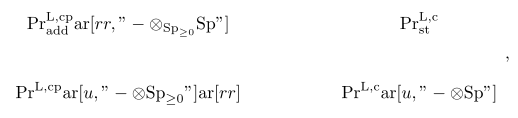 where the top horizontal morphism is the functor from construction 3.4.4, and the bottom horizontal functor is the subcategory inclusion (which is a symmetric monoidal left adjoint by proposition 3.2.10). Taking right adjoints, the middle square of functors in the following diagram commutes:
  The left and right square commute by proposition 3.3.4. By proposition 3.2.8.([003Z]), the bottom horizontal composite is the forgetful functor \(\mathrm{Cat}_{\infty}^{\mathrm{rex}, \mathrm{idem}}\rightarrow\mathrm{Cat}_{\infty}^{\sqcup, \mathrm{idem}}\). The top horizontal functor is the right adjoint to \((-)^{\mathrm{fin}}\) and hence agrees with the forgetful functor \(\mathrm{st}\rightarrow\mathrm{add}\).
We next prove fully faithfulness of the unit: Since both are left adjoints of the forgetful functor, the functor ([005B]) is equivalent to the functor \((-)^{\mathrm{fin}}\colon \mathrm{add}\rightarrow\mathrm{st}\) constructed in [ES22, Def. 2.1.17] which sends an additive, idempotent-complete \(\infty\)-category \(\mathcal C\) to the smallest full stable subcategory of \(\mathrm{Fun}^{\times}(\mathcal C^\mathrm{op}, \mathrm{Sp})\) (the category of functors taking finite coproducts in \(\mathcal C\) to finite products in \(\mathrm{Sp}\)) containing the image of the Yoneda embedding. In [ES22, Cor. 2.1.5], it is shown that the inclusion \(\mathcal C\rightarrow\mathrm{Fun}^{\times}(\mathcal C^{\mathrm{op}}, \mathrm{Sp})\) is fully faithful, and hence so is the inclusion \(\mathcal C\rightarrow\mathcal C^{\mathrm{fin}}\). ◻
3.4.3 \({\mathbf K}^b\) as a left adjoint[005E]
We now show that for an ordinary additive idempotent-complete \(1\)-category \(\mathcal A\), the universal stable \(\infty\)-category \(\mathcal A^{\mathrm{fin}}\) from proposition 3.4.5 is equivalent to \({\mathbf K}^b(\mathcal A)\).
Consider the symmetric monoidal left adjoint \((-)^{\mathrm{fin}} \colon \mathrm{add}\rightarrow\mathrm{st}\) of the forgetful functor from proposition 3.4.5. Categories in the image of \((-)^{\mathrm{fin}}\) carry so-called weight structures, which were originally introduced independently by Bondarko in [Bon10] and (under the name of co-t-structures) by Pauksztello in [Pau08], and afterwards adopted to the \(\infty\)-categorical setting by Elmanto and Sosnilo [ES22], whose exposition we closely follow.
By [ES22, Def. 2.2.1] a weight structure on an idempotent complete stable \(\infty\)-category \(\mathcal D\) is a pair \((\mathcal D_{\leq 0}, \mathcal D_{\geq 0})\) of two full idempotent complete subcategories fulfilling the following conditions:
\(\Sigma \mathcal D_{\geq 0} \subset \mathcal D_{\geq 0}, \Sigma^{-1} \mathcal D_{\leq 0} \subset \mathcal D_{\leq 0}\). We write \(\mathcal D_{\geq n} = \Sigma^n \mathcal D_{\geq 0}\), \(\mathcal D_{\leq n} = \Sigma^n \mathcal D_{\leq 0}\).
For \(x \in \mathcal D_{\leq 0}\) and \(y \in \mathcal D_{\geq 1}\), we have \(\pi_0(\mathrm{Hom}_{\mathcal D}(x,y)) \simeq 0.\)
For any object \(x\), there is a fiber sequence \(x_{\leq 0} \rightarrow x \rightarrow x_{\geq 1}\) with \(x_{\leq 0} \in \mathcal D_{\leq 0}, x_{\geq 1} \in \mathcal D_{\geq 1}\).
Note that condition (3) merely requires the existence of such a fiber sequence, neither is it unique nor functorially associated to \(x\). A weight structure is called bounded if \(\mathcal D= \bigcup_{n}(\mathcal D_{\geq -n} \cap \mathcal D_{\leq n})\). For any weight structure, the weight heart \(\mathcal D^{\heartsuit} \coloneqq \mathcal D_{\geq 0} \cap \mathcal D_{\leq 0}\) is additive and idempotent complete.
Just like t-structures, weight structures only depend on and may be constructed in terms of the underlying (triangulated) homotopy category of \(\mathcal D\).
[005G]
Example 3.4.8.
Given an ordinary additive, idempotent complete \(1\)-category \(\mathcal A\), the \(\infty\)-category \({\mathbf K}^b(\mathcal A)\) has a canonical bounded weight structure with \({\mathbf K}^b(\mathcal A)_{\geq 0}\) the (dg nerve on the) full subcategory of chain complexes supported in non-negative homological degrees. The weight heart \({\mathbf K}^b(\mathcal A)^\heartsuit \simeq \mathcal A\) recovers the original additive \(1\)-category and its inclusion is the canonical functor \(\mathcal A\rightarrow{\mathbf K}^b(\mathcal A)\).
A functor \(F\colon\mathcal C\rightarrow\mathcal D\) between stable, idempotent-complete \(\infty\)-categories with weight structure is weight exact if it is exact and the restriction of \(F\) to the full subcategory \(\mathcal C_{\geq 0} \subseteq \mathcal C\) factors through the full subcategory \(\mathcal D_{\geq 0} \subseteq \mathcal D\) and the restriction of \(F\) to \(\mathcal C_{\leq 0} \subseteq \mathcal C\) factors through \(\mathcal D_{\leq 0} \subseteq \mathcal D\). Weight exact functors \(F \colon \mathcal C\rightarrow\mathcal D\) restrict to additive functors \(F^{\heartsuit}\colon \mathcal C^{\heartsuit} \rightarrow\mathcal D^{\heartsuit}\) between the weight hearts.
[005H]
Notation 3.4.9.
Let \(\mathrm{st}^{bw}\) denote the \(\infty\)-category of idempotent complete stable categories equipped with bounded weight structures and weight exact functors.
A key result of [ES22] is that \((-)^{\mathrm{fin}}\colon\mathrm{add}\rightarrow\mathrm{st}\) factors as an equivalence \(\mathrm{add}\rightarrow\mathrm{st}^{bw}\) followed by the functor \(\mathrm{st}^{bw} \rightarrow\mathrm{st}\) which forgets the weight structure, see [ES22, Const. 2.2.7]. An inverse of this equivalence \(\mathrm{add}\rightarrow
\mathrm{st}^{bw}\) is given by the functor \((-)^{\heartsuit}\colon \mathrm{st}^{bw} \rightarrow\mathrm{add}\) taking the weight heart, see [ES22, Theorem 2.2.9]. The following corollary is a consequence of this theorem:
[005I]
Corollary 3.4.10.
Let \(\mathcal A\) be an ordinary additive, idempotent-complete \(1\)-category. We have an equivalence of \(\infty\)-categories \(\mathcal A^{\mathrm{fin}} \simeq {\mathbf K}^b(\mathcal A)\). In particular, for any stable, idempotent-complete \(\infty\)-category \(\mathcal B\), the inclusion of degree-zero chain complexes \(\mathcal A\rightarrow{\mathbf K}^b(\mathcal A)\) induces an equivalence \[\mathrm{Fun}^{\mathrm{ex}}({\mathbf K}^b(\mathcal A), \mathcal B) \rightarrow\mathrm{Fun}^{\sqcup}(\mathcal A, \mathcal B).\]
[005J]
Proof.
By [ES22, Thm. 2.2.9], for any additive, idempotent complete \(\infty\)-category \(\mathcal A\), the \(\infty\)-category \(\mathcal A^{\mathrm{fin}}\) is uniquely characterized by being a stable, idempotent-complete \(\infty\)-category with bounded weight structure with weight heart \(\mathcal A\). Since for an ordinary, additive, idempotent-complete \(1\)-category \(\mathcal A\), the \(\infty\)-category \({\mathbf K}^b(\mathcal A)\) is a stable, idempotent-complete \(\infty\)-category with weight structure and weight heart \(\mathcal A\), see proposition 3.4.2, example 3.4.8. The result follows. ◻
Extending corollary 3.4.10, we think of \((-)^{\mathrm{fin}}:\mathrm{add}\rightarrow\mathrm{st}\) as the correct generalization of \({\mathbf K}^b(\mathcal A)\) from ordinary additive, idempotent-complete \(1\)-categories to additive, idempotent-complete \(\infty\)-categories \(\mathcal A\).
[005K]
Notation 3.4.11.
Abusing notation, we will henceforth write \({\mathbf K}^b(-) \coloneqq (-)^{\mathrm{fin}}\colon \mathrm{add}\rightarrow\mathrm{st}\) for the left adjoint to the forgetful functor \(\mathrm{st}\rightarrow\mathrm{add}\), even when applied to additive \(\infty\)-categories.
3.5 \(\infty\)-categories of graded modules[005L]
The categories appearing in this paper will not just be additive or stable, but will typically be enriched in chain complexes of \(k\)-modules for a commutative ring \(k\), equipped with an additional \(\mathbb{Z}\)-grading. In this section, we recall the necessary technical machinery to address this coherently. This machinery will apply more generally to \(\mathbb E_{\infty}\)-ring spectra, i.e. commutative algebra objects in \(\mathrm{Sp}\). In §3.6, we relate these structures with possibly more familiar variants of derived categories. Similar definitions are discussed in [Lur18].
3.5.1 \(\mathbb{K}\)-modules[005M]
[005N]
Notation 3.5.1.
For \(k\) an ordinary commutative ring, we let \(\mathrm{mod}_k\) denote the ordinary symmetric monoidal \(1\)-category of \(k\)-modules.
We now discuss the \(\infty\)-categorical analog of \(\mathrm{mod}_k\). It follows from lemma 3.2.12.([004J]) that for an \(\mathbb E_{\infty}\)-ring spectrum \(\mathbb{K}\in \mathrm{CAlg}(\mathrm{Sp})\), the \(\infty\)-category \(\mathrm{Mod}_{\mathbb{K}}(\mathrm{Sp})\) is a compactly generated stable, presentably symmetric monoidal category, i.e. \(\mathrm{Mod}_{\mathbb{K}}(\mathrm{Sp}) \in \mathrm{CAlg}(\mathrm{Pr}^{\mathrm{L}, \mathrm{c}}_{\mathrm{st}})\).
[005P]
Notation 3.5.2.
For \(\mathbb{K}\in \mathrm{CAlg}(\mathrm{Sp})\), we write \(\mathrm{Mod}_{\mathbb{K}}\) for the category of \(\mathbb{K}\)-modules \(\mathrm{Mod}_{\mathbb{K}}(\mathrm{Sp}) \in \mathrm{CAlg}(\mathrm{Pr}^{\mathrm{L}, \mathrm{c}}_{\mathrm{st}})\) and \(\mathrm{Perf}_{\mathbb{K}}\) for the category of perfect \(\mathbb{K}\)-modules \(\mathrm{Perf}_{\mathbb{K}} \coloneqq \mathrm{Mod}_{\mathbb{K}}(\mathrm{Sp})^{\mathrm{c}} \in \mathrm{CAlg}(\mathrm{st})\).
The symmetric monoidal equivalence \(\operatorname{Ind}\colon \mathrm{st}\rightarrow\mathrm{Pr}^{\mathrm{L}, \mathrm{c}}_{\mathrm{st}}\) transports \(\mathrm{Perf}_{\mathbb{K}}\) to \(\mathrm{Mod}_{\mathbb{K}}\) and vice versa.
[005Q]
Example 3.5.3.
The main application of this paper will only be concerned with the case that \(\mathbb{K}= Hk\) is an Eilenberg-MacLane spectrum of a classical commutative ring \(k\). In this case, \(\mathrm{Mod}_{\mathbb{K}}\) is equivalent to the unbounded derived \(\infty\)-category \(\mathcal D(\mathrm{mod}_k)\) of the abelian category \(\mathrm{mod}_k\) of \(k\)-modules [Lur17, Thm 7.1.2.13] with symmetric monoidal structure given by the derived tensor product \(-\otimes^L_k-\). The \(\infty\)-category \(\mathrm{Perf}_{\mathbb{K}}\) is equivalent to its full subcategory on the perfect chain complexes, i.e. the chain complexes quasi-isomorphic to a bounded complex of finitely generated projective \(k\)-modules.
Since example 3.5.3 is the situation relevant to our paper, the reader can safely view \(\mathbb{K}\) as a classical ring \(k\) and \(\mathrm{Mod}_{\mathbb{K}}\) as \(\mathcal D(\mathrm{mod}_k)\). The situation of example 3.5.3 will be discussed in more detail in §3.6.
3.5.2 Compact-projective \(\mathbb{K}\)-modules[005R]
As above, we will be concerned with the additive variants of the notions in §3.5.1. Let \(\mathbb{K}\) be a connective \(\mathbb E_{\infty}\)-ring spectrum, i.e. a commutative algebra \(\mathbb{K}\in \mathrm{CAlg}(\mathrm{Sp}_{\geq 0})\). Since \(\mathrm{Sp}_{\geq 0}\in \mathrm{CAlg}(\mathrm{Pr}^{\mathrm{L}, \mathrm{cp}}_{\mathrm{add}})\), it follows from lemma 3.2.12 that the category \(\mathrm{Mod}_{\mathbb{K}}(\mathrm{Sp}_{\geq 0})\in \mathrm{CAlg}(\mathrm{Pr}^{\mathrm{L}, \mathrm{cp}}_{\mathrm{add}})\).
[005S]
Notation 3.5.4.
Fix \(\mathbb{K}\in \mathrm{CAlg}(\mathrm{Sp}_{\geq 0})\), we write \(\mathrm{Mod}^{\geq 0}_{\mathbb{K}}\) for the \(\infty\)-category of connective \(\mathbb{K}\)-modules \(\mathrm{Mod}_{\mathbb{K}}(\mathrm{Sp}_{\geq 0}) \in \mathrm{CAlg}(\mathrm{Pr}^{\mathrm{L}, \mathrm{cp}}_{\mathrm{add}})\) and \(\mathrm{CProj}_{\mathbb{K}}\) for the category of compact-projective \(\mathbb{K}\)-modules \(\mathrm{CProj}_{\mathbb{K}} \coloneqq \mathrm{Mod}_{\mathbb{K}}(\mathrm{Sp}_{\geq 0})^{\mathrm{cp}} \in \mathrm{CAlg}(\mathrm{add})\).
Note that \(\mathrm{Mod}^{\geq 0}_{\mathbb{K}}\) is a full subcategory of \(\mathrm{Mod}_{\mathbb{K}}\).
[005T]
Example 3.5.5.
For \(\mathbb{K}= Hk\) an Eilenberg-MacLane spectrum of a classical commutative ring \(k\), the \(\infty\)-category \(\mathrm{Mod}^{\geq 0}_{Hk}\) is equivalent to the full subcategory \(\mathcal D(\mathrm{mod}_k)_{\geq 0}\) of the unbounded derived \(\infty\)-category \(\mathcal D(\mathrm{mod}_k)\) of the ring \(k\) on those chain complexes with homology in non-negative homological degree. It follows from lemma 3.5.7 below that the full subcategory \(\mathrm{CProj}_{Hk}\) is equivalent to the \(1\)-category of finitely generated projective \(k\)-modules in the usual sense (with fully faithful inclusion into \(\mathcal D(\mathrm{mod}_k)_{\geq 0}\) as complexes concentrated in degree zero), see also §3.6.
[005U]
Observation 3.5.6.
The symmetric monoidal equivalence \(\operatorname{Ind}\colon \mathrm{st}\rightarrow\mathrm{Pr}^{\mathrm{L}, \mathrm{c}}_{\mathrm{st}}\) transports \(\mathrm{Perf}_{\mathbb{K}}\) to \(\mathrm{Mod}_{\mathbb{K}}\). Similarly, the symmetric monoidal equivalence \(\mathcal P^{\Sigma}\colon \mathrm{add}\rightarrow\mathrm{Pr}^{\mathrm{L}, \mathrm{cp}}_{\mathrm{add}}\) transports \(\mathrm{CProj}_{\mathbb{K}}\) to \(\mathrm{Mod}^{\geq 0}_{\mathbb{K}}\).
[005V]
Lemma 3.5.7.
The following hold:
Let \(\mathbb{K}\in \mathrm{CAlg}(\mathrm{Sp}_{\geq 0})\). The rank one free module \(\mathbb{K}_{\mathbb{K}}\) generates \(\mathrm{CProj}_{\mathbb{K}}\) under retracts and finite direct sums; in particular, every object of \(\mathrm{CProj}_{\mathbb{K}}\) is a retract of a finite coproduct of modules isomorphic to \(\mathbb{K}_{\mathbb{K}}\).
Let \(\mathbb{K}\in \mathrm{CAlg}(\mathrm{Sp})\). The rank one free module \(\mathbb{K}_{\mathbb{K}}\) generates \(\mathrm{Perf}_{\mathbb{K}}\) under retracts and finite colimits; in particular, every object of \(\mathrm{Perf}_{\mathbb{K}}\) is a retract of an iterated finite colimit of modules isomorphic to \(\mathbb{K}_{\mathbb{K}}\).
[005Y]
Proof.
Immediate from lemma 3.2.9 and the fact that \(\mathrm{Mod}_{\mathbb{K}}\) and \(\mathrm{Mod}^{\geq 0}_{\mathbb{K}}\) are compact and compact projectively generated by \(\mathbb{K}_{\mathbb{K}}\) respectively. ◻
If \(k\) is an ordinary ring, then an object of \(\mathrm{Perf}_{Hk}\) can be represented by a bounded chain complex of finitely generated projective \(k\)-modules. This generalizes to any \(\mathbb{K}\in \mathrm{CAlg}(\mathrm{Sp}_{\geq 0})\):
[005Z]
Proposition 3.5.8.
For \(\mathbb{K}\in \mathrm{CAlg}(\mathrm{Sp}_{\geq 0})\) there is a symmetric monoidal equivalence \[{\mathbf K}^b(\mathrm{CProj}_{\mathbb{K}}) \simeq \mathrm{Perf}_{\mathbb{K}}.\]
[0060]
Proof.
Starting with the definition of \({\mathbf K}^b=(-)^{\mathrm{fin}}\) in proposition 3.4.5, we obtain the equivalence \[{\mathbf K}^b(\mathrm{CProj}_{\mathbb{K}}) := \left( \mathcal P^{\Sigma}(\mathrm{CProj}_{\mathbb{K}})\otimes_{\mathrm{Sp}_{\geq 0}}\mathrm{Sp}\right)^{c} \simeq \left( \mathrm{Mod}_{\mathbb{K}}(\mathrm{Sp}_{\geq 0}) \otimes_{\mathrm{Sp}_{\geq 0}}\mathrm{Sp}\right)^{c}\simeq \left( \mathrm{Mod}_{\mathbb{K}}(\mathrm{Sp})\right)^{c} =: \mathrm{Perf}_{\mathbb{K}}\] where the last step follows from proposition 3.1.8.([0036]). ◻
3.5.3 \(\mathcal Z\)-graded \(\mathbb{K}\)-modules[0061]
Given an ordinary monoid \(Z\) and a commutative ring \(k\), the category \(\mathrm{Fun}(Z, \mathrm{mod}_k)\) of \(Z\)-graded \(k\)-modules admits a convolution monoidal structure, for which the tensor product of \(Z\)-graded modules \((M_z)_{z \in Z}\) and \((N_z)_{z\in Z}\) is given by the \(Z\)-graded module which in degree \(z\in Z\) is \(\oplus_{z_1z_2 = z} M_{z_1} \otimes N_{z_2}\). This construction is a special case of the Day convolution monoidal structure on a functor category [Lur17, § 2.2.6]. Here, we focus on the symmetric monoidal case.
We briefly recall this construction of a symmetric monoidal structure on \(\mathrm{Fun}(J, \mathcal C)\) in the case where \(J\) is a small symmetric monoidal \(\infty\)-category and \(\mathcal C\) is a presentably symmetric monoidal \(\infty\)-category.
[0062]
Lemma 3.5.9.
For \(J\in \mathrm{Cat}_{\infty}\) and \(\mathcal C\in \mathrm{Pr}^\mathrm{L}\), the functor \(\mathcal C\times J \rightarrow\mathrm{Fun}(J^{\mathrm{op}}, \mathcal C)\), \[
(c,j)\mapsto c \otimes \mathrm{Hom}_{J}(-, j) \in \mathrm{Fun}(J^{\mathrm{op}}, \mathcal C)\] (where \(\otimes\) denotes the action of \(\mathcal S\) on \(\mathcal C\) inherited from the presentability of \(\mathcal C\)) induces an equivalence \[
\mathcal C\otimes \mathcal P(J) \simeq \mathrm{Fun}(J^{\mathrm{op}}, \mathcal C)\] in \(\mathrm{Pr}^\mathrm{L}\) (where \(\otimes\) denotes the tensor product of \(\mathrm{Pr}^\mathrm{L}\)).
[0065]
Proof.
Consider the chain of equivalences \[\mathcal C\otimes \mathcal P(J) \simeq \mathrm{Fun^L}(\mathcal P(J), \mathcal C^{\mathrm{op}})^{\mathrm{op}} \simeq \mathrm{Fun}(J, \mathcal C^{\mathrm{op}})^{\mathrm{op}} \simeq \mathrm{Fun}(J^{\mathrm{op}}, \mathcal C)\] Here, the first equivalence follows from ([002Z]), the second equivalence is the universal property of the Yoneda embedding [Lur09, Thm. 5.1.5.6], and the last records the interplay between functor categories and opposites. Precomposing this equivalence with the inclusion functor \(\mathcal C\times J \rightarrow\mathcal C\otimes \mathcal P(J)\) (which is cocontinuous in its second argument) unpacks to the functor ([0063]). ◻
Assume \(J\in \mathrm{CAlg}(\mathrm{Cat}_{\infty})\) and \(\mathcal C\in \mathrm{CAlg}(\mathrm{Pr}^\mathrm{L})\). Since \(\mathcal P\colon \mathrm{Cat}_{\infty}\rightarrow\mathrm{Pr}^\mathrm{L}\) is symmetric monoidal by proposition 3.1.6, it follows that for \(J \in \mathrm{CAlg}(\mathrm{Cat}_{\infty})\), the \(\infty\)-category \(\mathcal P(J)\) inherits a presentably symmetric monoidal structure, i.e. \(\mathcal P(J) \in \mathrm{CAlg}(\mathrm{Pr}^\mathrm{L})\). Then ([0064]) provides the following Day convolution monoidal structure on \(\mathrm{Fun}(J^{\mathrm{op}}, \mathcal C)\).
[0066]
Corollary 3.5.10.
Let \(J\in \mathrm{CAlg}(\mathrm{Cat}_{\infty})\) and \(\mathcal C\in \mathrm{CAlg}(\mathrm{Pr}^\mathrm{L})\). Then \(\mathrm{Fun}(J^{\mathrm{op}}, \mathcal C)\) inherits a presentably symmetric monoidal structure from the tensor product \(\mathcal C\otimes \mathcal P(J)\) of commutative algebras in \(\mathrm{Pr}^\mathrm{L}\).
[0068]
Lemma 3.5.12.
If \(J \in \mathrm{CAlg}(\mathrm{Cat}_{\infty})\) and \(\mathcal C\) is in \(\mathrm{CAlg}(\mathrm{Pr}^{\mathrm{L},\mathrm{c}})\) or \(\mathrm{CAlg}(\mathrm{Pr}^{\mathrm{L},\mathrm{cp}})\), then \(\mathrm{Fun}(J^{\mathrm{op}}, \mathcal C)\) with its Day convolution monoidal structure is also in \(\mathrm{CAlg}(\mathrm{Pr}^{\mathrm{L},\mathrm{c}})\) or \(\mathrm{CAlg}(\mathrm{Pr}^{\mathrm{L},\mathrm{cp}})\), respectively.
[0069]
Proof.
The Day convolution monoidal structure was defined by identifying \(\mathrm{Fun}(J^{\mathrm{op}}, \mathcal C)\) with \(\mathcal C\otimes \mathcal P(J)\). The presheaf category \(\mathcal P(J)\) is an object of \(\mathrm{CAlg}(\mathrm{Pr}^{\mathrm{L},\mathrm{cp}})\) (in fact, it is generated by a small set of objects which commute with all small colimits). Hence, if \(\mathcal C\) is in \(\mathrm{CAlg}(\mathrm{Pr}^{\mathrm{L},\mathrm{c}})\) or in the subcategory \(\mathrm{CAlg}(\mathrm{Pr}^{\mathrm{L},\mathrm{cp}})\), then so is \(\mathcal C\otimes \mathcal P(J)\). ◻
[006A]
Observation 3.5.13.
The monoidal unit \(I \in J\) of any symmetric monoidal \(\infty\)-category \(J\in \mathrm{CAlg}(\mathrm{Cat}_{\infty})\) induces a symmetric monoidal functor \(\mathcal S\rightarrow\mathcal P(J)\) left adjoint to the evaluation functor \(\mathrm{ev}_{I} \colon \mathcal P(J) \rightarrow\mathcal S\), and explicitly given by sending a space \(X\) to the functor \(\mathrm{Hom}_{J}(-, I) \times X\colon J^{\mathrm{op}} \rightarrow\mathcal S\). It follows that for any presentably symmetric monoidal category \(\mathcal C\), there is a symmetric monoidal left adjoint \[\mathcal C\simeq \mathcal C\otimes \mathcal S\rightarrow\mathcal C\otimes\mathcal P(J) \simeq \mathrm{Fun}(J^{\mathrm{op}}, \mathcal C)\] to the evaluation functor \(\mathrm{ev}_{I}\colon\mathrm{Fun}(J^{\mathrm{op}}, \mathcal C) \rightarrow\mathcal C\), explicitly given by sending \(c\in \mathcal C\) to the functor \(\mathrm{Hom}_{J}(-, I) \otimes c \colon J^{\mathrm{op}} \rightarrow\mathcal C\).
We will particularly focus on gradings by a homotopy coherent abelian monoid, i.e. a \(\mathcal Z\in \mathrm{CAlg}(\mathcal S)\).
[006B]
Definition 3.5.14.
Let \(\mathcal Z\in \mathrm{CAlg}(\mathcal S)\) and recall Day convolution from corollary 3.5.10.
For \(\mathbb{K}\in \mathrm{CAlg}(\mathrm{Sp}_{\geq 0})\), we define the \(\infty\)-category of \(\mathcal Z\)-graded connective \(\mathbb{K}\)-modules \(\mathrm{Mod}_{\mathbb{K}}^{\geq 0, \mathcal Z} \in \mathrm{CAlg}(\mathrm{Pr}^{\mathrm{L},\mathrm{cp}})\) as the functor category \(\mathrm{Fun}(\mathcal Z, \mathrm{Mod}^{\geq 0}_{\mathbb{K}})\) with the Day convolution structure.
For \(\mathbb{K}\in \mathrm{CAlg}(\mathrm{Sp})\), we define the \(\infty\)-category of \(\mathcal Z\)-graded \(\mathbb{K}\)-modules \(\mathrm{Mod}_{\mathbb{K}}^{\mathcal Z} \in \mathrm{CAlg}(\mathrm{Pr}^{\mathrm{L},\mathrm{c}})\) to be the functor category \(\mathrm{Fun}(\mathcal Z, \mathrm{Mod}_{\mathbb{K}})\) with the Day convolution structure.
[006C]
Example 3.5.15.
Following example 3.5.3, if \(\mathcal Z\) is a discrete (i.e. ordinary) commutative monoid \(Z\) and \(\mathbb{K}= Hk\) the Eilenberg-MacLane spectrum of an ordinary commutative ring \(k\), the \(\infty\)-category \(\mathrm{Mod}_{\mathbb{K}}^{\mathcal Z}\) is the unbounded derived \(\infty\)-category \(\mathcal D(\mathrm{mod}_k^Z)\) of the ordinary abelian \(1\)-category \(\mathrm{mod}_k^{Z}\coloneqq \mathrm{Fun}(Z, \mathrm{mod}_k)\) of \(Z\)-graded \(k\)-modules. This will be discussed in more detail in subsection 3.6.
Unpacking Day convolution from corollary 3.5.10 in these terms, the tensor product of an ordinary \(k\)-module \(M\) concentrated in degree \(z\in Z\) and an ordinary \(k\)-module \(N\) concentrated in degree \(w\in Z\) is given by the derived tensor product \(M\otimes_k^L N\) concentrated in degree \(z+w\in Z\).
[006D]
Example 3.5.16.
Still in the setup of example 3.5.15, the \(\infty\)-categories \(\left(\mathrm{Mod}_{Hk}^{\geq 0, Z}\right)^{\mathrm{cp}}\) and \(\left(\mathrm{Mod}_{Hk}^{Z}\right)^{\mathrm{c}}\) may be identified with the full subcategories \(\mathrm{Fun}^{\mathrm{fin.supp.}}(Z, \mathrm{CProj}_{k})\) and \(\mathrm{Fun}^{\mathrm{fin.supp.}}(Z, \mathrm{Perf}_{k})\) of the functor \(\infty\)-categories \(\mathrm{Fun}(Z, \mathrm{CProj}_{k})\) and \(\mathrm{Fun}(Z, \mathrm{Perf}_{k})\), respectively, on the finitely supported functors, i.e. functors that vanish on all but finitely many elements of \(Z\).
[006E]
Observation 3.5.17.
Assume \(\mathcal Z\in \mathrm{CAlg}(\mathcal S)\) and \(\mathbb{K}\in \mathrm{CAlg}(\mathrm{Sp}_{\geq 0})\). The symmetric monoidal functor \(- \otimes \mathrm{Sp}\colon \mathrm{Pr}^{\mathrm{L}, \mathrm{cp}}_{\mathrm{add}}\rightarrow\mathrm{Pr}^{\mathrm{L}, \mathrm{c}}_{\mathrm{st}}\) from construction 3.4.4 takes \(\mathrm{Mod}_{\mathbb{K}}^{\geq 0, \mathcal Z}\) with its Day convolution monoidal structure to \(\mathrm{Mod}_{\mathbb{K}}^{\mathcal Z}\) with its Day convolution monoidal structure. Indeed, we have the following sequence\[\mathrm{Mod}_{\mathbb{K}}^{\geq 0, \mathcal Z} \otimes \mathrm{Sp}\simeq \mathcal P(\mathcal Z) \otimes \mathrm{Mod}_{\mathbb{K}}^{\geq 0} \otimes \mathrm{Sp}\simeq \mathcal P(\mathcal Z) \otimes \mathrm{Mod}_{\mathbb{K}} \simeq \mathrm{Mod}_{\mathbb{K}}^{\mathcal Z}\] of symmetric monoidal equivalences. In particular, it follows that the fully faithful inclusion \(\mathrm{Mod}_{\mathbb{K}}^{\geq 0, \mathcal Z} \hookrightarrow \mathrm{Mod}_{\mathbb{K}}^{\mathcal Z}\) is symmetric monoidal and hence a morphism in \(\mathrm{CAlg}(\mathrm{Pr}^\mathrm{L})\).
3.6 Derived \(\infty\)-categories of graded modules[006F]
Many of the constructions of section 2 center around discrete (i.e. ordinary) graded \(k\)-algebras, and derived graded bimodules between them. In this section, we therefore focus on the case where \(\mathbb{K}\) is a discrete commutative ring \(k\) and \(\mathcal Z\) is a discrete commutative monoid \(Z\) and unpack our constructions in terms of homological algebra, generalizing Examples 3.5.3, 3.5.5 and 3.5.15.
3.6.1 Derived \(\infty\)-categories[006G]
We quickly review the basics of the theory of derived \(\infty\)-categories; we refer the reader to [Lur17, § 1.3] for more details.
Given an abelian \(1\)-category \(\mathcal A\), its (unbounded) derived \(\infty\)-category \(\mathcal D(\mathcal A)\) is the \(\infty\)-categorical localization of the \(\infty\)-category of unbounded chain complexes in \(\mathcal A\) (constructed as the dg nerve [Lur17, § 1.3.1] of the corresponding differential graded category) at the quasi-isomorphisms. In particular, the homotopy 1-category \(h_1\mathcal D(\mathcal A)\) agrees with the ordinary derived 1-category of \(\mathcal A\) in the usual sense.
Let \(\mathcal D(\mathcal A)_{\geq 0}\) denote the full subcategory of \(\mathcal D(\mathcal A)\) on the chain complexes with vanishing homology in negative degrees. When \(\mathcal A\) is particularly well-behaved, the \(\infty\)-categories \(\mathcal D(\mathcal A)_{\geq 0}\) and \(\mathcal D(\mathcal A)\) can be expressed in terms of completions (of the type introduced throughout section 3), as we discuss now.
Recall the following classical analogues of definition 3.2.1:
[006H]
Definition 3.6.1.
Let \(c\) be an object in an ordinary \(1\)-category \(\mathcal C\) with small colimits. Then, \(c\) is called
compact, if \(\mathrm{Hom}_{\mathcal C}(c, -) \colon \mathcal C\rightarrow\mathrm{Set}\) preserves filtered colimits;
\(1\)-projective, if \(\mathrm{Hom}_{\mathcal C}(c,-) \colon \mathcal C\rightarrow\mathrm{Set}\) preserves geometric realizations (equivalently, reflective coequalizers);
compact \(1\)-projective if \(\mathrm{Hom}_{\mathcal C}(c,-) \colon \mathcal C\rightarrow\mathrm{Set}\) preserves sifted colimits, or equivalently if \(c\) is compact and \(1\)-projective.
We say that \(\mathcal C\) is compactly generated (resp. \(1\)-projectively generated) if there is a small set of compact (resp. compact 1-projective) objects which generate \(\mathcal C\) under small colimits. We denote the full subcategory of compact, resp. compact \(1\)-projective, objects in \(\mathcal C\) by \(\mathcal C^{\mathrm{c}}\), resp. \(\mathcal C^{\mathrm{c}1\mathrm{p}}\).
[006I]
Example 3.6.2.
If \(\mathcal A\) is an abelian \(1\)-category, an object \(c \in \mathcal A\) is \(1\)-projective if and only if it is projective in the usual sense.
[006J]
Example 3.6.3.
A presentable abelian category \(\mathcal A\) is \(1\)-projectively generated if it is compactly generated and if the full subcategory of compact objects \(\mathcal A^{\mathrm{c}}\) has enough projective objects, i.e. if for every compact object \(a\in \mathcal A\) there exists a compact \(1\)-projective object \(p\) and an epimorphism \(p \twoheadrightarrow a\). In particular, this implies that also \(\mathcal A\) has enough projective objects, i.e. that for every object \(a\in \mathcal A\) there exists a \(1\)-projective \(p\) and an epimorphism \(p \twoheadrightarrow a\).
For example, the abelian category \(\mathrm{mod}_k\) is a \(1\)-projectively generated presentable \(1\)-category with \(\mathrm{mod}_k^{\mathrm{c}}\) the full subcategory of finitely generated modules and \(\mathrm{mod}_k^{\mathrm{c}1\mathrm{p}}\) the full subcategory of finitely generated projective \(k\)-modules.
[006L]
Warning 3.6.5.
remark 3.6.4 not true projectivity: The condition for an object \(c\in \mathcal C\) to be \(1\)-projective (i.e. \(\mathrm{Hom}_{\mathcal C}(c,-)\colon \mathcal C\rightarrow\mathrm{Set}\) preserving geometric realizations) is different to the condition for it to be projective (i.e. \(\mathrm{Hom}_{\mathcal C}(c,-)\colon \mathcal C\rightarrow\mathrm{Set} \rightarrow\mathcal S\) preserving geometric realizations), simply because the inclusion \(\mathrm{Set} \hookrightarrow \mathcal S\) does not preserve geometric realizations. This difference is at the heart of the process of animation [CS24, § 5.1.4], which takes an ordinary cocomplete category \(\mathcal C\) to \(\mathcal P^{\Sigma}(\mathcal C^{\mathrm{c}1\mathrm{p}})\), i.e. freely making the compact 1-projective objects into compact-projective objects.
The following statements are well-known and can be gathered from various parts of [Lur17, § 1.3]:
[006M]
Proposition 3.6.6.
Let \(\mathcal A\) be a \(1\)-projectively generated presentable abelian \(1\)-category.
The additive presentable \(\infty\)-category \(\mathcal D(\mathcal A)_{\geq 0}\) is equivalent to \(\mathcal P^{\Sigma}(\mathcal A^{\mathrm{c}1\mathrm{p}})\).
The stable presentable \(\infty\)-category \(\mathcal D(\mathcal A)\) is equivalent to its stabilization \[\mathcal P^{\Sigma}(\mathcal A^{\mathrm{c}1\mathrm{p}}) \otimes \mathrm{Sp}\simeq \operatorname{Ind}{\mathbf K}^b(\mathcal A^{\mathrm{c}1\mathrm{p}}).\]
[006Q]
Proof.
For the first statement, note that \(\mathcal A\) has enough projective objects (see example 3.6.3) and let \(\mathcal D_-(\mathcal A)\) be the dg-nerve of the differential graded category of bounded-below chain complexes of \(1\)-projective objects (i.e. projective objects in the standard abelian sense). Let \(\mathcal D_{-}(\mathcal A)_{\geq 0}\) be the full subcategory on the chain complexes with vanishing homology in negative degrees. Entirely analogous to the proof of [Lur17, Prop. 1.3.3.14], the Dold-Kan correspondence shows that \(\mathcal D_{-}(\mathcal A)_{\geq 0} \simeq \mathcal P^{\Sigma}(\mathcal A^{\mathrm{c}1\mathrm{p}})\). Since any \(1\)-projectively generated presentable abelian \(1\)-category is Grothendieck abelian [Lur17, Def. 1.3.5.1], it follows from [Lur17, Prop. 1.3.5.24, Def. 1.3.5.8, Prop. 1.3.5.13] that there is a fully faithful embedding \(\mathcal D_{-}(\mathcal A) \rightarrow\mathcal D(\mathcal A)\) with image the chain complexes with bounded-below homology. In particular, this embedding identifies \(\mathcal D_{-}(\mathcal A)_{\geq 0}\) with \(\mathcal D(\mathcal A)_{\geq 0}\).
For the second statement, since the \(t\)-structure \((\mathcal D(\mathcal A)_{\leq 0}, \mathcal D(\mathcal A)_{\geq 0})\) on \(\mathcal D(\mathcal A)\) is right-complete [Lur17, Prop. 1.3.5.21], it follows that \(\mathcal D(\mathcal A)\) is the stabilization of \(\mathcal D(\mathcal A)_{\geq 0}\); since \(\mathcal D(\mathcal A)_{\geq 0} = \mathcal P^{\Sigma}(\mathcal A^{\mathrm{c}1\mathrm{p}})\) is presentable this stabilization is given by tensoring with \(\mathrm{Sp}\) by [Lur17, Ex. 4.8.1.23]. The equivalence \(\mathcal P^{\Sigma}(\mathcal A^{\mathrm{c}1\mathrm{p}}) \otimes \mathrm{Sp}\simeq \operatorname{Ind}{\mathbf K}^b(\mathcal A^{\mathrm{c}1\mathrm{p}})\) follows then from the definition of \((-)^{\mathrm{fin}}\) in proposition 3.4.5 and its equivalence with \({\mathbf K}^b\) from corollary 3.4.10. ◻
3.6.2 Derived \(\infty\)-categories of graded modules[006R]
We return to the main goal of this subsection to give a homological perspective on the constructions of the last sections. Let \(\mathbb{K}\) be a discrete commutative ring \(k\) and \(\mathcal Z\) a discrete commutative monoid \(Z\). Recall the notation \(\mathrm{mod}_{k}^Z\) for the ordinary category of \(Z\)-graded \(k\)-modules. Throughout this subsection, we also fix an ordinary (not necessarily commutative) \(Z\)-graded \(k\)-algebra \(A \in \mathrm{Alg}(\mathrm{mod}_{k}^Z)\).
[006S]
Notation 3.6.7.
We let \(\mathrm{grmod}_A \coloneqq \mathrm{RMod}_A(\mathrm{mod}_{k}^Z)\) denote the ordinary \(1\)-category of \(Z\)-graded right \(A\)-modules.
This category \(\mathrm{grmod}_A\) is a \(1\)-projectively generated, in the sense of definition 3.6.1, presentable abelian \(1\)-category. A standard computation shows that its compact \(1\)-projective objects (i.e. its compact projective objects in the usual abelian sense) are precisely given by the graded-compact projective modules, defined as follows.
[006T]
Definition 3.6.8.
An (ordinary) \(Z\)-graded \(A\)-module \(M \in \mathrm{grmod}_A\) is graded-compact-projective if it is a retract of a finite direct sums of grading shifts of the free module \(A\). Let \(\mathrm{grmod}_A^{\mathrm{gr-cp}} \subset \mathrm{grmod}_A\) denote the full subcategory on the graded-compact-projective \(A\)-modules.
In the notation of definition 3.6.1, \(\mathrm{grmod}_A^{\mathrm{gr-cp}} = \left(\mathrm{grmod}_A\right)^{\mathrm{c}1\mathrm{p}}\).
Using proposition 3.6.6, we can identify the \(\infty\)-category \(\mathrm{RMod}_{HA}(\mathrm{Mod}_{Hk}^{\geq 0, Z})\) as well as its various subcategories in terms of homological algebra:
[006U]
Proposition 3.6.9.
Let \(Z\) be a discrete monoid, \(k\) a discrete commutative ring, and \(A\) a discrete \(Z\)-graded (not necessarily commutative) \(k\)-algebra.
The \(\infty\)-category \(\left(\mathrm{RMod}_{HA}(\mathrm{Mod}_{Hk}^{\geq 0, Z}) \right)^{cp}\) is equivalent to \(\mathrm{grmod}_A^{\mathrm{gr-cp}}\). In particular, it is a \(1\)-category.
The \(\infty\)-category \(\left( \mathrm{RMod}_{HA}(\mathrm{Mod}_{Hk}^Z) \right)^{c}\) is equivalent to the \(\infty\)-category \({\mathbf K}^b(\mathrm{grmod}_A^{\mathrm{gr-cp}})\).
The \(\infty\)-category \(\mathrm{RMod}_{HA}(\mathrm{Mod}_{Hk}^{\geq 0, Z})\) is equivalent to the \(\infty\)-category \(\mathcal D(\mathrm{grmod}_A)_{\geq 0}\).
The \(\infty\)-category \(\mathrm{RMod}_{HA}(\mathrm{Mod}_{Hk}^{Z})\) is equivalent to the (unbounded) derived \(\infty\)-category \(\mathcal D(\mathrm{grmod}_A)\).
[006Z]
Proof.
The \(\infty\)-category \(\mathrm{Mod}_{Hk}^{\geq 0, Z} = \mathrm{Fun}(Z, \mathrm{Mod}_{Hk}^{\geq 0})\) is generated by the set of compact \(1\)-projective objects \(Hk[z]\) for \(z\in Z\), i.e. the ground ring \(k\) in homological degree zero, and grading-degree \(z \in Z\). Hence, by lemma 3.2.12.([004I]), \(\mathrm{RMod}_{HA}(\mathrm{Mod}_{Hk}^{\geq 0, Z})\) is generated by shifted-free modules \(HA[z] = HA \otimes_{Hk} Hk[z]\) for \(z\in Z\). By lemma 3.2.9.([0043]), the compact-projective objects of \(\mathrm{RMod}_{HA}(\mathrm{Mod}_{Hk}^{\geq 0, Z})\) are retracts of finite direct sums of such modules, and hence are precisely the graded-compact-projective modules. This proves ([006V]).
For ([006X]), note that \(\mathrm{RMod}_{HA}(\mathrm{Mod}_{Hk}^{\geq 0, Z})\) is projectively generated (see lemma 3.2.12), and hence equivalent to \[\mathcal P^{\Sigma}\left(\mathrm{RMod}_{HA}(\mathrm{Mod}_{Hk}^{\geq 0, Z})^{\mathrm{cp}}\right) = \mathcal P^{\Sigma}(\mathrm{grmod}_{A}^{\mathrm{gr-cp}}).\] Since \(\mathrm{grmod}_A^{\mathrm{gr-cp}}\) is the full subcategory on the compact 1-projectives in the \(1\)-projectively generated presentable abelian category \(\mathrm{grmod}_A\), it follows from proposition 3.6.6.([006N]) that this is equivalent to \(\mathcal D(\mathrm{grmod}_A)_{\geq 0}\).
Statement ([006Y]) follows from proposition 3.6.6.([006P]) since by [Lur17, Thm. 4.8.4.6], \(\mathrm{RMod}_{HA}(\mathrm{Mod}_{Hk}^{\geq 0, Z}) \otimes \mathrm{Sp}\simeq \mathrm{RMod}_{HA}(\mathrm{Mod}_{Hk}^{\geq 0, Z} \otimes \mathrm{Sp}) \simeq \mathrm{RMod}_{HA} (\mathrm{Mod}_{Hk}^Z).\)
Statement ([006W]) then follows since \(\mathcal D(\mathrm{grmod}_A) \simeq \operatorname{Ind}({\mathbf K}^b(\mathrm{grmod}_A^{\mathrm{gr-cp}}))\) by proposition 3.6.6.([006P]). ◻
Motivated by proposition 3.6.9, we call the objects in the full subcategory \(\mathcal D(\mathrm{grmod}_A)^{\mathrm{c}} \subseteq \mathcal D(\mathrm{grmod}_A)\) graded-perfect.
[0071]
Notation 3.6.11.
We write \(\mathcal D(\mathrm{grmod}_A)^{\mathrm{gr-perf}}\coloneqq \mathcal D(\mathrm{grmod}_A)^{\mathrm{c}}\) for the full subcategory of \(\mathcal D(\mathrm{grmod}_A)\) on the graded-perfect modules.