For \(n \geq -1\), we say that a morphism of \(\infty\)-operads is \(n\)-surjective if it is surjective-on-objects on \(\infty\)-categories of colors and multi-homwise \((n-1)\)-connected and we say that it is \(n\)-faithful if it is multi-homwise \((n-1)\)-truncated. We extend this to the case that \(n = -2\) by declaring that every morphism of \(\infty\)-operads is \((-2)\)-surjective, and that a morphism of \(\infty\)-operads is \((-2)\)-faithful if and only if it is an equivalence.
7.5 A factorization system on the \(\infty\)-category of operads[00FE]
We introduce the obstruction theoretic machinery at the heart of our main theorem.
In this section, we will show that the \(n\)-faithful and \(n\)-surjective operad maps form a factorization system on the \(\infty\)-category \(\mathrm{Op}\) of \(\infty\)-operads. Recall that by definition, \(\mathrm{Op}\) is a subcategory of \({\mathrm{Cat}_{\infty}}_{/\mathrm{Fin}_*}\).
A morphism of \(\infty\)-operads is \(n\)-surjective (resp. \(n\)-faithful) if and only if its image under the composite functor \(\mathrm{Op}\hookrightarrow(\mathrm{Cat}_\infty)_{/\mathrm{Fin}_*} \xrightarrow{{\textup{fgt}}} \mathrm{Cat}_\infty\) is so (in the sense of definition 5.3.1).
Proof.
The Segal conditions for \(\infty\)-operads imply that surjectivity on underlying functors is equivalent to surjectivity on \(\infty\)-categories of colors. Moreover, the hom-spaces in an \(\infty\)-operad are disjoint unions of (finite) products of multi-hom spaces, and these operations both preserve the class of \((n-1)\)-connected (resp. \((n-1)\)-truncated) morphisms of spaces. (To see that products preserve \((n-1)\)-connectedness (resp. \((n-1)\)-truncatedness), note that this notion is determined fiberwise, that fibers of a product of morphisms of spaces are computed factorwise since limits commute with limits, and that \((n-1)\)-truncated (resp. \((n-1)\)-connected) spaces are stable under products.) ◻
For any \(n \geq -2\), the classes of (\(n\)-surjective, \(n\)-faithful) operad maps defines a factorization system on the \(\infty\)-category \(\mathrm{Op}\) of \(\infty\)-operads.
Proof.
By Observation B.1.19.([00K6]), the (\(n\)-surjective, \(n\)-faithful) factorization system on \(\mathrm{Cat}_\infty\) pulls back to a factorization system on \((\mathrm{Cat}_\infty)_{/\mathrm{Fin}_*}\). By Lemma 7.5.2, the classes of our asserted factorization system are restricted along the inclusion \(\mathrm{Op}\hookrightarrow(\mathrm{Cat}_\infty)_{/\mathrm{Fin}_*}\). So, in order to verify that they indeed define a factorization system on \(\mathrm{Op}\), we verify the equivalent conditions of Observation B.2.1.
In order to proceed, we recall that given two \(\infty\)-operads \(\mathcal O,\mathcal O' \in \mathrm{Op}\), a morphism \(\mathcal O^{\otimes} \rightarrow\mathcal O'^{\otimes}\) in \((\mathrm{Cat}_\infty)_{/\mathrm{Fin}_*}\) lies in \(\mathrm{Op}\) if and only if it is inert-coCartesian (i.e it preserves coCartesian lifts over inert morphisms in \(\mathrm{Fin}_*\)). Moreover, we make the following observation for repeated future use.
Assuming that \(n \geq 0\), if a morphism in \(\mathrm{Op}\) is \(n\)-surjective then it is surjective on inert-coCartesian morphisms.
We now turn to condition ([00KE]) of Observation B.2.1: given a solid commutative diagram 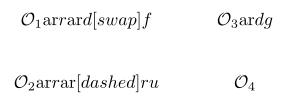 in \(\mathrm{Op}\) in which \(f\) is \(n\)-surjective and \(g\) is \(n\)-faithful, we must show that the dashed lift in \((\mathrm{Cat}_\infty)_{/\mathrm{Fin}_*}\) (which exists and is unique due to its factorization system) also lies in \(\mathrm{Op}\). This is trivial in the case that \(n < 0\), and in the case that \(n \geq 0\) this follows immediately from \((*)\).
We now turn to condition ([00KF]) of Observation B.2.1: given any morphism \(\mathcal O\xrightarrow{h} \mathcal O'\) in \(\mathrm{Op}\), we must show that the factorization  in \((\mathrm{Cat}_\infty)_{/\mathrm{Fin}_*}\) determined by its (\(n\)-surjective, \(n\)-faithful) factorization system in fact lies in \(\mathrm{Op}\). To simplify our notation, we write \(\mathcal F^{\otimes} \coloneqq \mathrm{Fact}(h)\). Additionally, we write \(\mathcal O^{\otimes} \xrightarrow{p} \mathrm{Fin}_*\), \(\mathcal O'^{\otimes} \xrightarrow{p'} \mathrm{Fin}_*\), and \(\mathcal F^{\otimes} \xrightarrow{q} \mathrm{Fin}_*\) for the indicated functors. We note immediately that the claim is trivial both when \(n = -2\) (since then \(\mathcal F^{\otimes} \xrightarrow{r} \mathcal O'^{\otimes}\) is an equivalence) and when \(n = -1\) (since then \(\mathcal F^{\otimes} \xrightarrow{r} \mathcal O'^{\otimes}\) is the inclusion of the full suboperad on the colors in the image of \(\underline{\mathcal O} \xrightarrow{\underline{h}} \underline{\mathcal O'}\)). So, we henceforth assume that \(n \geq 0\).
We first show that the functor \(\mathcal F^{\otimes} \xrightarrow{q} \mathrm{Fin}_*\) admits coCartesian lifts of inert morphisms. For this, fix an object \(X \in \mathcal F^{\otimes}_{\underline{m}_+}\) as well as an inert morphism \(\underline{m}_+ \xrightarrow{\alpha} \underline{n}_+\) in \(\mathrm{Fin}_*\). Because the functor \(\mathcal O^{\otimes} \xrightarrow{l} \mathcal F^{\otimes}\) is surjective, we may choose a lift \(\widetilde{X} \in \mathcal O_{\underline{m}_+}^{\otimes}\) of \(X\). Let \(\widetilde{X} \xrightarrow{\widetilde{\alpha}} Y\) be a \(p\)-coCartesian lift of \(\alpha\). We claim that \(X \simeq l(\widetilde{X}) \xrightarrow{l(\widetilde{\alpha})} l(Y)\) is a \(q\)-coCartesian lift of \(\alpha\). To see this, observe first that \(r(l(\widetilde{\alpha})) \simeq h(\widetilde{\alpha})\) is \(p'\)-coCartesian (since \(h\) is a morphism in \(\mathrm{Op}\)). Now, to check that \(l(\widetilde{\alpha})\) is \(q\)-coCartesian, we must check that the canonical functor  is an equivalence. This fits into a commutative diagram
  in which the two outer vertical functors are equivalences. We do so by showing that it is fully faithful and surjective. Since we have assumed that \(n \geq 0\) (so that \(n-1 \geq -1\)), the lower left horizontal functor is surjective, which implies that the middle vertical functor is surjective. To show that it is fully faithful, given any pair of objects in \(\mathcal F^{\otimes}_{l(Y)/}\), we may lift them to \(\mathcal O^{\otimes}_{Y/}\) (again using that \(n \geq 0\)), and then examine the induced commutative diagram (of the same shape) on hom-spaces. Because its left and right vertical maps are equivalences, both of its left horizontal maps are \((n-1)\)-connected, and both of its right horizontal maps are \((n-1)\)-truncated, its middle vertical map is also an equivalence since factorizations for the (\((n-1)\)-connected, \((n-1)\)-truncated) factorization system on \(\mathcal S\) are unique. So indeed, the middle vertical functor in the above diagram is an equivalence. This proves that \(\mathcal F^{\otimes} \xrightarrow{q} \mathrm{Fin}_*\) admits coCartesian lifts of inert morphisms, as desired.
The same argument proves the Segal conditions for \(\mathcal F^{\otimes}\), which establishes that \(\mathcal F^{\otimes}\) is indeed an \(\infty\)-operad. Moreover, it also proves that \(l\) preserves inert-coCartesian morphisms, and in combination with \((*)\) we find that \(r\) preserves inert-coCartesian morphisms as well. So all in all, the factorization ([00FK]) lies in the subcategory \(\mathrm{Op}\subset (\mathrm{Cat}_\infty)_{/\mathrm{Fin}_*}\), which proves condition ([00KF]) of Observation B.2.1. So indeed, the (\(n\)-surjective, \(n\)-faithful) factorization system on \((\mathrm{Cat}_\infty)_{/\mathrm{Fin}_*}\) restricts to a factorization system on this subcategory. ◻
Similar to the situation with \(\infty\)-categories outlined in warning 5.3.9, we caution the reader that the (\(n\)-surjective, \(n\)-faithful) factorization systems on \(\mathrm{Op}\) differs from the (\(n\)-truncated, \(n\)-connected) factorization systems [GK17, Prop. 4.6] derived from the presentability of \(\mathrm{Op}\). We refer the reader to warning 5.3.9 for an in-depth comparison which also applies here.
Similar to proposition 5.3.15, the orthogonality of \(n\)-surjective and \(n\)-faithful operad maps may be generalized as follows:
Given a (solid) commuting square in \(\mathrm{Op}\)  where \(F\) is \(n\)-surjective and \(G\) is \(m\)-faithful for \(m \geq n \geq -2\), the space of (dashed) lifts is \((m-n-2)\)-truncated.
Proof.
When \(m = n\), the statement follows from proposition 7.5.3. For \(m>n\), consider the commuting square of spaces: 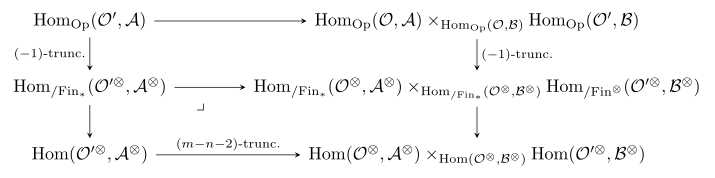 The space of lifts of our original square is by definition a fiber of the top horizontal map; it hence suffices to prove that this top horizontal map is \((m-n-2)\)-truncated.
By lemma 7.5.2, the \((\infty,1)\)-functor \(F^{\otimes} \colon \mathcal O^{\otimes} \rightarrow\mathcal O'^{\otimes}\) is \(n\)-surjective and \(G^{\otimes} \colon \mathcal A^{\otimes} \rightarrow\mathcal B^{\otimes}\) is \(m\)-faithful. Hence, it follows from proposition 5.3.15 that the bottom horizontal map is \((m-n-2)\)-truncated. By definition of the over-category, the bottom square is a pullback square; hence, the middle horizontal map is \((m-n-2)\)-truncated. Since \(\mathrm{Op}\) is a subcategory of \({\mathrm{Cat}_{\infty}}_{/\mathrm{Fin}_*}\), the top vertical maps are \((-1)\)-truncated. . Since \(m-n-2\geq -1\), the composite of the left vertical and the middle horizontal map is \((m-n-2)\)-truncated. It follows from Lemma 5.2.4.([009U]) that the top horizontal map is \((m-n-2)\)-truncated. ◻
Original source: arXiv:2401.02956v2
Original source · 2401.02956v2