Given a sequence of objects \((b_1, \ldots, b_n)\) and another object \(c\) in \(\underline{\mathrm{Alg}}_{\mathcal O}(\mathcal P)\), the multi-hom space \(\mathrm{Mul}_{\mathrm{Alg}_{\mathcal O}(\mathcal P)}(b_1, \ldots, b_n; c)\) is explicitly defined, as for any \(\infty\)-operad, as the space of lifts of the square 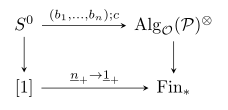 Let \(\mathrm{Fin}_* \times\mathrm{Fin}_* \xrightarrow{\wedge} \mathrm{Fin}_*\) denote the smash product symmetric monoidal structure of \(\mathrm{Fin}_*\) (see [Lur17, Not. 2.2.5.1]). Unwinding the definition of \(\mathrm{Alg}_{\mathcal O}(\mathcal P)^{\otimes}\) from [Lur17, Cons. 3.2.4.1], this space of lifts is equivalent to the full subspace of the space of lifts
 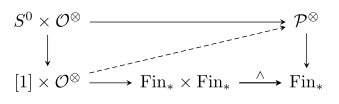 on those lifts with the property that for every vertex \(v\in [1]\), the map \(\mathcal O^{\otimes} \simeq \{v\} \times \mathcal O^{\otimes} \rightarrow[1] \times \mathcal O^{\otimes} \rightarrow\mathcal P^{\otimes}\) sends inert coCartesian morphisms to inert coCartesian morphisms. However, since \(S^0 \rightarrow[1]\) is surjective on objects this condition is automatically satisfied since it is satisfied by the top horizontal map. Thus, the space of lifts of ([00GK]), and hence the multi-hom space \(\mathrm{Mul}_{\mathrm{Alg}_{\mathcal O}(\mathcal P)}(b_1, \ldots, b_n; c)\) is equivalent to the space of lifts of ([00GL]). Hence, after adjunction, it is equivalent to the space of lifts
 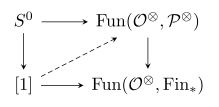 More generally, given any functor of \(\infty\)-categories \(X\rightarrow Y\) which is surjective on objects, an \(\infty\)-operad map \(\mathcal P\rightarrow\mathcal Q\) and a commuting square of \(\infty\)-categories
 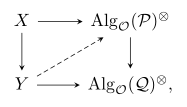 the same argument shows that the space of (dashed) lifts of this square is equivalent to the space of lifts
Original source: arXiv:2401.02956v2
Original source · 2401.02956v2