Let \(n \geq 0\) and consider categories and functors in \(\mathrm{Cat}_{(\infty,2)}\)  with faithfulness properties as indicated. Then, the map induced by applying \(h_1\) \[\mathrm{Hom}_{{\mathrm{Cat}_{(\infty, {2})}}_{/\mathcal W}}\left(\mathcal Y^{\times n}, \mathcal Z\right) \rightarrow\mathrm{Hom}_{{\mathrm{Cat}_{({1}, {1})}}_{/h_1\mathcal W}}\left(h_1 \mathcal Y^{\times n} , h_1 \mathcal Z\right)\] is an equivalence of spaces.
8.4 Proof of the main theorem[00HS]
We now prove the various truncatedness conditions appearing in Corollaries 8.3.4 – 8.3.5 in the setting of theorem 8.2.1, and assemble the obtained equivalences between spaces of (pre-)braidings into a proof of our main theorem.
We first recall from section 5 that faithful \((\infty,2)\)-functors are completely determined by their induced ordinary functors between homotopy \(1\)-categories, with the following straight-forward corollary:
Proof.
Since \(h_1 \colon \mathrm{Cat}_{(\infty, {2})}\rightarrow\mathrm{Cat}_{({1}, {1})}\) is (strongly) symmetric monoidal, this follows directly from corollary 5.5.7. ◻
Moving to locally additive \((\infty,2)\)-categories, recall from notation 6.2.3 that we call a morphism \(F \colon \mathcal X\rightarrow\mathcal Y\) in \(\mathrm{Cat}[\mathrm{add}_{k}^{B\mathbb{Z}}]\) surjective-on-objects-and-dominant-on-1-morphisms if its underlying \((\infty,2)\)-functor is surjective on objects and if for each pair of objects \(x,x' \in \mathcal X\), every object of \(\underline{\mathrm{Hom}}_{\mathcal Y}(Fx,Fx')\) is a retract of an object in the image of \(\underline{\mathrm{Hom}}_{\mathcal X}(x,x') \rightarrow\underline{\mathrm{Hom}}_{\mathcal Y}(Fx,Fx')\). The key technical statement of this section is the following straight-forward application of the (surjective-on-objects-and-dominant-on-1-morphisms, faithful)-factorization system on \(\mathrm{Cat}[\mathrm{add}_{k}^{B\mathbb{Z}}]\) constructed in corollary 6.2.4.
Let \(n \geq 0\) and consider categories and functors in \(\mathrm{Cat}[\mathrm{add}_{k}^{B\mathbb{Z}}]\)  with surjectivity and faithfulness properties as indicated (and where \(\otimes\) denotes the tensor product in \(\mathrm{Cat}[\mathrm{add}_{k}^{B\mathbb{Z}}]\)). Then, the map induced by precomposition with the tensor power \(\mathcal X^{\otimes n} \rightarrow\mathcal Y^{\otimes n}\) \[\mathrm{Hom}_{\mathrm{Cat}[\mathrm{add}_{k}^{B\mathbb{Z}}]_{/\mathcal W}}\left(\mathcal Y^{\otimes n}, \mathcal Z\right) \rightarrow\mathrm{Hom}_{\mathrm{Cat}[\mathrm{add}_{k}^{B\mathbb{Z}}]_{/\mathcal W}}\left( \mathcal X^{\otimes n} , \mathcal Z\right)\] is an equivalence of spaces.
Proof.
Since the (surjective on objects and dominant on 1-morphisms, faithful) factorization system is compatible with the monoidal structure on \(\mathrm{Cat}[\mathrm{add}_{k}^{B\mathbb{Z}}]\), as an \(n\)-fold tensor power of a functor in the left class, the functor \(\mathcal X^{\otimes n} \rightarrow\mathcal Y^{\otimes n}\) remains surjective on objects and dominant on \(1\)-morphisms, and hence the first map is an equivalence as a direct consequence of the orthogonality of surjective-on-objects-and-dominant-on-1-morphisms and faithful functors. ◻
Below, we will repeatedly use the following simple lemma:
Suppose we are given a commuting square of spaces 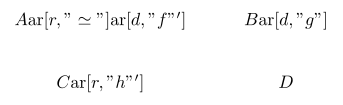 where the top horizontal map is an equivalence and where for every point \(c \in
C\), the induced map of fibers \(\mathrm{fib}_c(f) \rightarrow\mathrm{fib}_{h(c)}(g)\) is an equivalence. Then, the induced map \[\mathrm{Im}(f) \rightarrow\mathrm{Im}(g)\] is an equivalence.
where the top horizontal map is an equivalence and where for every point \(c \in
C\), the induced map of fibers \(\mathrm{fib}_c(f) \rightarrow\mathrm{fib}_{h(c)}(g)\) is an equivalence. Then, the induced map \[\mathrm{Im}(f) \rightarrow\mathrm{Im}(g)\] is an equivalence.
Proof.
The square ([00HY]) factors as 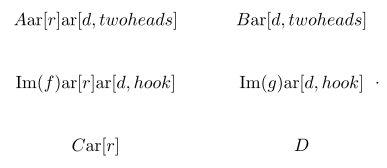 Hence, we may without loss of generality assume that \(\mathrm{Im}(f) = C\) and \(\mathrm{Im}(g) = D\), i.e. that \(f\) and \(g\) are surjective on \(\pi_0\) and prove that in this case \(h\) is an isomorphism. Working fiberwise (and identifying \(A\) with \(B\) via the given equivalence), it suffices to consider the case \(D={\sf pt}\); in other words, given a \((-1)\)-connected map \(f\colon A\twoheadrightarrow C\) so that for all \(c\in C\) the map \(\mathrm{fib}_c(f) \rightarrow A (=\mathrm{fib}_{\sf pt}(A\rightarrow{\sf pt}))\) is an isomorphism, we need to show that \(C\) is contractible. This follows directly from the long exact sequence of homotopy groups associated to the fiber sequence. ◻
Recall from ([00CP]) the adjunction  where the right adjoint forgets additivity, \(k\)-linearity and the \(\mathbb{Z}\)-action and the (strongly) symmetric monoidal left adjoint \(\mathrm{Lin}_{k, \mathrm{loc}}^{\mathbb{Z}} (-)\) sends an \((\infty,2)\)-category \(\mathcal C\) to the locally additive \(k\)-linear \((\infty,2)\)-category with local shifts with the same objects as \(\mathcal C\) and hom-categories given by the linearization \(\mathrm{Lin}_k(\underline{\mathrm{Hom}}_{\mathcal C}(a,b) \times \mathbb{Z})\) with free \(\mathbb{Z}\)-action.
Given categories and functors as in the assumptions of theorem 8.2.1. Then, for each \(n \geq 0\), the following hold:
The space \[\mathrm{Im}\left( S_n \rightarrow\mathrm{Hom}_{\mathrm{Cat}[\mathrm{st}^{B\mathbb{Z}}_{k}]_{/\mathcal D}}\left( {\mathbf K}^b_{\mathrm{loc}}(\mathcal C)^{\otimes n}, {\mathbf K}^b_{\mathrm{loc}}(\mathcal C) \right) \right)\] is \(1\)-truncated, i.e. a \(1\)-groupoid.
The map of spaces \[\begin{aligned} \mathrm{Im}\left(S_n \rightarrow\vphantom{\mathrm{Hom}_{\mathrm{Cat}[\mathrm{add}_{k}^{B\mathbb{Z}}]_{/\mathcal D}}}\right. & \left. \mathrm{Hom}_{\mathrm{Cat}[\mathrm{add}_{k}^{B\mathbb{Z}}]_{/\mathcal D}} \left( \mathcal C^{\otimes n}, {\mathbf K}^b_{\mathrm{loc}}(\mathcal C)\right)\right) \\ &\longrightarrow \mathrm{Im}\left(S_n \rightarrow\mathrm{Hom}_{\mathrm{Cat}[\mathrm{add}_{k}^{B\mathbb{Z}}]_{/\mathcal D}}\left(\mathrm{Lin}_{k, \mathrm{loc}}^{\mathbb{Z}} (\mathcal B)^{\otimes n}, {\mathbf K}^b_{\mathrm{loc}}(\mathcal C) \right) \right) \end{aligned}\] is an equivalence.
The map of spaces \[\begin{aligned} \mathrm{Im}\left( S_n \rightarrow\vphantom{\mathrm{Hom}_{{\mathrm{Cat}_{(\infty, {2})}}_{/\mathcal D}}} \right. & \left. \mathrm{Hom}_{{\mathrm{Cat}_{(\infty, {2})}}_{/\mathcal D}} \left( \mathcal B^{\times n}, {\mathbf K}^b_{\mathrm{loc}}(\mathcal C)\right) \right) \\ &\longrightarrow \mathrm{Im}\left( S_n \rightarrow\mathrm{Hom}_{{\mathrm{Cat}_{({1}, {1})}}_{/h_1\mathcal D}}\left(h_1\mathcal B^{\times n}, h_1 {\mathbf K}^b_{\mathrm{loc}}(\mathcal C) \right) \right) \end{aligned}\] is an equivalence
We warn the reader that the functor \({\mathbf K}^b_{\mathrm{loc}}(\mathcal C) \rightarrow\mathcal D\) is not faithful, and hence Propositions 8.4.1 and 8.4.2 do not apply directly.
Proof.
We first prove the part ([00I3]). Since the monoidal structure on \(\mathcal C\rightarrow{\mathbf K}^b_{\mathrm{loc}}(\mathcal C)\) arises from adjunction, the relevant maps from \(S_n\) all factor as:  Since \(\mathcal C\rightarrow\mathcal D\) is faithful, it follows from proposition 8.4.2 that the top horizontal map is an equivalence. Moreover, for every \(f\in \mathrm{Hom}_{\mathrm{Cat}[\mathrm{add}^{B \mathbb{Z}}_k]_{/\mathcal D}}(\mathcal C^{\otimes n}, {\mathbf K}^b_{\mathrm{loc}}(\mathcal C))\), the induced map between the fibers of the vertical maps is \[\mathrm{Hom}_{\mathrm{Cat}[\mathrm{add}^{B \mathbb{Z}}_k]_{/{\mathbf K}^b_{\mathrm{loc}}(\mathcal C)}}(\mathcal C^{\otimes n}, \mathcal C) \rightarrow\mathrm{Hom}_{\mathrm{Cat}[\mathrm{add}_{k}^{B\mathbb{Z}}]_{/{\mathbf K}^b_{\mathrm{loc}}(\mathcal C)}}\left(\mathrm{Lin}_{k, \mathrm{loc}}^{\mathbb{Z}} (\mathcal B)^{\otimes n}, \mathcal C\right).\] It follows from proposition 4.3.2 that \(\mathcal C\rightarrow{\mathbf K}^b_{\mathrm{loc}}(\mathcal C)\) is faithful. Hence, this map between fibers is also an equivalence by proposition 8.4.2. Therefore, it follows from lemma 8.4.3 that the induced map between the full images of the vertical maps is an equivalence, and hence so is also the induced map between the full images of \(S_n\).
The proof of part ([00I3]) is entirely analogous: The relevant maps from \(S_n\) all factor as 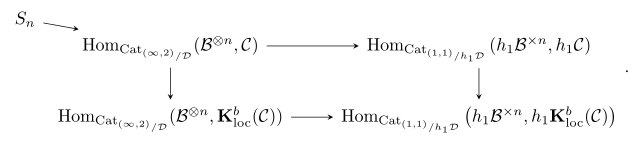 Since \(\mathcal C\rightarrow\mathcal D\) is faithful by assumption, it follows from corollary 8.4.1 that the top horizontal map is an equivalence. The induced map between the fibers of the vertical maps at an \(f\in \mathrm{Hom}_{{\mathrm{Cat}_{(\infty, {2})}}_{/\mathcal D}}(\mathcal B^{\otimes n}, {\mathbf K}^b_{\mathrm{loc}}(\mathcal C))\) is given by \[\mathrm{Hom}_{{\mathrm{Cat}_{(\infty, {2})}}_{/{\mathbf K}^b_{\mathrm{loc}}(\mathcal C)}}(\mathcal B^{\otimes n}, \mathcal C) \rightarrow\mathrm{Hom}_{{\mathrm{Cat}_{({1}, {1})}}_{/h_1{\mathbf K}^b_{\mathrm{loc}}(\mathcal C)}}\left(h_1 \mathcal B^{\times n}, h_1\mathcal C\right)\] and hence is also an equivalence by corollary 8.4.1 since also \(\mathcal C\rightarrow{\mathbf K}^b_{\mathrm{loc}}(\mathcal C)\) is faithful. Therefore, it follows from lemma 8.4.3 that the induced map between the full images of the vertical maps is an equivalence, and hence so is also the induced map between the full images of \(S_n\).
Part ([00I2]) follows from combining parts ([00I3]) and ([00I4]): It follows from adjunction and monoidality of \({\mathbf K}^b_{\mathrm{loc}}(-)\) that \[\mathrm{Hom}_{\mathrm{Cat}[\mathrm{st}^{B\mathbb{Z}}_{k}]_{/\mathcal D}}\left( {\mathbf K}^b_{\mathrm{loc}}(\mathcal C)^{\otimes n}, {\mathbf K}^b_{\mathrm{loc}}(\mathcal C) \right) \simeq \mathrm{Hom}_{\mathrm{Cat}[\mathrm{add}_{k}^{B\mathbb{Z}}]_{/\mathcal D}}\left( \mathcal C^{\otimes n}, {\mathbf K}^b_{\mathrm{loc}}(\mathcal C)\right).\] Similarly, it follows from adjunction and monoidality of \(\mathrm{Lin}_{k, \mathrm{loc}}^{\mathbb{Z}} (-)\) that \[\mathrm{Hom}_{\mathrm{Cat}[\mathrm{add}_{k}^{B\mathbb{Z}}]_{/\mathcal D}}\left( \mathrm{Lin}_{k, \mathrm{loc}}^{\mathbb{Z}} (\mathcal B)^{\otimes n}, {\mathbf K}^b_{\mathrm{loc}}(\mathcal C) \right) \simeq \mathrm{Hom}_{{\mathrm{Cat}_{(\infty, {2})}}_{/\mathcal D}} \left( \mathcal B^{\times n}, {\mathbf K}^b_{\mathrm{loc}}(\mathcal C)\right).\] Hence, combining the second and third statement, we find that \[\mathrm{Im}\left( S_n \rightarrow\mathrm{Hom}_{\mathrm{Cat}[\mathrm{st}^{B\mathbb{Z}}_{k}]_{/\mathcal D}}\left( {\mathbf K}^b_{\mathrm{loc}}(\mathcal C)^{\otimes n}, {\mathbf K}^b_{\mathrm{loc}}(\mathcal C) \right) \right) \simeq \mathrm{Im}\left( S_n \rightarrow\mathrm{Hom}_{{\mathrm{Cat}_{({1}, {1})}}_{/h_1\mathcal D}}\left(h_1\mathcal B^{\times n}, h_1 {\mathbf K}^b_{\mathrm{loc}}(\mathcal C) \right) \right)\] which is — as a mapping space of \(\mathrm{Cat}_{({1}, {1})}\) — a \(1\)-groupoid. ◻
Now we prove the main theorem:
Proof of theorem 8.2.1.
Given categories and functors as in part ([00H4]) of theorem 8.2.1, we will prove that the composite \[\begin{aligned} \mathrm{Braid}_{\mathrm{Cat}[\mathrm{st}^{B\mathbb{Z}}_{k}]_{/\mathcal D}}({\mathbf K}^b_{\mathrm{loc}}(\mathcal C)) &\rightarrow\mathrm{PreBraid}_{{\mathrm{Cat}_{({1}, {1})}}_{/h_1\mathcal D}}(h_1 \mathcal C\rightarrow h_1{\mathbf K}^b_{\mathrm{loc}}(\mathcal C)) \\ \nonumber &\rightarrow\mathrm{PreBraid}_{{\mathrm{Cat}_{({1}, {1})}}_{/h_1\mathcal D}}(h_1 \mathcal B\rightarrow h_1{\mathbf K}^b_{\mathrm{loc}}(\mathcal C)) \end{aligned}\] is an equivalence. Note that part ([00H2]) of theorem 8.2.1 then follows by taking \(\mathcal B\rightarrow\mathcal C\) to be the identity \(\mathcal C\rightarrow\mathcal C\) (which clearly satisfies the required conditions). Then, the second statement follows since the first map and the composite in ([00I7]) are equivalences, and hence so is the second map.
To prove that ([00I7]) is an equivalence, note that it follows from lemma 6.3.1 that the condition on \(\mathcal B\rightarrow\mathcal C\) in the statement of theorem 8.2.1.([00H4]) equivalently asserts that \(\mathrm{Lin}_{k, \mathrm{loc}}^{\mathbb{Z}} (\mathcal B) \rightarrow\mathcal C\) is surjective on objects and dominant on \(1\)-morphisms.
We now unpack ([00I7]) as a sequence of equivalences of spaces of (pre-)braidings:
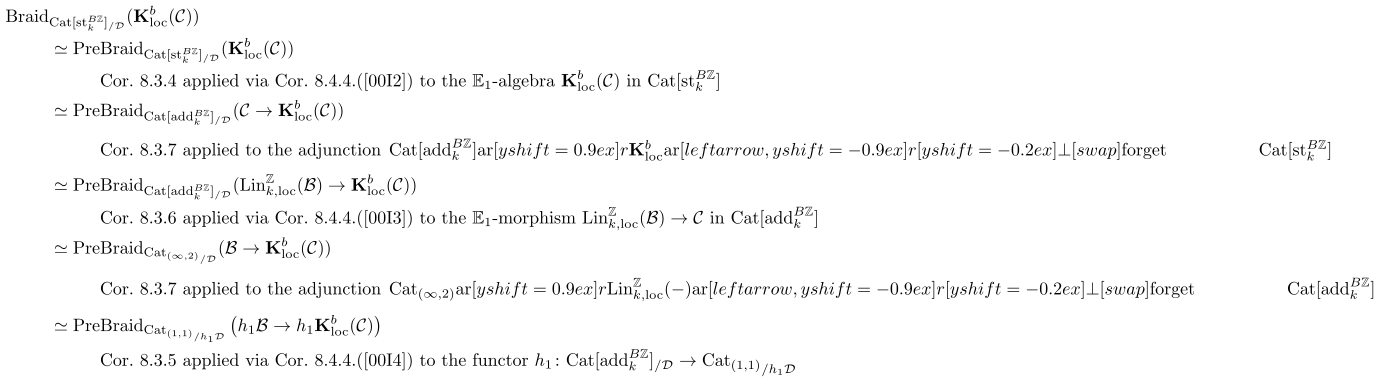 Diagram references: 8.3.4 8.4.4 ([00I2]) 8.3.7 8.3.6 8.4.4 ([00I3]) 8.3.7 8.3.5 8.4.4 ([00I4]) This completes the proof of theorem 8.2.1. ◻
Original source: arXiv:2401.02956v2
Original source · 2401.02956v2