4.4 \(\infty\)-Morita theory[008D]
For any monoidal \(1\)-category \(\mathbb V\) with reflective coequalizers distributing over the tensor product, one may construct a Morita \(2\)-category whose objects are algebras in \(\mathbb V\), whose \(1\)-morphisms are bimodules and whose \(2\)-morphisms are bimodule maps. If \(\mathbb V\) is moreover presentably symmetric monoidal, and hence self-enriched, then also the categories of bimodules \(_{A}\mathrm{BMod}_B(\mathbb V)\) will inherit a \(\mathbb V\)-enrichment and thus the Morita 2-category inherits a \(\mathbb V\)-enrichment at the level of \(2\)-morphisms. The goal of this section it to establish \(\infty\)-categorical variants of these statements to be used for our homotopy coherent construction of the Soergel \((2,2)\)-category in section 6.
Various \(\infty\)-categorical constructions of \((\infty,2)\)-Morita categories exist in the literature, see e.g. [Lur17], [Hau17], [JS17] and references therein. Due to their compatibility with enrichment, we follow ideas from [Lur17]. Our starting point is the following:
[008E]
Proposition 4.4.1. ([Lur17, Thm. 4.8.5.15, Rem. 4.8.4.9]).
Let \(\mathbb V\in \mathrm{CAlg}(\mathrm{Pr}^\mathrm{L})\) and \(A, B \in \mathrm{Alg}(\mathbb V)\).
The \(\infty\)-category \(\mathrm{RMod}_A(\mathbb V)\) carries a left action by \(\mathbb V\), and can be viewed as an object in \(\mathrm{Mod}_{\mathbb V}(\mathrm{Pr}^\mathrm{L})\). This defines a symmetric monoidal functor \[\mathrm{RMod}_{-}(\mathbb V) \colon \mathrm{Alg}(\mathbb V) \rightarrow\mathrm{Mod}_\mathbb V(\mathrm{Pr}^\mathrm{L}).\]
Given an \(A\)–\(B\) bimodule \(_{A}M_{B} \in {}_{A}\mathrm{BMod}_{B}(\mathbb V)\), tensoring with \(M\) over \(A\) \[- \otimes_{A}M_{B} \colon \mathrm{RMod}_{A}(\mathbb V) \rightarrow\mathrm{RMod}_{B}(\mathbb V)\] defines a cocontinuous \(\mathbb V\)-linear functor, i.e. an object in \(\mathrm{Fun}^L_{\mathbb V}(\mathrm{RMod}_A(\mathbb V), \mathrm{RMod}_B(\mathbb V))\). These assemble into an equivalence: \[{}_{A}\mathrm{BMod}_{B}(\mathbb V) \xrightarrow{\simeq} \mathrm{Fun}^L_{\mathbb V}(\mathrm{RMod}_A(\mathbb V), \mathrm{RMod}_B(\mathbb V)).\] Furthermore, composition of functors corresponds to the relative tensor product of bimodules.
We can therefore think of the full subcategory of \(\mathrm{Mod}_{\mathbb V}(\mathrm{Pr}^\mathrm{L})\) on those presentable \(\mathbb V\)-module categories which are of the form \(\mathrm{RMod}_A(\mathbb V)\) for algebra objects \(A\) in \(\mathbb V\), as an \(\infty\)-categorical Morita category with objects algebras, morphisms given by bimodules and composition given by relative tensor product (cf. [Lur17, Rem. 4.8.4.9]). In the following, we will be interested in versions of the Morita category where we further restrict our bimodules requiring certain compactness or projectivity properties:
[008H]
Notation 4.4.2.
Given \(\mathbb V\in \mathrm{Alg}(\mathrm{Pr}^{\mathrm{L},\mathrm{cp}})\) and \(A, B \in \mathrm{Alg}(\mathbb V)\), we denote by \[{}_{A}\mathrm{BMod}^{\mathrm{cp}}_{B}(\mathbb V)\subseteq {}_{A}\mathrm{BMod}_{B}(\mathbb V)\]the full subcategory on those \(A\)–\(B\)-bimodules which are compact-projective as right \(B\)-modules.
Similarly, given \(\mathbb V\in \mathrm{Alg}(\mathrm{Pr}^{\mathrm{L},\mathrm{c}})\) and \(A, B \in \mathrm{Alg}(\mathbb V)\), we denote by \[{}_{A}\mathrm{BMod}^{\mathrm{c}}_{B}(\mathbb V)\subseteq {}_{A}\mathrm{BMod}_{B}(\mathbb V)\] the full subcategory on those \(A\)–\(B\)-bimodules which are compact as right \(B\)-modules.
For \(\mathbb V\in \mathrm{CAlg}(\mathrm{Pr}^{\mathrm{L},\mathrm{c}})\) and \(A\in \mathrm{Alg}(\mathbb V)\), the \(\infty\)-category \(\mathrm{RMod}_{A}(\mathbb V)\) is compactly generated and the \(\mathbb V\)-action preserves compact generators, see lemma 3.2.12.([004G])-([004H]); the functor \(\mathrm{RMod}_{-}(\mathbb V) \colon \mathrm{Alg}(\mathbb V) \rightarrow\mathrm{Mod}_{\mathbb V}(\mathrm{Pr}^\mathrm{L})\) thus factors through \(\mathrm{Mod}_{\mathbb V}(\mathrm{Pr}^{\mathrm{L},\mathrm{c}})\). The analogous statement holds for \(\mathbb V\in \mathrm{CAlg}(\mathrm{Pr}^{\mathrm{L},\mathrm{cp}})\) by lemma 3.2.12.([004C])-([004D]).
[008I]
Corollary 4.4.3.
The following hold.
For \(\mathbb V\in \mathrm{CAlg}(\mathrm{Pr}^{\mathrm{L},\mathrm{cp}})\), \(A, B \in \mathrm{Alg}(\mathbb V)\) and \({}_{A}M_B \in{}_A\mathrm{BMod}_B(\mathbb V)\), the functor \[- \otimes_{A}M \colon \mathrm{RMod}_{A}(\mathbb V) \rightarrow\mathrm{RMod}_{B}(\mathbb V)\] preserves compact projective objects if and only if \(M_B\), viewed as a right \(B\)-module, is a compact projective object in \(\mathrm{RMod}_{B}(\mathbb V)\). The equivalence from proposition 4.4.1.([008G]) restricts to \[{}_{A}\mathrm{BMod}^{\mathrm{cp}}_{B}(\mathbb V) \simeq \mathrm{Fun}^{L, \mathrm{cp}}_{\mathbb V}(\mathrm{RMod}_A(\mathbb V), \mathrm{RMod}_B(\mathbb V)).\]
For \(\mathbb V\in \mathrm{CAlg}(\mathrm{Pr}^{\mathrm{L},\mathrm{c}})\), \(A, B \in \mathrm{Alg}(\mathbb V)\) and \({}_{A}M_B \in{}_A\mathrm{BMod}_B(\mathbb V)\), the functor \[- \otimes_{A}M \colon \mathrm{RMod}_{A}(\mathbb V) \rightarrow\mathrm{RMod}_{B}(\mathbb V)\] preserves compact objects if and only if \(M\), viewed as a right \(B\)-module, is a compact object in \(\mathrm{RMod}_{B}(\mathbb V)\). The equivalence from proposition 4.4.1.([008G]) restricts to an equivalence \[{}_{A}\mathrm{BMod}^{\mathrm{c}}_{B}(\mathbb V) \simeq \mathrm{Fun}^{L, \mathrm{c}}_{\mathbb V}(\mathrm{RMod}_A(\mathbb V), \mathrm{RMod}_B(\mathbb V)).\]
[008L]
Proof.
We will prove statement ([008J]), the proof of statement ([008K]) is completely analogous. Since \(\mathrm{RMod}_A(\mathbb V)\) is projectively generated by free modules \(v\otimes A\), see lemma 3.2.12.([004E]), where \(v \in \mathbb V\) is compact projective, it suffices to show that \(-\otimes_A M \colon \mathrm{RMod}_{A}(\mathbb V) \rightarrow\mathrm{RMod}_B(\mathbb V)\) preserves compact projective objects if and only if it sends such free modules \(v\otimes A\) to compact projectives in \(\mathrm{RMod}_B(\mathbb V)\) for all compacts \(v\in \mathbb V\). Since the action functor \(\mathbb V\times \mathrm{RMod}_B(\mathbb V) \rightarrow\mathrm{RMod}_B(\mathbb V)\) takes pairs of compact projectives to compact projectives by lemma 3.2.12.([004D]), this in turn is equivalent to the assertion that \(A\otimes_A M_B \simeq M_B \in \mathrm{RMod}_B(\mathbb V)\) is compact projective. ◻
We are now ready to define our Morita categories of interest.
[008M]
Definition 4.4.4.
Fix \(\mathcal Z\in \mathrm{CAlg}(\mathcal S)\).
Given \(\mathbb{K}\in \mathrm{CAlg}(\mathrm{Sp}_{\geq 0})\), we define \(\mathrm{Morita}^{\mathrm{cp}}(\mathrm{Mod}_{\mathbb{K}}^{\geq 0, \mathcal Z})\) to be the full symmetric monoidal \(\mathrm{add}_{\mathbb{K}}^{B\mathcal Z}\)-enriched subcategory of \(\mathrm{Pr}^{\mathrm{L}, \mathrm{cp}}_{{\mathrm{Mod}_{\mathbb{K}}^{\geq 0,\mathcal Z}}}\) (equipped with \(\mathrm{add}_{\mathbb{K}}^{B\mathcal Z}\)-enrichment as in observation 4.3.5) on the objects in the image of the symmetric monoidal functor \(\mathrm{Alg}(\mathrm{Mod}_{\mathbb{K}}^{\geq 0, \mathcal Z}) \rightarrow\mathrm{Pr}^{\mathrm{L}, \mathrm{cp}}_{{\mathrm{Mod}_{\mathbb{K}}^{\geq 0,\mathcal Z}}}\) from proposition 4.4.1.([008F]).
Given \(\mathbb{K}\in \mathrm{CAlg}(\mathrm{Sp})\), we define \(\mathrm{Morita}^{\mathrm{c}}(\mathrm{Mod}_{\mathbb{K}}^{\mathcal Z})\) to be the full symmetric monoidal \(\mathrm{st}_{\mathbb{K}}^{B\mathcal Z}\)-enriched subcategory of \(\mathrm{Pr}^{\mathrm{L}, \mathrm{c}}_{\mathrm{Mod}_{\mathbb{K}}^{\mathcal Z}}\) (equipped with \(\mathrm{st}_{\mathbb{K}}^{B\mathcal Z}\)-enrichment as in observation 4.3.5) on the objects in the image of the symmetric monoidal functor \(\mathrm{Alg}(\mathrm{Mod}_{\mathbb{K}}^{ \mathcal Z}) \rightarrow\mathrm{Pr}^{\mathrm{L}, \mathrm{c}}_{\mathrm{Mod}_{\mathbb{K}}^{\mathcal Z}}\) from proposition 4.4.1.([008F]).
We unpack the relevant properties of these Morita categories:
[008N]
Corollary 4.4.5.
Fix \(\mathcal Z\in \mathrm{CAlg}(\mathcal S)\).
Given \(\mathbb{K}\in \mathrm{CAlg}(\mathrm{Sp}_{\geq 0})\), definition 4.4.4 defines a large symmetric monoidal \(\mathrm{add}_{\mathbb{K}}^{B\mathcal Z}\)-enriched \(\infty\)-category \[\mathrm{Morita}^{\mathrm{cp}}(\mathrm{Mod}_{\mathbb{K}}^{\geq 0, \mathcal Z}) \in \mathrm{CAlg}(\widehat{\mathrm{Cat}}[\mathrm{add}_{\mathbb{K}}^{B\mathcal Z}])\] with a symmetric monoidal surjective-on-objects functor \(\mathrm{Alg}(\mathrm{Mod}_{\mathbb{K}}^{\geq 0, \mathcal Z}) \rightarrow\mathrm{Morita}^{\mathrm{cp}}(\mathrm{Mod}_{\mathbb{K}}^{\geq 0, \mathcal Z})\) and such that the \(\mathrm{add}_{\mathbb{K}}^{B\mathcal Z}\)-enriched hom between \(A, B\) in \(\mathrm{Alg}(\mathrm{Mod}_{\mathbb{K}}^{\geq 0, \mathcal Z})\) is given by \[{}_A\mathrm{BMod}^{\mathrm{cp}}_{B}(\mathrm{Mod}_{\mathbb{K}}^{\geq 0, \mathcal Z}) \in \mathrm{add}_{\mathbb{K}}^{B\mathcal Z},\] with the \(\mathrm{CProj}_{\mathbb{K}}\) and \(\mathcal Z\)-action induced by their respective actions on \(\mathrm{Mod}_{\mathbb{K}}^{\geq 0, \mathcal Z}\).
The symmetric monoidal structure is given by the tensor product in \(\mathrm{Mod}_{\mathbb{K}}^{\geq 0, \mathcal Z}\), and the composition of \(1\)-morphisms is given by the relative tensor product of bimodules therein.
Given \(\mathbb{K}\in \mathrm{CAlg}(\mathrm{Sp})\), definition 4.4.4 defines a large symmetric monoidal \(\mathrm{st}_{\mathbb{K}}^{B\mathcal Z}\)-enriched \(\infty\)-category \[\mathrm{Morita}^{\mathrm{c}}(\mathrm{Mod}_{\mathbb{K}}^{ \mathcal Z}) \in \mathrm{CAlg}(\widehat{\mathrm{Cat}}[\mathrm{st}_{\mathbb{K}}^{B\mathcal Z}])\] with a symmetric monoidal surjective-on-objects functor \(\mathrm{Alg}(\mathrm{Mod}_{\mathbb{K}}^{\mathcal Z}) \rightarrow\mathrm{Morita}^{\mathrm{cp}}(\mathrm{Mod}_{\mathbb{K}}^{ \mathcal Z})\), and such that the \(\mathrm{st}_{\mathbb{K}}^{B\mathcal Z}\)-enriched hom between \(A, B\) in \(\mathrm{Alg}(\mathrm{Mod}_{\mathbb{K}}^{\mathcal Z})\) is given by \[{}_A\mathrm{BMod}^{\mathrm{c}}_{B}(\mathrm{Mod}_{\mathbb{K}}^{\mathcal Z}) \in \mathrm{st}_{\mathbb{K}}^{B\mathcal Z},\] with the \(\mathrm{Perf}_{\mathbb{K}}\) and \(\mathcal Z\)-action induced by their respective actions on \(\mathrm{Mod}_{\mathbb{K}}^{\mathcal Z}\).
The symmetric monoidal structure is given by the tensor product in \(\mathrm{Mod}_{\mathbb{K}}^{ \mathcal Z}\), and the composition of \(1\)-morphisms is given by the relative tensor product of bimodules therein.
Given \(\mathbb{K}\in \mathrm{CAlg}(\mathrm{Sp}_{\geq 0})\), the symmetric monoidal inclusion \(\mathrm{Mod}_{\mathbb{K}}^{\geq 0, \mathcal Z} \hookrightarrow \mathrm{Mod}_{\mathbb{K}}^{\mathcal Z}\) from observation 3.5.17 induces a symmetric monoidal \(\mathrm{add}_{\mathbb{K}}^{B\mathcal Z}\)-enriched functor \[\mathrm{Morita}^{\mathrm{cp}}(\mathrm{Mod}_{\mathbb{K}}^{\geq 0, \mathcal Z}) \rightarrow\mathrm{Morita}^{\mathrm{c}}(\mathrm{Mod}_{\mathbb{K}}^{ \mathcal Z}),\] where \(\mathrm{Morita}^{\mathrm{c}}(\mathrm{Mod}_{\mathbb{K}}^{ \mathcal Z})\) is considered \(\mathrm{add}_{\mathbb{K}}^{B\mathcal Z}\)-enriched by transporting its \(\mathrm{st}_{\mathbb{K}}^{B\mathcal Z}\)-enrichment along the forgetful functor \(\mathrm{st}_{\mathbb{K}}^{B\mathcal Z}\rightarrow\mathrm{add}_{\mathbb{K}}^{B\mathcal Z}\).
On objects, this functor acts via the inclusion \((\mathrm{Alg}(\mathrm{Mod}_{\mathbb{K}}^{\geq 0, \mathcal Z}))^{\simeq} \hookrightarrow (\mathrm{Alg}(\mathrm{Mod}_{\mathbb{K}}^{\mathcal Z}))^{\simeq}\), and on hom-categories as the additive \(\mathbb{K}\)-linear \(\mathcal Z\)-equivariant (i.e. \(\mathrm{add}_{\mathbb{K}}^{B\mathcal Z}\)-morphism) full inclusion \[{}_A\mathrm{Mod}^{\mathrm{cp}}_B(\mathrm{Mod}_{\mathbb{K}}^{\geq 0, \mathcal Z}) \hookrightarrow {}_A\mathrm{Mod}^{c}_B(\mathrm{Mod}_{\mathbb{K}}^{\mathcal Z}).\]
[008S]
Proof.
Statements ([008P]) and ([008Q]) follow immediately from corollary 4.4.3 and observation 4.3.5. For statement ([008R]), the inclusion \(\mathrm{Mod}_{\mathbb{K}}^{\geq 0, \mathcal Z} \hookrightarrow \mathrm{Mod}_{\mathbb{K}}^{\mathcal Z}\) induces a symmetric monoidal left adjoint functor \[\begin{aligned}
\mathrm{Pr}^{\mathrm{L}, \mathrm{cp}}_{{\mathrm{Mod}_{\mathbb{K}}^{\geq 0,\mathcal Z}}}&\simeq \mathrm{Mod}_{\mathrm{Mod}_{\mathbb{K}}^{\geq 0, \mathcal Z}}(\mathrm{Pr}^{\mathrm{L},\mathrm{cp}}) \xrightarrow{\mathrm{Mod}_{\mathrm{Mod}_{\mathbb{K}}^{\geq 0, \mathcal Z}}\left( \mathrm{Pr}^{\mathrm{L},\mathrm{cp}}\rightarrow\mathrm{Pr}^{\mathrm{L},\mathrm{c}}\right)} \mathrm{Mod}_{\mathrm{Mod}_{\mathbb{K}}^{\geq 0, \mathcal Z}}(\mathrm{Pr}^{\mathrm{L},\mathrm{c}})\\& \xrightarrow{-\otimes_{\mathrm{Mod}_{\mathbb{K}}^{\geq 0, \mathcal Z}} \mathrm{Mod}_{\mathbb{K}}^{\mathcal Z}}\mathrm{Mod}_{\mathrm{Mod}_{\mathbb{K}}^{\mathcal Z}}(\mathrm{Pr}^{\mathrm{L},\mathrm{c}}) \simeq \mathrm{Pr}^{\mathrm{L}, \mathrm{c}}_{\mathrm{Mod}_{\mathbb{K}}^{\mathcal Z}}.
\end{aligned}\] Analogous to proposition 3.4.5, this functor fits into a commuting square in \(\mathrm{CAlg}(\mathrm{Pr}^\mathrm{L})\) of the form 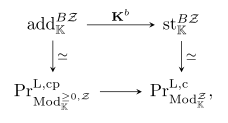 where the top horizontal morphism is left adjoint to the forgetful functor. Using ([008T]) to consider the bottom horizontal morphism as a morphism in \(\mathrm{CAlg}(\mathrm{Pr}^\mathrm{L})_{\mathrm{add}_{\mathbb{K}}^{B\mathcal Z}/}\), it enhances by proposition 4.1.7 to a symmetric monoidal \(\mathrm{add}_{\mathbb{K}}^{B\mathcal Z}\)-enriched functor \(\mathrm{Pr}^{\mathrm{L}, \mathrm{cp}}_{{\mathrm{Mod}_{\mathbb{K}}^{\geq 0,\mathcal Z}}}\rightarrow\mathrm{Pr}^{\mathrm{L}, \mathrm{c}}_{\mathrm{Mod}_{\mathbb{K}}^{\mathcal Z}}\). (By commutativity of ([008T]) and observation 4.1.2, we may understand the \(\mathrm{add}_{\mathbb{K}}^{B\mathcal Z}\)-enrichment of \(\mathrm{Pr}^{\mathrm{L}, \mathrm{c}}_{\mathrm{Mod}_{\mathbb{K}}^{\mathcal Z}}\) as induced by restricting its \(\mathrm{st}_{\mathbb{K}}^{B\mathcal Z}\)-enrichment from observation 4.3.5 along the forgetful functor \(\mathrm{st}_{\mathbb{K}}^{B\mathcal Z}\rightarrow\mathrm{add}_{\mathbb{K}}^{B\mathcal Z}\).) For an algebra \(A\in \mathrm{Alg}(\mathrm{Mod}_{\mathbb{K}}^{\geq 0, \mathcal Z})\), it follows from [Lur17, Thm. 4.8.4.6] that \[\mathrm{RMod}_A(\mathrm{Mod}_{\mathbb{K}}^{\geq 0, \mathcal Z}) \otimes_{\mathrm{Mod}_{\mathbb{K}}^{\geq 0, \mathcal Z}} \mathrm{Mod}_{\mathbb{K}}^{\mathcal Z} \simeq \mathrm{RMod}_{A}(\mathrm{Mod}_{\mathbb{K}}^{\mathcal Z}).\] Thus, the \(\mathrm{add}_{\mathbb{K}}^{B\mathcal Z}\)-enriched functor \(\mathrm{Pr}^{\mathrm{L}, \mathrm{cp}}_{{\mathrm{Mod}_{\mathbb{K}}^{\geq 0,\mathcal Z}}}\rightarrow\mathrm{Pr}^{\mathrm{L}, \mathrm{c}}_{\mathrm{Mod}_{\mathbb{K}}^{\mathcal Z}}\) restricts to an \(\mathrm{add}_{\mathbb{K}}^{B\mathcal Z}\)-enriched functor between the full subcategories \[\mathrm{Morita}^{\mathrm{cp}}(\mathrm{Mod}_{\mathbb{K}}^{\geq 0, \mathcal Z}) \rightarrow\mathrm{Morita}^{\mathrm{c}}(\mathrm{Mod}_{\mathbb{K}}^{ \mathcal Z}).\] Its explicit description on additive hom-categories can be unpacked from observation 4.1.2. ◻