5.2 Truncatedness and connectedness[009L]
Here we recall the standard definition of the (\(n\)-connected, \(n\)-truncated) factorization system on the \(\infty\)-category \(\mathcal S\) of spaces. This will be the base case for our factorization systems on \((\infty, k)\)-categories.
[009M]
Definition 5.2.1.
For any \(n \geq 0\), a space \(X \in \mathcal S\) is called
\(n\)-connected if \(X\) is connected and if \(\pi_i(X,x) = 0\) for all \(i \leq n\) and all \(x \in X\) and
\(n\)-truncated if \(\pi_i(X,x) = 0\) for all \(i > n\) and all \(x \in X\).
We extend this to the case that \(n=-1\) by declaring that \(X\) is
and to the case that \(n=-2\) by declaring that \(X\) is
For any \(n \geq -2\), we declare that a map of spaces is \(n\)-connected (resp. \(n\)-truncated) if its fibers are all such. By [Lur09, Ex. 5.2.8.16] the classes of (\(n\)-connected, \(n\)-truncated) maps form a factorization system of small generation on \(\mathcal S\), generated by the single morphism \(S^{n+1} \rightarrow{\sf pt}\). See also example B.1.16.
[009N]
Example 5.2.2.
To obtain examples, the following explicit alternative descriptions of \(n\)-connectedness and \(n\)-truncatedness for low values of \(n\) are useful.
A space is \(0\)-connected if and only if it is connected (and in particular nonempty), and it is \(1\)-connected if and only if it is simply connected (and in particular connected).
A map of spaces is always \((-2)\)-connected, and it is \((-1)\)-connected if and only if it is surjective.
A space is \(n\)-truncated if and only if it is an \(n\)-type, e.g. it is \(0\)-truncated if and only if it is discrete.
A map of spaces is \((-2)\)-truncated if and only if it is an equivalence, it is \((-1)\)-truncated if and only if it is a monomorphism, and it is \(0\)-truncated if and only if it is a covering map (in the classical sense).
[009Q]
Observation 5.2.3.
We note the following basic facts, which we use without further comment.
For any \(n \geq -2\), a space \(X\) is \(n\)-connected (resp. \(n\)-truncated) if and only if the map \(X \rightarrow{\sf pt}\) is such.
For any \(n \geq -2\), a space is both \(n\)-connected and \(n\)-truncated if and only if it is contractible, and hence a map is both \(n\)-connected and \(n\)-truncated if and only if it is an equivalence.
For any \(n \geq -2\), we have the implications \[\text{$n$-connected} \Longleftarrow \text{$(n+1)$-connected}
\qquad
\text{and}
\qquad
\text{$n$-truncated} \Longrightarrow \text{$(n+1)$-truncated}\] for spaces and hence also for maps of spaces.
For any \(n \geq -2\), both \(n\)-connected and \(n\)-truncated maps are stable under base change.
By the long exact sequence in homotopy groups, for any \(n \geq -1\), a map \(X \xrightarrow{f} Y\) of spaces is
\(n\)-connected if and only if for every \(x \in X\) the map \(\pi_i(X,x) \xrightarrow{\pi_i(f)} \pi_i(Y,f(x))\) is
and
\(n\)-truncated if and only if for every \(x \in X\) the map \(\pi_i(X,x) \xrightarrow{\pi_i(f)} \pi_i(Y,f(x))\) is
Throughout, we will use the following cancellation properties generalizing well-known facts about surjections and injections of sets.
[009S]
Lemma 5.2.4.
Suppose that \(A \xrightarrow{f} B \xrightarrow{g} C\) are composable maps of spaces, and let \(n \geq -2\).
If \(g\) is \((n+1)\)-connected and \(gf\) is \(n\)-connected, then \(f\) is \(n\)-connected.
If \(g\) is \((n+1)\)-truncated and \(gf\) is \(n\)-truncated, then \(f\) is \(n\)-truncated.
[009V]
Proof.
Since connectivity and truncatedness of maps of spaces are defined fiberwise, we may henceforth assume that \(C=*\). In this case, (1) and (2) become:
\(f \colon A \rightarrow B\) is a map from an \(n\)-connected space to an \((n+1)\)-connected space, then the fibers of \(f\) are \(n\)-connected.
If \(f\colon A \rightarrow B\) is a map from an \(n\)-truncated space to an \((n+1)\)-truncated space, then the fibers of \(f\) are \(n\)-truncated.
For \(n=-2\), these statements are obvious, for higher \(n\) they can be easily verified from the long exact sequence of homotopy groups associated to \(f\). ◻
[009W]
Proposition 5.2.5.
Fix any \(n \geq -2\). A commutative square of spaces 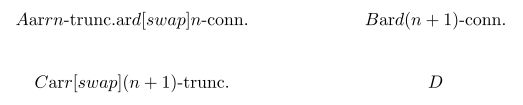 in which the maps are truncated and connected as indicated is necessarily a pullback square.
[009X]
Proof.
Consider the commuting diagram  where we have used that truncated and connected maps are stable under pullback. By Lemma 5.2.4, the map \(A \rightarrow B \times_D C\) is both \(n\)-connected and \(n\)-truncated, and so is an equivalence. ◻