5.3 Factorization systems for \((\infty,k)\)-categories[009Y]
In this subsection we define \(n\)-surjective and \(n\)-faithful morphisms in \(\mathrm{Cat}_{(\infty, {k})}\) and prove in theorem 5.3.7 that they form factorization systems, using the main result theorem B.4.1 of section B. Furthermore, we establish various properties of these factorization systems.
[009Z]
Definition 5.3.1.
Consider a morphism \(\mathcal C\xrightarrow{F} \mathcal D\) in \(\mathrm{Cat}_{(\infty, {k})}\) for some \(k \geq 0\) and let \(n\geq -2\).
We declare that any \(F\) is \((-2)\)-surjective and that \(F\) is \((-2)\)-faithful if it is an equivalence.
If \(k=0\), we say that \(F\) is \(n\)-surjective if it is \(n\)-connected and \(n\)-faithful if it is \(n\)-truncated.
For \(n > -2\) and \(k > 0\), we inductively define \(F\) to be
\(n\)-surjective if it is surjective on objects and for every \(c,c' \in \mathcal C\) the morphism \(\underline{\mathrm{Hom}}_\mathcal C(c,c') \rightarrow\underline{\mathrm{Hom}}_\mathcal D(Fc,Fc')\) in \(\mathrm{Cat}_{(\infty, {k-1})}\) is \((n-1)\)-surjective, and
\(n\)-faithful if for every \(c,c' \in \mathcal C\) the morphism \(\underline{\mathrm{Hom}}_\mathcal C(c,c') \rightarrow\underline{\mathrm{Hom}}_\mathcal D(Fc,Fc')\) in \(\mathrm{Cat}_{(\infty, {k-1})}\) is \((n-1)\)-faithful.
[00A0]
Example 5.3.2.
We give a few explicit alternative descriptions of \(n\)-surjectivity and \(n\)-faithfulness for low values of \(n\) (and any \(k \geq 0\)).
A functor is \((-1)\)-surjective if and only if it is surjective on objects.
A functor is \((-1)\)-faithful if and only if it is fully faithful.
A functor is \(0\)-surjective if and only if it is surjective on objects and on \(1\)-morphisms.
A functor is \(0\)-faithful if and only if the induced functors on hom-categories are fully faithful.
[00A1]
Notation 5.3.3.
To simplify our terminology, we refer to a \(0\)-faithful functor simply as faithful.
Recall the cancellation property lemma 5.2.4 of truncated and connected maps of spaces. The second part of lemma 5.2.4 generalizes to functors of \((\infty,k)\)-categories:
[00A3]
Lemma 5.3.5.
Let \(k \geq 0\) and \(n\geq -2\), and consider composable functors \(\mathcal A\xrightarrow{F} \mathcal B\xrightarrow{G} \mathcal C\) of \((\infty,k)\)-categories. Then, if \(G\) is \((n+1)\)-faithful and \(GF\) is \(n\)-faithful, then \(F\) is \(n\)-faithful.
[00A4]
Proof.
The case \(n=-2\) is the straight-forward statement that a section of a fully faithful functor is an equivalence. For \(n\geq -1\), we induct on \(k \geq 0\). The base case \(k=0\) is Lemma 5.2.4. For \(k \geq 1\), \(F\) being \(n\)-faithful is equivalent to proving that for \(a, a' \in \mathcal A\) the induced functor of \((\infty,k-1)\)-categories \(\underline{\mathrm{Hom}}_{\mathcal A}(a,a') \rightarrow\underline{\mathrm{Hom}}_{\mathcal B}(Fa, Fa')\) is \((n-1)\)-faithful. Since the composable sequence of functors of \((\infty,k-1)\)-categories \(\underline{\mathrm{Hom}}_{\mathcal A}(a,a') \rightarrow\underline{\mathrm{Hom}}_{\mathcal B}(Fa, Fa') \rightarrow\underline{\mathrm{Hom}}_{\mathcal C}(GFa, GFa')\) the last functor is \(n\)-faithful, and the composite is \((n-1)\)-faithful by assumption, the first functor is \((n-1)\)-faithful by induction. ◻
Just as with the (\(n\)-connected, \(n\)-truncated) factorization system on the \(\infty\)-category of spaces, the \(n\)-surjective and \(n\)-faithful functors form a factorization system on the \(\infty\)-category of \((\infty,k)\)-categories:
[00A6]
Theorem 5.3.7.
Let \(k \geq 0\) and \(n \geq -2\).
The pair (\(n\)-surjective functors, \(n\)-faithful functors) defines a factorization system on the \(\infty\)-category \(\mathrm{Cat}_{(\infty, {k})}\) of \((\infty,k)\)-categories.
This factorization system is compatible with the Cartesian symmetric monoidal structure on \(\mathrm{Cat}_{(\infty, {k})}\).
This factorization system is of small generation. More specifically,
if \(n+2 \leq k\) then it is generated by the set \(\{ \partial c_i \rightarrow c_i \}_{n+2 \leq i \leq k}\), and
if \(n+2 \geq k\) then it is generated by the single morphism \(\{ \Sigma^k[S^{n-k+1}] \rightarrow\Sigma^k[{\sf pt}] \eqqcolon c_k \}\).
[00A8]
Proof.
In the base case that \(k = 0\), this factorization system is recorded as [Lur09, Ex. 5.2.8.16], which is easy to check is compatible with the Cartesian symmetric monoidal structure and generated by the single morphism \(\{ S^{n+1} \rightarrow{\sf pt}\}\). So, let us assume that \(k > 0\).
If \(n = -2\), then this is the trivial factorization system \((\mathrm{Cat}_{(\infty, {k})},\mathrm{Cat}_{(\infty, {k})}^\simeq)\) (as in Example B.1.7). Moreover, it is trivially compatible with the Cartesian symmetric monoidal structure, and it is also clearly generated by the set \(\{ \partial c_i \rightarrow c_i \}_{0 \leq i \leq k}\): by induction (and the universal property of the categorical suspension functor \(\Sigma[-]\)), a morphism \(\mathcal C\rightarrow\mathcal D\) is right orthogonal to this set if and only if it is an equivalence on maximal subgroupoids and on hom-\((\infty,k-1)\)-categories.
From here, in the case that \(n > -2\) (and \(k > 0\)) the claim follows by applying Theorem B.4.1 inductively (varying both \(k\) and \(n\) simultaneously). ◻
[00A9]
Definition 5.3.8.
Given a morphism \(\mathcal C\xrightarrow{F} \mathcal D\) in \(\mathrm{Cat}_{(\infty, {k})}\), we refer to its unique factorization guaranteed by the (\(n\)-surjective, \(n\)-faithful) factorization system as its \(n\)-factorization, and denote it by \[\mathrm{Fact}_n(F)
\coloneqq
\mathrm{Fact}_{\textup{($n$-surjective, $n$-faithful)}}(F)
\in \mathrm{Cat}_{(\infty, {k})}.\]
[00AA]
Warning 5.3.9.
Recall from [GK17, Prop. 4.6] that any presentable \(\infty\)-category admits a factorization system of (\(n\)-connected, \(n\)-truncated) morphisms. We warn the reader that for any \(k \geq 1\) and any \(n > -2\), the (\(n\)-surjective, \(n\)-faithful) factorization system on \(\mathrm{Cat}_{(\infty, {k})}\) of Theorem 5.3.7 does not coincide with this (\(n\)-connected, \(n\)-truncated) factorization system induced from presentability of \(\mathrm{Cat}_{(\infty, {k})}\). This can already be seen in the case that \(k=1\): A functor \(\mathcal C\rightarrow\mathcal D\) of \((\infty,1)\)-categories is \(n\)-truncated if and only if it is so on spaces of objects and morphisms. Indeed, we have the diagram of irreversible implications  for morphisms in \(\mathrm{Cat}_{(\infty, {1})}\). For example, a \((-1)\)-truncated functor of \((\infty,1)\)-categories, i.e. a monomorphism in \(\mathrm{Cat}_{(\infty, {1})}\), is a functor \(F\colon \mathcal C\rightarrow\mathcal D\) which for any two objects \(c, c' \in \mathcal C\) induces a \((-1)\)-truncated map \(\mathrm{Hom}_{\mathcal C}(c,c') \hookrightarrow \mathrm{Hom}_{\mathcal D}(Fc, Fc')\) which restricts to an equivalence between the full subspaces of isomorphisms \(\mathrm{Hom}_{\iota_0\mathcal C}(c,c') \rightarrow\mathrm{Hom}_{\iota_0\mathcal D}(Fc,Fc')\). In particular, any \((-1)\)-faithful, i.e. fully faithful, functor is \((-1)\)-truncated, and any \((-1)\)-truncated functor is \(0\)-faithful, but neither of these implications is reversible. In particular, a \(0\)-faithful functor \(F \colon \mathcal C\rightarrow\mathcal D\) does not necessarily exhibit \(\mathcal C\) as a subcategory of \(\mathcal D\) in the sense of subsection A.2.2.
Homwise iterating these observations, a similar diagram applies for \((\infty,k)\)-categories with \(k+1\) rows corresponding to the enrichment-depth at which functors between higher hom-categories are required to be truncated rather than faithful.
[00AB]
Observation 5.3.10.
Fix any \(j \geq k \geq 0\) and \(n \geq -2\). By the description of the generators in theorem 5.3.7.([00A7]), and their truncations in observation 5.1.7, we see that the inclusion \(\mathrm{Cat}_{(\infty, {k})} \xhookrightarrow{i_j} \mathrm{Cat}_{(\infty, {j})}\) preserves and detects the (\(n\)-surjective, \(n\)-faithful) factorization system. In particular, a map of spaces \(f \colon X \rightarrow Y\) is \(n\)-connected (or \(n\)-truncated) if and only if it is \(n\)-surjective (or \(n\)-faithful) as a map of \((\infty, k)\)-categories for any \(k \geq 0\).
It follows that \(n\)-factorizations in \(\mathrm{Cat}_{(\infty, {k})}\) remain so in \(\mathrm{Cat}_{(\infty, {j})}\). It also follows that the left adjoint \(\mathrm{Cat}_{(\infty, {j})} \xrightarrow{|-|_k} \mathrm{Cat}_{(\infty, {k})}\) preserves the notion of \(n\)-surjectivity and that the right adjoint \(\mathrm{Cat}_{(\infty, {j})} \xrightarrow{\iota_k} \mathrm{Cat}_{(\infty, {k})}\) preserves the notion of \(n\)-faithfulness.
In fact, the maximal sub-\((\infty,k)\)-category functor \(\mathrm{Cat}_{(\infty, {j})} \xrightarrow{\iota_k} \mathrm{Cat}_{(\infty, {k})}\) also preserves \(n\)-surjectivity provided \(n\) lies outside of the interval \([k, j)\):
[00AC]
Lemma 5.3.11.
For \(j \geq k \geq 0\) and either \(n\geq j\) or \(k>n \geq -2\), the maximal sub-\((\infty,k)\)-category functor \(\iota_k \colon \mathrm{Cat}_{(\infty, {j})} \xrightarrow{\iota_k} \mathrm{Cat}_{(\infty, {k})}\) preserves \(n\)-surjective functors.
[00AD]
Proof.
The case \(n=-2\) is trivial; we henceforth assume \(n \geq -1\). Similarly, the case \(j=k\) is trivial. It suffices to prove the statement for \(j=k+1\), the general case follows from the observation that \(\iota_k = \iota_{k} \iota_{k+1} \cdots \iota_{j-1}\). Thus we need to prove that if \(k\geq 0\) and \(k \neq n \geq -1,\) then \(\iota_k \colon \mathrm{Cat}_{(\infty, {k+1})} \rightarrow\mathrm{Cat}_{(\infty, {k})}\) preserves \(n\)-surjective functors. We prove this statement by induction on \(k \geq 0\):
For the basecase \(k =0\), and hence \(0 \neq n\geq -1\), we show that \(\iota_0 \colon \mathrm{Cat}_{(\infty, {1})} \rightarrow\mathrm{Cat}_{(\infty, {0})}= \mathcal S\) preserves \(n\)-surjective functors. Consider an \(n\)-surjective functor \(F \colon \mathcal C\rightarrow\mathcal D\) between \((\infty,1)\)-categories. We claim that \(\iota_0 F \colon \iota_0 \mathcal C\rightarrow\iota_0 \mathcal D\) is \(n\)-connected. For \(n=-1\) this follows since if \(F\) is surjective on objects, then \(\iota_0 F\) is surjective on \(\pi_0\) and hence \((-1)\)-connected. For the remaining cases \(n\geq 1\), it suffices to show that \(\iota_0 F\) induces \((n-1)\)-connected maps on hom-spaces. Let \(c,d\in \mathcal C\) and consider the commuting diagram of spaces 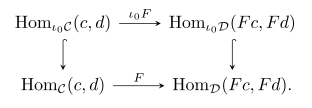 By assumption, the bottom horizontal map is \((n-1) \geq 0\)-connected. Since the vertical maps are inclusions of components, to show that the top horizontal map is \((n-1) \geq 0\)-connected, it suffices to show that the top horizontal map is surjective on \(\pi_0\). Given any \(\beta \in \mathrm{Hom}_{\iota_0 \mathcal D}(Fc, Fd)\), i.e. an isomorphism between \(Fc\) and \(Fd\) in \(\mathcal D\), let \(\alpha \in \mathrm{Hom}_{\mathcal C}(c,d)\) be a lift of \(\beta\) in \(\mathcal C\). We claim that \(\alpha\) is an isomorphism: let \(\beta^{-1} \in \mathrm{Hom}_{\iota_0 \mathcal D}(Fd, Fc)\) be an inverse of \(\beta\) and \(\overline{\alpha} \in \mathrm{Hom}_{\mathcal C}(d,c)\) a lift of \(\beta^{-1}\). Then \(\alpha \circ \overline{\alpha}\) and \(\overline{\alpha} \circ \alpha\) are in the same component of \(\mathrm{Hom}_{\mathcal C}(c,c)\) and \(\mathrm{Hom}_{\mathcal C}(d,d)\) as the respective identities \(\mathrm{id}_c\) and \(\mathrm{id}_d\) as \(F\) is \(\geq 1\)-connected and hence induces bijections on the sets of components of all hom-spaces. Therefore, \(\overline{\alpha}\) is an inverse of \(\alpha\) and thus \(\alpha\) lifts to \(\mathrm{Hom}_{\iota_0 \mathcal C}(c,d)\).
For the induction step, let \(k \geq 1\) and hence \(k \neq n \geq -1\). Given an \(n\)-surjective functor \(F \colon \mathcal C\rightarrow\mathcal D\) in \(\mathrm{Cat}_{(\infty, {k+1})}\), the functor \(\iota_k F\) is surjective on objects since \(F\) is. For objects \(c,d\in \mathcal C\), note that the component \((\iota_k F)_{c,d} \colon \underline{\mathrm{Hom}}_{\iota_k \mathcal C}(c, d) \rightarrow\underline{\mathrm{Hom}}_{\iota_k \mathcal D}(\iota_k F c, \iota_k Fd)\) agrees with the functor \(\iota_{k-1} (F_{c,d})\) which is \((n-1)\)-surjective by induction. ◻
[00AF]
Corollary 5.3.13.
Given \(j \geq k \geq 0\) and either \(n \geq j\) or \(k>n \geq -2\), and \(F \colon \mathcal A\rightarrow\mathcal B\) in \(\mathrm{Cat}_{(\infty, {j})}\). Then, the maximal sub-\((\infty,k)\)-category functor \(\iota_k \colon \mathrm{Cat}_{(\infty, {j})} \xrightarrow{\iota_k} \mathrm{Cat}_{(\infty, {k})}\) preserves \(n\)-factorizations. That is, if \(\mathrm{Fact}_n (F)\) is the factorization of \(F\) with respect to the (\(n\)-surjective, \(n\)-faithful) factorization system, then the induced factorization \(\iota_k \mathcal A\rightarrow\iota_k \mathrm{Fact}_n(F) \rightarrow\iota_k \mathcal B\) realizes \(\iota_k \mathrm{Fact}_n(F)\) as the factorization \(\mathrm{Fact}_n (\iota_k F)\) of \(\iota_k F\) with respect to the (\(n\)-surjective, \(n\)-faithful) factorization system on \(\mathrm{Cat}_{(\infty, {k})}\).
[00AG]
Proof.
The statement follows from the fact that \(\iota_k\) preserves both \(n\)-surjectivity (lemma 5.3.11) and \(n\)-faithfulness (observation 5.3.10). ◻
Throughout, we will also repeatedly use the following simple observation:
[00AH]
Lemma 5.3.14.
For \(j > k \geq 0\) and \(\mathcal C\in \mathrm{Cat}_{(\infty, {j})}\), the inclusion of the maximal sub-\((\infty,k)\)-category \(\iota_k \mathcal C\rightarrow\mathcal C\) is \((k-1)\)-surjective.
[00AI]
Proof.
Factoring \(\iota_k \mathcal C\rightarrow\iota_{k+1} \mathcal C\rightarrow\ldots \rightarrow\iota_{j-1} \mathcal C\rightarrow\mathcal C\), it suffices to prove the case \(j=k+1\). For \(k=0\) and \(\mathcal C\in \mathrm{Cat}_{(\infty, {1})}\), the functor \(\iota_0 \mathcal C\rightarrow\mathcal C\) is surjective on objects, i.e. \((-1)\)-surjective. For \(k\geq 1\) and \(\mathcal C\in \mathrm{Cat}_{(\infty, {k+1})}\), the functor \(\iota_k \mathcal C\rightarrow\mathcal C\) is surjective on objects and by induction homwise \((k-2)\)-surjective, hence \(\iota_k \mathcal C\rightarrow\mathcal C\) is \((k-1)\)-surjective. ◻
We end this subsection with the following useful proposition, generalizing [SY19, Prop. 4.2.8].
[00AJ]
Proposition 5.3.15.
Let \(k \geq 0\) and \(m \geq n \geq -2\). Given a commuting (solid) square in \(\mathrm{Cat}_{(\infty, {k})}\)  where \(F\) is \(n\)-surjective and \(G\) is \(m\)-faithful. Then the space of (dashed) lifts is \((m-n-2)\)-truncated.
[00AL]
Proof.
We induct on \(k \geq 0\). The base case \(k = 0\) is proven in [SY19, Prop. 4.2.8]. For \(k>0\), fix a functor \(G\colon \mathcal C\rightarrow\mathcal D\) which is \(m\)-faithful and let \(S\) be the class of morphisms \(F\) in \(\mathrm{Cat}_{(\infty, {k})}\) for which the space of lifts ([00AK]) against \(G\) is \((m-n-2)\)-truncated. We will now prove that \(S\) contains the \(n\)-surjective functors. Since \(S\) contains equivalences, and is closed under composition, small colimits and cobase change, it forms a saturated class of morphisms (definition B.1.13). By proposition B.1.14, to show that \(S\) contains all \(n\)-surjective morphisms, it suffices to show that it contains the generators of the left class; i.e. by theorem 5.3.7.([00A7]) the functors \(\{\partial c_{i} \rightarrow c_{i}\}_{n+2 \leq i \leq k}\) for \(n +2 < k\) and the functor \(\Sigma^k[S^{n-k+1}] \rightarrow c_k\) for \(n+2 \geq k\).
We first consider the case that \(n + 2 \geq k\), where we need to show that a commuting diagram of \((\infty,k)\)-categories 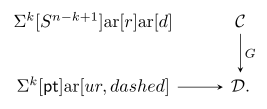 has \((m-n-2)\)-truncated space of lifts. Let \(\alpha\) denote the composite \(\partial c_k = \Sigma^k[\emptyset] \rightarrow\Sigma^k[S^{n-k+1}] \rightarrow\mathcal C\), picking out a pair of parallel \((k-1)\)-morphisms. By observation 5.1.9, the space of lifts of ([00AM]) is equivalent to the space of lift of the following diagram in spaces
 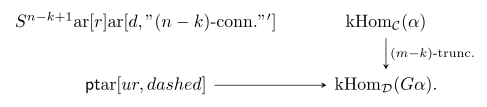 By definition of faithfulness, if \(G\) is \(m\)-faithful, then the right vertical map is \((m-k)\)-truncated for any \(\alpha \colon \partial c_k \rightarrow\mathcal C\). Hence, it follows from [SY19, Prop. 4.2.8] that the space of lifts of ([00AN]) is \((m-n-2)\)-truncated.
Now we consider the case \(n+2 < k\), where we need to show that \(\partial c_i \rightarrow c_i\) is in \(S\) for \(n+2 \leq i \leq k\). For \(i=k\), since \(\partial c_k \rightarrow c_k\) is \((k-2)\)-surjective and \((k-2) +2 \geq k\), it follows from the previous case that the space of lifts of \(\partial c_k \rightarrow c_k\) against \(G\) is \((m-(k-2)-2)\)-truncated, and since \((m-(k-2)-2) \leq (m-n-2)\) also \((m-n-2)\)-truncated. It remains to show that \(\partial c_i \rightarrow c_i\) is in \(S\) for \(n+2 \leq i < k\). As both \(\partial c_i\) and \(c_i\) are \((\infty, k-1)\)-categories, by the \((i_{k},\iota_{k-1})\) adjunction, the two space of lifts are equivalent:  Since \(\iota_{k-1} G\) is a \(n\)-faithful functor between \((\infty, k-1)\)-categories by observation 5.3.10, by induction the space of lifts is \((m-n-2)\)-truncated. ◻