6 The monoidal \((\infty,2)\)-category of chain complexes of Soergel bimodules[00C2]
Throughout this section, we let \(k\) be a \(\mathbb{Q}\)-algebra. Recall from definition 4.3.1 the presentably symmetric monoidal \(\infty\)-categories \(\mathrm{add}_{k}^{B\mathbb{Z}}\coloneqq \mathrm{Fun}(B\mathbb{Z}, \mathrm{add}_k)\) and \(\mathrm{st}^{B\mathbb{Z}}_{k}\coloneqq \mathrm{Fun}(B \mathbb{Z}, \mathrm{st}_k)\) of small \(k\)-linear additive, resp. stable, idempotent complete \(\infty\)-categories equipped with a \(\mathbb{Z}\)-action. These categories will always be understood as equipped with the Day convolution symmetric monoidal structure.
[00C3]
Notation 6.0.1.
Throughout this section, we will use the following terminology:
We refer to objects and morphisms of \(\mathrm{Cat}[\mathrm{Set}^{B\mathbb{Z}}]\) as ordinary \(1\)-categories with local shifts and shift-preserving functors.
We refer to objects and morphisms of \(\mathrm{Cat}[\mathrm{add}_{k}^{B\mathbb{Z}}]\) as \(k\)-linear \((\infty,2)\)-categories with local shifts and shift-preserving \(k\)-linear functors.
We refer to objects and morphisms of \(\mathrm{Cat}[\mathrm{st}^{B\mathbb{Z}}_{k}]\) as \(k\)-linear stable \((\infty,2)\)-categories with local shifts and shift-preserving \(k\)-linear exact functors.
Similarly, we refer to objects and morphisms in \(\mathrm{Alg}_{\mathbb E_1}\) of the \(\infty\)-categories in (1)–(3) as monoidal ordinary categories with local shifts, etc.
Unpacked, an ordinary category with local shifts is a \(1\)-category \(\mathcal C\) equipped with, for every \(c, c' \in \mathcal C\) a \(\mathbb{Z}\)-action on the hom-set \(\mathrm{Hom}_{\mathcal C}(c,c')\), denoted by \([n]\colon \mathrm{Hom}_{\mathcal C}(c,c') \rightarrow\mathrm{Hom}_{\mathcal C}(c,c')\) for \(n \in \mathbb{Z}\), which is compatible with composition in the sense that the following diagram commutes: Similarly, a \(k\)-linear (stable) \((\infty,2)\)-category with local shifts is an \((\infty,2)\)-category whose hom-categories are additive (stable), \(k\)-linear, and have a homotopy coherent \(\mathbb{Z}\)-action which is compatible with composition.
[00C4]
Example 6.0.2.
Most of our constructions in this section are built on the symmetric monoidal \(k\)-linear \((2,2)\)-category with local shifts \[\mathrm{Mor}^{\mathrm{flat}, \mathrm{gr-proj}}(\mathrm{mod}_{k}^{\mathbb{Z}})\in \mathrm{CAlg}(\widehat{\mathrm{Cat}}[\mathrm{add}_{k}^{B\mathbb{Z}}])\] from definition 4.5.7. By corollary 4.5.8.([0093]), its objects are \(\mathbb{Z}\)-graded flat \(k\)-algebras, and its \(k\)-linear additive, idempotent-complete hom-categories between two such algebras \(A\) and \(B\) is given by the full subcategory of the \(1\)-category \({}_{A}\mathrm{grbmod}_{B}\) of (ordinary) \(\mathbb{Z}\)-graded \(A\)–\(B\)-bimodules on those bimodules which are graded-compact-projective (definition 3.6.8), as a right \(B\)-module. The homwise \(\mathbb{Z}\)-action is given by shifting the grading degree of these bimodules.
We warn the reader that \(\mathrm{Mor}^{\mathrm{flat}, \mathrm{gr-proj}}(\mathrm{mod}_{k}^{\mathbb{Z}})\) is a locally small, but not a small (the flat \(\mathbb{Z}\)-graded \(k\)-algebras do not form a small set) \((\infty,2)\)-category. Since all algebras of relevance to this paper are graded polynomial algebras, it will be convenient to restrict to the small full subcategory on those:
[00C5]
Notation 6.0.3.
Let \(\mathrm{Mor}^{\mathrm{poly}, \mathrm{gr-proj}}(\mathrm{mod}_k^{\mathbb{Z}})\subseteq \mathrm{Mor}^{\mathrm{flat}, \mathrm{gr-proj}}(\mathrm{mod}_{k}^{\mathbb{Z}})\) denote the small full subcategory on the graded polynomial algebras \(k[x_1, \ldots, x_n]\) for \(n \geq 0\), with all \(x_i\) in degree \(2\). (Graded polynomial algebras are flat, see example 4.5.4, this hence indeed defines a full subcategory.) Since tensor products of polynomial algebras are polynomial algebras, this is in fact a symmetric monoidal subcategory and hence defines an object \[\mathrm{Mor}^{\mathrm{poly}, \mathrm{gr-proj}}(\mathrm{mod}_k^{\mathbb{Z}})\in \mathrm{CAlg}(\mathrm{Cat}[\mathrm{add}_{k}^{B\mathbb{Z}}]).\]
The goal of this section is to first define \(\mathrm{BSbim}\) as a monoidal \((2,2)\)-category and then \(\mathrm{Sbim}\) as \(k\)-linear monoidal \((2,2)\)-category with local shifts, both equipped with faithful monoidal functors to \(\mathrm{Mor}^{\mathrm{poly}, \mathrm{gr-proj}}(\mathrm{mod}_k^{\mathbb{Z}})\), i.e. functors which induces fully-faithful inclusions on hom-categories (see notation 5.3.3).
The following warning makes our construction of a monoidal structure on \(\mathrm{BSbim}\) and \(\mathrm{Sbim}\) from the monoidal structure of \(\mathrm{Mor}^{\mathrm{poly}, \mathrm{gr-proj}}(\mathrm{mod}_k^{\mathbb{Z}})\) somewhat more subtle than one might think.
[00C6]
Warning 6.0.4.
We warn the reader that one should not think of \(\mathrm{BSbim}\) and \(\mathrm{Sbim}\) as sub-\((2,2)\)-categories of \(\mathrm{Mor}^{\mathrm{poly}, \mathrm{gr-proj}}(\mathrm{mod}_k^{\mathbb{Z}})\). Indeed, \(\mathrm{BSbim}\) and \(\mathrm{Sbim}\) do not contain all \(1\)-equivalences between their objects that exists in \(\mathrm{Mor}^{\mathrm{poly}, \mathrm{gr-proj}}(\mathrm{mod}_k^{\mathbb{Z}})\). Hence, the faithful functors \(\mathrm{BSbim}\rightarrow\mathrm{Mor}^{\mathrm{poly}, \mathrm{gr-proj}}(\mathrm{mod}_k^{\mathbb{Z}})\) and \(\mathrm{Sbim}\rightarrow\mathrm{Mor}^{\mathrm{poly}, \mathrm{gr-proj}}(\mathrm{mod}_k^{\mathbb{Z}})\) are not monomorphisms in \(\mathrm{Cat}_{(\infty, {2})}\); see also warning 5.3.9. In particular, for an \((\infty,2)\)-functor \(\mathcal X\rightarrow\mathrm{Mor}^{\mathrm{poly}, \mathrm{gr-proj}}(\mathrm{mod}_k^{\mathbb{Z}})\), it is not merely a property to factor through \(\mathrm{BSbim}\) or \(\mathrm{Sbim}\) but additional data.
6.1 The monoidal \((2,2)\)-category of Bott-Samelson bimodules[00C7]
Recall that to define a full subcategory of an \((\infty,1)\)-category \(\mathcal A\), it suffices to specify a subset of the set \(h_0 \mathcal A\) of isomorphism classes of objects of \(\mathcal A\). Similarly, it follows from corollary 5.5.3 that to define an \((\infty,2)\)-category \(\mathcal C\) together with a faithful functor \(\mathcal C\rightarrow\mathcal A\) into a fixed \((\infty,2)\)-category \(\mathcal A\), it suffices to define an ordinary \(1\)-category \(h_1\mathcal C\) together with an ordinary faithful functor \(h_1\mathcal C\rightarrow h_1\mathcal A\) into the homotopy \(1\)-category of \(\mathcal A\), see definition 5.4.11. We will use this to define our monoidal \((2,2)\)-category \(\mathrm{BSbim}\) together with its faithful functor to \(\mathrm{Mor}^{\mathrm{poly}, \mathrm{gr-proj}}(\mathrm{mod}_k^{\mathbb{Z}})\).
[00C8]
Observation 6.1.1.
Following corollary 4.5.8.([0093]), \(h_1 \mathrm{Mor}^{\mathrm{poly}, \mathrm{gr-proj}}(\mathrm{mod}_k^{\mathbb{Z}})\) is the (small) ordinary symmetric-monoidal \(1\)-category whose objects are given by graded polynomial algberas, and whose morphisms are given by isomorphism classes of ordinary graded bimodules which are graded-compact-projective as right modules. Furthermore, composition is given by relative tensor product and the symmetric monoidal structure is given by tensoring over \(k\).
[00C9]
Proposition 6.1.2.
The ordinary monoidal \(1\)-category \(h_1\mathrm{BSbim}\) from definition 2.3.1 admits a faithful monoidal functor \[h_1\mathrm{BSbim}\rightarrow h_1 \mathrm{Mor}^{\mathrm{poly}, \mathrm{gr-proj}}(\mathrm{mod}_k^{\mathbb{Z}}).\]
[00CA]
Proof.
Recall from definition 2.3.1 that \(h_1\mathrm{BSbim}\) has objects \(n \in \mathbb{N}_0\) and endo-hom-sets defined as the subset \(h_0 \mathrm{BSbim}_n \subseteq h_0({}_{R_n} \mathrm{grbmod}_{R_n})\) of isomorphism classes of graded bimodules for the graded polynomial algebra \(R_n = k[x_1, \ldots, x_n]\) with \(x_i\) in degree \(2\) on the Bott-Samelson bimodules. The desired functor to \(h_1\mathrm{Mor}^{\mathrm{poly}, \mathrm{gr-proj}}(\mathrm{mod}_k^{\mathbb{Z}})\) follows immediately from this description: It sends an object \(n \in \mathbb{N}_0\) of \(h_1\mathrm{BSbim}\) to the graded polynomial algebra \(R_n= k[x_1,\ldots, x_n]\) and is defined on hom-sets as the full inclusion \(h_0 \mathrm{BSbim}_n \hookrightarrow h_0({}_{R_n}\mathrm{grbmod}^{\mathrm{gr-cp}}_{R_n}).\) Since Bott-Samelson bimodules are graded-compact-projective as right (and left) modules by remark 2.1.3, and since the composition and monoidal structure in \(h_1 \mathrm{Mor}^{\mathrm{poly}, \mathrm{gr-proj}}(\mathrm{mod}_k^{\mathbb{Z}})\) are defined by the relative (underived) tensor product and the tensor product \(\otimes_k\), this indeed defines a faithful monoidal functor. ◻
The following corollary justifies the notation \(h_1 \mathrm{BSbim}\) from §2.
[00CB]
Corollary 6.1.3.
There exists a unique monoidal \((2,2)\)-category \[\mathrm{BSbim}\in \mathrm{Alg}_{\mathbb E_1}(\mathrm{Cat}_{(\infty, {2})})\] equipped with a faithful monoidal functor \(\mathrm{BSbim}\rightarrow\mathrm{Mor}^{\mathrm{poly}, \mathrm{gr-proj}}(\mathrm{mod}_k^{\mathbb{Z}})\) which agrees on homotopy categories with the monoidal functor \(h_1 \mathrm{BSbim}\rightarrow h_1\mathrm{Mor}^{\mathrm{poly}, \mathrm{gr-proj}}(\mathrm{mod}_k^{\mathbb{Z}})\) from observation 6.1.1.
[00CC]
Proof.
Recall corollary 5.5.5, that for any small monoidal \((\infty,2)\)-category \(\mathcal D\in \mathrm{Alg}_{\mathbb E_1}(\mathrm{Cat}_{(\infty, {2})})\), taking the homotopy 1-category induces an equivalence \[h_1 \colon {\mathrm{Alg}_{\mathbb E_1}(\mathrm{Cat}_{(\infty, {2})})}_{\small{/^{\tiny{\text{f}}\,}}{\mathcal D}} \rightarrow{\mathrm{Alg}_{\mathbb E_1}(\mathrm{Cat}_{({1}, {1})})}_{\small{/^{\tiny{\text{f}}\,}}{h_1\mathcal D}}\] between the full subcategories of \(\mathrm{Alg}_{\mathbb E_1}(\mathrm{Cat}_{(\infty, {2})})_{/\mathcal D}\) and \(\mathrm{Alg}_{\mathbb E_1}(\mathrm{Cat}_{({1}, {1})})_{/h_1\mathcal D}\) on the faithful functors. Applying this to \(\mathcal D= \mathrm{Mor}^{\mathrm{poly}, \mathrm{gr-proj}}(\mathrm{mod}_k^{\mathbb{Z}})\), the monoidal \((2,2)\)-category \(\mathrm{BSbim}\) is the unique pre-image of \(h_1 \mathrm{BSbim}\rightarrow h_1 \mathrm{Mor}^{\mathrm{poly}, \mathrm{gr-proj}}(\mathrm{mod}_k^{\mathbb{Z}})\). Since any \((\infty,2)\)-category with a faithful functor to a \((2,2)\)-category is again a \((2,2)\)-category, it follows that \(\mathrm{BSbim}\) is a \((2,2)\)-category. ◻
[00CD]
Definition 6.1.4.
We refer to the monoidal \((2,2)\)-category \(\mathrm{BSbim}\) from corollary 6.1.3 as the Bott-Samelson \((2,2)\)-category.
[00CE]
Observation 6.1.5.
By construction, the isomorphism classes of objects of \(\mathrm{BSbim}\) are in bijection with the natural numbers \(n\in \mathbb{N}_0\). For every \(n \in \mathbb{N}_0\) we now fix a representing object in \(\mathrm{BSbim}\) in that isomorphism class and simply denote it by \(n\). For \(n,m \in \mathrm{BSbim}\), the hom-category in \(\mathrm{BSbim}\) is given by \[\underline{\mathrm{Hom}}_{\mathrm{BSbim}}(n,m)= \left\{ \begin{array}{lr} 0 & n \neq m\\ \mathrm{BSBim}_n & n=m \end{array} \right. ,\] where \(\mathrm{BSbim}_n\) is the category from definition 2.1.2. The monoidal functor \(\mathrm{BSbim}\rightarrow\mathrm{Mor}^{\mathrm{poly}, \mathrm{gr-proj}}(\mathrm{mod}_k^{\mathbb{Z}})\) sends objects \(n\) to the polynomial algebra \(R_n\) and is given on hom-categories by the evident full inclusion of \(\mathrm{BSBim}_n\) into the category of graded \(R_n\)–\(R_n\)-bimodules that are graded-compact-projective as right \(R_n\)-modules.
6.2 The monoidal \((2,2)\)-category of Soergel bimodules[00CF]
Having defined \(\mathrm{BSbim}\) together with its inclusion \(\mathrm{BSbim}\rightarrow\mathrm{Mor}^{\mathrm{poly}, \mathrm{gr-proj}}(\mathrm{mod}_k^{\mathbb{Z}})\), we will now define \(\mathrm{Sbim}\) as the homwise completion of \(\mathrm{BSbim}\) under \(\mathbb{Z}\)-shifts, direct sums and splitting of idempotents inside of \(\mathrm{Mor}^{\mathrm{poly}, \mathrm{gr-proj}}(\mathrm{mod}_k^{\mathbb{Z}})\).
To formally implement this, we need to construct a factorization system on the presentably symmetric monoidal \(\infty\)-category \(\mathrm{add}_{k}^{B\mathbb{Z}}\) of additive \(k\)-linear \(\infty\)-categories with a \(\mathbb{Z}\)-action, equipped with the Day convolution monoidal structure, constructed in subsection 4.3.
[00CG]
Definition 6.2.1.
We will use the following terminology:
A functor \(F\colon \mathcal C\rightarrow\mathcal D\) between idempotent-complete \(\infty\)-categories is called dominant if every object in \(\mathcal D\) is a retract of an object in the image of \(F\).
A morphism in \(\mathrm{add}_{k}^{B\mathbb{Z}}\) is dominant, resp. fully faithful, if its underlying functor is.
[00CH]
Proposition 6.2.2.
The (dominant, fully faithful)-functors define a factorization system on \(\mathrm{add}_{k}^{B\mathbb{Z}}\) which is of small generation and compatible with the symmetric monoidal structure.
[00CI]
Proof.
Consider the sequence of morphisms in \(\mathrm{CAlg}(\mathrm{Pr}^\mathrm{L})\) \[\mathrm{Cat}_{\infty}\rightarrow\mathrm{Cat}_{\infty}^{\sqcup} \rightarrow\mathrm{Cat}_{\infty}^{\sqcup, \mathrm{idem}}\rightarrow\mathrm{Mod}_{\mathrm{CProj}_k}(\mathrm{Cat}_{\infty}^{\sqcup, \mathrm{idem}}) \simeq \mathrm{add}_k\] left adjoint to the respective forgetful functors (see proposition 3.1.11 for the first two functors, and observation 4.2.4 for the latter one). We will successively lift the (surjective-on-objects, fully faithful)-factorization system on \(\mathrm{Cat}_{\infty}\) to \(\mathrm{add}_k\).
Step 1: We first show that the (surjective-on-objects, fully faithful)-functors define a factorization system on \(\mathrm{Cat}_{\infty}^{\sqcup}\) which is of small generation and compatible with the symmetric monoidal structure. Given a morphism \(F\colon \mathcal C\rightarrow\mathcal D\) in \(\mathrm{Cat}_{\infty}^{\sqcup}\), i.e. a functor between \(\infty\)-categories with finite coproducts that preserves finite coproducts, we consider its (surjective-on-objects, fully faithful) factorization in \(\mathrm{Cat}_{\infty}\) 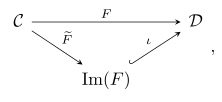 where \(\widetilde{F}\) is surjective on objects and \(\iota\) is fully faithful. Using observation B.2.1 and lemma B.2.2 we can deduce that the factorization system on \(\mathrm{Cat}_{\infty}\) restricts to one on \(\mathrm{Cat}_{\infty}^{\sqcup}\) which is of small generation and compatible with the symmetric monoidal structure, provided we can show that \(\mathrm{Im}(F)\) admits finite coproducts and that \(\widetilde{F}\) and \(\iota\) preserve them. In fact, since \(\iota\) is fully faithful, it is enough to prove that \(\mathrm{Im}(F)\) is closed under finite coproducts in \(\mathcal D\). To this end, let \(S\) be a finite set and \(I\colon S \rightarrow\mathrm{Im}(F)\) a diagram. Since \(\widetilde{F}\colon \mathcal C\rightarrow\mathrm{Im}(F)\) is surjective on objects, we can lift \(I\) to a functor \(\widetilde{I} \colon S \rightarrow\mathcal C\) which has a colimit \(\mathrm{colim}~\widetilde{I}\in \mathcal C\) by assumption. Since \(F\) preserves coproducts and using the factorization, the coproduct \(\mathrm{colim}~\iota \circ I\) agrees with \(F(\mathrm{colim}~\widetilde{I})\) and hence is in the image of \(F\), as required.
Step 2: To lift from \(\mathrm{Cat}_{\infty}^{\sqcup}\) to \(\mathrm{Cat}_{\infty}^{\sqcup, \mathrm{idem}}\), observe that the symmetric monoidal left adjoint \((-)^{\mathrm{idem}}:\mathrm{Cat}_{\infty}^{\sqcup} \rightarrow\mathrm{Cat}_{\infty}^{\sqcup, \mathrm{idem}}\) is a reflective localization, i.e. that the right adjoint is fully faithful. We observe the following:
A morphism in \(\mathrm{Cat}_{\infty}^{\sqcup, \mathrm{idem}}\) is of the form \((F)^{\mathrm{idem}}\) for a fully faithful morphism \(F\) in \(\mathrm{Cat}_{\infty}^{\sqcup}\) if and only if it is fully faithful.
A morphism in \(\mathrm{Cat}_{\infty}^{\sqcup, \mathrm{idem}}\) is of the form \((F)^{\mathrm{idem}}\) for a surjective-on-objects morphism \(F\) in \(\mathrm{Cat}_{\infty}^{\sqcup}\) if and only if it is dominant.
Since the class of dominant functors is stable under retracts in \(\mathrm{Cat}_{\infty}^{\sqcup, \mathrm{idem}}\), it therefore follows from lemma B.2.5 that the (surjective-on-objects, fully faithful)-factorization system on \(\mathrm{Cat}_{\infty}^{\sqcup}\) induces the (dominant, fully faithful)-factorization system on \(\mathrm{Cat}_{\infty}^{\sqcup, \mathrm{idem}}\), and that this factorization system is of small generation and compatible with the monoidal structure on \(\mathrm{Cat}_{\infty}^{\sqcup, \mathrm{idem}}\).
Step 3: Since  is a monadic adjunction, whose underlying monad \(\mathrm{CProj}_k \otimes - \colon \mathrm{Cat}_{\infty}^{\sqcup, \mathrm{idem}}\rightarrow\mathrm{Cat}_{\infty}^{\sqcup, \mathrm{idem}}\) preserves colimits (and in particular geometric realizations), and preserves dominant functors (since \(\otimes\) is compatible with the (dominant, fully faithful)-factorization system on \(\mathrm{Cat}_{\infty}^{\sqcup, \mathrm{idem}}\), as follows from Step 2), it follows fromlemma B.2.7 that the (dominant, fully faithful) functors form a factorization system on \(\mathrm{add}_k\) which is of small generation and compatible with its symmetric monoidal structure.
Step 4: Lastly, by lemma B.2.3, the (dominant, fully faithful)-factorization system induces one on \(\mathrm{Fun}(B\mathbb{Z}, \mathrm{add}_k)\) which is of small generation and compatible with the Day convolution symmetric monoidal structure. ◻
[00CJ]
Notation 6.2.3.
We will use the following terminology:
A morphism \(F\colon \mathcal C\rightarrow\mathcal D\) in \(\mathrm{Cat}[\mathrm{add}_{k}^{B\mathbb{Z}}]\) is called faithful if its underlying \((\infty,2)\)-functor is (see notation 5.3.3). It is called surjective-on-objects-and-dominant-on-1-morphisms if it is surjective on objects and if for each \(c, c'\in \mathcal C\), the induced additive functor \(\underline{\mathrm{Hom}}_{\mathcal C}(c,c') \rightarrow\underline{\mathrm{Hom}}_{\mathcal C}(Fc,Fc')\) is dominant.
A morphism in \(\mathrm{Alg}_{\mathbb E_1}(\mathrm{Cat}[\mathrm{add}_{k}^{B\mathbb{Z}}])\) is called faithful or surjective-on-objects-and-dominant-on-1-morphisms if the underlying morphism in \(\mathrm{Cat}[\mathrm{add}_{k}^{B\mathbb{Z}}]\) is.
Applying the factorization system from proposition 6.2.2 homwise leads to the following corollary.
[00CK]
Corollary 6.2.4.
The (surjective-on-objects-and-dominant-on-1-morphisms, faithful)-functors define factorization systems on \(\mathrm{Cat}[\mathrm{add}_{k}^{B\mathbb{Z}}]\) and \(\mathrm{Alg}_{\mathbb E_1}(\mathrm{Cat}[\mathrm{add}_{k}^{B\mathbb{Z}}])\), respectively, which are of small generation and compatible with the symmetric monoidal structure.
[00CL]
Proof.
This follows immediately from applying theorem B.4.1 and then theorem B.3.1 to the factorization system of proposition 6.2.2. ◻
The forgetful functor \(\mathrm{add}_k \rightarrow\mathrm{Cat}_{\infty}\) has a symmetric monoidal left adjoint ‘linearization functor’ \[\mathrm{Lin}_k\colon \mathrm{Cat}_{\infty}\rightarrow\mathrm{add}_k,\] which is the composite of symmetric monoidal left adjoints \[
\mathrm{Cat}_{\infty}\xrightarrow{(-)^{\sqcup, \mathrm{idem}}}\mathrm{Cat}_{\infty}^{\sqcup, \mathrm{idem}}\xrightarrow{\mathrm{CProj}_k \otimes -} \mathrm{Mod}_{\mathrm{CProj}_k}(\mathrm{Cat}_{\infty}^{\sqcup, \mathrm{idem}}) \simeq \mathrm{add}_k,\] where \((-)^{\sqcup, \mathrm{idem}}\) freely adjoints finite coproducts and splittings of idempotents (see proposition 3.1.11) and \(\mathrm{CProj}_k\otimes -\) constructs free \(\mathrm{CProj}_k\)-modules (see proposition 3.1.8). This induces a symmetric monoidal left adjoint of the forgetful functor \(\mathrm{add}_{k}^{B\mathbb{Z}}\rightarrow\mathrm{Cat}_{\infty}^{B\mathbb{Z}}\) \[\mathrm{Fun}(B\mathbb{Z}, \mathrm{Lin}_k(-))\colon \mathrm{Cat}_{\infty}^{B\mathbb{Z}}\rightarrow\mathrm{add}_{k}^{B\mathbb{Z}},\] which we will also denote by \(\mathrm{Lin}_k(-) \colon \mathrm{Cat}_{\infty}^{B\mathbb{Z}}\rightarrow\mathrm{add}_{k}^{B\mathbb{Z}}\). Unpacking observation 3.5.13, the forgetful functor \(\mathrm{Cat}_{\infty}^{B \mathbb{Z}} \rightarrow\mathrm{Cat}_{\infty}\) (i.e. the functor \(\mathrm{ev}_*\colon \mathrm{Fun}(B\mathbb{Z}, \mathrm{Cat}_{\infty}) \rightarrow\mathrm{Cat}_{\infty}\)) has a left adjoint \[- \times \mathbb{Z}: \mathrm{Cat}_{\infty}\rightarrow\mathrm{Cat}_{\infty}^{B\mathbb{Z}}\] which sends an \(\infty\)-category \(\mathcal C\) to the \(\infty\)-category \(\mathcal C\times \mathbb{Z}\) with free \(\mathbb{Z}\)-action, and which is symmetric monoidal with respect to the Day convolution structure on \(\mathrm{Cat}_{\infty}^{B\mathbb{Z}}\).
Combining these left adjoints, we obtain a symmetric monoidal left adjoint \[
\mathrm{Lin}_k(- \times \mathbb{Z}): \mathrm{Cat}_{\infty}\rightarrow\mathrm{add}_{k}^{B\mathbb{Z}}.\]
Applying \(\mathrm{Lin}_k(-\times \mathbb{Z})\) homwise, this induces by subsection A.10 and subsection A.8.11 symmetric monoidal left adjoints \[
\mathrm{Lin}_{k, \mathrm{loc}}^{\mathbb{Z}}\coloneqq \mathrm{Cat}[\mathrm{Lin}_k(-\times \mathbb{Z})]\colon \mathrm{Cat}_{(\infty, {2})} = \mathrm{Cat}[\mathrm{Cat}_{\infty}] \rightarrow\mathrm{Cat}[\mathrm{add}_{k}^{B\mathbb{Z}}]\] and (abusing notation) \[\mathrm{Lin}_{k, \mathrm{loc}}^{\mathbb{Z}} \coloneqq \mathrm{Alg}_{\mathbb E_1}(\mathrm{Cat}[\mathrm{Lin}_k(-\times \mathbb{Z})])\colon \mathrm{Alg}_{\mathbb E_1}(\mathrm{Cat}_{(\infty, {2})}) \rightarrow\mathrm{Alg}_{\mathbb E_1}(\mathrm{Cat}[\mathrm{add}_{k}^{B\mathbb{Z}}])\] of the respective forgetful functors.
[00CR]
Proposition 6.2.5.
The functor \(\mathrm{BSbim}\rightarrow\mathrm{Mor}^{\mathrm{poly}, \mathrm{gr-proj}}(\mathrm{mod}_k^{\mathbb{Z}})\) of monoidal \((\infty,2)\)-categories from corollary 6.1.3 factors through a monoidal \(\mathrm{add}_{k}^{B\mathbb{Z}}\)-enriched functor \[\mathrm{Lin}_{k, \mathrm{loc}}^{\mathbb{Z}} (\mathrm{BSbim}) \rightarrow\mathrm{Mor}^{\mathrm{poly}, \mathrm{gr-proj}}(\mathrm{mod}_k^{\mathbb{Z}}).\]
[00CS]
Proof.
Since \(\mathrm{Mor}^{\mathrm{poly}, \mathrm{gr-proj}}(\mathrm{mod}_k^{\mathbb{Z}})\) is an object in \(\mathrm{Alg}_{\mathbb E_1} (\mathrm{Cat}[\mathrm{add}_{k}^{B\mathbb{Z}}])\), the statement immediately follows from the adjunction ([00CQ]). ◻
Explicitly, \(\mathrm{Lin}_{k, \mathrm{loc}}^{\mathbb{Z}} (\mathrm{BSbim})\) has objects natural numbers and additive \(k\)-linear hom-categories with \(\mathbb{Z}\)-action given by the \(k\)-linearization \(\mathrm{Lin}_k(\mathrm{BSbim}_n \times \mathbb{Z})\) of the 1-category \(\mathrm{BSbim}_n \times \mathbb{Z}\) with free \(\mathbb{Z}\)-action.
[00CT]
Definition 6.2.6.
Define the monoidal \(k\)-linear (2,2)-category with local shifts \(\mathrm{Sbim}\in \mathrm{Alg}_{\mathbb E_1}(\mathrm{Cat}[\mathrm{add}_{k}^{B\mathbb{Z}}])\), the Soergel \((2,2)\)-category, as the unique factorization  of \(\mathrm{Lin}_{k, \mathrm{loc}}^{\mathbb{Z}} (\mathrm{BSbim}) \rightarrow\mathrm{Mor}^{\mathrm{poly}, \mathrm{gr-proj}}(\mathrm{mod}_k^{\mathbb{Z}})\) with respect to the (surjective-on-objects-and-dominant-on-morphisms, faithful)-factorization system on \(\mathrm{Alg}_{\mathbb E_1}(\mathrm{Cat}[\mathrm{add}_{k}^{B\mathbb{Z}}])\).
We denote the composite monoidal shift-preserving functor \(\mathrm{BSbim}\rightarrow\mathrm{Lin}_{k, \mathrm{loc}}^{\mathbb{Z}} (\mathrm{BSbim}) \rightarrow\mathrm{Sbim}\) by \[
\iota\colon \mathrm{BSbim}\rightarrow\mathrm{Sbim}.\]
Composing with the monoidal \((\infty,2)\)-functor \(\mathrm{BSbim}\rightarrow\mathrm{Lin}_{k, \mathrm{loc}}^{\mathbb{Z}} (\mathrm{BSbim})\) (i.e. the unit of the adjunction ([00CQ])), we can summarize the categories and functors defined so far thus:
[00CV]
Corollary 6.2.7.
The above defined functors assemble into a commuting diagram of monoidal \((2,2)\)-functors  where the top and right diagonal functors are faithful and the right diagonal functor is shift-preserving and \(k\)-linear.
6.3 The Soergel \((2,2)\)-category agrees with its classical variant[00CX]
We now explain how the monoidal \((2,2)\)-category \(\mathrm{Sbim}\) is indeed just a homwise additive and idempotent-completion of \(\mathrm{BSbim}\). We first record the following useful observation about the adjunction 
[00CY]
Lemma 6.3.1.
Let \(F\colon \mathcal C\rightarrow\mathcal D\) be a functor of \((\infty,1)\)-categories, where \(\mathcal C\in \mathrm{Cat}_{\infty}\) and \(\mathcal D\in \mathrm{add}_{k}^{B\mathbb{Z}}\). Then the following properties of \(F\) are equivalent:
Its adjunct \(\mathrm{Lin}_k(\mathcal C\times \mathbb{Z}) \rightarrow\mathcal D\) is dominant.
Every object of \(\mathcal D\) is a retract of a finite coproduct of shifts (under the \(\mathbb{Z}\)-action) of objects in the image of \(F\).
[00CZ]
Proof.
The tensor unit of \(\mathrm{Cat}_{\infty}^{\sqcup, \mathrm{idem}}\) is the category \(\mathrm{Set}^{\mathrm{fin}}\) of finite sets, and since \(\mathrm{CProj}_k \in \mathrm{CAlg}(\mathrm{Cat}_{\infty}^{\sqcup, \mathrm{idem}})\), the unit induces a finite coproduct preserving functor \(\mathrm{Set}^{\mathrm{fin}} \rightarrow\mathrm{CProj}_k\) which sends a finite set \(X\) to the coproduct \(\sqcup_X k\) and is therefore dominant by lemma 3.5.7.([005W]). Hence, since the tensor product in \(\mathrm{Cat}_{\infty}^{\sqcup, \mathrm{idem}}\) of dominant functors is again dominant (since its (dominant, fully faithful)-factorization system is compatible with its monoidal structure, as follows from the proof of proposition 6.2.2), it follows that for any \(\mathcal A\in \mathrm{Cat}_{\infty}^{\sqcup, \mathrm{idem}}\), the unit \(\mathcal A\simeq \mathrm{Set}^{\mathrm{fin}} \otimes \mathcal A\rightarrow\mathrm{CProj}_k \otimes \mathcal A\) of the adjunction between \(\mathrm{Cat}_{\infty}^{\sqcup, \mathrm{idem}}\) and \(\mathrm{add}_k\) is dominant. In particular, it immediately follows that for any \(\mathcal B\in \mathrm{add}_k\), a functor \(\mathcal A\rightarrow\mathcal B\) in \(\mathrm{Cat}_{\infty}^{\sqcup, \mathrm{idem}}\) is dominant if and only if its adjunct (drawn horizontally) is: 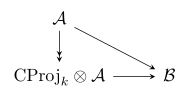
Hence, a functor \(F\) as in the statement of the lemma is dominant, if and only if the functor \((\mathcal C\times \mathbb{Z})^{\sqcup, \mathrm{idem}} \rightarrow\mathcal D\) is, equivalently if every object of \(\mathcal D\) is a retract of a finite coproduct of objects in the image of \(\mathcal C\times \mathbb{Z}\), i.e. of objects which are \(\mathbb{Z}\)-shifts of objects in the image of \(\mathcal C\). ◻
For the following we recall from subsection 2.1 the notation \(R_n \coloneqq k[x_1,\ldots, x_n]\) for the graded polynomial algebra over \(k\) in \(n\in
\mathbb{N}_0\) variables, each of degree two.
[00D0]
Proposition 6.3.2.
The functor \(\iota\colon \mathrm{BSbim}\rightarrow\mathrm{Sbim}\) is surjective on objects. For objects \(n \neq m\in \mathrm{BSbim}\), the hom-category \(\underline{\mathrm{Hom}}_{\mathrm{Sbim}}(\iota n, \iota m)\) is the zero category, and for \(n=m\) it is the smallest additive and idempotent-complete full subcategory of the ordinary additive category \[{}_{R_n}\mathrm{grbmod}_{R_n}\] of graded \(R_n\)-bimodules, which contains the full subcategory \(\mathrm{BSbim}_n\) and is closed under the grading-shift \(\mathbb{Z}\)-action.
[00D1]
Proof.
Since \(\mathrm{Lin}_{k, \mathrm{loc}}^{\mathbb{Z}} (-)\) is defined by applying \(\mathrm{Lin}_k(-\times \mathbb{Z})\) homwise, the functor \[\alpha\colon \mathrm{BSbim}\rightarrow\mathrm{Lin}_{k, \mathrm{loc}}^{\mathbb{Z}} (\mathrm{BSbim})\] is the identity on objects and hence the composite \(\iota\colon \mathrm{BSbim}\rightarrow
\mathrm{Lin}_{k, \mathrm{loc}}^{\mathbb{Z}} (\mathrm{BSbim}) \rightarrow\mathrm{Sbim}\) is surjective on objects. The induced functor on hom-categories between \(n, m \in \mathrm{BSbim}\) therefore factors as follows in \(\mathrm{add}_{k}^{B\mathbb{Z}}\): \[\mathrm{Lin}_k(\mathrm{BSbim}(n,m) \times \mathbb{Z}) =:\mathrm{Lin}_{k, \mathrm{loc}}^{\mathbb{Z}} (\mathrm{BSbim}) (\alpha n, \alpha m) \rightarrow\mathrm{Sbim}(\iota n, \iota m) \rightarrow{}_{R_n}\mathrm{grbmod}_{R_m}\] The first functor is dominant (since \(\mathrm{Lin}_{k, \mathrm{loc}}^{\mathbb{Z}} (\mathrm{BSbim}) \rightarrow
\mathrm{Sbim}\) is dominant on morphisms) and the second functor is fully faithful (since \(\mathrm{Sbim}\rightarrow\mathrm{Mor}^{\mathrm{poly}, \mathrm{gr-proj}}(\mathrm{mod}_k^{\mathbb{Z}})\) is faithful).
It follows from fully faithfulness of the second functor (and the fact that it is a morphism in \(\mathrm{add}_{k}^{B\mathbb{Z}}\)), that \(\mathrm{Sbim}(\iota n, \iota m)\) is a full additive and idempotent-complete subcategory of \({}_{R_n}\mathrm{grbmod}_{R_m}\) which is closed under grading shifts. By lemma 6.3.1, dominance of the first functor implies that every object of this full subcategory is a retract of a finite coproduct of shifts of objects in the image of \(\mathrm{BSbim}(n,m) \hookrightarrow {}_{R_n}\mathrm{grbmod}_{R_m}\). ◻
[00D2]
Observation 6.3.3.
As there are no non-zero morphisms between \(n\neq m\), it follows immediately from proposition 6.3.2 that the monoidal \((2,2)\)-functor \(\iota\colon \mathrm{BSbim}\rightarrow\mathrm{Sbim}\) induces a bijection on the set of isomorphism classes of objects. For objects \(n, m \in \mathrm{Sbim}\), the additive \(k\)-linear hom-category is given by \[\underline{\mathrm{Hom}}_{\mathrm{Sbim}}(n,m) \simeq \left\{\begin{array}{lr} 0 & n \neq m\\
\mathrm{Sbim}_n & n = m \end{array}\right. ,\] where \(\mathrm{Sbim}_n\) is the ordinary \(k\)-linear additive category from definition 2.1.4 with \(\mathbb{Z}\)-action by grading shift. The monoidal shift-preserving \(k\)-linear functor \(\mathrm{Sbim}\rightarrow\mathrm{Mor}^{\mathrm{poly}, \mathrm{gr-proj}}(\mathrm{mod}_k^{\mathbb{Z}})\) sends objects \(n\) to the polynomial algebra \(R_n\) and is given on hom-categories by the evident full inclusion of \(\mathrm{Sbim}_n\) into the category of all graded bimodules which are graded-compact-projective as right modules.
It follows from functoriality that the composition of \(1\)-morphisms in \(\underline{\mathrm{Hom}}_{\mathrm{Sbim}}(n,n)\) is given by the relative tensor product \(-\otimes_{R_n}-\) (and hence, that the endomorphism \(1\)-category \(\underline{\mathrm{Hom}}_{\mathrm{Sbim}}(n,n)\) is equivalent to the monoidal category \(\mathrm{Sbim}_n\) as in definition 2.1.4), and that the monoidal structure of \(\mathrm{Sbim}\) is given by \(-\otimes_k-\) (and hence acts by parabolic induction on the hom-categories \(\mathrm{Sbim}_n \times \mathrm{Sbim}_m \rightarrow\mathrm{Sbim}_{n+m}\) as in definition 2.1.5, see remark 2.3.3).
6.4 The monoidal \((\infty,2)\)-category of chain complexes of Soergel bimodules[00D3]
Recall from Sections 3.4.2 and 3.4.3 that the forgetful functor \(\mathrm{st}\rightarrow\mathrm{add}\) from the presentably symmetric monoidal \(\infty\)-category of small stable \(\infty\)-categories to that of small additive \(\infty\)-categories has a symmetric monoidal left adjoint \[{\mathbf K}^b\colon \mathrm{add}\rightarrow\mathrm{st},\] which sends an ordinary additive \(1\)-category \(\mathcal A\) to the \(\infty\)-category of bounded chain complexes in \(\mathcal A\) with chain maps and (higher) chain homotopies between them. By proposition 4.3.2, this is compatible with linearity and \(\mathbb{Z}\)-action and induces a symmetric monoidal left adjoint \[{\mathbf K}^b\colon \mathrm{add}_{k}^{B\mathbb{Z}}\rightarrow\mathrm{st}^{B\mathbb{Z}}_{k}\] of the forgetful functor \(\mathrm{st}^{B\mathbb{Z}}_{k}\rightarrow\mathrm{add}_{k}^{B\mathbb{Z}}\). Applying \({\mathbf K}^b\) homwise, it follows from subsection A.10 and subsection A.8.11 that we obtain symmetric monoidal left-adjoints of the respective forgetful functors: \[{\mathbf K}^b_{\mathrm{loc}}:= \mathrm{Cat}[{\mathbf K}^b] \colon \mathrm{Cat}[\mathrm{add}_{k}^{B\mathbb{Z}}] \rightarrow\mathrm{Cat}[\mathrm{st}^{B\mathbb{Z}}_{k}]\] \[
{\mathbf K}^b_{\mathrm{loc}}\colon \mathrm{Alg}_{\mathbb E_1}\left(\mathrm{Cat}[\mathrm{add}_{k}^{B\mathbb{Z}}]\right) \rightarrow\mathrm{Alg}_{\mathbb E_1}\left(\mathrm{Cat}[\mathrm{st}^{B\mathbb{Z}}_{k}] \right).\]
[00D5]
Definition 6.4.1.
We call the monoidal \(k\)-linear stable \((\infty,2)\)-category with local shifts \[{\mathbf K}^b_{\mathrm{loc}}\left(\mathrm{Sbim}\right) \in \mathrm{Alg}_{\mathbb E_1} \left( \mathrm{Cat}[\mathrm{st}^{B\mathbb{Z}}_{k}]\right)\] the chain complex Soergel \((\infty, 2)\)-category.
The unit of the adjunction ([00D4]) is a monoidal \(\mathrm{add}_{k}^{B\mathbb{Z}}\)-enriched \((\infty,2)\)-functor \[
\mathrm{Sbim}\rightarrow{\mathbf K}^b_{\mathrm{loc}}(\mathrm{Sbim}).\]
Since the functor \({\mathbf K}^b_{\mathrm{loc}}\) is defined by applying \({\mathbf K}^b\) homwise, we immediately obtain the following explicit description of \({\mathbf K}^b_{\mathrm{loc}}(\mathrm{Sbim})\), which completes the construction of \({\mathbf K}^b_{\mathrm{loc}}\) as described in theorem A:
[00D7]
Proposition 6.4.2.
The objects of \({\mathbf K}^b_{\mathrm{loc}}(\mathrm{Sbim})\) agree with those of \(\mathrm{Sbim}\), while the stable \(k\)-linear hom-categories are given by \[\underline{\mathrm{Hom}}_{{\mathbf K}^b_{\mathrm{loc}}(\mathrm{Sbim})}(n,m) = \left\{ \begin{array}{lr} 0 & n \neq m \\ {\mathbf K}^b(\mathrm{Sbim}_n) & n = m \end{array}\right. ,\] with \(\mathbb{Z}\)-action given by internal (i.e. non-homological!) grading shift.
The functor \(\mathrm{Sbim}\rightarrow{\mathbf K}^b_{\mathrm{loc}}(\mathrm{Sbim})\) from ([00D6]) sends objects to themselves and is on hom-categories given by the additive \(k\)-linear \(\mathbb{Z}\)-equivariant functor \(\mathrm{Sbim}_n \hookrightarrow {\mathbf K}^b(\mathrm{Sbim}_n)\) including Soergel bimodules as chain complexes concentrated in degree zero. In particular, it is faithful as an \((\infty,2)\)-functor.
Note that while \(\mathrm{Sbim}\) is a \((2,2)\)-category, the category \({\mathbf K}^b_{\mathrm{loc}}(\mathrm{Sbim})\) is a true \((\infty,2)\)-category with non-trivial higher cells.
The following makes the connection to section 2 and justifies the notation \(h_1\mathrm{K}^b_{\mathrm{loc}}(\mathrm{Sbim})\) from there.
[00D8]
Corollary 6.4.3.
The homotopy \(1\)-category \(h_1{\mathbf K}^b_{\mathrm{loc}}(\mathrm{Sbim})\) of the monoidal \((\infty,2)\)-category \({\mathbf K}^b_{\mathrm{loc}}(\mathrm{Sbim})\) agrees with the monoidal \(1\)-category \(h_1\mathrm{K}^b_{\mathrm{loc}}(\mathrm{Sbim})\) from definition 2.3.2.
Moreover, after taking homotopy \(1\)-categories, the monoidal \((\infty,2)\)-functor \(\mathrm{BSbim}\rightarrow\mathrm{Sbim}\rightarrow{\mathbf K}^b_{\mathrm{loc}}(\mathrm{Sbim})\) becomes the ordinary monoidal \(1\)-functor \[h_1 \mathrm{BSbim}\rightarrow h_1 \mathrm{K}^b_{\mathrm{loc}}(\mathrm{Sbim})\] from ([001D]).
6.5 The fiber functor on \({\mathbf K}^b_{\mathrm{loc}}(\mathrm{Sbim})\)[00D9]
We now construct the monoidal shift-preserving \(k\)-linear exact functor \({\mathbf K}^b_{\mathrm{loc}}(\mathrm{Sbim}) \rightarrow\mathrm{st}^{B\mathbb{Z}}_{k}\).
Recall from corollary 4.5.8.([0094]) the (large) derived Morita category \[\mathrm{DMor}^{\mathrm{flat}, \mathrm{gr-perf}}(\mathrm{mod}_{k}^{\mathbb{Z}})\in \mathrm{CAlg}(\widehat{\mathrm{Cat}}[\mathrm{st}_k^{B\mathbb{Z}}]).\] Its objects can be understood as ordinary \(\mathbb{Z}\)-graded flat \(k\)-algebras, and its \(k\)-linear stable, idempotent-complete hom-category between two objects \(A\) and \(B\) is given by the full subcategory of the derived \(\infty\)-category \(\mathcal D( {}_{A}\mathrm{grbmod}_{B})\) of the abelian category \({}_{A}\mathrm{grbmod}_{B}\) of graded \(A\)–\(B\) bimodules on those objects which are graded-perfect as right \(B\)-modules, i.e. are quasi-isomorphic to bounded chain complexes of graded-compact-projective \(B\)-modules.
As before, it suffices to consider the small full subcategory of polynomial algebras:
[00DA]
Notation 6.5.1.
Let \(\mathrm{DMor}^{\mathrm{poly}, \mathrm{gr-perf}}(\mathrm{mod}_k^{\mathbb{Z}})\subseteq \mathrm{DMor}^{\mathrm{flat}, \mathrm{gr-perf}}(\mathrm{mod}_{k}^{\mathbb{Z}})\) denote the small full subcategory on the graded polynomial algebras \(k[x_1, \ldots, x_n]\) for \(n \geq 0\), with all \(x_i\) in degree \(2\). (Graded polynomial algebras are flat, see example 4.5.4, this hence indeed defines a full subcategory.) Since tensor products of polynomial algebras are polynomial algebras, this is in fact a symmetric monoidal subcategory and hence defines an object \[\mathrm{DMor}^{\mathrm{poly}, \mathrm{gr-perf}}(\mathrm{mod}_k^{\mathbb{Z}})\in \mathrm{CAlg}(\mathrm{Cat}[\mathrm{st}^{B\mathbb{Z}}_{k}]).\]
In corollary 4.5.8.([0095]) we constructed a symmetric monoidal \(\mathrm{add}_{k}^{B\mathbb{Z}}\)-enriched functor \[\mathrm{Mor}^{\mathrm{flat}, \mathrm{gr-proj}}(\mathrm{mod}_{k}^{\mathbb{Z}})\rightarrow\mathrm{DMor}^{\mathrm{flat}, \mathrm{gr-perf}}(\mathrm{mod}_{k}^{\mathbb{Z}})\] which sends flat graded algebras to themselves and includes graded bimodules as the discrete objects into the derived \(\infty\)-category of graded bimodules, and hence restricts to a symmetric monoidal \(\mathrm{add}_{k}^{B\mathbb{Z}}\)-enriched functor \[\mathrm{Mor}^{\mathrm{poly}, \mathrm{gr-proj}}(\mathrm{mod}_k^{\mathbb{Z}})\rightarrow\mathrm{DMor}^{\mathrm{poly}, \mathrm{gr-perf}}(\mathrm{mod}_k^{\mathbb{Z}}).\]
By definition 6.2.6, there is also a faithful monoidal shift-preserving \(k\)-linear functor \(\mathrm{Sbim}\rightarrow\mathrm{Mor}^{\mathrm{poly}, \mathrm{gr-proj}}(\mathrm{mod}_k^{\mathbb{Z}})\).
[00DB]
Proposition 6.5.2.
The monoidal \(\mathrm{add}_{k}^{B\mathbb{Z}}\)-enriched functor \[\mathrm{Sbim}\rightarrow\mathrm{Mor}^{\mathrm{poly}, \mathrm{gr-proj}}(\mathrm{mod}_k^{\mathbb{Z}})\rightarrow\mathrm{DMor}^{\mathrm{poly}, \mathrm{gr-perf}}(\mathrm{mod}_k^{\mathbb{Z}})\] factors through a monoidal \(\mathrm{st}^{B\mathbb{Z}}_{k}\)-enriched functor \[
H_{\mathrm{loc}}\colon {\mathbf K}^b_{\mathrm{loc}}(\mathrm{Sbim}) \rightarrow\mathrm{DMor}^{\mathrm{poly}, \mathrm{gr-perf}}(\mathrm{mod}_k^{\mathbb{Z}}).\]
[00DD]
Proof.
This follows immediately from the adjunction  ◻
◻
[00DE]
Observation 6.5.3.
Unpacked, the functor \(H_{\mathrm{loc}}\colon {\mathbf K}^b_{\mathrm{loc}}(\mathrm{Sbim}) \rightarrow
\mathrm{DMor}^{\mathrm{poly}, \mathrm{gr-perf}}(\mathrm{mod}_k^{\mathbb{Z}})\) sends an object \(n\) to the polynomial algebra \(R_n:=k[x_1,
\ldots, x_n]\), and a bounded chain complex of Soergel bimodules to the induced object in \(\mathcal D({}_{R_n} \mathrm{grbmod}_{R_n})^{\mathrm{gr-perf}}\), i.e. the chain complex considered up to quasi-isomorphism. Thinking of this as a homotopy coherent version of ‘taking homology’ motivates the notation \(H_{\mathrm{loc}}\).
The unpacking of the functor \(H_{\mathrm{loc}}\) from proposition 6.5.2 in observation 6.5.3 immediately implies the following:
[00DF]
Corollary 6.5.4.
The induced functor on homotopy categories \[h_1H_{\mathrm{loc}}\colon h_1{\mathbf K}^b_{\mathrm{loc}}(\mathrm{Sbim}) \rightarrow h_1\mathrm{DMor}^{\mathrm{poly}, \mathrm{gr-perf}}(\mathrm{mod}_k^{\mathbb{Z}})\] agrees with the functor \(h_1{H_{\mathrm{loc}}}\) from ([001H]).
[00DG]
Notation 6.5.5.
Recall from observation 4.5.10 that \(\mathrm{DMor}^{\mathrm{flat}, \mathrm{gr-perf}}(\mathrm{mod}_{k}^{\mathbb{Z}})\) has a symmetric monoidal fully faithful \(\mathrm{st}^{B\mathbb{Z}}_{k}\)-enriched functor \[\mathrm{DMor}^{\mathrm{flat}, \mathrm{gr-perf}}(\mathrm{mod}_{k}^{\mathbb{Z}})\hookrightarrow \mathrm{st}^{B\mathbb{Z}}_{k}.\] We will abuse notation and also denote by \(H_{\mathrm{loc}}\) the monoidal \(\mathrm{st}^{B\mathbb{Z}}_{k}\)-enriched composite \[
H_{\mathrm{loc}}\colon {\mathbf K}^b_{\mathrm{loc}}(\mathrm{Sbim}) \rightarrow\mathrm{DMor}^{\mathrm{poly}, \mathrm{gr-perf}}(\mathrm{mod}_k^{\mathbb{Z}})\hookrightarrow \mathrm{DMor}^{\mathrm{flat}, \mathrm{gr-perf}}(\mathrm{mod}_{k}^{\mathbb{Z}})\hookrightarrow \mathrm{st}^{B\mathbb{Z}}_{k}.\] The composite sends a graded \(k\)-algebra \(A\) to the stable \(\infty\)-category of bounded chain complexes of graded-compact-projective right \(A\)-modules, with \(\mathbb{Z}\)-action given by the internal (i.e. non-homological) grading shift.
[00DI]
Lemma 6.5.6.
The composite \(\mathrm{add}_{k}^{B\mathbb{Z}}\)-enriched functor \(\mathrm{Sbim}\rightarrow{\mathbf K}^b_{\mathrm{loc}}(\mathrm{Sbim}) \rightarrow\mathrm{DMor}^{\mathrm{poly}, \mathrm{gr-perf}}(\mathrm{mod}_k^{\mathbb{Z}})\) and its further composite \(\mathrm{Sbim}\rightarrow{\mathbf K}^b_{\mathrm{loc}}(\mathrm{Sbim}) \rightarrow\mathrm{DMor}^{\mathrm{poly}, \mathrm{gr-perf}}(\mathrm{mod}_k^{\mathbb{Z}})\hookrightarrow \mathrm{st}^{B\mathbb{Z}}_{k}\) are faithful.
[00DJ]
Proof.
We show that the former functor is faithful, the latter functor is a composite with a fully faithful functor and hence also faithful. By construction, the former functor factors as \(\mathrm{Sbim}\rightarrow\mathrm{Mor}^{\mathrm{poly}, \mathrm{gr-proj}}(\mathrm{mod}_k^{\mathbb{Z}})\rightarrow\mathrm{DMor}^{\mathrm{poly}, \mathrm{gr-perf}}(\mathrm{mod}_k^{\mathbb{Z}})\), the first of which is faithful by corollary 6.2.7, and the second is faithful since the induced map on hom-categories between two polynomial algebras \(A\) and \(B\) is given by the full inclusion. \[{}_{A}\mathrm{grbmod}^{\mathrm{gr-cp}}_{B} \hookrightarrow \mathcal D({}_{A} \mathrm{grbmod}_{B})^{\mathrm{gr-perf}}\] by corollary 4.5.8.([0095]). ◻
