4 Graded-linear \(\infty\)-categories and Morita theory[0072]
The goal of this section is twofold: in the first half of this section we introduce the relevant notions of graded and linear \(\infty\)-categories, and prove an \(\infty\)-categorical version of the familiar equivalence between categories enriched in graded modules and categories with an action. We have seen a concrete \(1\)-categorical instance already in form of the categories \(\overline{\mathrm{BSbim}}^{\mathrm{gr}}_n\) and \(\mathrm{BSbim}_n\) in section 2. In the second half of this section, we introduce the Morita categories relevant for the construction of our monoidal \((2,2)\)-category \(\mathrm{Sbim}\).
4.1 Presentably enriched \(\infty\)-categories[0073]
4.1.1 Closed monoidal \(\infty\)-categories and closed module \(\infty\)-categories[0074]
[0075]
Definition 4.1.1. ([Lur17, Def. 4.2.1.28]).
Let \(\mathbb V\) be a (possibly large) monoidal \(\infty\)-category, and \(\mathcal C\) a left \(\mathbb V\)-module \(\infty\)-category. A morphism object between objects \(x,y \in \mathcal C\) is an object \(\underline{\mathrm{Hom}}_{\mathcal C}(x,y) \in \mathbb V\) representing the presheaf \(\mathrm{Hom}_{\mathcal C}(- \otimes x, y) \colon \mathbb V^{\mathrm{op}} \rightarrow\mathcal S\), i.e. equipped with isomorphisms natural in \(v\in \mathbb V\) \[\mathrm{Hom}_{\mathbb V}(v, \underline{\mathrm{Hom}}_{\mathcal C}(x,y)) \simeq \mathrm{Hom}_{\mathcal C}(v \otimes x, y).\] A \(\mathbb V\)-module category \(\mathcal C\) is closed if a morphism object exists between every pair of objects \(x, y \in \mathcal C\). A closed monoidal \(\infty\)-category is a monoidal \(\infty\)-category whose left action on itself is closed.
[0076]
Observation 4.1.2.
Let \(F \colon \mathbb V\rightarrow\mathbb W\) be a monoidal functor from a monoidal \(\infty\)-category to a closed monoidal \(\infty\)-category \(\mathbb W\) which is left adjoint to a functor \(G\). Then, the induced \(\mathbb V\)-action on \(\mathbb W\) is closed with morphism object \(G \underline{\mathrm{Hom}}_{\mathbb W}(w, w') \in \mathbb V\) for \(w, w' \in \mathbb W\). If \(\mathbb V\) is also closed monoidal, then for \(v, v' \in \mathbb V\), the map of spaces \(\mathrm{Hom}_{\mathbb V}(v,v') \rightarrow\mathrm{Hom}_{\mathbb W}(Fv, Fv')\) lifts along \(\mathrm{Hom}_{\mathbb V}(I, -)\colon \mathbb V\rightarrow\mathcal S\) to a \(\mathbb V\)-morphism \[\underline{\mathrm{Hom}}_{\mathbb V}(v,v') \rightarrow G \underline{\mathrm{Hom}}_{\mathbb W}(Fv, Fv').\]
[0077]
Example 4.1.3.
Let \(\mathbb V\in \mathrm{Alg}(\mathrm{Pr}^\mathrm{L})\) and \(\mathcal C\in \mathrm{LMod}_{\mathbb V}(\mathrm{Pr}^\mathrm{L})\), i.e. \(\mathcal C\) is a presentable \(\infty\)-category with an action \(- \otimes -\colon \mathbb V\times \mathcal C\rightarrow\mathcal C\) by a presentable monoidal \(\infty\)-category \(\mathbb V\) which is cocontinuous in both variables. It follows from the adjoint functor theorem, proposition 3.1.4, that \(\mathrm{Hom}_{\mathcal C}(- \otimes x, y)\colon \mathbb V^{\mathrm{op}} \rightarrow\mathcal S\) is representable for all \(x, y \in \mathcal C\), i.e. that the \(\mathbb V\)-module category \(\mathcal C\) is closed. In particular, any presentably monoidal \(\infty\)-category is closed monoidal.
[0078]
Example 4.1.4.
Let \(\mathcal K\) be a set of simplicial sets and recall from \(\mathrm{Cat}_{\infty}^{\mathcal K}\) the presentably symmetric monoidal \(\infty\)-category of \(\infty\)-categories with \(\mathcal K\)-colimits and \(\mathcal K\)-colimit preserving functors. For \(\mathcal C, \mathcal D\in \mathrm{Cat}_{\infty}^{\mathcal K}\), the full subcategory \(\mathrm{Fun}^{\mathcal K}(\mathcal C, \mathcal D)\) of \(\mathrm{Fun}(\mathcal C, \mathcal D)\) on the \(\mathcal K\)-colimit preserving functors is closed under \(\mathcal K\)-colimits [Lur17, Rem. 4.8.4.14] and hence is an object of \(\mathrm{Cat}_{\infty}^{\mathcal K}\). It follows directly from the characterization of the tensor product in \(\mathrm{Cat}_{\infty}^{\mathcal K}\), see proposition 3.1.11, that \(\mathrm{Fun}^{\mathcal K}(\mathcal C, \mathcal D) \in \mathrm{Cat}_{\infty}^{\mathcal K}\) is the morphism object between \(\mathcal C\) and \(\mathcal D\) in \(\mathrm{Cat}_{\infty}^{\mathcal K}\) (cf. proof of [Lur17, Lem. 4.8.4.2]).
We generalize example 4.1.4 to module categories using the following terminology.
[0079]
Notation 4.1.5.
Let \(\mathcal K\) be a small set of simplicial sets, \(\mathbb V\in \mathrm{Alg}(\mathrm{Cat}_{\infty}^{\mathcal K})\) and \(\mathcal C, \mathcal D\in \mathrm{LMod}_{\mathbb V}(\mathrm{Cat}_{\infty}^{\mathcal K})\). Let \(\mathrm{Fun}_{\mathbb V}(\mathcal C, \mathcal D)\) be the \(\infty\)-category of \(\mathbb V\)-module functors [Lur17, Def. 4.6.2.7] and \(\mathrm{Fun}^{\mathcal K}_{\mathbb V}(\mathcal C, \mathcal D) \subset \mathrm{Fun}_{\mathbb V}(\mathcal C, \mathcal D)\) the full subcategory on those module functors whose underlying functors preserve \(\mathcal K\)-colimits.
By [Lur17, Rem. 4.8.4.14], \(\mathrm{Fun}^{\mathcal K}_{\mathbb V}(\mathcal C, \mathcal D)\) is closed under \(\mathcal K\)-colimits, thus an object of \(\mathrm{Cat}_{\infty}^{\mathcal K}\).
[007A]
Lemma 4.1.6.
Let \(\mathcal K\) be a small set of simplicial sets and let \(\mathbb V\in \mathrm{Alg}(\mathrm{Cat}_{\infty}^{\mathcal K})\). Cconsider the right action of \(\mathrm{Cat}_{\infty}^{\mathcal K}\) on \(\mathrm{LMod}_{\mathbb V}(\mathrm{Cat}_{\infty}^{\mathcal K})\). Let \(\mathcal C, \mathcal D\in \mathrm{LMod}_{\mathbb V}(\mathrm{Cat}_{\infty}^{\mathcal K})\). Then, the following hold.
\(\mathrm{Fun}^{\mathcal K}_{\mathbb V}(\mathcal C, \mathcal D)\) is a morphism object in \(\mathrm{Cat}_{\infty}^{\mathcal K}\) between \(\mathcal C, \mathcal D\in \mathrm{LMod}_{\mathbb V}(\mathrm{Cat}_{\infty}^{\mathcal K})\).
If \(\mathbb V\) is furthermore symmetric monoidal, then \(\mathrm{Fun}^{\mathcal K}_{\mathbb V}(\mathcal C, \mathcal D)\) admits a \(\mathbb V\)-action which makes it into a morphism object in \(\mathrm{Mod}_{\mathbb V}(\mathrm{Cat}_{\infty}^{\mathcal K})\).
[007D]
Proof.
We first prove statement ([007B]) for \(\mathcal K= \emptyset\). Consider the locally coCartesian fibration \(\mathcal C^{\circledast} \rightarrow\mathbb V^{\circledast}\) from [Lur17, Not. 4.2.2.17, Lem. 4.2.2.20] associated to a \(\mathbb V\)-module category \(\mathcal C\). It follows from [Lur17, Lem. 4.8.4.12] that \(\mathrm{Fun}_{\mathbb V}(\mathcal C, \mathcal D) \subset \mathrm{Fun}_{/\mathbb V^{\circledast}}(\mathcal C^{\circledast}, \mathcal D^{\circledast})\) is the full subcategory on those functors which preserve locally coCartesian morphisms, where for given functors \(F\colon \mathcal A\rightarrow\mathcal B\leftarrow \mathcal C\colon G\) of \(\infty\)-categories, we let \(\mathrm{Fun}_{/ \mathcal B}(\mathcal A, \mathcal C) \coloneqq \mathrm{Fun}(\mathcal A, \mathcal C) \times_{\mathrm{Fun}(\mathcal A, \mathcal B)} \{F\}\) denote the over-functor category. If \(\mathcal C, \mathcal D\in \mathrm{LMod}_{\mathbb V}(\mathrm{Cat}_{\infty})\) and \(\mathcal A\in \mathrm{Cat}_{\infty}\), the evident equivalence \[\mathrm{Fun}(\mathcal A, \mathrm{Fun}_{/\mathbb V^\circledast}(\mathcal C^{\circledast}, \mathcal D^{\circledast})) \simeq \mathrm{Fun}_{/\mathbb V^{\circledast}}(\mathcal A\times \mathcal C^{\circledast} , \mathcal D^{\circledast}) \simeq \mathrm{Fun}_{/\mathbb V^{\circledast}}((\mathcal A\times \mathcal C)^{\circledast} , \mathcal D^{\circledast})\] restricts to an equivalence \[
\mathrm{Fun}(\mathcal A, \mathrm{Fun}_{\mathbb V}(\mathcal C, \mathcal D)) \simeq \mathrm{Fun}_{\mathbb V}(\mathcal A\times \mathcal C, \mathcal D)\] which upon passing to maximal \(\infty\)-subgroupoids shows that \(\mathrm{Fun}_{\mathbb V}(\mathcal C, \mathcal D)\) is the morphism object for the action of \(\mathrm{Cat}_{\infty}\) on \(\mathrm{LMod}_{\mathbb V}(\mathrm{Cat}_{\infty})\).
Now let \(\mathcal K\) be general. Let \(\mathcal A\in \mathrm{Cat}_{\infty}^{\mathcal K}\) and \(\mathcal C, \mathcal D\in \mathrm{LMod}_{\mathbb V}(\mathrm{Cat}_{\infty}^{\mathcal K})\), and let \(\otimes\) denote the action of \(\mathrm{Cat}_{\infty}^{\mathcal K}\) on \(\mathrm{LMod}_{\mathbb V}(\mathrm{Cat}_{\infty}^{\mathcal K})\). By definition of the action, it induces an equivalence \[
\mathrm{Fun}^{\mathcal K}_{\mathbb V}(\mathcal A\otimes \mathcal C, \mathcal D) \simeq \mathrm{Fun}^{\mathcal K\times\mathcal K}_{\mathbb V}(\mathcal A\times \mathcal C, \mathcal D),\] where \(\mathrm{Fun}^{\mathcal K\times \mathcal K}_{\mathbb V}(\mathcal A\times \mathcal C, \mathcal D) \subset \mathrm{Fun}_{\mathbb V}(\mathcal A\times \mathcal C, \mathcal D)\) denotes the full subcategory of \(\mathbb V\)-linear functors whose underlying functor \(\mathcal A\times \mathcal C\rightarrow\mathcal D\) preserves \(\mathcal K\)-index colimits separately in each variable. On the other hand, by the description of \(\mathcal K\)-indexed colimits in \(\mathrm{Fun}^{\mathcal K}_{\mathbb V}(\mathcal C, \mathcal D)\) [Lur17, Lem. 4.8.4.13], the equivalence ([007E]) restricts to an equivalence of full subcategories \[
\mathrm{Fun}^{\mathcal K}(\mathcal A, \mathrm{Fun}^{\mathcal K}_{\mathbb V}(\mathcal C, \mathcal D)) \simeq \mathrm{Fun}^{\mathcal K, \mathcal K}_{\mathbb V}(\mathcal A\times \mathcal C, \mathcal D).\] Composing ([007F]) and ([007G]) exhibits \(\mathrm{Fun}^{\mathcal K}_{\mathbb V}(\mathcal C, \mathcal D)\) as the morphism object of \(\mathcal C, \mathcal D\) in \(\mathrm{Cat}_{\infty}^{\mathcal K}\). This proves part ([007B]). Part ([007C]) follows now with observation 4.1.2 applied to the (symmetric) monoidal left adjoint \(\mathrm{Cat}_{\infty}^{\mathcal K} \rightarrow\mathrm{Mod}_{\mathbb V}(\mathrm{Cat}_{\infty}^{\mathcal K})\). ◻
4.1.2 Presentably enriched \(\infty\)-categories[007H]
Let \(\mathbb V\in \mathrm{Alg}(\mathrm{Pr}^\mathrm{L})\) and \(\mathcal C\in \mathrm{LMod}_{\mathbb V}(\mathrm{Pr}^\mathrm{L})\), i.e. \(\mathcal C\) is a presentable \(\infty\)-category with an action \(- \otimes -\colon \mathbb V\times \mathcal C\rightarrow\mathcal C\) by a presentable monoidal \(\infty\)-category \(\mathbb V\) which is cocontinuous in both variables. As in example 4.1.3, it follows from the adjoint functor theorem that the action is closed, i.e. for any pair of objects \(x, y \in \mathcal C\), there exists a morphism object \(\underline{\mathrm{Hom}}_{\mathcal C}(x, y ) \in \mathbb V\). It is shown in [GH15, Cor. 7.4.13] that these morphism objects assemble \(\mathcal C\) into a \(\mathbb V\)-enriched \(\infty\)-category with space of objects \(\mathcal C^{\simeq}\), and which we will also denote by \(\mathcal C\). By [Hei23, Thm. 7.21, Thm. 1.2], this construction is functorial and multiplicative in the following sense:
[007I]
Proposition 4.1.7.
Let \(\mathbb V\in \mathrm{CAlg}(\mathrm{Pr}^\mathrm{L})\) and let \(\widehat{\mathrm{Cat}}[\mathbb V]\) denote the \(\infty\)-category of large \(\mathbb V\)-enriched \(\infty\)-categories equipped with the enriched tensor product. The construction of an enriched \(\infty\)-category from a presentable module category then assembles into a lax symmetric monoidal faithful functor \[\mathrm{Mod}_{\mathbb V}(\mathrm{Pr}^\mathrm{L}) \rightarrow\widehat{\mathrm{Cat}}[\mathbb V].\] In particular, this induces a functor \[ \mathrm{CAlg}(\mathrm{Mod}_{\mathbb V}(\mathrm{Pr}^\mathrm{L})) \simeq \mathrm{CAlg}(\mathrm{Pr}^\mathrm{L})_{\mathbb V/} \rightarrow\mathrm{CAlg}(\widehat{\mathrm{Cat}}[\mathbb V]).\]
The functor ([007J]) will be our meain tool to construct symmetric monoidal enriched \(\infty\)-categories and symmetric monoidal enriched functors between them. In particular, if \(\mathbb V\in \mathrm{CAlg}(\mathrm{Pr}^\mathrm{L})\), then \(\mathbb V\) itself may be considered as self-enriched, i.e. \(\mathbb V\in \mathrm{CAlg}(\widehat{\mathrm{Cat}}[\mathbb V])\).
[007K]
Notation 4.1.8.
We follow [MS21, § A.3] and call a \(\mathbb V\)-enriched \(\infty\)-category \(\mathcal C\in \widehat{\mathrm{Cat}}[\mathbb V]\) presentably \(\mathbb V\)-enriched if its underlying \(\infty\)-category is presentable, admits tensors, and if moreover for every \(v\in \mathbb V\), the induced functor \(v\otimes -\colon \mathcal C\rightarrow\mathcal C\) between the underlying \(\infty\)-categories preserves small colimits.
4.2 Graded linear \(\infty\)-categories[007M]
To incorporate \(\mathbb{K}\)-linearity for \(\mathbb{K}\in \mathrm{CAlg}(\mathrm{Sp})\) into the setup, we could define small \(\mathbb{K}\)-linear \(\infty\)-categories as small \(\infty\)-categories enriched in the presentably symmetric monoidal \(\infty\)-category \(\mathrm{Mod}_{\mathbb{K}}\) from notation 3.5.2. Due to proposition 4.1.7 and remark 4.1.9, it is technically easier to work with presentably enriched \(\infty\)-categories instead, as these can be expressed purely in the language of module categories. Our ‘presentable \(\mathbb{K}\)-linear’ terminology is justified by remark 4.2.3.
4.2.1 \(\mathbb{K}\)-linear \(\infty\)-categories[007N]
We start with some definitions which are crucial throughout the paper.
[007P]
Definition 4.2.1.
For \(\mathbb{K}\in \mathrm{CAlg}(\mathrm{Sp}_{\geq 0})\), we define
the \(\infty\)-category \({\mathrm{Pr}^{\mathrm{L}}_{{\mathrm{add}_{\mathbb{K}}}}}\) of additive presentable \(\mathbb{K}\)-linear \(\infty\)-categories as \[{\mathrm{Pr}^{\mathrm{L}}_{{\mathrm{add}_{\mathbb{K}}}}}:= \mathrm{Mod}_{\mathrm{Mod}^{\geq 0}_{\mathbb{K}}}(\mathrm{Pr}^\mathrm{L});\]
the \(\infty\)-category \(\mathrm{add}_{\mathbb{K}}\) of small additive, idempotent-complete \(\mathbb{K}\)-linear \(\infty\)-categories as \[\mathrm{add}_{\mathbb{K}}:=\mathrm{Mod}_{\mathrm{CProj}_{\mathbb{K}}}(\mathrm{add}).\]
For \(\mathbb{K}\in \mathrm{CAlg}(\mathrm{Sp})\), we define
the \(\infty\)-category \({\mathrm{Pr}^{\mathrm{L}}_{{\mathrm{st}_{\mathbb{K}}}}}\) of stable presentable \(\mathbb{K}\)-linear \(\infty\)-categories as \[{\mathrm{Pr}^{\mathrm{L}}_{{\mathrm{st}_{\mathbb{K}}}}}:= \mathrm{Mod}_{\mathrm{Mod}_{\mathbb{K}}}(\mathrm{Pr}^\mathrm{L});\]
the \(\infty\)-category \(\mathrm{st}_{\mathbb{K}}\) of small stable, idempotent-complete \(\mathbb{K}\)-linear \(\infty\)-categories to be \[\mathrm{st}_{\mathbb{K}}:= \mathrm{Mod}_{\mathrm{Perf}_{\mathbb{K}}}(\mathrm{st}).\]
The following justifies the terminology ‘stable/additive presentable \(\mathbb{K}\)-linear’ in definition 4.2.1.
[007S]
Observation 4.2.4.
Since \(\mathrm{Mod}_{\mathbb{K}}\) is stable and \(\mathrm{Mod}_{\mathbb{K}}^{\geq 0}\) is additive, we obtain the following equivalences from proposition 3.1.8.([0034]): \[\begin{aligned}
{\mathrm{Pr}^{\mathrm{L}}_{{\mathrm{add}_{\mathbb{K}}}}}&:= \mathrm{Mod}_{\mathrm{Mod}^{\geq 0}_{\mathbb{K}}}(\mathrm{Pr}^\mathrm{L})
\simeq \mathrm{Mod}_{\mathrm{Mod}^{\geq 0}_{\mathbb{K}}}({\mathrm{Pr}^{\mathrm{L}}_{\mathrm{add}}})\\
{\mathrm{Pr}^{\mathrm{L}}_{{\mathrm{st}_{\mathbb{K}}}}}& := \mathrm{Mod}_{\mathrm{Mod}_{\mathbb{K}}}(\mathrm{Pr}^\mathrm{L})\simeq \mathrm{Mod}_{\mathrm{Mod}_{\mathbb{K}}}({\mathrm{Pr}^{\mathrm{L}}_{\mathrm{st}}})
\end{aligned}\] In particular, any presentably \(\mathrm{Mod}_{\mathbb{K}}\)-enriched \(\infty\)-category is automatically stable, and any presentably \(\mathrm{Mod}_{\mathbb{K}}^{\geq 0}\)-enriched \(\infty\)-category is automatically additive. Combining proposition 3.1.8.([0034]) with the equivalences from §3.1 and subsection 3.3, we obtain the analogous characterizations of their small variants: \[\begin{aligned}
\mathrm{add}_{\mathbb{K}}& :=\mathrm{Mod}_{\mathrm{CProj}_{\mathbb{K}}}(\mathrm{add}) \simeq \mathrm{Mod}_{\mathrm{Mod}_{\mathbb{K}}^{\geq 0}}(\mathrm{Pr}^{\mathrm{L}, \mathrm{cp}}_{\mathrm{add}}) \simeq \mathrm{Mod}_{\mathrm{Mod}_{\mathbb{K}}^{\geq 0}}(\mathrm{Pr}^{\mathrm{L},\mathrm{cp}}) \simeq \mathrm{Mod}_{\mathrm{CProj}_{\mathbb{K}}}(\mathrm{Cat}_{\infty}^{\sqcup, \mathrm{idem}})
\\
\mathrm{st}_{\mathbb{K}}&:=\mathrm{Mod}_{\mathrm{Perf}_{\mathbb{K}}}(\mathrm{st})\simeq \mathrm{Mod}_{\mathrm{Mod}_{\mathbb{K}}}(\mathrm{Pr}^{\mathrm{L}, \mathrm{c}}_{\mathrm{st}}) \simeq \mathrm{Mod}_{\mathrm{Mod}_{\mathbb{K}}}(\mathrm{Pr}^{\mathrm{L},\mathrm{c}}) \simeq \mathrm{Mod}_{\mathrm{Perf}_{\mathbb{K}}}(\mathrm{Cat}_{\infty}^{\mathrm{rex}, \mathrm{idem}})
\end{aligned}\]
The next remark covers our main case of interest and connects to the framework from section 2.
[007U]
Observation 4.2.6.
As \(\infty\)-categories of modules of commutative algebras in presentably symmetric monoidal \(\infty\)-categories, both \(\mathrm{add}_{\mathbb{K}}\) and \(\mathrm{st}_{\mathbb{K}}\) are presentably symmetric monoidal. The symmetric monoidal structure on \(\mathrm{add}_{\mathbb{K}}\) can be characterized as follows: for \(\mathcal C, \mathcal D\in \mathrm{add}_{\mathbb{K}}\), there is a functor \(\mathcal C\times \mathcal D\rightarrow\mathcal C\otimes \mathcal D\) which is additive and \(\mathbb{K}\)-linear in either variable, and which for all \(\mathcal E\in \mathrm{add}_{\mathbb{K}}\) induces an equivalence between the \(\infty\)-category of additive \(\mathbb{K}\)-linear functors \(\mathcal C\otimes \mathcal D\rightarrow\mathcal E\) and the \(\infty\)-category of functors \(\mathcal C\times \mathcal D\rightarrow\mathcal E\) that are additive and \(\mathbb{K}\)-linear in either variable. An analogous characterization with additive replaced by exact holds for \(\mathrm{st}_{\mathbb{K}}\).
[007V]
Proposition 4.2.7.
Let \(\mathbb{K}\in \mathrm{CAlg}(\mathrm{Sp}_{\geq 0})\). Recall the functor \({\mathbf K}^b\colon \mathrm{st}\rightarrow\mathrm{add}\) from notation 3.4.11.
This functor induces a symmetric monoidal functor \({\mathbf K}^b\colon st_{\mathbb{K}} \rightarrow\mathrm{add}_{\mathbb{K}}\) which is left adjoint to the forgetful functor \(\mathrm{add}_{\mathbb{K}} \rightarrow\mathrm{st}_{\mathbb{K}}\).
For \(\mathcal C\in \mathrm{add}_{\mathbb{K}}\), the unit of the adjunction \(\mathcal C\rightarrow{\mathbf K}^b(\mathcal C)\) is fully faithful.
[007W]
Proof.
By proposition 3.1.8.([0035]), the symmetric monoidal left adjoint \({\mathbf K}^b: \mathrm{add}\rightarrow\mathrm{st}\) induces a symmetric monoidal left adjoint functor \(\mathrm{add}_{\mathbb{K}} = \mathrm{Mod}_{\mathrm{CProj}_{\mathbb{K}}}(\mathrm{add}) \rightarrow\mathrm{Mod}_{{\mathbf K}^b(\mathrm{CProj}_{\mathbb{K}})} (\mathrm{st})\). Composing with the equivalence \({\mathbf K}^b(\mathrm{CProj}_{\mathbb{K}}) \simeq \mathrm{Perf}_{\mathbb{K}}\) from proposition 3.5.8 results in the desired functor proing the first part. Fully faithfulness of the unit of the adjunction follows from proposition 3.4.5. ◻
4.2.2 \(\infty\)-categories enriched in graded modules[007X]
remark 4.1.9 motivates the following terminology:
[007Y]
Definition 4.2.8.
Let \(\mathcal Z\) be a homotopy coherent abelian monoid, i.e. \(\mathcal Z\in \mathrm{CAlg}(\mathcal S)\).
For \(\mathbb{K}\in \mathrm{CAlg}(\mathrm{Sp}_{\geq 0})\), we define
the \(\infty\)-category \(\mathrm{Pr}^{\mathrm{L}}_{{\mathrm{Mod}_{\mathbb{K}}^{\geq 0,\mathcal Z}}}\) of presentably \(\mathrm{Mod}_{\mathbb{K}}^{\geq 0, \mathcal Z}\)-enriched \(\infty\)-categories, \[\mathrm{Pr}^{\mathrm{L}}_{{\mathrm{Mod}_{\mathbb{K}}^{\geq 0,\mathcal Z}}}\coloneqq \mathrm{Mod}_{{\mathrm{Mod}_{\mathbb{K}}^{\geq 0,\mathcal Z}}}(\mathrm{Pr}^\mathrm{L}) ~;\]
the \(\infty\)-category \(\mathrm{Pr}^{\mathrm{L}, \mathrm{cp}}_{{\mathrm{Mod}_{\mathbb{K}}^{\geq 0,\mathcal Z}}}\) of projectively generated presentably \(\mathrm{Mod}_{\mathbb{K}}^{\geq 0, \mathcal Z}\)-enriched \(\infty\)-categories, \[\mathrm{Pr}^{\mathrm{L}, \mathrm{cp}}_{{\mathrm{Mod}_{\mathbb{K}}^{\geq 0,\mathcal Z}}}\coloneqq \mathrm{Mod}_{{\mathrm{Mod}_{\mathbb{K}}^{\geq 0,\mathcal Z}}}(\mathrm{Pr}^{\mathrm{L},\mathrm{cp}}) ~.\]
For \(\mathbb{K}\in \mathrm{CAlg}(\mathrm{Sp})\), we define
the \(\infty\)-category \({\mathrm{Pr}^{\mathrm{L}}_{{\mathrm{Mod}_{\mathbb{K}}^{\mathcal Z}}}}\) of presentably \(\mathrm{Mod}_{\mathbb{K}}^{ \mathcal Z}\)-enriched \(\infty\)-categories, \[{\mathrm{Pr}^{\mathrm{L}}_{{\mathrm{Mod}_{\mathbb{K}}^{\mathcal Z}}}}\coloneqq \mathrm{Mod}_{{\mathrm{Mod}_{\mathbb{K}}^{\mathcal Z}}}(\mathrm{Pr}^\mathrm{L}) ~;\]
the \(\infty\)-category \(\mathrm{Pr}^{\mathrm{L}, \mathrm{c}}_{\mathrm{Mod}_{\mathbb{K}}^{\mathcal Z}}\) of compactly generated presentably \(\mathrm{Mod}_{\mathbb{K}}^{\mathcal Z}\)-enriched \(\infty\)-categories, \[\mathrm{Pr}^{\mathrm{L}, \mathrm{c}}_{\mathrm{Mod}_{\mathbb{K}}^{\mathcal Z}}\coloneqq \mathrm{Mod}_{{\mathrm{Mod}_{\mathbb{K}}^{\mathcal Z}}}(\mathrm{Pr}^{\mathrm{L},\mathrm{c}})~.\]
As \(\infty\)-categories of modules of commutative algebras in presentably symmetric monoidal categories, both, \(\mathrm{Pr}^{\mathrm{L}, \mathrm{cp}}_{{\mathrm{Mod}_{\mathbb{K}}^{\geq 0,\mathcal Z}}}\) and \(\mathrm{Pr}^{\mathrm{L}, \mathrm{c}}_{\mathrm{Mod}_{\mathbb{K}}^{\mathcal Z}}\), are presentably symmetric monoidal \(\infty\)-categories.
[0080]
Example 4.2.10.
As discussed in example 3.5.15, if \(\mathcal Z\) is a discrete (i.e. ordinary) commutative monoid \(Z\), then \((\mathrm{Mod}_{\mathbb{K}}^{\mathcal Z})^{\mathrm{cp}}\) and \((\mathrm{Mod}_{\mathbb{K}}^{\mathcal Z})^c\) are the \(\infty\)-categories of finitely supported functors \(\mathrm{Fun}^{\text{fin.supp.}}(Z, \mathrm{CProj}_{\mathbb{K}})\) and \(\mathrm{Fun}^{\text{fin.supp.}}(Z, \mathrm{Perf}_{\mathbb{K}})\), i.e. of functors that vanish on all but finitely many elements of \(Z\). In particular, in the case of grading by a discrete monoid \(Z\), we obtain the following equivalences:\[\begin{aligned}
\mathrm{Pr}^{\mathrm{L},\mathrm{cp}}_{\mathrm{Mod}_{\mathbb{K}}^{\geq 0, Z}} &\simeq \mathrm{Mod}_{\mathrm{Fun}^{\text{fin.supp.}}(Z, \mathrm{CProj}_{\mathbb{K}})}(\mathrm{add})
\\
\mathrm{Pr}^{\mathrm{L},\mathrm{c}}_{\mathrm{Mod}_{\mathbb{K}}^{ Z}} &\simeq \mathrm{Mod}_{\mathrm{Fun}^{\text{fin.supp.}}(Z, \mathrm{Perf}_{\mathbb{K}})}(\mathrm{st})
\end{aligned}\]
4.3 From gradings to actions[0081]
Given a ring \(k\), and a \(k\)-linear category \(\mathcal C\) with an action by a discrete monoid \(Z\), then the category \(\mathcal C\) is canonically enriched in the ordinary category \(\mathrm{mod}_k^Z\) of \(Z\)-graded \(k\)-modules. Indeed, given objects \(c, d\in \mathcal C\) we define the \(k\)-module of degree-\(z\) morphisms to be \[\mathrm{Hom}_{\mathcal C}(c,d)_z \coloneqq \mathrm{Hom}_{\mathcal C}(c, d[z])\] where \((-)[z] \colon \mathcal C\rightarrow\mathcal C\) denotes the action of \(z\in Z\) on \(\mathcal C\). Conversely, if \(\mathcal C\) is a category enriched in \(Z\)-graded \(k\)-modules and if moreover for every \(z\in Z\), the inner-hom functor \(\underline{\mathrm{Hom}}_{\mathcal C}(c,-) \colon \mathcal C\rightarrow\mathrm{mod}_k^Z\) is corepresentable (e.g. if \(\mathcal C\) is presentably enriched), then the enrichment arises from a \(Z\)-action on the underlying category. These constructions provide an equivalence between the category of presentable \(k\)-linear categories with an \(Z\)-action and the category of categories presentably enriched in \(Z\)-graded \(k\)-modules. In this section, we generalize these constructions to our \(\infty\)-categorical setting.
[0082]
Definition 4.3.1.
Let \(J\in \mathrm{CAlg}(\mathrm{Cat}_{\infty})\).
For \(\mathbb{K}\in \mathrm{CAlg}(\mathrm{Sp}_{\geq 0})\), we define the \(\infty\)-category \(\mathrm{add}_{\mathbb{K}}^J\) of \(J\)-graded additive, idempotent-complete \(\mathbb{K}\)-linear categories as \[\mathrm{add}_{\mathbb{K}}^J\coloneqq \mathrm{Fun}(J^{\mathrm{op}}, \mathrm{add}_{\mathbb{K}}).\]
For \(\mathbb{K}\in \mathrm{CAlg}(\mathrm{Sp})\), we define the \(\infty\)-category \(\mathrm{st}_{\mathbb{K}}^J\) of \(J\)-graded stable, idempotent-complete \(\mathbb{K}\)-linear categories as \[\mathrm{st}_{\mathbb{K}}^J \coloneqq \mathrm{Fun}(J^{\mathrm{op}}, \mathrm{st}_{\mathbb{K}}).\]
We need the following compatibilities of structures with the functor \({\mathbf K}^b\) from proposition 4.2.7.
[0083]
Proposition 4.3.2.
Let \(J\in \mathrm{CAlg}(\mathrm{Cat}_{\infty})\).
Day convolution induces presentably symmetric monoidal structures on \(\mathrm{add}_{\mathbb{K}}^J\) and on \(\mathrm{st}_\mathbb{K}^J\) for \(\mathbb{K}\in \mathrm{CAlg}(\mathrm{Sp}_{\geq 0})\) and \(\mathbb{K}\in \mathrm{CAlg}(\mathrm{Sp})\), respectively.
Composing with the symmetric monoidal left adjoint \({\mathbf K}^b\colon \mathrm{add}_{\mathbb{K}} \rightarrow\mathrm{st}_{\mathbb{K}}\) from proposition 4.2.7 induces a symmetric monoidal functor \[{\mathbf K}^b: \mathrm{add}_{\mathbb{K}}^J = \mathrm{Fun}(J^{\mathrm{op}}, \mathrm{add}_{\mathbb{K}}) \rightarrow\mathrm{Fun}(J^{\mathrm{op}}, \mathrm{st}_{\mathbb{K}}) =\mathrm{st}_{\mathbb{K}}^J\] left adjoint to the forgetful functor. Moreover, for \(\mathcal C\in \mathrm{add}_{\mathbb{K}}^J = \mathrm{Fun}(J^{\mathrm{op}}, \mathrm{add}_{\mathbb{K}})\), the unit of the adjunction \(\mathcal C\rightarrow{\mathbf K}^b(\mathcal C)\) is pointwise (i.e. for every \(j\in J\)) fully faithful.
[0085]
Proof.
Since \(\mathrm{st}_{\mathbb{K}}\) and \(\mathrm{add}_{\mathbb{K}}\) are in \(\mathrm{CAlg}(\mathrm{Pr}^\mathrm{L})\) by proposition 4.2.7 and \(J\in \mathrm{CAlg}(\mathrm{Cat}_{\infty})\), corollary 3.5.10 induces a presentably symmetric monoidal structure on \(\mathrm{Fun}(J^{\mathrm{op}}, \mathrm{st}_{\mathbb{K}})\) and \(\mathrm{Fun}(J^{\mathrm{op}}, \mathrm{add}_{\mathbb{K}})\). Under the equivalence \(\mathrm{Fun}(J^{\mathrm{op}}, \mathrm{add}_{\mathbb{K}}) \simeq \mathrm{add}_{\mathbb{K}} \otimes \mathcal P(J)\) of lemma 3.5.9, the postcomposition functor becomes the functor \({\mathbf K}^b\otimes \mathrm{id}_{\mathcal P(J)}\) and hence is a morphism in \(\mathrm{CAlg}(\mathrm{Pr}^\mathrm{L})\). Given \(\mathcal C\in \mathrm{add}_{\mathbb{K}}^J\), i.e. \(\mathcal C_{-}\colon J^{\mathrm{op}} \rightarrow\mathrm{add}_{\mathbb{K}}\), the unit of the adjunction \(\mathcal C\rightarrow{\mathbf K}^b(\mathcal C)\) is given by the natural transformation which at an object \(j\in J\) is the unit \(\mathcal C_j \rightarrow{\mathbf K}^b(\mathcal C_j)\) of the adjunction \({\mathbf K}^b\colon \mathrm{add}_{\mathbb{K}} \rightarrow\mathrm{st}_{\mathbb{K}}\). This is fully faithful by proposition 4.2.7. ◻
We are interested in \(\infty\)-categories with an action by a commutative monoid. For \(\mathcal Z\in \mathrm{CAlg}(\mathcal S)\), let \(B \mathcal Z\in \mathrm{CAlg}(\mathrm{Cat}_{\infty})\) denote its delooped symmetric monoidal \(\infty\)-category. Since \(\mathcal Z\) is commutative, there is a symmetric monoidal equivalence \(B\mathcal Z\simeq B\mathcal Z^{\mathrm{op}}\). Then an object of \(\mathrm{add}_{\mathbb{K}}^{B\mathcal Z} = \mathrm{Fun}(B\mathcal Z, \mathrm{add}_{\mathbb{K}})\) is precisely a small additive, idempotent complete \(\mathbb{K}\)-linear \(\infty\)-category with an action by \(\mathcal Z\) via \(\mathbb{K}\)-linear additive functors (and similarly for \(\mathrm{st}_{\mathbb{K}}^{B\mathcal Z}\)).
The equivalence between gradings and actions derives from the following proposition:
[0086]
Proposition 4.3.3.
Let \(\mathcal Z\in \mathrm{CAlg}(\mathcal S)\) with delooping \(B\mathcal Z\in \mathrm{CAlg}(\mathrm{Cat}_{\infty})\). Then, there is a symmetric monoidal equivalence between \(\mathrm{Fun}(B\mathcal Z, \mathcal S)\) with its Day convolution symmetric monoidal structure and \(\mathrm{Mod}_{\mathcal Z}(\mathcal S)\) with symmetric monoidal structure given by relative tensor product over \(\mathcal Z\).
[0087]
Proof.
For \(\mathcal C\in \mathrm{CAlg}(\mathrm{Pr}^\mathrm{L})\) for which \(\mathrm{Hom}_{\mathcal C}(I,-)\colon \mathcal C\rightarrow\mathcal S\) preserves all small colimits and is conservative, it follows from [Lur17, Prop. 4.8.5.21] that \(\mathcal C\) is symmetric monoidally equivalent to \(\mathrm{Mod}_{\mathrm{End}_{\mathcal C}(I)}(\mathcal S)\) where \(\mathrm{End}_{\mathcal C}(I) \in \mathrm{CAlg}(\mathcal S)\) is equipped with the commutative monoid structure induced from symmetric monoidality of \(\mathcal C\).
If \(J \in \mathrm{CAlg}(\mathrm{Cat}_{\infty})\), then the Yoneda embedding \(J \rightarrow\mathrm{Fun}(J^{\mathrm{op}}, \mathcal S)\) is symmetric monoidal for the Day convolution symmetric monoidal structure. In particular, the monoidal unit of \(\mathrm{Fun}(J^{\mathrm{op}}, \mathcal S)\) is the image under the Yoneda embedding of \(I \in J\), and its endomorphism algebra agrees with \(\mathrm{End}_J(I)\). In particular, as a representable presheaf, \(\mathrm{Hom}_{\mathrm{Fun}(J^{\mathrm{op}}, \mathcal S)}(I,-) \colon \mathrm{Fun}(J^{\mathrm{op}}, \mathcal S) \rightarrow\mathcal S\) preserves all small colimits.
Let now \(J=B\mathcal Z\) for a \(\mathcal Z\in \mathrm{CAlg}(\mathcal S)\). The functor \(\mathrm{Hom}_{\mathrm{Fun}(B \mathcal Z^{\mathrm{op}}, \mathcal S)}(I,-) \colon \mathrm{Fun}(B \mathcal Z^{\mathrm{op}}, \mathcal S) \rightarrow\mathcal S\) then forgets the \(\mathcal Z\) action and is hence conservative. Since the unit of \(B\mathcal Z\) is the basepoint \({\sf pt}\) with \(\mathrm{End}_{B\mathcal Z}({\sf pt}) \simeq \mathcal Z\) as commutative algebras in spaces, and using the symmetric monoidal equivalence \(B\mathcal Z^{\mathrm{op}} \simeq B\mathcal Z\) induced by commutativity of \(\mathcal Z\), it therefore follows [Lur17, Prop. 4.8.5.21] that we have symmetric monoidal equivalences \(\mathrm{Fun}(B\mathcal Z, \mathcal S) \simeq \mathrm{Fun}(B\mathcal Z^{\mathrm{op}}, \mathcal S) \simeq \mathrm{Mod}_{\mathrm{End}_{B\mathcal Z}({\sf pt})}(\mathcal S) = \mathrm{Mod}_{\mathcal Z}(\mathcal S)\). ◻
We now prove the main proposition of this subsection: For a homotopy coherent abelian monoid \(\mathcal Z\), the \(\infty\)-category of compactly generated presentably \(\mathrm{Mod}_{\mathbb{K}}^{\mathcal Z}\)-enriched \(\infty\)-categories is equivalent to the category \(\mathrm{Fun}(B\mathcal Z, \mathrm{st}_{\mathbb{K}})\), i.e. to the category of \(\mathbb{K}\)-linear stable \(\infty\)-categories with an action by \(\mathcal Z\). This equivalence is symmetric monoidal for the Day convolution structure on \(\mathrm{Fun}(B\mathcal Z, \mathrm{st}_{\mathbb{K}})\).
[0088]
Proposition 4.3.4.
Fix \(\mathcal Z\in \mathrm{CAlg}(\mathcal S)\).
For \(\mathbb{K}\in \mathrm{CAlg}(\mathrm{Sp}_{\geq 0})\), the equivalence \((-)^{\mathrm{cp}}\colon \mathrm{Pr}^{\mathrm{L}, \mathrm{cp}}_{\mathrm{add}}\simeq \mathrm{add}_{\mathbb{K}} \colon \mathcal P^{\Sigma}\) induces a symmetric monoidal equivalence: 
For \(\mathbb{K}\in \mathrm{CAlg}(\mathrm{Sp})\), the equivalence \((-)^{\mathrm{c}} \colon \mathrm{Pr}^{\mathrm{L}, \mathrm{c}}_{\mathrm{st}}\simeq \mathrm{st}_{\mathbb{K}} \colon \operatorname{Ind}\) induces a symmetric monoidal equivalence: 
[008B]
Proof.
We prove statement ([008A]), the proof of statement ([0089]) is entirely analogous. Consider the symmetric monoidal equivalences \[\mathrm{st}_{\mathbb{K}}^{B\mathcal Z} \coloneqq \mathrm{st}_{\mathbb{K}} \otimes \mathcal P(B\mathcal Z) \simeq \mathrm{st}_{\mathbb{K}} \otimes \mathrm{Mod}_{\mathcal Z}(\mathcal S) \simeq \mathrm{Mod}_{\mathrm{Mod}_\mathbb{K}}(\mathrm{Pr}^{\mathrm{L},\mathrm{c}}) \otimes \mathrm{Mod}_{\mathcal Z}(\mathcal S),\] where the first equivalence is given by proposition 4.3.3 and the second equivalence follows from observation 4.2.4. It then follows from corollary 3.1.9 and lemma 3.2.11 that \[\mathrm{Mod}_{\mathrm{Mod}_\mathbb{K}}(\mathrm{Pr}^{\mathrm{L},\mathrm{c}}) \otimes \mathrm{Mod}_{\mathcal Z}(\mathcal S) \simeq \mathrm{Mod}_{\mathcal P(\mathcal Z) \otimes \mathrm{Mod}_{\mathbb{K}}}(\mathrm{Pr}^{\mathrm{L},\mathrm{c}}) = \mathrm{Mod}_{\mathrm{Mod}_{\mathbb{K}}^{\mathcal Z}}(\mathrm{Pr}^{\mathrm{L},\mathrm{c}}).\qedhere\] ◻
[008C]
Observation 4.3.5.
As presentably symmetric monoidal \(\infty\)-categories, \(\mathrm{Pr}^{\mathrm{L}, \mathrm{cp}}_{{\mathrm{Mod}_{\mathbb{K}}^{\geq 0,\mathcal Z}}}\) and \(\mathrm{Pr}^{\mathrm{L}, \mathrm{c}}_{\mathrm{Mod}_{\mathbb{K}}^{\mathcal Z}}\) are self-enriched. Transporting these self-enrichments along the equivalences from proposition 4.3.4 provides enrichments in \(\mathrm{add}_{\mathbb{K}}^{B\mathcal Z}\) and \(\mathrm{st}_{\mathbb{K}}^{B\mathcal Z}\), respectively, i.e. \[\mathrm{Pr}^{\mathrm{L}, \mathrm{cp}}_{{\mathrm{Mod}_{\mathbb{K}}^{\geq 0,\mathcal Z}}}\in \mathrm{CAlg}(\widehat{\mathrm{Cat}}[\mathrm{add}_{\mathbb{K}}^{B\mathcal Z}])\hspace{0.25cm}\text{ and }\hspace{0.25cm} \mathrm{Pr}^{\mathrm{L}, \mathrm{c}}_{\mathrm{Mod}_{\mathbb{K}}^{\mathcal Z}}\in \mathrm{CAlg}(\widehat{\mathrm{Cat}}[\mathrm{st}_{\mathbb{K}}^{B\mathcal Z}]).\]
It follows from lemma 4.1.6 applied to \(\mathrm{Mod}_{\left(\mathrm{Mod}_{\mathbb{K}}^{\geq 0, \mathcal Z}\right)^{\mathrm{cp}}}(\mathrm{Cat}_{\infty}^{\sqcup, \mathrm{idem}})\) that given \(\mathcal C, \mathcal D\in \mathrm{Pr}^{\mathrm{L}, \mathrm{cp}}_{{\mathrm{Mod}_{\mathbb{K}}^{\geq 0,\mathcal Z}}}\), their \(\mathrm{add}_{\mathbb{K}}^{B\mathcal Z}\)-enriched hom is the small idempotent-complete additive \(\infty\)-category \[\mathrm{Fun}^{\mathrm{L}, \mathrm{cp}}_{\mathrm{Mod}_{\mathbb{K}}^{\geq 0, B\mathcal Z}}\left( \mathcal C, \mathcal D\right)\in \mathrm{add}_{\mathbb{K}}^{B\mathcal Z}\] with \(\mathrm{CProj}_{\mathbb{K}}\) and \(\mathcal Z\)-action induced by the \(\mathrm{Mod}_{\mathbb{K}}^{\geq 0, \mathcal Z}\)-action on \(\mathcal D\).
Similarly, it follows from lemma 4.1.6 applied to \(\mathrm{Mod}_{\left(\mathrm{Mod}_{\mathbb{K}}^{ \mathcal Z}\right)^{\mathrm{cp}}}(\mathrm{Cat}_{\infty}^{\mathrm{rex}, \mathrm{idem}})\) that given \(\mathcal C, \mathcal D\in \mathrm{Pr}^{\mathrm{L}, \mathrm{c}}_{\mathrm{Mod}_{\mathbb{K}}^{\mathcal Z}}\), their \(\mathrm{st}_{\mathbb{K}}^{B\mathcal Z}\)-enriched hom is the small idempotent-complete stable \(\infty\)-category \[\mathrm{Fun}^{\mathrm{L}, \mathrm{c}}_{\mathrm{Mod}_{\mathbb{K}}^{B\mathcal Z}}\left( \mathcal C, \mathcal D\right) \in \mathrm{st}_{\mathbb{K}}^{B\mathcal Z}\] with \(\mathrm{Perf}_{\mathbb{K}}\) and \(\mathcal Z\)-action induced by the \(\mathrm{Mod}_{\mathbb{K}}^{\mathcal Z}\)-action on \(\mathcal D\).
4.4 \(\infty\)-Morita theory[008D]
For any monoidal \(1\)-category \(\mathbb V\) with reflective coequalizers distributing over the tensor product, one may construct a Morita \(2\)-category whose objects are algebras in \(\mathbb V\), whose \(1\)-morphisms are bimodules and whose \(2\)-morphisms are bimodule maps. If \(\mathbb V\) is moreover presentably symmetric monoidal, and hence self-enriched, then also the categories of bimodules \(_{A}\mathrm{BMod}_B(\mathbb V)\) will inherit a \(\mathbb V\)-enrichment and thus the Morita 2-category inherits a \(\mathbb V\)-enrichment at the level of \(2\)-morphisms. The goal of this section it to establish \(\infty\)-categorical variants of these statements to be used for our homotopy coherent construction of the Soergel \((2,2)\)-category in section 6.
Various \(\infty\)-categorical constructions of \((\infty,2)\)-Morita categories exist in the literature, see e.g. [Lur17], [Hau17], [JS17] and references therein. Due to their compatibility with enrichment, we follow ideas from [Lur17]. Our starting point is the following:
[008E]
Proposition 4.4.1. ([Lur17, Thm. 4.8.5.15, Rem. 4.8.4.9]).
Let \(\mathbb V\in \mathrm{CAlg}(\mathrm{Pr}^\mathrm{L})\) and \(A, B \in \mathrm{Alg}(\mathbb V)\).
The \(\infty\)-category \(\mathrm{RMod}_A(\mathbb V)\) carries a left action by \(\mathbb V\), and can be viewed as an object in \(\mathrm{Mod}_{\mathbb V}(\mathrm{Pr}^\mathrm{L})\). This defines a symmetric monoidal functor \[\mathrm{RMod}_{-}(\mathbb V) \colon \mathrm{Alg}(\mathbb V) \rightarrow\mathrm{Mod}_\mathbb V(\mathrm{Pr}^\mathrm{L}).\]
Given an \(A\)–\(B\) bimodule \(_{A}M_{B} \in {}_{A}\mathrm{BMod}_{B}(\mathbb V)\), tensoring with \(M\) over \(A\) \[- \otimes_{A}M_{B} \colon \mathrm{RMod}_{A}(\mathbb V) \rightarrow\mathrm{RMod}_{B}(\mathbb V)\] defines a cocontinuous \(\mathbb V\)-linear functor, i.e. an object in \(\mathrm{Fun}^L_{\mathbb V}(\mathrm{RMod}_A(\mathbb V), \mathrm{RMod}_B(\mathbb V))\). These assemble into an equivalence: \[{}_{A}\mathrm{BMod}_{B}(\mathbb V) \xrightarrow{\simeq} \mathrm{Fun}^L_{\mathbb V}(\mathrm{RMod}_A(\mathbb V), \mathrm{RMod}_B(\mathbb V)).\] Furthermore, composition of functors corresponds to the relative tensor product of bimodules.
We can therefore think of the full subcategory of \(\mathrm{Mod}_{\mathbb V}(\mathrm{Pr}^\mathrm{L})\) on those presentable \(\mathbb V\)-module categories which are of the form \(\mathrm{RMod}_A(\mathbb V)\) for algebra objects \(A\) in \(\mathbb V\), as an \(\infty\)-categorical Morita category with objects algebras, morphisms given by bimodules and composition given by relative tensor product (cf. [Lur17, Rem. 4.8.4.9]). In the following, we will be interested in versions of the Morita category where we further restrict our bimodules requiring certain compactness or projectivity properties:
[008H]
Notation 4.4.2.
Given \(\mathbb V\in \mathrm{Alg}(\mathrm{Pr}^{\mathrm{L},\mathrm{cp}})\) and \(A, B \in \mathrm{Alg}(\mathbb V)\), we denote by \[{}_{A}\mathrm{BMod}^{\mathrm{cp}}_{B}(\mathbb V)\subseteq {}_{A}\mathrm{BMod}_{B}(\mathbb V)\]the full subcategory on those \(A\)–\(B\)-bimodules which are compact-projective as right \(B\)-modules.
Similarly, given \(\mathbb V\in \mathrm{Alg}(\mathrm{Pr}^{\mathrm{L},\mathrm{c}})\) and \(A, B \in \mathrm{Alg}(\mathbb V)\), we denote by \[{}_{A}\mathrm{BMod}^{\mathrm{c}}_{B}(\mathbb V)\subseteq {}_{A}\mathrm{BMod}_{B}(\mathbb V)\] the full subcategory on those \(A\)–\(B\)-bimodules which are compact as right \(B\)-modules.
For \(\mathbb V\in \mathrm{CAlg}(\mathrm{Pr}^{\mathrm{L},\mathrm{c}})\) and \(A\in \mathrm{Alg}(\mathbb V)\), the \(\infty\)-category \(\mathrm{RMod}_{A}(\mathbb V)\) is compactly generated and the \(\mathbb V\)-action preserves compact generators, see lemma 3.2.12.([004G])-([004H]); the functor \(\mathrm{RMod}_{-}(\mathbb V) \colon \mathrm{Alg}(\mathbb V) \rightarrow\mathrm{Mod}_{\mathbb V}(\mathrm{Pr}^\mathrm{L})\) thus factors through \(\mathrm{Mod}_{\mathbb V}(\mathrm{Pr}^{\mathrm{L},\mathrm{c}})\). The analogous statement holds for \(\mathbb V\in \mathrm{CAlg}(\mathrm{Pr}^{\mathrm{L},\mathrm{cp}})\) by lemma 3.2.12.([004C])-([004D]).
[008I]
Corollary 4.4.3.
The following hold.
For \(\mathbb V\in \mathrm{CAlg}(\mathrm{Pr}^{\mathrm{L},\mathrm{cp}})\), \(A, B \in \mathrm{Alg}(\mathbb V)\) and \({}_{A}M_B \in{}_A\mathrm{BMod}_B(\mathbb V)\), the functor \[- \otimes_{A}M \colon \mathrm{RMod}_{A}(\mathbb V) \rightarrow\mathrm{RMod}_{B}(\mathbb V)\] preserves compact projective objects if and only if \(M_B\), viewed as a right \(B\)-module, is a compact projective object in \(\mathrm{RMod}_{B}(\mathbb V)\). The equivalence from proposition 4.4.1.([008G]) restricts to \[{}_{A}\mathrm{BMod}^{\mathrm{cp}}_{B}(\mathbb V) \simeq \mathrm{Fun}^{L, \mathrm{cp}}_{\mathbb V}(\mathrm{RMod}_A(\mathbb V), \mathrm{RMod}_B(\mathbb V)).\]
For \(\mathbb V\in \mathrm{CAlg}(\mathrm{Pr}^{\mathrm{L},\mathrm{c}})\), \(A, B \in \mathrm{Alg}(\mathbb V)\) and \({}_{A}M_B \in{}_A\mathrm{BMod}_B(\mathbb V)\), the functor \[- \otimes_{A}M \colon \mathrm{RMod}_{A}(\mathbb V) \rightarrow\mathrm{RMod}_{B}(\mathbb V)\] preserves compact objects if and only if \(M\), viewed as a right \(B\)-module, is a compact object in \(\mathrm{RMod}_{B}(\mathbb V)\). The equivalence from proposition 4.4.1.([008G]) restricts to an equivalence \[{}_{A}\mathrm{BMod}^{\mathrm{c}}_{B}(\mathbb V) \simeq \mathrm{Fun}^{L, \mathrm{c}}_{\mathbb V}(\mathrm{RMod}_A(\mathbb V), \mathrm{RMod}_B(\mathbb V)).\]
[008L]
Proof.
We will prove statement ([008J]), the proof of statement ([008K]) is completely analogous. Since \(\mathrm{RMod}_A(\mathbb V)\) is projectively generated by free modules \(v\otimes A\), see lemma 3.2.12.([004E]), where \(v \in \mathbb V\) is compact projective, it suffices to show that \(-\otimes_A M \colon \mathrm{RMod}_{A}(\mathbb V) \rightarrow\mathrm{RMod}_B(\mathbb V)\) preserves compact projective objects if and only if it sends such free modules \(v\otimes A\) to compact projectives in \(\mathrm{RMod}_B(\mathbb V)\) for all compacts \(v\in \mathbb V\). Since the action functor \(\mathbb V\times \mathrm{RMod}_B(\mathbb V) \rightarrow\mathrm{RMod}_B(\mathbb V)\) takes pairs of compact projectives to compact projectives by lemma 3.2.12.([004D]), this in turn is equivalent to the assertion that \(A\otimes_A M_B \simeq M_B \in \mathrm{RMod}_B(\mathbb V)\) is compact projective. ◻
We are now ready to define our Morita categories of interest.
[008M]
Definition 4.4.4.
Fix \(\mathcal Z\in \mathrm{CAlg}(\mathcal S)\).
Given \(\mathbb{K}\in \mathrm{CAlg}(\mathrm{Sp}_{\geq 0})\), we define \(\mathrm{Morita}^{\mathrm{cp}}(\mathrm{Mod}_{\mathbb{K}}^{\geq 0, \mathcal Z})\) to be the full symmetric monoidal \(\mathrm{add}_{\mathbb{K}}^{B\mathcal Z}\)-enriched subcategory of \(\mathrm{Pr}^{\mathrm{L}, \mathrm{cp}}_{{\mathrm{Mod}_{\mathbb{K}}^{\geq 0,\mathcal Z}}}\) (equipped with \(\mathrm{add}_{\mathbb{K}}^{B\mathcal Z}\)-enrichment as in observation 4.3.5) on the objects in the image of the symmetric monoidal functor \(\mathrm{Alg}(\mathrm{Mod}_{\mathbb{K}}^{\geq 0, \mathcal Z}) \rightarrow\mathrm{Pr}^{\mathrm{L}, \mathrm{cp}}_{{\mathrm{Mod}_{\mathbb{K}}^{\geq 0,\mathcal Z}}}\) from proposition 4.4.1.([008F]).
Given \(\mathbb{K}\in \mathrm{CAlg}(\mathrm{Sp})\), we define \(\mathrm{Morita}^{\mathrm{c}}(\mathrm{Mod}_{\mathbb{K}}^{\mathcal Z})\) to be the full symmetric monoidal \(\mathrm{st}_{\mathbb{K}}^{B\mathcal Z}\)-enriched subcategory of \(\mathrm{Pr}^{\mathrm{L}, \mathrm{c}}_{\mathrm{Mod}_{\mathbb{K}}^{\mathcal Z}}\) (equipped with \(\mathrm{st}_{\mathbb{K}}^{B\mathcal Z}\)-enrichment as in observation 4.3.5) on the objects in the image of the symmetric monoidal functor \(\mathrm{Alg}(\mathrm{Mod}_{\mathbb{K}}^{ \mathcal Z}) \rightarrow\mathrm{Pr}^{\mathrm{L}, \mathrm{c}}_{\mathrm{Mod}_{\mathbb{K}}^{\mathcal Z}}\) from proposition 4.4.1.([008F]).
We unpack the relevant properties of these Morita categories:
[008N]
Corollary 4.4.5.
Fix \(\mathcal Z\in \mathrm{CAlg}(\mathcal S)\).
Given \(\mathbb{K}\in \mathrm{CAlg}(\mathrm{Sp}_{\geq 0})\), definition 4.4.4 defines a large symmetric monoidal \(\mathrm{add}_{\mathbb{K}}^{B\mathcal Z}\)-enriched \(\infty\)-category \[\mathrm{Morita}^{\mathrm{cp}}(\mathrm{Mod}_{\mathbb{K}}^{\geq 0, \mathcal Z}) \in \mathrm{CAlg}(\widehat{\mathrm{Cat}}[\mathrm{add}_{\mathbb{K}}^{B\mathcal Z}])\] with a symmetric monoidal surjective-on-objects functor \(\mathrm{Alg}(\mathrm{Mod}_{\mathbb{K}}^{\geq 0, \mathcal Z}) \rightarrow\mathrm{Morita}^{\mathrm{cp}}(\mathrm{Mod}_{\mathbb{K}}^{\geq 0, \mathcal Z})\) and such that the \(\mathrm{add}_{\mathbb{K}}^{B\mathcal Z}\)-enriched hom between \(A, B\) in \(\mathrm{Alg}(\mathrm{Mod}_{\mathbb{K}}^{\geq 0, \mathcal Z})\) is given by \[{}_A\mathrm{BMod}^{\mathrm{cp}}_{B}(\mathrm{Mod}_{\mathbb{K}}^{\geq 0, \mathcal Z}) \in \mathrm{add}_{\mathbb{K}}^{B\mathcal Z},\] with the \(\mathrm{CProj}_{\mathbb{K}}\) and \(\mathcal Z\)-action induced by their respective actions on \(\mathrm{Mod}_{\mathbb{K}}^{\geq 0, \mathcal Z}\).
The symmetric monoidal structure is given by the tensor product in \(\mathrm{Mod}_{\mathbb{K}}^{\geq 0, \mathcal Z}\), and the composition of \(1\)-morphisms is given by the relative tensor product of bimodules therein.
Given \(\mathbb{K}\in \mathrm{CAlg}(\mathrm{Sp})\), definition 4.4.4 defines a large symmetric monoidal \(\mathrm{st}_{\mathbb{K}}^{B\mathcal Z}\)-enriched \(\infty\)-category \[\mathrm{Morita}^{\mathrm{c}}(\mathrm{Mod}_{\mathbb{K}}^{ \mathcal Z}) \in \mathrm{CAlg}(\widehat{\mathrm{Cat}}[\mathrm{st}_{\mathbb{K}}^{B\mathcal Z}])\] with a symmetric monoidal surjective-on-objects functor \(\mathrm{Alg}(\mathrm{Mod}_{\mathbb{K}}^{\mathcal Z}) \rightarrow\mathrm{Morita}^{\mathrm{cp}}(\mathrm{Mod}_{\mathbb{K}}^{ \mathcal Z})\), and such that the \(\mathrm{st}_{\mathbb{K}}^{B\mathcal Z}\)-enriched hom between \(A, B\) in \(\mathrm{Alg}(\mathrm{Mod}_{\mathbb{K}}^{\mathcal Z})\) is given by \[{}_A\mathrm{BMod}^{\mathrm{c}}_{B}(\mathrm{Mod}_{\mathbb{K}}^{\mathcal Z}) \in \mathrm{st}_{\mathbb{K}}^{B\mathcal Z},\] with the \(\mathrm{Perf}_{\mathbb{K}}\) and \(\mathcal Z\)-action induced by their respective actions on \(\mathrm{Mod}_{\mathbb{K}}^{\mathcal Z}\).
The symmetric monoidal structure is given by the tensor product in \(\mathrm{Mod}_{\mathbb{K}}^{ \mathcal Z}\), and the composition of \(1\)-morphisms is given by the relative tensor product of bimodules therein.
Given \(\mathbb{K}\in \mathrm{CAlg}(\mathrm{Sp}_{\geq 0})\), the symmetric monoidal inclusion \(\mathrm{Mod}_{\mathbb{K}}^{\geq 0, \mathcal Z} \hookrightarrow \mathrm{Mod}_{\mathbb{K}}^{\mathcal Z}\) from observation 3.5.17 induces a symmetric monoidal \(\mathrm{add}_{\mathbb{K}}^{B\mathcal Z}\)-enriched functor \[\mathrm{Morita}^{\mathrm{cp}}(\mathrm{Mod}_{\mathbb{K}}^{\geq 0, \mathcal Z}) \rightarrow\mathrm{Morita}^{\mathrm{c}}(\mathrm{Mod}_{\mathbb{K}}^{ \mathcal Z}),\] where \(\mathrm{Morita}^{\mathrm{c}}(\mathrm{Mod}_{\mathbb{K}}^{ \mathcal Z})\) is considered \(\mathrm{add}_{\mathbb{K}}^{B\mathcal Z}\)-enriched by transporting its \(\mathrm{st}_{\mathbb{K}}^{B\mathcal Z}\)-enrichment along the forgetful functor \(\mathrm{st}_{\mathbb{K}}^{B\mathcal Z}\rightarrow\mathrm{add}_{\mathbb{K}}^{B\mathcal Z}\).
On objects, this functor acts via the inclusion \((\mathrm{Alg}(\mathrm{Mod}_{\mathbb{K}}^{\geq 0, \mathcal Z}))^{\simeq} \hookrightarrow (\mathrm{Alg}(\mathrm{Mod}_{\mathbb{K}}^{\mathcal Z}))^{\simeq}\), and on hom-categories as the additive \(\mathbb{K}\)-linear \(\mathcal Z\)-equivariant (i.e. \(\mathrm{add}_{\mathbb{K}}^{B\mathcal Z}\)-morphism) full inclusion \[{}_A\mathrm{Mod}^{\mathrm{cp}}_B(\mathrm{Mod}_{\mathbb{K}}^{\geq 0, \mathcal Z}) \hookrightarrow {}_A\mathrm{Mod}^{c}_B(\mathrm{Mod}_{\mathbb{K}}^{\mathcal Z}).\]
[008S]
Proof.
Statements ([008P]) and ([008Q]) follow immediately from corollary 4.4.3 and observation 4.3.5. For statement ([008R]), the inclusion \(\mathrm{Mod}_{\mathbb{K}}^{\geq 0, \mathcal Z} \hookrightarrow \mathrm{Mod}_{\mathbb{K}}^{\mathcal Z}\) induces a symmetric monoidal left adjoint functor \[\begin{aligned}
\mathrm{Pr}^{\mathrm{L}, \mathrm{cp}}_{{\mathrm{Mod}_{\mathbb{K}}^{\geq 0,\mathcal Z}}}&\simeq \mathrm{Mod}_{\mathrm{Mod}_{\mathbb{K}}^{\geq 0, \mathcal Z}}(\mathrm{Pr}^{\mathrm{L},\mathrm{cp}}) \xrightarrow{\mathrm{Mod}_{\mathrm{Mod}_{\mathbb{K}}^{\geq 0, \mathcal Z}}\left( \mathrm{Pr}^{\mathrm{L},\mathrm{cp}}\rightarrow\mathrm{Pr}^{\mathrm{L},\mathrm{c}}\right)} \mathrm{Mod}_{\mathrm{Mod}_{\mathbb{K}}^{\geq 0, \mathcal Z}}(\mathrm{Pr}^{\mathrm{L},\mathrm{c}})\\& \xrightarrow{-\otimes_{\mathrm{Mod}_{\mathbb{K}}^{\geq 0, \mathcal Z}} \mathrm{Mod}_{\mathbb{K}}^{\mathcal Z}}\mathrm{Mod}_{\mathrm{Mod}_{\mathbb{K}}^{\mathcal Z}}(\mathrm{Pr}^{\mathrm{L},\mathrm{c}}) \simeq \mathrm{Pr}^{\mathrm{L}, \mathrm{c}}_{\mathrm{Mod}_{\mathbb{K}}^{\mathcal Z}}.
\end{aligned}\] Analogous to proposition 3.4.5, this functor fits into a commuting square in \(\mathrm{CAlg}(\mathrm{Pr}^\mathrm{L})\) of the form 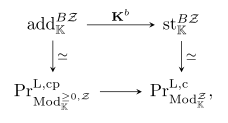 where the top horizontal morphism is left adjoint to the forgetful functor. Using ([008T]) to consider the bottom horizontal morphism as a morphism in \(\mathrm{CAlg}(\mathrm{Pr}^\mathrm{L})_{\mathrm{add}_{\mathbb{K}}^{B\mathcal Z}/}\), it enhances by proposition 4.1.7 to a symmetric monoidal \(\mathrm{add}_{\mathbb{K}}^{B\mathcal Z}\)-enriched functor \(\mathrm{Pr}^{\mathrm{L}, \mathrm{cp}}_{{\mathrm{Mod}_{\mathbb{K}}^{\geq 0,\mathcal Z}}}\rightarrow\mathrm{Pr}^{\mathrm{L}, \mathrm{c}}_{\mathrm{Mod}_{\mathbb{K}}^{\mathcal Z}}\). (By commutativity of ([008T]) and observation 4.1.2, we may understand the \(\mathrm{add}_{\mathbb{K}}^{B\mathcal Z}\)-enrichment of \(\mathrm{Pr}^{\mathrm{L}, \mathrm{c}}_{\mathrm{Mod}_{\mathbb{K}}^{\mathcal Z}}\) as induced by restricting its \(\mathrm{st}_{\mathbb{K}}^{B\mathcal Z}\)-enrichment from observation 4.3.5 along the forgetful functor \(\mathrm{st}_{\mathbb{K}}^{B\mathcal Z}\rightarrow\mathrm{add}_{\mathbb{K}}^{B\mathcal Z}\).) For an algebra \(A\in \mathrm{Alg}(\mathrm{Mod}_{\mathbb{K}}^{\geq 0, \mathcal Z})\), it follows from [Lur17, Thm. 4.8.4.6] that \[\mathrm{RMod}_A(\mathrm{Mod}_{\mathbb{K}}^{\geq 0, \mathcal Z}) \otimes_{\mathrm{Mod}_{\mathbb{K}}^{\geq 0, \mathcal Z}} \mathrm{Mod}_{\mathbb{K}}^{\mathcal Z} \simeq \mathrm{RMod}_{A}(\mathrm{Mod}_{\mathbb{K}}^{\mathcal Z}).\] Thus, the \(\mathrm{add}_{\mathbb{K}}^{B\mathcal Z}\)-enriched functor \(\mathrm{Pr}^{\mathrm{L}, \mathrm{cp}}_{{\mathrm{Mod}_{\mathbb{K}}^{\geq 0,\mathcal Z}}}\rightarrow\mathrm{Pr}^{\mathrm{L}, \mathrm{c}}_{\mathrm{Mod}_{\mathbb{K}}^{\mathcal Z}}\) restricts to an \(\mathrm{add}_{\mathbb{K}}^{B\mathcal Z}\)-enriched functor between the full subcategories \[\mathrm{Morita}^{\mathrm{cp}}(\mathrm{Mod}_{\mathbb{K}}^{\geq 0, \mathcal Z}) \rightarrow\mathrm{Morita}^{\mathrm{c}}(\mathrm{Mod}_{\mathbb{K}}^{ \mathcal Z}).\] Its explicit description on additive hom-categories can be unpacked from observation 4.1.2. ◻
4.5 Morita categories of discrete flat algebras[008U]
For the rest of this section, we focus on the case where \(\mathbb{K}= Hk\) for an ordinary commutative ring \(k\) and where \(\mathcal Z\) is a discrete commutative monoid \(Z\). Our goal of this subsection is to restrict our Morita categories from corollary 4.4.5 to certain symmetric monoidal full subcategories which only contain discrete (i.e. ordinary) \(k\)-algebras and whose hom-categories are given by ordinary categories of discrete graded bimodules, or their derived variants.
[008V]
Definition 4.5.1.
A discrete \(Z\)-graded \(k\)-module \(M\) is flat if \(\oplus_{z \in Z} M_z\) is flat as a \(k\)-module. We let \(\mathrm{mod}_k^{Z, \mathrm{flat}}\) denote the full subcategory of the ordinary category of discrete \(Z\)-graded \(k\)-modules \(\mathrm{mod}_{k}^Z\) on the flat modules. A (not necessarily commutative) discrete \(Z\)-graded \(k\)-algebra \(A\) is flat if it is flat as a \(Z\)-graded \(k\)-module.
The following two observations and example are crucial when connecting back to section 2.
[008X]
Observation 4.5.3.
An ordinary \(Z\)-graded \(k\)-module \(M\) is flat if and only if it is degreewise flat, i.e. each graded component \(M_z\) is a flat \(k\)-module for all \(z\in Z\). This follows from the fact that flatness is preserved under infinite coproducts and retracts.
[008Y]
Example 4.5.4.
Free modules are flat. In particular, if \(k\) is a field, all \(Z\)-graded \(k\)-vector spaces are flat, and if \(k\) is an ordinary commutative ring and \(n\geq 0\), the polynomial algebra \(k[x_1,\ldots, x_n]\) is flat, and hence it is also flat if considered as a \(\mathbb{Z}\)-graded \(k\)-algebra with generators \(x_i\) in some degree \(n_i \in \mathbb{Z}\).
[008Z]
Observation 4.5.5.
As flatness is closed under tensor products, \(\mathrm{mod}_k^{Z, \mathrm{flat}}\) is a symmetric monoidal full subcategory of \(\mathrm{mod}_{k}^Z\). On the other hand, \(\mathrm{mod}_k^{Z, \mathrm{flat}}\) is also a symmetric monoidal full subcategory of \(\mathrm{Mod}_{Hk}^{ \geq 0, Z} \hookrightarrow \mathrm{Mod}_{Hk}^Z\): under the equivalence \(\mathrm{Mod}_{Hk}^Z \simeq \mathcal D(\mathrm{mod}_{k}^Z)\) by example 3.5.15. The tensor product in \(\mathcal D(\mathrm{mod}_{k}^Z)\) is given by Day convolution of derived tensor products, which reduces to the Day convolution of ordinary tensor products on flat modules. In particular, tensor products of discrete flat \(Z\)-graded \(k\)-algebras are also discrete and flat.
[0090]
Notation 4.5.6.
For flat \(Z\)-graded \(k\)-algebras \(A\) and \(B\), we let \({}_A\mathrm{grbmod}_B\coloneqq{}_A\mathrm{BMod}_B(\mathrm{mod}_{k}^Z)\) denote the abelian \(1\)-category of ordinary graded \(A\)–\(B\) bimodules. Let \({}_A\mathrm{grbmod}_B^{\mathrm{gr-cp}}\) denote its full subcategory on those bimodules that are graded-compact-projective, see definition 3.6.8, as right \(B\)-modules.
Let \(\mathcal D({}_A\mathrm{grbmod}_B)^{\mathrm{gr-perf}}\) denote the full subcategory of the derived \(\infty\)-category \(\mathcal D({}_A\mathrm{grbmod}_B)\) on those objects that are graded-perfect, see remark 3.6.10 and preceeding definition, as derived right \(B\)-modules.
Most of the constructions in section 6 will build on the following \(\infty\)-categories.
[0091]
Definition 4.5.7.
Let \(k\) be an ordinary commutative ring and \(Z\) a discrete commutative monoid. We define \[\mathrm{Mor}^{\mathrm{flat}, \mathrm{gr-proj}}(\mathrm{mod}_{k}^{Z})\subseteq \mathrm{Morita}^{\mathrm{cp}}(\mathrm{Mod}_{Hk}^{\geq 0, Z})\] to be the full \(\mathrm{add}_{Hk}^{BZ}\)-enriched subcategory on the discrete flat \(Z\)-graded \(k\)-algebras.
Similarly, we define \[\mathrm{DMor}^{\mathrm{flat}, \mathrm{gr-perf}}(\mathrm{mod}_{k}^{Z})\subseteq \mathrm{Morita}^{\mathrm{c}}(\mathrm{Mod}_{Hk}^{Z})\] to be the full \(\mathrm{st}_{Hk}^{BZ}\)-enriched subcategory on the discrete flat \(Z\)-graded \(k\)-algebras.
The following justifies the terminology ’Morita categories’, see also example 6.0.2.
[0092]
Corollary 4.5.8.
Let \(k\) be an ordinary commutative ring and \(Z\) a discrete commutative monoid.
definition 4.5.7 defines a large symmetric monoidal \(\mathrm{add}_{Hk}^{BZ}\)-enriched \(\infty\)-category \[\mathrm{Mor}^{\mathrm{flat}, \mathrm{gr-proj}}(\mathrm{mod}_{k}^{Z})\in \mathrm{CAlg}(\widehat{\mathrm{Cat}}[\mathrm{add}_{Hk}^{BZ}])\] equipped with a symmetric monoidal surjective-on-objects functor \[\mathrm{Alg}(\mathrm{mod}_k^{Z, \mathrm{flat}}) \rightarrow\mathrm{Mor}^{\mathrm{flat}, \mathrm{gr-proj}}(\mathrm{mod}_{k}^{Z}).\] The additive \(k\)-linear hom-category between algebras \(A, B \in \mathrm{Alg}(\mathrm{mod}_k^{Z, \mathrm{flat}})\) is given by the ordinary category \({}_A\mathrm{grbmod}_B^{\mathrm{gr-cp}}\) with \(Z\)-action by grading shift.
Composition is given by the ordinary relative tensor product, and the monoidal structure by the ordinary tensor product over \(k\).
definition 4.5.7 defines a large symmetric monoidal \(\mathrm{st}_{Hk}^{BZ}\)-enriched \(\infty\)-category \[\mathrm{DMor}^{\mathrm{flat}, \mathrm{gr-perf}}(\mathrm{mod}_{k}^{Z})\in \mathrm{CAlg}(\widehat{\mathrm{Cat}}[\mathrm{st}_{Hk}^{BZ}])\] equipped with a symmetric monoidal surjective-on-objects functor \[\mathrm{Alg}(\mathrm{mod}_k^{Z, \mathrm{flat}}) \rightarrow\mathrm{DMor}^{\mathrm{flat}, \mathrm{gr-perf}}(\mathrm{mod}_{k}^{Z}).\] The stable \(k\)-linear hom-category between algebras \(A, B \in \mathrm{Alg}(\mathrm{mod}_k^{Z, \mathrm{flat}})\) is \(\mathcal D(_A\mathrm{grbmod}_B)^{\mathrm{gr-perf}}\) with \(Z\)-action by grading shift.
Composition is given by the derived relative tensor product, and the monoidal structure by the derived tensor product over \(k\).
The functor from corollary 4.4.5.([008R]) restricts to a symmetric monoidal \(\mathrm{add}_{Hk}^{BZ}\)-enriched functor \[\mathrm{Mor}^{\mathrm{flat}, \mathrm{gr-proj}}(\mathrm{mod}_{k}^{Z})\rightarrow\mathrm{DMor}^{\mathrm{flat}, \mathrm{gr-perf}}(\mathrm{mod}_{k}^{Z}).\] On objects this functor acts via the identity on \(\mathrm{Alg}(\mathrm{mod}_k^{Z, \mathrm{flat}})^{\simeq}\); on hom-categories between \(A, B \in \mathrm{Alg}(\mathrm{mod}_k^{Z, \mathrm{flat}})\) it is given by the additive \(k\)-linear \(Z\)-equivariant fully faithful inclusion \[_A\mathrm{grbmod}_B^{\mathrm{gr-cp}} \hookrightarrow \mathcal D(_A\mathrm{grbmod}_B)^{\mathrm{gr-perf}}.\]
[0096]
Proof.
Since the derived tensor product of discrete flat \(Z\)-graded algebras is again a discrete and flat algebra, the functor \(\mathrm{Alg}(\mathrm{mod}_k^{Z, \mathrm{flat}}) \rightarrow\mathrm{Alg}(\mathrm{Mod}_{Hk}^{\geq 0, \mathcal Z})\) is symmetric monoidal, and hence the full subcategories \(\mathrm{Mor}^{\mathrm{flat}, \mathrm{gr-proj}}(\mathrm{mod}_{k}^{Z})\) and \(\mathrm{DMor}^{\mathrm{flat}, \mathrm{gr-perf}}(\mathrm{mod}_{k}^{Z})\) are closed under the tensor product in \(\mathrm{Morita}^{\mathrm{cp}}(\mathrm{Mod}_{Hk}^{\geq 0, Z})\) and \(\mathrm{Morita}^{\mathrm{c}}(\mathrm{Mod}_{Hk}^{ Z})\), respectively. Denoting the derived and underived Day convolution tensor product by \(\otimes^{L, \mathrm{gr}}\) and \(\otimes^{\mathrm{gr}}\), respectively, and using proposition 3.6.9 and observation 4.5.5 we obtain the following equivalences for discrete flat \(Z\)-graded \(k\)-algebras \(A\) and \(B\) \[\begin{aligned}
{}_A\mathrm{BMod}_B(\mathrm{Mod}_{Hk}^{Z}) & \simeq \mathrm{RMod}_{A^{\mathrm{op}}\otimes^{L, \mathrm{gr}} B}(\mathrm{Mod}_{Hk}^Z) \simeq \mathrm{RMod}_{A^{\mathrm{op}}\otimes^{\mathrm{gr}} B}(\mathrm{Mod}_{Hk}^Z) \\& \simeq \mathcal D(\mathrm{grmod}_{A^{\mathrm{op}}\otimes^{\mathrm{gr}} B}) \simeq \mathcal D({}_A\mathrm{grbmod}_B).
\end{aligned}\] Recalling notation 4.4.2 for the full subcategories \({}_{A}\mathrm{BMod}^{\mathrm{cp}}_B(\mathrm{Mod}_{Hk}^{\geq 0, Z})\) and \({}_{A}\mathrm{BMod}^{\mathrm{c}}_B(\mathrm{Mod}_{Hk}^{Z})\) on those bimodules which are compact-projective, resp. compact as right \(B\)-modules, the above equivalence restricts to an equivalence between subcategories (see notation 4.5.6) \[{}_A\mathrm{BMod}^{\mathrm{cp}}_{B}(\mathrm{Mod}_{Hk}^{\geq 0, Z}) \simeq {}_A\mathrm{grbmod}_B^{\mathrm{gr-cp}} \quad \mathrm{and} \quad {}_A\mathrm{BMod}^{\mathrm{c}}_{B}(\mathrm{Mod}_{Hk}^{Z}) \simeq \mathcal D(_A\mathrm{grbmod}_B)^{\mathrm{gr-perf}}.\] Using these observations, corollary 4.5.8 follow directly from corollary 4.4.5. ◻
[0098]
Observation 4.5.10.
By definition, \(\mathrm{DMor}^{\mathrm{flat}, \mathrm{gr-perf}}(\mathrm{mod}_{k}^{Z})\) is a full symmetric monoidal subcategory of \(\mathrm{Pr}^{\mathrm{L},\mathrm{c}}_{\mathrm{Mod}_{Hk}^{Z}}\). Thus, it comes equipped with a symmetric monoidal fully faithful \(\mathrm{st}_{Hk}^{BZ}\)-enriched functor \[\mathrm{DMor}^{\mathrm{flat}, \mathrm{gr-perf}}(\mathrm{mod}_{k}^{Z})\hookrightarrow \mathrm{Pr}^{\mathrm{L},\mathrm{c}}_{\mathrm{Mod}_{Hk}^{Z}} ~\stackrel{(-)^{\mathrm{c}}}{\simeq} ~\mathrm{st}_{Hk}^{BZ}.\]
Explicitly, the functor in observation 4.5.10 sends a flat \(Z\)-graded \(k\)-algebra \(A\) to the stable \(\infty\)-category \[\mathrm{RMod}_{HA}\left(\mathrm{Mod}_{Hk}^{BZ}\right)^{\mathrm{c}}~~ \stackrel{\mathrm{Prop.}~\href{/tag/006U}{3.6.9}}{\simeq} ~~\mathcal D(\mathrm{grmod}_A)^{\mathrm{gr-perf}}\] of graded-perfect right \(A\)-modules, with \(Z\)-action given by grading shift.