3.1 Completions of \(\infty\)-categories[002N]
3.1.1 The Yoneda embedding[002P]
Any small \(\infty\)-category \(\mathcal C\) has a Yoneda embedding into its \(\infty\)-category of (\(\mathcal S\)-valued) presheaves \(\mathcal P(\mathcal C)=\mathrm{Fun}(\mathcal C^\mathrm{op}, \mathcal S)\), [Lur09, Prop. 5.1.3.1], see also [Cis19]. It is characterized by the universal property that \(\mathcal P(\mathcal C)\) has all small colimits (i.e. is cocomplete) [Lur09, Cor. 5.1.2.4], and that for any cocomplete \(\infty\)-category \(\mathcal D\) the restriction along the Yoneda embedding induces an equivalence \[
\mathrm{Fun^L}(\mathcal P(\mathcal C),\mathcal D) \rightarrow\mathrm{Fun}(\mathcal C,\mathcal D)\] where \(\mathrm{Fun^L}\) denotes the full subcategory of the \(\infty\)-category of functors on those functors which preserve all small colimits (i.e. the cocontinuous functors) [Lur09, Thm. 5.1.5.6], see also [Cis19, Thm. 6.3.13]. An \(\infty\)-category \(\mathcal C\) is called idempotent complete if its image under the Yoneda embedding \(\mathcal C\rightarrow\mathcal P(\mathcal C)\) is closed under retracts (see [Lur09, Proof of Prop. 5.1.4.2]). We refer to [Lur09, § 4.4.5] for a discussion of retracts and idempotents in \(\infty\)-categories.
[002R]
Notation 3.1.1.
We write
\(\mathrm{Cat}_{\infty}^\mathrm{idem}\) for the full subcategory of \(\mathrm{Cat}_{\infty}\) on the idempotent complete small \(\infty\)-categories,
\(\mathrm{Cat}_{\infty}^{\sqcup, \mathrm{idem}}\) for the subcategory of \(\mathrm{Cat}_{\infty}^\mathrm{idem}\) on the idempotent complete small \(\infty\)-categories that admit finite coproducts and functors which preserve finite coproducts, and
\(\mathrm{Cat}_{\infty}^{\mathrm{rex}, \mathrm{idem}}\) for the subcategory of \(\mathrm{Cat}_{\infty}^{\sqcup, \mathrm{idem}}\) on the idempotent complete small \(\infty\)-categories that admit finite colimits and functors which preserve finite colimits.
3.1.2 Presentable \(\infty\)-categories[002S]
In general, the presheaf category \(\mathcal P(\mathcal C)\) of a small \(\infty\)-category \(\mathcal C\) is a large category. The sense in which \(\mathcal P(\mathcal C)\) is nevertheless still controlled by a small amount of data is formalized by the notion of a presentable \(\infty\)-category. We recall the definition and some basic facts from [Lur09, Sec. 5.4 and 5.5].
[002T]
Definition 3.1.2.
Let \(\mathcal D\) be a (possibly large) \(\infty\)-category.
Let \(\mathcal K\) be a collection of \(\infty\)-categories and \(S\) a small set of objects of \(\mathcal D\). Then \(\mathcal D\) is generated by \(S\) under \(\mathcal K\)-indexed colimits if \(\mathcal D\) has all colimits indexed by categories in \(\mathcal K\) and is the smallest full subcategory of \(\mathcal D\) which contains the objects in \(S\) and is closed under \(\mathcal K\)-indexed colimits.
Let \(\kappa\) be an infinite regular cardinal and assume \(\mathcal D\) admits \(\kappa\)-filtered colimits. Then an object \(d\in \mathcal D\) is called \(\kappa\)-compact if the functor \(\mathrm{Hom}_{\mathcal D}(d,-)\colon \mathcal D\rightarrow\mathcal S\) preserves \(\kappa\)-filtered colimits.
The \(\infty\)-category \(\mathcal D\) is called accessible if it is locally small and there exists a regular cardinal \(\kappa\) and a small set \(S\) of \(\kappa\)-compact objects in \(\mathcal C\) that generates \(\mathcal C\) under \(\kappa\)-filtered colimits.
The \(\infty\)-category \(\mathcal D\) is called presentable if it has all small colimits and is accessible.
[002U]
Example 3.1.3.
By Simpson’s characterisation of presentable \(\infty\)-categories as localizations of presheaf categories, [Lur09, Thm. 5.5.1.1], we obtain presentability of \(\mathcal P(\mathcal C)\) for any small \(\infty\)-category \(\mathcal C\) [Lur09, Ex. 5.4.2.7, Ex. 5.5.1.8.], and more generally the presentability of \(\mathrm{Fun}(\mathcal C, \mathcal D)\) for a small \(\infty\)-category \(\mathcal C\) and a presentable \(\infty\)-category \(\mathcal D\).
A main application of the notion of presentable \(\infty\)-category is the adjoint functor theorem:
[002V]
Proposition 3.1.4. ([Lur09, Cor. 5.5.2.9 and Rem. 5.5.2.10]).
A functor from a presentable \(\infty\)-category to a locally small \(\infty\)-category preserves small colimits if and only if it is a left adjoint.
[002W]
Notation 3.1.5.
We denote by
\(\mathrm{Pr}^\mathrm{L}\) the \(\infty\)-category of presentable \(\infty\)-categories and small colimit preserving functors, i.e left adjoint functors by the adjoint functor theorem.
\(\mathrm{Fun^L}(\mathcal C,\mathcal D)\), for \(\mathcal C, \mathcal D\in \mathrm{Pr}^\mathrm{L}\), the full subcategory of \(\mathrm{Fun}(\mathcal C, \mathcal D)\) of left adjoint (equivalently cocontinuous) functors. Dually, full subcategories of right adjoint functors will be denoted \(\mathrm{Fun^R}(-,-)\).
When denoting an adjunction
between \(\infty\)-categories, we use the convention that the top arrow is the left adjoint and the bottom arrow the right adjoint.
For more details, we refer to [Lur09, § 5.5.3] and [Cis19, § 7].
3.1.3 The monoidal structure on \(\mathrm{Pr}^\mathrm{L}\) and presentably symmetric monoidal categories[002X]
[002Y]
Proposition 3.1.6. ([Lur17, Prop. 4.8.1.15, Prop. 4.8.1.10]).
The \(\infty\)-category \(\mathrm{Pr}^\mathrm{L}\) can be equipped with a symmetric monoidal structure for which the Yoneda embedding defines a symmetric monoidal functor \[\mathcal P\colon \mathrm{Cat}_{\infty}\rightarrow\mathrm{Pr}^\mathrm{L}\] where \(\mathrm{Cat}_{\infty}\) is equipped with its Cartesian symmetric monoidal structure.
The tensor unit of this symmetric monoidal structure is given by the presentable \(\infty\)-category \(\mathcal S\) of spaces. The tensor product \(\mathcal C_1\otimes \mathcal C_2\) of two presentable \(\infty\)-categories \(\mathcal C_1, \mathcal C_2\) comes equipped with a functor \(\mathcal C_1 \times \mathcal C_2 \rightarrow\mathcal C_1\otimes \mathcal C_2\) which preserves small colimits separately in both variables and is characterized by the universal property that for any presentable \(\infty\)-category \(\mathcal D\), the induced functor \[\mathrm{Fun^L}(\mathcal C_1\otimes \mathcal C_2, \mathcal D) \rightarrow\mathrm{Fun^{L \times L}}(\mathcal C_1 \times \mathcal C_2, \mathcal D)\] is an equivalence. Here, \(\mathrm{\mathrm{Fun}^{L \times L}}(\mathcal C_1 \times \mathcal C_2,\mathcal D)\) denotes the full subcategory of \(\mathrm{Fun}(\mathcal C_1\times \mathcal C_2, \mathcal D)\) on those functors which preserve small colimits separately in both variables. Abusing notation, given objects \(c_1\in \mathcal C_1\) and \(c_2\in \mathcal C_2\) we denote the image of \((c_1, c_2) \in \mathcal C_1 \times \mathcal C_2\) under the functor \(\mathcal C_1\times \mathcal C_2 \rightarrow\mathcal C_1\otimes \mathcal C_2\) by \(c_1\boxtimes c_2\in \mathcal C_1 \otimes \mathcal C_2\) and call it their external tensor product.
It follows from [Lur17, Prop. 4.8.1.17, Prop. 4.8.1.16] after taking adjoints, that the tensor product of presentable \(\infty\)-categories can be expressed as the following functor category (which is in particular presentable): \[
\mathcal C\otimes \mathcal D\simeq \mathrm{Fun^L}(\mathcal D, \mathcal C^\mathrm{op})^\mathrm{op}= \mathrm{Fun^R}(\mathcal C^\mathrm{op}, \mathcal D)\]
The symmetric monoidal structure on \(\mathrm{Pr}^\mathrm{L}\) allow us to study (commutative) algebras therein, see subsection A.8.4.
[0030]
Definition 3.1.7.
A presentably symmetric monoidal \(\infty\)-category is a commutative algebra object in \(\mathrm{Pr}^\mathrm{L}\).
More explicitly, a presentably symmetric monoidal \(\infty\)-category is a symmetric monoidal \(\infty\)-category whose underlying \(\infty\)-category \(\mathcal C\) is presentable and so that the tensor product functor \(-\otimes-\colon \mathcal C\times \mathcal C\rightarrow\mathcal C\) preserves small colimits separately in both variables.
If \(A\) is a commutative algebra object in a symmetric monoidal \(\infty\)-category \(\mathcal C\), consider the \(\infty\)-category \(\mathrm{Mod}_A(\mathcal C)\) of left \(A\)-modules in \(\mathcal C\) (see subsection A.9).
[0031]
Proposition 3.1.8.
Given \(\mathcal C, \mathcal D\in \mathrm{CAlg}(\mathrm{Pr}^\mathrm{L})\), together with \(A, B \in \mathrm{CAlg}(\mathcal C)\).
The relative tensor product \(-\otimes_A - \colon \mathrm{Mod}_A(\mathcal C) \times \mathrm{Mod}_A(\mathcal C) \rightarrow\mathrm{Mod}_A(\mathcal C)\) defines a presentably symmetric monoidal structure on \(\mathrm{Mod}_A(\mathcal C)\). Moreover, there is an equivalence \(\mathrm{CAlg}(\mathrm{Mod}_A(\mathcal C)) \simeq \mathrm{CAlg}(\mathcal C)_{A/}\).
Any algebra homomorphism \(f\colon A\rightarrow B\) in \(\mathrm{CAlg}(\mathcal C)\) induces a symmetric monoidal induction functor \(-\otimes_A B\colon \mathrm{Mod}_A(\mathcal C) \rightarrow\mathrm{Mod}_B(\mathcal C)\) that is left adjoint to the restriction functor along \(f\), and hence a morphism in \(\mathrm{CAlg}(\mathrm{Pr}^\mathrm{L})\).
For any algebra homomorphism \(A\rightarrow B\), it follows from (2) that we can view \(B\) as an object in \(\mathrm{CAlg}(\mathrm{Mod}_A(\mathcal C))\). Forgetting the \(A\)-action induces a symmetric monoidal equivalence: \[\mathrm{Mod}_B(\mathrm{Mod}_A(\mathcal C)) \xrightarrow{\simeq} \mathrm{Mod}_B(\mathcal C)\]
Any functor \(F \colon \mathcal C\rightarrow\mathcal D\) in \(\mathrm{CAlg}(\mathrm{Pr}^\mathrm{L})\) induces a functor \(\mathrm{CAlg}(\mathcal C) \rightarrow\mathrm{CAlg}(\mathcal D)\) on commutative algebra objects, which we will also simply denote by \(F\). Moreover, it induces a functor \[\mathrm{Mod}_A(F) \colon \mathrm{Mod}_A(\mathcal C) \rightarrow\mathrm{Mod}_{F(A)}(\mathcal D)\] in \(\mathrm{CAlg}(\mathrm{Pr}^\mathrm{L})\).
Any functor \(F \colon \mathcal C\rightarrow\mathcal D\) in \(\mathrm{CAlg}(\mathrm{Pr}^\mathrm{L})\) induces an equivalence in \(\mathrm{CAlg}(\mathrm{Pr}^\mathrm{L})\) \[\mathcal D\otimes_{\mathcal C}(\mathrm{Mod}_A(\mathcal C)) \simeq \mathrm{Mod}_{F(A)}(\mathcal D),\] where \(-\otimes_{\mathcal C}-\) denotes the pushout in \(\mathrm{CAlg}(\mathrm{Pr}^\mathrm{L})\), whose underlying presentable \(\infty\)-category is given by the relative tensor product in \(\mathrm{Pr}^\mathrm{L}\) [Lur17, Prop. 3.2.4.10], hence the notation.
[0037]
Proof.
The first two statements follow from [Lur17, Prop. 3.4.1.3, Cor. 4.2.3.7, Thm. 4.5.3.1], the third statement follows from [Lur17, Cor. 3.4.1.9]. The existence of the symmetric monoidal functor \(\mathrm{Mod}_A(F)\) in part ([0035]) follows from the functoriality of the \(\mathrm{Mod}\) construction in [Lur17, § 3.3.3]. Furthermore, \(\mathrm{Mod}_A(F)\) preserves colimits by [Lur17, Cor. 4.2.3.5]. Functoriality of the construction of modules induces a commuting square in \(\mathrm{CAlg}(\mathrm{Pr}^\mathrm{L})\) 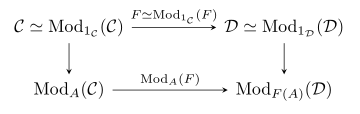 and hence a morphism in \(\mathrm{CAlg}(\mathrm{Pr}^\mathrm{L})\) from the pushout \(\mathcal D\otimes_{\mathcal C} \mathrm{Mod}_{A}(\mathcal C) \rightarrow\mathrm{Mod}_{F(A)}(\mathcal D)\). This is an equivalence in \(\mathrm{CAlg}(\mathrm{Pr}^\mathrm{L})\) because its underlying functor is one by [Lur17, Thm. 4.8.4.6]. ◻
Since \(\mathcal S\) is the tensor unit of the symmetric monoidal structure on \(\mathrm{Pr}^\mathrm{L}\), it is initial in \(\mathrm{CAlg}(\mathrm{Pr}^\mathrm{L})\) and any \(\mathcal C\in \mathrm{CAlg}(\mathrm{Pr}^\mathrm{L})\) comes equipped with a unique symmetric monoidal left adjoint functor \(\iota_{\mathcal C} \colon \mathcal S\rightarrow\mathcal C\).
[0038]
Corollary 3.1.9.
For \(\mathcal Z\in \mathrm{CAlg}(\mathcal S)\), proposition 3.1.8.([0036]) implies that there is an equivalence in \(\mathrm{CAlg}(\mathrm{Pr}^\mathrm{L})\): \[\mathcal C\otimes \mathrm{Mod}_\mathcal Z(\mathcal S)
\simeq
\mathcal C\otimes_{\mathcal S}\mathrm{Mod}_{\mathcal Z}(\mathcal S)
\simeq
\mathrm{Mod}_{\iota_{\mathcal C}(\mathcal Z)}(\mathcal C\otimes_\mathcal S\mathcal S)
\simeq
\mathrm{Mod}_{\iota_{\mathcal C}(\mathcal Z)}(\mathcal C).\]
3.1.4 Adjoining colimits[0039]
[003A]
Notation 3.1.10.
For a small set \(\mathcal K\) of simplicial sets, let \(\mathrm{Cat}_{\infty}^{\mathcal K}\) denote the subcategory of \(\mathrm{Cat}_{\infty}\) on those small \(\infty\)-categories which admit colimits of diagrams indexed by elements of \(\mathcal K\), and those functors which preserve such colimits.
The \(\infty\)-categories \(\mathrm{Cat}_{\infty}^\mathrm{idem}, \mathrm{Cat}_{\infty}^{\sqcup, \mathrm{idem}}\) and \(\mathrm{Cat}_{\infty}^{\mathrm{rex}, \mathrm{idem}}\) from notation 3.1.1 are instances of \(\mathrm{Cat}_{\infty}^\mathcal K\) for \(\mathcal K\) consisting of the ‘walking idempotent’ of [Lur09, § 4.4.5], or the walking idempotent together with the set of finite (discrete) sets or the set of finite simplicial sets, respectively.
Just like the presheaf \(\infty\)-category \(\mathcal P(\mathcal C)\) is the free completion of a small \(\infty\)-category \(\mathcal C\) under small colimits, we may complete under other classes of colimits. The following combines [Lur17, Lem. 4.8.4.2, Rem. 4.8.1.8] and [Lur09, Cor. 5.3.6.10]:
[003B]
Proposition 3.1.11.
Let \(\mathcal K\) be a small set of simplicial sets.
The \(\infty\)-category \(\mathrm{Cat}_{\infty}^{\mathcal K}\) is presentable and admits a presentably symmetric monoidal structure, which can be characterized as follows: If \(\mathcal C, \mathcal D\in \mathrm{Cat}_{\infty}^{\mathcal K}\), the tensor product \(\mathcal C\otimes \mathcal D\) is equipped with a functor \(\mathcal C\times \mathcal D\rightarrow\mathcal C\otimes \mathcal D\) which preserves \(\mathcal K\)-colimits separately in both variables and which induces for all \(\mathcal E\in \mathrm{Cat}_{\infty}^{\mathcal K}\) an equivalence \[\mathrm{Fun}^{\mathcal K}(\mathcal C\otimes \mathcal D, \mathcal E) \rightarrow\mathrm{\mathrm{Fun}^{\mathcal K\times \mathcal K}}(\mathcal C\times \mathcal D, \mathcal E),\] where \(\mathrm{Fun}^{\mathcal K}(\mathcal C\otimes \mathcal D, \mathcal E)\) denotes the full subcategory of \(\mathrm{Fun}(\mathcal C\otimes \mathcal D,\mathcal E)\) on those functors which preserve \(\mathcal K\)-colimits and where \(\mathrm{Fun}^{\mathcal K\times \mathcal K}(\mathcal C\times \mathcal D, \mathcal E)\) denotes the full subcategory of \(\mathrm{Fun}(\mathcal C\times \mathcal D, \mathcal E)\) on those functors which preserve \(\mathcal K\)-colimits separately in both variables.
Let \(\mathcal K'\) be a small set of simplicial sets with containing \(\mathcal K\). Then the subcategory inclusion \(\mathrm{Cat}_{\infty}^{\mathcal K'} \rightarrow\mathrm{Cat}_{\infty}^{\mathcal K}\) admits a symmetric monoidal left adjoint \[\mathcal P_{\mathcal K}^{\mathcal K'}\colon \mathrm{Cat}_{\infty}^{\mathcal K} \rightarrow\mathrm{Cat}_{\infty}^{\mathcal K'}\] whose unit \(\mathcal C\rightarrow\mathcal P_{\mathcal K}^{\mathcal K'}(\mathcal C)\) for \(\mathcal C\in \mathrm{Cat}_{\infty}^{\mathcal K'}\) is a fully faithful functor.
The second statement of proposition 3.1.11 implies that \(\mathcal C\hookrightarrow \mathcal P_{\mathcal K}^{\mathcal K'}(\mathcal C)\) may be thought of as a generalized Yoneda embedding: It is the free cocompletion of \(\mathcal C\) under \(\mathcal K'\)-shaped colimits subject to the relation that \(\mathcal K\)-shaped colimits in \(\mathcal C\) are preserved.