3.1.3 The monoidal structure on \(\mathrm{Pr}^\mathrm{L}\) and presentably symmetric monoidal categories[002X]
[002Y]
Proposition 3.1.6. ([Lur17, Prop. 4.8.1.15, Prop. 4.8.1.10]).
The \(\infty\)-category \(\mathrm{Pr}^\mathrm{L}\) can be equipped with a symmetric monoidal structure for which the Yoneda embedding defines a symmetric monoidal functor \[\mathcal P\colon \mathrm{Cat}_{\infty}\rightarrow\mathrm{Pr}^\mathrm{L}\] where \(\mathrm{Cat}_{\infty}\) is equipped with its Cartesian symmetric monoidal structure.
The tensor unit of this symmetric monoidal structure is given by the presentable \(\infty\)-category \(\mathcal S\) of spaces. The tensor product \(\mathcal C_1\otimes \mathcal C_2\) of two presentable \(\infty\)-categories \(\mathcal C_1, \mathcal C_2\) comes equipped with a functor \(\mathcal C_1 \times \mathcal C_2 \rightarrow\mathcal C_1\otimes \mathcal C_2\) which preserves small colimits separately in both variables and is characterized by the universal property that for any presentable \(\infty\)-category \(\mathcal D\), the induced functor \[\mathrm{Fun^L}(\mathcal C_1\otimes \mathcal C_2, \mathcal D) \rightarrow\mathrm{Fun^{L \times L}}(\mathcal C_1 \times \mathcal C_2, \mathcal D)\] is an equivalence. Here, \(\mathrm{\mathrm{Fun}^{L \times L}}(\mathcal C_1 \times \mathcal C_2,\mathcal D)\) denotes the full subcategory of \(\mathrm{Fun}(\mathcal C_1\times \mathcal C_2, \mathcal D)\) on those functors which preserve small colimits separately in both variables. Abusing notation, given objects \(c_1\in \mathcal C_1\) and \(c_2\in \mathcal C_2\) we denote the image of \((c_1, c_2) \in \mathcal C_1 \times \mathcal C_2\) under the functor \(\mathcal C_1\times \mathcal C_2 \rightarrow\mathcal C_1\otimes \mathcal C_2\) by \(c_1\boxtimes c_2\in \mathcal C_1 \otimes \mathcal C_2\) and call it their external tensor product.
It follows from [Lur17, Prop. 4.8.1.17, Prop. 4.8.1.16] after taking adjoints, that the tensor product of presentable \(\infty\)-categories can be expressed as the following functor category (which is in particular presentable): \[
\mathcal C\otimes \mathcal D\simeq \mathrm{Fun^L}(\mathcal D, \mathcal C^\mathrm{op})^\mathrm{op}= \mathrm{Fun^R}(\mathcal C^\mathrm{op}, \mathcal D)\]
The symmetric monoidal structure on \(\mathrm{Pr}^\mathrm{L}\) allow us to study (commutative) algebras therein, see subsection A.8.4.
[0030]
Definition 3.1.7.
A presentably symmetric monoidal \(\infty\)-category is a commutative algebra object in \(\mathrm{Pr}^\mathrm{L}\).
More explicitly, a presentably symmetric monoidal \(\infty\)-category is a symmetric monoidal \(\infty\)-category whose underlying \(\infty\)-category \(\mathcal C\) is presentable and so that the tensor product functor \(-\otimes-\colon \mathcal C\times \mathcal C\rightarrow\mathcal C\) preserves small colimits separately in both variables.
If \(A\) is a commutative algebra object in a symmetric monoidal \(\infty\)-category \(\mathcal C\), consider the \(\infty\)-category \(\mathrm{Mod}_A(\mathcal C)\) of left \(A\)-modules in \(\mathcal C\) (see subsection A.9).
[0031]
Proposition 3.1.8.
Given \(\mathcal C, \mathcal D\in \mathrm{CAlg}(\mathrm{Pr}^\mathrm{L})\), together with \(A, B \in \mathrm{CAlg}(\mathcal C)\).
The relative tensor product \(-\otimes_A - \colon \mathrm{Mod}_A(\mathcal C) \times \mathrm{Mod}_A(\mathcal C) \rightarrow\mathrm{Mod}_A(\mathcal C)\) defines a presentably symmetric monoidal structure on \(\mathrm{Mod}_A(\mathcal C)\). Moreover, there is an equivalence \(\mathrm{CAlg}(\mathrm{Mod}_A(\mathcal C)) \simeq \mathrm{CAlg}(\mathcal C)_{A/}\).
Any algebra homomorphism \(f\colon A\rightarrow B\) in \(\mathrm{CAlg}(\mathcal C)\) induces a symmetric monoidal induction functor \(-\otimes_A B\colon \mathrm{Mod}_A(\mathcal C) \rightarrow\mathrm{Mod}_B(\mathcal C)\) that is left adjoint to the restriction functor along \(f\), and hence a morphism in \(\mathrm{CAlg}(\mathrm{Pr}^\mathrm{L})\).
For any algebra homomorphism \(A\rightarrow B\), it follows from (2) that we can view \(B\) as an object in \(\mathrm{CAlg}(\mathrm{Mod}_A(\mathcal C))\). Forgetting the \(A\)-action induces a symmetric monoidal equivalence: \[\mathrm{Mod}_B(\mathrm{Mod}_A(\mathcal C)) \xrightarrow{\simeq} \mathrm{Mod}_B(\mathcal C)\]
Any functor \(F \colon \mathcal C\rightarrow\mathcal D\) in \(\mathrm{CAlg}(\mathrm{Pr}^\mathrm{L})\) induces a functor \(\mathrm{CAlg}(\mathcal C) \rightarrow\mathrm{CAlg}(\mathcal D)\) on commutative algebra objects, which we will also simply denote by \(F\). Moreover, it induces a functor \[\mathrm{Mod}_A(F) \colon \mathrm{Mod}_A(\mathcal C) \rightarrow\mathrm{Mod}_{F(A)}(\mathcal D)\] in \(\mathrm{CAlg}(\mathrm{Pr}^\mathrm{L})\).
Any functor \(F \colon \mathcal C\rightarrow\mathcal D\) in \(\mathrm{CAlg}(\mathrm{Pr}^\mathrm{L})\) induces an equivalence in \(\mathrm{CAlg}(\mathrm{Pr}^\mathrm{L})\) \[\mathcal D\otimes_{\mathcal C}(\mathrm{Mod}_A(\mathcal C)) \simeq \mathrm{Mod}_{F(A)}(\mathcal D),\] where \(-\otimes_{\mathcal C}-\) denotes the pushout in \(\mathrm{CAlg}(\mathrm{Pr}^\mathrm{L})\), whose underlying presentable \(\infty\)-category is given by the relative tensor product in \(\mathrm{Pr}^\mathrm{L}\) [Lur17, Prop. 3.2.4.10], hence the notation.
[0037]
Proof.
The first two statements follow from [Lur17, Prop. 3.4.1.3, Cor. 4.2.3.7, Thm. 4.5.3.1], the third statement follows from [Lur17, Cor. 3.4.1.9]. The existence of the symmetric monoidal functor \(\mathrm{Mod}_A(F)\) in part ([0035]) follows from the functoriality of the \(\mathrm{Mod}\) construction in [Lur17, § 3.3.3]. Furthermore, \(\mathrm{Mod}_A(F)\) preserves colimits by [Lur17, Cor. 4.2.3.5]. Functoriality of the construction of modules induces a commuting square in \(\mathrm{CAlg}(\mathrm{Pr}^\mathrm{L})\) 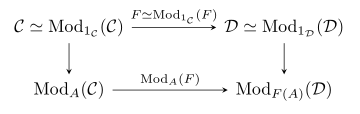 and hence a morphism in \(\mathrm{CAlg}(\mathrm{Pr}^\mathrm{L})\) from the pushout \(\mathcal D\otimes_{\mathcal C} \mathrm{Mod}_{A}(\mathcal C) \rightarrow\mathrm{Mod}_{F(A)}(\mathcal D)\). This is an equivalence in \(\mathrm{CAlg}(\mathrm{Pr}^\mathrm{L})\) because its underlying functor is one by [Lur17, Thm. 4.8.4.6]. ◻
Since \(\mathcal S\) is the tensor unit of the symmetric monoidal structure on \(\mathrm{Pr}^\mathrm{L}\), it is initial in \(\mathrm{CAlg}(\mathrm{Pr}^\mathrm{L})\) and any \(\mathcal C\in \mathrm{CAlg}(\mathrm{Pr}^\mathrm{L})\) comes equipped with a unique symmetric monoidal left adjoint functor \(\iota_{\mathcal C} \colon \mathcal S\rightarrow\mathcal C\).
[0038]
Corollary 3.1.9.
For \(\mathcal Z\in \mathrm{CAlg}(\mathcal S)\), proposition 3.1.8.([0036]) implies that there is an equivalence in \(\mathrm{CAlg}(\mathrm{Pr}^\mathrm{L})\): \[\mathcal C\otimes \mathrm{Mod}_\mathcal Z(\mathcal S)
\simeq
\mathcal C\otimes_{\mathcal S}\mathrm{Mod}_{\mathcal Z}(\mathcal S)
\simeq
\mathrm{Mod}_{\iota_{\mathcal C}(\mathcal Z)}(\mathcal C\otimes_\mathcal S\mathcal S)
\simeq
\mathrm{Mod}_{\iota_{\mathcal C}(\mathcal Z)}(\mathcal C).\]