Let \(n\geq k \geq 0\) and \(F \colon \mathcal C\rightarrow\mathcal D\) be a functor between \((\infty,k)\)-categories which is \((n-1)\)-faithful. Then, the following commutative diagram is a pullback square in \(\mathrm{Cat}_{(\infty, {k})}\): 
5.6 Proof of theorem 5.5.2[00BM]
This subsection is devoted to the proof of theorem 5.5.2.
We first consider the special case that \(k=n\). This will be a consequence of the following observation relating faithfulness and homotopy categories, well known in the case \(k=n=1\) of \((\infty,1)\)-categories.
Proof.
Since the inclusion \(\mathrm{Cat}_{(\infty, {k})} \hookrightarrow \mathrm{Cat}_{(\infty, {n})}\) preserves pullbacks, and preserves \(n\)-factorizations and hence commutes with \(\tau_n\), it suffices to prove the statement for \(n=k\). We induct on \(n\geq 0\). The base case \(n=0\) is immediate. For general \(n\), we prove that the underlying diagram of spaces 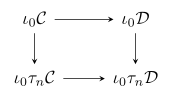 is a pullback square and that for each \(c, c' \in \mathcal C\) the induced square of \((\infty,n-1)\)-categories
 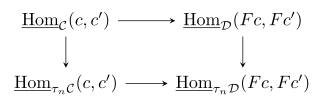 is a pullback square. Using lemma 5.4.7, the latter square is a pullback square by induction.
For the former square ([00BR]), the top horizontal map is \((n-1)\)-truncated by observation 5.3.10. By lemma 5.4.9, the bottom horizontal map is equivalent to \(\tau_n \iota_0 \mathcal C\rightarrow\tau_n \iota_0 \mathcal D\), i.e. to the map between the \(n\)-truncations of the spaces \(\iota_0 \mathcal C\) and \(\iota_0 \mathcal D\). Since \(\tau_n\) preserves truncatedness, the bottom horizontal map is also \((n-1)\)-truncated. On the other hand, for any space \(X\), the truncation map \(X \rightarrow\tau_n X\) is \(n\)-connected, and hence so are the vertical maps. Now proposition 5.2.5 implies that ([00BR]) is a pullback square. ◻
We use proposition 5.6.1 to prove the \(n\geq k \geq 0\) case of theorem 5.5.2.
For \(n\geq k \geq 0\), the following commuting square of \(\infty\)-categories is a pullback square 
Proof.
We show that the functor \[ \textrm{Ar}^{(n-1)}(\mathrm{Cat}_{(\infty, {k})}) \rightarrow\mathrm{Cat}_{(\infty, {k})} \times_{\mathrm{Cat}_{({n}, {k})}} \textrm{Ar}^{(n-1)}(\mathrm{Cat}_{({n}, {k})})\] is surjective and fully faithful.
Surjectivity amounts to the following: For any \((\infty,k)\)-category \(\mathcal D\) equipped with a \((n-1)\)-faithful functor \(\mathcal C' \rightarrow\tau_n \mathcal D\) from an \((n,k)\)-category \(\mathcal C'\), there exists an \((\infty,k)\)-category \(\mathcal C\) and a \((n-1)\)-faithful functor \(\mathcal C\rightarrow\mathcal D\) which is sent to \(\mathcal C' \rightarrow\tau_n \mathcal D\) under \(\tau_n\).
Define \(\mathcal C\) to be the pullback in \(\mathrm{Cat}_{(\infty, {k})}\) 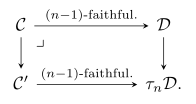 Since the right class of a factorization system is preserved under pullback, and since \(\mathcal C' \rightarrow\tau_n \mathcal D\) is \((n-1)\)-faithful, so is its pullback \(\mathcal C\rightarrow\mathcal D\). We will now prove by induction on \(n\geq 0\) that the functor \(\tau_n \mathcal C\rightarrow\mathcal C'\) adjunct to \(\mathcal C\rightarrow\mathcal C'\) is an equivalence, proving surjectivity of ([00BV]). The base case \(n=0\) is immediate. In general, we will show that \(\tau_n \mathcal C\rightarrow\mathcal C'\) is surjective on objects and fully faithful. Since \(\mathcal D\rightarrow\tau_{n}\mathcal D\) is surjective on object (in fact \((n-1)\)-surjective), the pullback \(\mathcal C\rightarrow\mathcal C'\) is surjective on objects. Since \(\mathcal C\rightarrow\mathcal C'\) factors as \(\mathcal C\rightarrow\tau_n \mathcal C\rightarrow\mathcal C'\), it follows that also \(\tau_n \mathcal C\rightarrow\mathcal C'\) is surjective on objects. Fully faithfulness of \(\tau_n \mathcal C\rightarrow\mathcal C'\) follows by induction using lemma 5.4.7.
We now prove that ([00BV]) induces an equivalence on the hom-space between any pair of objects \(\{\mathcal C_1 \rightarrow\mathcal D_1\}, \{\mathcal C_2 \rightarrow\mathcal D_2\} \in\ \textrm{Ar}^{(n-1)}(\mathrm{Cat}_{(\infty, {k})})\), and hence that ([00BV]) is fully faithful. Unwinding the hom-spaces in the relevant arrow categories, this is equivalent to the statement that for any fixed functor \(G\colon \mathcal D_1 \rightarrow\mathcal D_2\) of \((\infty, k)\)-categories, the map of spaces of dashed lifts  is an equivalence. This follows immediately from proposition 5.6.1. ◻
To generalize lemma 5.6.2 to also allow for the case \(k>n\), we will use the following lemma.
For all \(k>n \geq 0\), the commutative square of \(\infty\)-categories 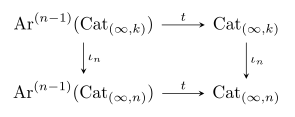 is a pullback square.
Proof.
We show that the functor \[ \textrm{Ar}^{(n-1)}(\mathrm{Cat}_{(\infty, {k})}) \rightarrow\mathrm{Cat}_{(\infty, {k})} \times_{\mathrm{Cat}_{(\infty, {n})}} \textrm{Ar}^{(n-1)}(\mathrm{Cat}_{(\infty, {n})})\] is surjective and fully faithful.
Surjectivity amounts to the following: For any \((\infty,k)\)-category \(\mathcal D\) equipped with an \((n-1)\)-faithful functor \(\mathcal C' \rightarrow\iota_n \mathcal D\) from an \((\infty,n)\)-category \(\mathcal C'\), there exits an \((\infty,k)\)-category \(\mathcal C\) with an \((n-1)\)-faithful functor \(\mathcal C\rightarrow\mathcal D\) which under \(\iota_n\) gets mapped to the original functor \(\mathcal C' \rightarrow\mathcal D\).
Define \(\mathcal C\coloneqq \mathrm{Fact}_{n-1}(\mathcal C' \rightarrow\iota_n \mathcal D\rightarrow\mathcal D)\) as the factorization with respect to the (\((n-1)\)-surjective, \((n-1)\)-faithful) factorization system in \(\mathrm{Cat}_{(\infty, {k})}\), and hence equipped with morphisms \(\mathcal C' \rightarrow\mathcal C\rightarrow\mathcal D\) where the former is \((n-1)\)-surjective and the latter is \((n-1)\)-faithful. To conclude, we show that the map \(\mathcal C' \simeq \iota_n \mathcal C' \rightarrow\iota_n \mathcal C\) is an equivalence, and hence that \(\iota_n(\mathcal C\rightarrow\mathcal D)\) is equivalent to \(\mathcal C' \rightarrow\iota_n \mathcal D\). Consider the following commutative diagram:  The bottom horizontal and leftmost diagonal functor are surjective/faithful as indicate by the definition of \(\mathcal C\). The top-most diagonal functor is \((n-1)\)-faithful by assumption. The top horizontal functor is \((n-1)\)-faithful since \(\iota_n\) preserves faithfulness by observation 5.3.10. It then follows from lemma 5.3.5 that the functor \(\mathcal C'\rightarrow\iota_n \mathcal C\) is \((n-1)\)-faithful. Since \(\mathcal C' \rightarrow\mathcal C\) is \((n-1)\)-surjective and since \(\iota_n \colon \mathrm{Cat}_{(\infty, {k})} \rightarrow\mathrm{Cat}_{(\infty, {n})}\) preserves \((n-1)\)-surjective functors by lemma 5.3.11 it follows that \(\mathcal C' \simeq \iota_n \mathcal C' \rightarrow\iota_n \mathcal C\) is \((n-1)\)-surjective. Hence, \(\mathcal C' \rightarrow\iota_n \mathcal C\) is \((n-1)\)-faithful and \((n-1)\)-surjective and hence an equivalence.
We now prove that ([00BZ]) induces an equivalence on the hom-space between any pair of objects \(\{\mathcal C_1 \rightarrow\mathcal D_1\}, \{\mathcal C_2 \rightarrow\mathcal D_2\} \in\ \textrm{Ar}^{(n-1)}(\mathrm{Cat}_{(\infty, {k})})\), and hence that ([00BV]) is fully faithful. Unwinding the hom-spaces in the relevant arrow \(\infty\)-categories, this is equivalent to the statement that for any fixed \(\mathcal D_1 \rightarrow\mathcal D_2\) and any fixed dashed lift as shown in the first diagram in ([00C0]), the space of dashed lifts as shown in the commuting square in the second diagram in ([00C0]) is contractible. 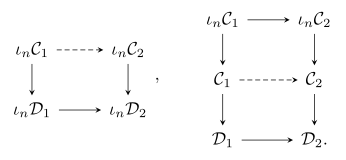 By lemma 5.3.14, \(\iota_n \mathcal C_1 \rightarrow\mathcal C_1\) is \((n-1)\)-surjective, and \(\mathcal C_2 \rightarrow\mathcal D_2\) is \((n-1)\)-faithful by assumption, hence the space of lift is contractible since \((n-1)\)-surjective/\((n-1)\)-faithful functors form a factorization system on \(\mathrm{Cat}_{(\infty, {k})}\). ◻
We can combine lemma 5.6.2 and lemma 5.6.3 into a proof of theorem 5.5.2.
Proof of theorem 5.5.2.
The case \(n\geq k\) is lemma 5.6.2. For \(k> n\), decompose the square as 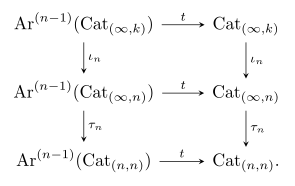 By Lemmas 5.6.2 and 5.6.3 the bottom and top squares are pullbacks, respectively. ◻
Original source: arXiv:2401.02956v2
Original source · 2401.02956v2