Given a map of spaces \(f \colon A \rightarrow B\), we let \(\mathrm{Im}(f) \subseteq B\) denote the full image of \(f\), i.e. the subspace of \(B\) given by the union of those connected components of \(B\) in the image of \(\pi_0 f\).
8.3 From prebraidings to braidings[00HC]
Our proof will proceed by successively simplifying the space of prebraidings and braidings on \({\mathbf K}^b_{\mathrm{loc}}(\mathcal C)\). This subsection contains the operadic heart of our proof, captured by four corollaries of results in section 7.
In other words, \(A \rightarrow\mathrm{Im}(f) \hookrightarrow B\) is the factorization of \(f\) with respect to the (\((-1)\)-connected, \((-1)\)-truncated)-factorization system on spaces.
Recall the (\(0\)-surjective, \(0\)-faithful) factorization system on the \(\infty\)-category \(\mathrm{Op}\) from definition 7.5.1 and proposition 7.5.3.
Given a map of operads \(\mathbb E_1 \rightarrow\mathcal O\), corepresenting an \(\mathbb E_1\)-algebra \(A\) in \(\mathcal O\), we write \(\mathcal O|_{\mathbb E_1}\) for the factorization \(\mathbb E_1 \rightarrow\mathcal O|_{ \mathbb E_1} \rightarrow\mathcal O\) into a \(0\)-surjective followed by a \(0\)-faithful map of operads.
Explicitly, \(\mathcal O|_{\mathbb E_1}\) has one color \(A\) and the only non-empty multi-hom spaces are given by the full images \[\mathrm{Mul}_{\mathcal O|_{\mathbb E_1}}(A, \ldots, A; A) = \mathrm{Im}\left( S_n \rightarrow\mathrm{Mul}_{\mathcal O}(A, \ldots, A; A) \right)\] of the map \(\mathbb E_1(n) = S_n \rightarrow\mathrm{Mul}_{\mathcal O}(A, \ldots, A ; A)\) induced by the \(\mathbb E_1\)-structure on \(A\).
(In other words, \(\mathrm{Im}\left( S_n \rightarrow\mathrm{Mul}_{\mathcal O}(A, \ldots, A; A) \right)\) is precisely the union of those components of \(\mathrm{Mul}_{\mathcal O}(A, \ldots, A ; A)\) which contain the orbit of the \(n\)-ary multiplication of \(A\) under the \(S_n\)-action permuting its inputs.)
Given a map of operads \([1] \otimes \mathbb E_1 \rightarrow\mathcal O\), corepresenting a morphism \(f \colon A \rightarrow B\) of \(\mathbb E_1\)-algebras in \(\mathcal O\), we write \(\mathcal O|_{[1]\otimes \mathbb E_1}\) for the factorization \([1] \otimes \mathbb E_1 \rightarrow\mathcal O|_{[1] \otimes \mathbb E_1} \rightarrow\mathcal O\) into a \(0\)-surjective followed by a \(0\)-faithful map of operads.
Explicitly, \(\mathcal O|_{[1]\otimes \mathbb E_1}\) has (at most) two colors \(A, B\) and multi-hom spaces connecting them, one of them being \[\mathrm{Mul}_{\mathcal O|_{[1] \otimes \mathbb E_1}}(A, \ldots, A; B) = \mathrm{Im}\left(S_n \rightarrow\mathrm{Mul}_{\mathcal O}(A, \ldots, A; B)\right),\]where the map from \(S_n = \mathbb E_1(n)\) is induced by the \(\mathbb E_1\)-structures on \(f\). (In other words, \(\mathrm{Im}\left( S_n \rightarrow\mathrm{Mul}_{\mathcal O}(A, \ldots, A; B) \right)\) is the union of those components of \(\mathrm{Mul}_{\mathcal O}(A, \ldots, A ; B)\) which contain the orbit of \(f \circ \mu_A \simeq \mu_B \circ f\) under the \(S_n\)-action permuting its inputs.)
Given a map of operads \([2] \otimes \mathbb E_1 \rightarrow\mathcal O\), corepresenting a composable pair of \(\mathbb E_1\)-algebra morphisms \(A \rightarrow B \rightarrow C\), we can similarly consider \(\mathcal O|_{[2] \otimes \mathbb E_1}\), which has (at most) three objects \(A, B, C\), and multi-hom spaces connecting them, such as \[\begin{aligned} \mathrm{Mul}_{\mathcal O|_{[2] \otimes \mathbb E_1}}(A, \ldots, A; B)& = \mathrm{Im}\left(S_n \rightarrow\mathrm{Mul}_{\mathcal O}(A, \ldots, A; B)\right)\\ \mathrm{Mul}_{\mathcal O|_{[2] \otimes \mathbb E_1}}(B, \ldots, B; C) &= \mathrm{Im}\left(S_n \rightarrow\mathrm{Mul}_{\mathcal O}(B, \ldots, B; C)\right), \end{aligned}\] where the maps from \(S_n = \mathbb E_1(n)\) are induced by the \(\mathbb E_1\)-structure on \(f\) and \(g\), respectively.
Throughout we will repeatedly use the following simple observation, applied to the \(\infty\)-category \(\mathcal V= \mathrm{Op}\) with its (\(0\)-surjective, \(0\)-faithful) factorization system.
In an \(\infty\)-category \(\mathcal V\) with a factorization system \((\mathcal L, \mathcal R)\), consider a commuting square 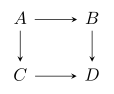 and a further morphism \(Q\rightarrow A\) in \(\mathcal L\) so that also the composite \(Q\rightarrow C\) is in \(\mathcal L\). Let \(Q\rightarrow B|_{Q} \rightarrow B\) and \(Q \rightarrow D|_Q \rightarrow D\) denote the factorizations of the induced morphisms from \(Q\). Then, the map between spaces of (dashed) lifts
 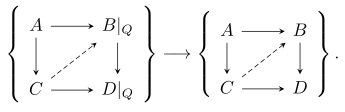 is an equivalence. 39
Proof.
Let \(\mathcal V_{Q/^{\mathcal L}}\) denote the full subcategory of \(\mathcal V_{Q/}\) on the morphisms \(Q\rightarrow X\) which are in \(\mathcal L\). The factorization system induces a right adjoint of the inclusion \(\mathcal V_{Q/^{\mathcal L}} \hookrightarrow \mathcal V_{Q/}\) which sends \(Q\rightarrow X\) to its factorization \(Q\rightarrow X|_Q\). The statement then follows immediately from adjunction. ◻
The fact that braidings and prebraidings agree on ordinary \(1\)-categories, see example 8.1.2, generalizes to the following observation:
Let \(\mathcal O\) be an \(\infty\)-operad, \(A\) an \(\mathbb E_1\)-algebra in \(\mathcal O\), and assume that the spaces \[\mathrm{Im}\left( S_n \rightarrow\mathrm{Mul}_{\mathcal O}(\underbrace{A, \ldots, A}_{n}; A) \right)\] are \(1\)-truncated (i.e. \(1\)-groupoids) for all \(n\geq 0\), where the map from \(S_n = \mathbb E_1(n)\) is induced by the \(\mathbb E_1\)-structure on \(A\). Then, the map of spaces \[\mathrm{Braid}_{\mathcal O}(A) \rightarrow\mathrm{PreBraid}_{\mathcal O}(A)\] is an equivalence.
Proof.
Fix a prebraiding on \(A\), represented by a lift of the map of \(\infty\)-operads \(\mathbb E_1 \rightarrow\mathcal O\) representing \(A\), to a map of \(\infty\)-operads \(\mathbb A_2 \otimes \mathbb E_1 \rightarrow\mathcal O\). The fiber of \(\mathrm{Braid}_{\mathcal O}(A) \rightarrow\mathrm{PreBraid}_{\mathcal O}(A)\) at this prebraiding is precisely the space of further lifts 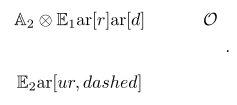 The operad map \(\mathbb E_1 \rightarrow\mathbb A_2 \otimes \mathbb E_1\) is \(0\)-surjective by proposition 7.6.1, and the composite \(\mathbb E_1 \rightarrow\mathbb A_2 \otimes \mathbb E_1 \rightarrow\mathbb E_2\) is \(0\)-surjective since all mapping spaces of \(\mathbb E_2\) are connected and all mapping spaces of \(\mathbb E_1\) are non-empty. Hence, it follows from lemma 8.3.3 applied to the \(\infty\)-category \(\mathrm{Op}\) (with its (\(0\)-surjective, \(0\)-faithful) factorization system) that this space of lifts is equivalent to the space of lifts
 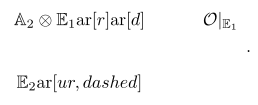 Since all multi-hom spaces of \(\mathcal O|_{\mathbb E_1}\) are by assumption \(1\)-truncated, and hence \(\mathcal O|_{\mathbb E_1}\) is a \(2\)-operad (see definition 7.7.1), it follows from corollary 7.7.8 that this space of lifts is contractible. ◻
Let \(F \colon \mathcal O\rightarrow\mathcal P\) be a map of \(\infty\)-operads and let \(g \colon b \rightarrow c\) be a morphism of \(\mathbb E_1\)-algebras in \(\mathcal O\). Assume that for all \(n \geq 0\) the map of spaces \[\mathrm{Im}\left(S_n \rightarrow\mathrm{Mul}_{\mathcal O}(\underbrace{b, \ldots, b}_{n}; c) \right) \xrightarrow{F(-)} \mathrm{Im}\left(S_n \rightarrow\mathrm{Mul}_{\mathcal P}(\underbrace{F(b), \ldots, F(b)}_{n} ; F(c)) \right)\] is an equivalence, where the maps from \(S_n\) are induced by the \(\mathbb E_1\)-structure on \(g\) and \(F(g)\). Then, the map of spaces \[\mathrm{PreBraid}_{\mathcal O}(g) \rightarrow\mathrm{PreBraid}_{\mathcal P}(F(g))\] is an equivalence.
Proof.
Consider the map of operads \([1] \otimes \mathbb E_1 \rightarrow\mathcal O\) representing the \(\mathbb E_1\)-algebra map \(f \colon A \rightarrow B\). The fiber of \(\mathrm{PreBraid}_{\mathcal O}(f) \rightarrow\mathrm{PreBraid}_{\mathcal P}(F(f))\) at a prebraiding represented by an operad map \(\mathbb T_2 \otimes \mathbb E_1 \rightarrow\mathcal P\) is precisely the space of (dashed) lifts of the following commuting square of operads: 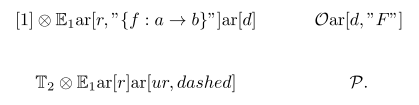 Since \([1] \otimes \mathbb E_1 \rightarrow\mathbb T_2 \otimes \mathbb E_1\) is \(0\)-surjective, it follows from lemma 8.3.3 that this space of lifts is equivalent to the space of lifts
  Hence, replacing \(\mathcal O\) by \(\mathcal O|_{[1] \otimes \mathbb E_1}\) and \(\mathcal P\) by \(\mathcal P|_{[1] \otimes \mathbb E_1}\) with multimapping spaces as in observation 8.3.2, we may without loss of generality assume that the maps \[\mathrm{Mul}_{\mathcal O}(a, \ldots, a; b) \rightarrow\mathrm{Mul}_{\mathcal P}(Fa, \ldots, Fa; Fb)\] are equivalences. It then follows from proposition 7.8.2.([00GH]) that the maps \[\mathrm{Mul}_{\mathrm{Alg}_{\mathbb E_1}(\mathcal O)}(a, \ldots, a; b) \rightarrow\mathrm{Mul}_{\mathrm{Alg}_{\mathbb E_1}(\mathcal P)}(Fa, \ldots, Fa; Fb)\] are equivalences. Hence, \[\begin{aligned}
\mathrm{PreBraid}_{\mathcal O}(g) = &\mathrm{Mul}_{\mathrm{Alg}_{\mathbb E_1}(\mathcal O)}(a,a; b) \times_{\mathrm{Mul}_{\mathrm{Alg}_{\mathbb E_1}(\mathcal O)}(a, b)^{2}} \{g\} \\
&\longrightarrow \mathrm{Mul}_{\mathrm{Alg}_{\mathbb E_1}(\mathcal P)}(Fa,Fa; Fb) \times_{\mathrm{Mul}_{\mathrm{Alg}_{\mathbb E_1}(\mathcal P)}(Fa, Fb)^{2}} \{Fg\} = \mathrm{PreBraid}_{\mathcal O}(Fg)
\end{aligned}\] is an equivalence. ◻
Hence, replacing \(\mathcal O\) by \(\mathcal O|_{[1] \otimes \mathbb E_1}\) and \(\mathcal P\) by \(\mathcal P|_{[1] \otimes \mathbb E_1}\) with multimapping spaces as in observation 8.3.2, we may without loss of generality assume that the maps \[\mathrm{Mul}_{\mathcal O}(a, \ldots, a; b) \rightarrow\mathrm{Mul}_{\mathcal P}(Fa, \ldots, Fa; Fb)\] are equivalences. It then follows from proposition 7.8.2.([00GH]) that the maps \[\mathrm{Mul}_{\mathrm{Alg}_{\mathbb E_1}(\mathcal O)}(a, \ldots, a; b) \rightarrow\mathrm{Mul}_{\mathrm{Alg}_{\mathbb E_1}(\mathcal P)}(Fa, \ldots, Fa; Fb)\] are equivalences. Hence, \[\begin{aligned}
\mathrm{PreBraid}_{\mathcal O}(g) = &\mathrm{Mul}_{\mathrm{Alg}_{\mathbb E_1}(\mathcal O)}(a,a; b) \times_{\mathrm{Mul}_{\mathrm{Alg}_{\mathbb E_1}(\mathcal O)}(a, b)^{2}} \{g\} \\
&\longrightarrow \mathrm{Mul}_{\mathrm{Alg}_{\mathbb E_1}(\mathcal P)}(Fa,Fa; Fb) \times_{\mathrm{Mul}_{\mathrm{Alg}_{\mathbb E_1}(\mathcal P)}(Fa, Fb)^{2}} \{Fg\} = \mathrm{PreBraid}_{\mathcal O}(Fg)
\end{aligned}\] is an equivalence. ◻
Let \(\mathcal O\) be an \(\infty\)-operad and let \[a \xrightarrow{f} b \xrightarrow{g} c\] be morphisms of \(\mathbb E_1\)-algebras in \(\mathcal O\). Assume that for all \(n\geq 0\), the map of spaces \[\mathrm{Im}\left( S_n \rightarrow\mathrm{Mul}_{\mathcal O}(\underbrace{b, \ldots, b}_{n} ; c) \right) \xrightarrow{-\circ (f, \ldots, f)} \mathrm{Im}\left( S_n \rightarrow\mathrm{Mul}_{\mathcal O}(\underbrace{a, \ldots, a}_{n}; c) \right)\] are equivalences, where the maps from \(S_n\) are induced by the \(\mathbb E_1\)-structures on \(g\) and on \(g \circ f\). Then, the map of spaces \[\mathrm{PreBraid}_{\mathcal O}(g) \rightarrow\mathrm{PreBraid}_{\mathcal O}(g \circ f)\] is an equivalence.
Proof.
The pair of composable morphisms of \(\mathbb E_1\)-algebras \(\{f,g\}\) may be corepresented by an operad map \([2] \otimes \mathbb E_1 \rightarrow\mathcal O\). Recall the operad maps \([2] \otimes \mathbb E_0 \rightarrow\mathbb T_2 \sqcup_{\{0<2\}} [2] \rightarrow\mathbb T_2 \sqcup_{\{1<2\}}\) from observation 7.2.10 corepresenting a pair of composable \(\mathbb E_0\)-morphisms with a \(\mathbb T_2\)-structure on \(g\) and on \(g\circ f\), respectively, and the construction of a \(\mathbb T_2\)-structure on \(g\) from a \(\mathbb T_2\)-structure on \(g\circ f\).
Fix a prebraiding on \(g\circ f\), corepresented by a lift of the operad map \([2] \otimes \mathbb E_1 \rightarrow\mathcal O\) to an operad map \(\mathbb T_2 \sqcup_{\{0<2\}}[2] \otimes \mathbb E_1 \rightarrow\mathcal O\). The fiber of \(\mathrm{PreBraid}_{\mathcal O}(g) \rightarrow\mathrm{PreBraid}_{\mathcal O}(g\circ f)\) is given by the space of lifts 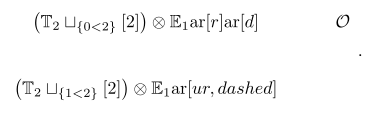 We now claim that both operad maps \[
[2] \otimes \mathbb E_1 \rightarrow\left(\mathbb T_2 \sqcup_{\{0<2\}}{[2]} \right) \otimes \mathbb E_1 \qquad [2] \otimes \mathbb E_1 \rightarrow\left( \mathbb T_2 \sqcup_{\{1<2\}}{[2]} \right) \otimes \mathbb E_1\] are \(0\)-surjective. Indeed, this follows since \([1] \otimes \mathbb E_1 \rightarrow\mathbb T_2 \otimes \mathbb E_1\) is \(0\)-surjective by proposition 7.6.1 and since both operad maps ([00HN]) are by definition given by a pushout of this \(0\)-surjective operad map against the operad maps \([1] \otimes \mathbb E_1 \rightarrow[2] \otimes \mathbb E_1\) induced by the inclusions \(\{0<2\} \rightarrow[2]\) and \(\{1<2\} \rightarrow[2]\), respectively (see observation 7.2.10).
We now claim that both operad maps \[
[2] \otimes \mathbb E_1 \rightarrow\left(\mathbb T_2 \sqcup_{\{0<2\}}{[2]} \right) \otimes \mathbb E_1 \qquad [2] \otimes \mathbb E_1 \rightarrow\left( \mathbb T_2 \sqcup_{\{1<2\}}{[2]} \right) \otimes \mathbb E_1\] are \(0\)-surjective. Indeed, this follows since \([1] \otimes \mathbb E_1 \rightarrow\mathbb T_2 \otimes \mathbb E_1\) is \(0\)-surjective by proposition 7.6.1 and since both operad maps ([00HN]) are by definition given by a pushout of this \(0\)-surjective operad map against the operad maps \([1] \otimes \mathbb E_1 \rightarrow[2] \otimes \mathbb E_1\) induced by the inclusions \(\{0<2\} \rightarrow[2]\) and \(\{1<2\} \rightarrow[2]\), respectively (see observation 7.2.10).
Hence, it follows from lemma 8.3.3 applied to the \(\infty\)-category \(\mathrm{Op}\) that our space of lifts is equivalent to the space of lifts 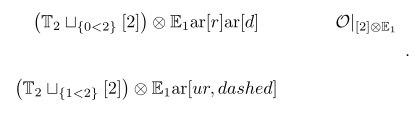 Therefore, without loss of generality, we may replace \(\mathcal O\) by \(\mathcal O|_{[2] \otimes \mathbb E_1}\) and hence with observation 8.3.2, we may assume that \[\mathrm{Mul}_{\mathcal O}(b, \ldots, b; c) \rightarrow\mathrm{Mul}_{\mathcal O}(a, \ldots, a; c)\] are equivalences. It therefore follows from proposition 7.8.2.([00GI]) that \[\mathrm{Mul}_{\mathrm{Alg}_{\mathbb E_1}(\mathcal O)}(b, \ldots, b; c) \rightarrow\mathrm{Mul}_{\mathrm{Alg}_{\mathbb E_1}{\mathcal O}}(a, \ldots, a; c)\] are equivalences, and hence as in the proof of corollary 8.3.5 that \[\mathrm{PreBraid}_{\mathcal O}(g) \rightarrow\mathrm{PreBraid}_{\mathcal O}(g\circ f)\] are equivalences. ◻
Lastly, we record the following special case of lemma 7.2.9 that prebraidings transport along adjunctions:
Consider an adjunction between symmetric monoidal \(\infty\)-categories with (strongly) symmetric monoidal left adjoint \(L\)  and denote the induced adjunction between \(\infty\)-categories of \(\mathbb E_1\)-algebras by
  Then, for any morphism of \(\mathbb E_1\)-algebras \(f \colon L_{\mathbb E_1} a \rightarrow b\) in \(\mathcal W\), the induced map of spaces \[\mathrm{PreBraid}_{\mathcal W}(f) \rightarrow\mathrm{PreBraid}_{\mathcal V}(R_{\mathbb E_1}f) \rightarrow\mathrm{PreBraid}_{\mathcal V}( R_{\mathbb E_1}f \circ \eta_a)\] (constructed as in lemma 7.2.9) is an equivalence, where \(\eta\) denotes the unit of the adjunction.
Proof.
This is an immediate corollary of lemma 7.2.9 applied to the adjunction ([00HQ]). ◻
Original source: arXiv:2401.02956v2
Original source · 2401.02956v2