Given a presentably symmetric monoidal \(\infty\)-category \(\mathcal C\) and a small \(\infty\)-operad \(\mathcal O\), the \(\infty\)-category \(\mathrm{Alg}_{\mathcal O}(\mathcal C)\) is presentable and carries a symmetric monoidal structure. However, it is not necessarily presentably symmetric monoidal: The symmetric monoidal structure on \(\mathrm{Alg}_{\mathcal O}(\mathcal C)\) is not necessarily compatible with finite coproducts (though it is always compatible with sifted colimits). An easy counterexample is \(\mathcal C= \mathrm{Set}\) and \(\mathcal O=\mathbb E_1\).
A Recollections, notation, and conventions regarding higher category theory[00I8]
In this paper, we make essential use of higher category theory and higher algebra. Here, we give a rapid overview of the notions that are most important to this paper (with further references for the interested reader).
A.1 From \(n\)-categories to \((\infty,n)\)-categories[00I9]
As a starting point, let us recall the distinction between strict and weak 2-categories [Bén+67]. In a strict 2-category, one requires associativity and unitality of composition to hold up to equality. By contrast, in a weak 2-category, one only requires these to hold up to natural isomorphism. Moreover, these natural isomorphisms are then required to satisfy further coherence conditions.40 We can summarize the situation with the slogan that a weak 2-category is “a category that is enriched in 1-categories up to coherent natural isomorphism”. More generally, one would like to define a weak \(n\)-category as “a category that is enriched in weak \((n-1)\)-categories up to coherent natural isomorphism”. However, making this notion rigorous for higher values of \(n\) – with all of the desired coherence conditions – becomes increasingly infeasible as \(n\) grows [GPS95].
Homotopy theory provides a remarkable alternative perspective on this problem, which leads to a uniform and robust solution. To explain it, let us recall Grothendieck’s homotopy hypothesis: any appropriate definition of “weak \(n\)-category” should have that its weak \(n\)-groupoids are equivalent (in a suitably homotopical sense) to homotopy \(n\)-types (i.e. topological spaces with homotopy groups above dimension \(n\) all vanishing, taken up to weak homotopy equivalence).41 Note that under the homotopy hypothesis, natural isomorphisms on the categorical side correspond to homotopies on the topological side. Hence, we arrive at an alternative proposed definition for “weak \((n,1)\)-categories”,42 namely as categories that are enriched either in weak \((n-1)\)-groupoids up to coherent natural isomorphism or in homotopy \(n\)-types up to coherent homotopy. In the limit, we find that “weak \((\infty,1)\)-categories” should be categories that are enriched in (arbitrary) homotopy types up to coherent homotopy.
Before continuing our discussion, we pause to note a few conventions. First of all, just as we may refer to 1-categories simply as “categories”, we will also refer to \((\infty,1)\)-categories simply as “\(\infty\)-categories”. Moreover, given that we will only be interested in “weak” notions, we usually leave this term implicit henceforth.
Now, there exist a number of robust models for \(\infty\)-categories (i.e. categories enriched in homotopy types up to coherent homotopy), although all are known to be equivalent (in a suitably homotopical sense) [Toë05]. The most developed is that of quasicategories, thanks to Lurie’s foundational work [Lur09], which we take as a primary reference. However, we stress that throughout this paper we work in an entirely model-independent fashion: we only manipulate \(\infty\)-categories in a manner that makes no reference to a specific model (so e.g. we never make reference to the individual simplices of a quasicategory).
The theory of \(\infty\)-categories reifies the limiting case of Grothendieck’s homotopy hypothesis: among \(\infty\)-categories, the \(\infty\)-groupoids are equivalent to homotopy types. We refer to such objects alternately as \(\infty\)-groupoids or as spaces, depending on the context. We write \(\mathrm{Cat}_\infty\) for the \(\infty\)-category of (small) \(\infty\)-categories (see Subsection A.6 for a brief discussion of set-theoretic matters), and we write \(\mathcal S\subset \mathrm{Cat}_\infty\) for the full subcategory of spaces.
We can now return to the problem of defining weak \(n\)-categories. The essential observation is as follows: all of the desired coherence conditions articulate equivalences between various composite operations. Thus, in order to obtain a robust theory of \((\infty,n)\)-categories, it suffices to have a robust theory of \(\infty\)-categories enriched in a given one: then, we can recursively define \((\infty,n)\)-categories to be \(\infty\)-categories that are enriched in the \((\infty,1)\)-category of \((\infty,n-1)\)-categories. As we explain further in Subsection A.10, such a robust formalism is provided by [GH15]. Hence, writing \(\mathrm{Cat}[\mathbb V]\) for the \(\infty\)-category of \(\mathbb V\)-enriched \(\infty\)-categories, we may recursively define the \((\infty,1)\)-category of \((\infty,n)\)-categories as \(\mathrm{Cat}_{(\infty, {n})} \coloneqq \mathrm{Cat}[\mathrm{Cat}_{(\infty, {n-1})}]\), the \(\infty\)-category of \(\infty\)-categories enriched in (small) \((\infty,n-1)\)-categories; as a base case we define \(\mathrm{Cat}_{(\infty, {0})} \coloneqq \mathcal S\), and as a consistency check we have an equivalence \(\mathrm{Cat}_{(\infty, {1})} \coloneqq \mathrm{Cat}[\mathrm{Cat}_{(\infty, {0})}] \simeq \mathrm{Cat}_\infty\) [GH15, Thm. 5.4.6]. As explained in Subsection A.10, for \(k \geq 0\), \(\mathrm{Cat}_{(\infty, {k})}\) is Cartesian presentably symmetric monoidal. Among the \((\infty,n)\)-categories, weak \((n,n)\)-categories can then be defined simply as those satisfying certain discreteness conditions [GH15, § 6.1].
In fact, this definition ultimately affords an \((\infty,n+1)\)-category (as opposed to just an \((\infty,1)\)-category) of \((\infty,n)\)-categories, using the fact that \(\mathrm{Cat}_{(\infty, {n})}\) is Cartesian closed [Rez10]: for any \((\infty,n)\)-categories \(\mathcal C\) and \(\mathcal D\) we have an \((\infty,n)\)-category \(\mathrm{Fun}(\mathcal C,\mathcal D)\) of functors between them, which is uniquely characterized by the universal property that we have a natural equivalence \[\mathrm{Hom}_{\mathrm{Cat}_{(\infty, {n})}}(\mathcal E, \mathrm{Fun}(\mathcal C,\mathcal D)) \simeq \mathrm{Hom}_{\mathrm{Cat}_{(\infty, {n})}}(\mathcal E\times \mathcal C, \mathcal D)\] of hom-spaces for any \((\infty,n)\)-category \(\mathcal E\in \mathrm{Cat}_{(\infty, {n})}\).
A.2 Some basic notions in \(\infty\)-category theory[00IA]
Here we highlight a few \(\infty\)-categorical notions that we use repeatedly throughout this paper. We make no effort to give a comprehensive account, and instead refer the interested reader to [Lur09] for a more thorough treatment. Indeed, a remarkable number of notions in ordinary category theory port over to \(\infty\)-category theory with minimal modification (though see Subsection A.3 for a prominent non-example, and see Subsection A.2.6 for another non-example).
A.2.1 Basic notions[00IB]
Broadly speaking, the fundamental role played by sets in ordinary category theory is played by spaces in \(\infty\)-category theory. In particular, as noted in Subsection A.1, an \(\infty\)-category \(\mathcal C\) is enriched in spaces (i.e. \(\infty\)-groupoids): for any pair of objects \(c,d \in \mathcal C\) we obtain a space \(\mathrm{Hom}_\mathcal C(c,d) \in \mathcal S\). These hom-spaces admit a composition law, which is associative and unital up to coherent homotopy.
Any \(\infty\)-category has an associated ordinary \(1\)-category \(h_1\mathcal C\), called its homotopy category, with the same objects as \(\mathcal C\) and hom-sets \(\mathrm{Hom}_{h_1 \mathcal C}(c,d) \coloneqq \pi_0 \mathrm{Hom}_{\mathcal C}(c,d)\), i.e. identifying \(1\)-morphisms in \(\mathcal C\) if there is an invertible \(2\)-morphism between them.
A presheaf on an \(\infty\)-category \(\mathcal C\) is a functor \(\mathcal C^\mathrm{op}\rightarrow\mathcal S\). These assemble into the \(\infty\)-category \(\mathcal P(\mathcal C) \coloneqq \mathrm{Fun}(\mathcal C^\mathrm{op},\mathcal S)\), which receives a fully faithful Yoneda embedding \(\mathcal C\xrightarrow{\mathrm{Hom}_\mathcal C(=,-)} \mathcal P(\mathcal C)\) [Lur09, Prop. 5.1.3.1].
As a matter of terminology, we interchangeably use the terms “isomorphism”, as in ordinary category theory and “equivalence” (in order to emphasize that one is working in a higher-categorical context).
In ordinary categories, objects characterized by universal properties (e.g. limits and colimits) are unique up to unique isomorphism when they exist: said differently, the collection of objects satisfying the characterization assemble into an empty or contractible groupoid. In \(\infty\)-categories, objects characterized by a universal property instead assemble into an empty or contractible \(\infty\)-groupoid. For instance, an object \(c \in \mathcal C\) is called initial if for every \(d \in \mathcal C\) the space \(\mathrm{Hom}_\mathcal C(c,d)\) is contractible, and the initial objects of \(\mathcal C\) assemble into an empty or contractible \(\infty\)-groupoid.
In classical category theory, the term “unique up to unique isomorphism” is sometimes replaced by the shorter term “essentially unique”. The word “essentially” here is meant to indicate that object is not literally unique (e.g. there exist many terminal objects in the category \(\mathrm{Set}\) of sets (namely the singletons)), but rather that it is unique in the appropriate category-theoretic sense. However, in \(\infty\)-category theory one is emphatically never interested in uniqueness beyond that in the \(\infty\)-categorical sense (i.e. parametrized by a contractible \(\infty\)-groupoid), and so we generally omit all technical uses of the word “essentially”. Relatedly, we will refer to a functor \(\mathcal C\xrightarrow{F} \mathcal D\) simply as surjective (rather than “essentially surjective”) if for every object \(d \in \mathcal D\) there exists an object \(c \in \mathcal C\) and an equivalence \(F(c) \simeq d\).
A.2.2 Monomorphisms and subcategories[00IC]
A general pattern in higher category theory is that one must keep track of “higher coherence data” (see e.g. Subsection A.3). Thus, it is notable when a given construction does not require this. Given a construction that a priori might involve coherence data, we say that the data is in fact (merely) a condition in order to indicate that such data is unique if it exists (i.e. that the \(\infty\)-category of such assembles into an empty or contractible \(\infty\)-groupoid).
Most fundamentally, given a space \(X\) and a subset of its path components, it is merely a condition for a point \(x \in X\) to lie in one of these. In fact, the inclusions of path components are precisely the monomorphisms in the \(\infty\)-category of spaces: given an inclusion of path components \(Y \xhookrightarrow{i} X\), it is merely a condition for any map \(Z \rightarrow X\) to factor through it.
This notion generalizes: we say that a morphism \(c \rightarrow d\) in an \(\infty\)-category \(\mathcal C\) is a monomorphism if it is merely a condition for any morphism \(e \rightarrow d\) to factor through it.43 This is equivalent to the condition that the resulting morphism \(\mathrm{Hom}_\mathcal C(-,c) \rightarrow\mathrm{Hom}_\mathcal C(-,d)\) in \(\mathcal P(\mathcal C)\) is a componentwise monomorphism.
As a notable example, the monomorphisms in \(\mathrm{Cat}_\infty\) are precisely the functors that are fully faithful on equivalences and monomorphisms on all hom-spaces.44 We reserve the term subcategory for (the image of) a monomorphism (in \(\mathrm{Cat}_\infty\), or more generally in \(\mathrm{Cat}[\mathbb V]\) (again see Subsection A.10)).
As another notable example, it is merely a condition for a morphism in an \(\infty\)-category to be an equivalence. Said differently, the functor \([1] \rightarrow[1]^{\textup{gpd}}\simeq {\sf pt}\) is an epimorphism in \(\mathrm{Cat}_\infty\) (see §§A.2.4-A.2.5 for an explanation of the notation).
A.2.3 Adjunctions[00ID]
It is merely a condition for a functor \(\mathcal C\xrightarrow{F} \mathcal D\) to be a (say) left adjoint: its space of right adjoints is either empty or contractible. First of all, a pointwise right adjoint to \(F\) at an object \(d \in \mathcal D\) is a pair of an object \(c \in \mathcal C\) and a morphism \(F(c) \xrightarrow{\varepsilon_d} d\) such that for every \(c' \in \mathcal C\) the composite \(\mathrm{Hom}_\mathcal C(c',c) \xrightarrow{F} \mathrm{Hom}_\mathcal D(F(c'),F(c)) \xrightarrow{\varepsilon_d} \mathrm{Hom}_\mathcal D(F(c'),d)\) is an equivalence. Equivalently, this is the data of a representing object for the presheaf \(\mathcal C^\mathrm{op}\xrightarrow{\mathrm{Hom}_\mathcal D(F(-),d)} \mathcal S\) (which by definition comes equipped with the data of a universal element \(\varepsilon_d \in \mathrm{Hom}_\mathcal D(F(c),d)\) witnessing it as such). Then, a right adjoint exists if and only if a pointwise right adjoint exists at all objects of \(\mathcal D\); in this case, the right adjoint is the (necessarily unique) factorization of the functor \(\mathcal D\xrightarrow{\mathrm{Hom}_\mathcal D(F(=),-)} \mathcal P(\mathcal C)\) through the Yoneda embedding. (See Subsection A.5 for an alternative description of \(\infty\)-categorical adjunctions.)
As a basic example, there exists a right adjoint \(\mathcal S\xleftarrow{\iota_0} \mathrm{Cat}_\infty\) to the inclusion, which carries an \(\infty\)-category \(\mathcal C\) to its maximal subgroupoid \(\mathcal C^\simeq\) (which is obtained by discarding all of its noninvertible morphisms).
A.2.4 Simplicial objects[00IE]
We write \(\Delta\) for the simplicial indexing category (the full subcategory of \(\mathrm{Cat}_\infty\) on the finite nonempty totally ordered sets), and for any \(n \geq 0\) we write \([n] \coloneqq \{ 0 < 1 < \cdots < n \} \in \Delta\) for the indicated standard object. A simplicial object in an \(\infty\)-category \(\mathcal C\) is a functor \(\Delta^\mathrm{op}\xrightarrow{X} \mathcal C\); we use the term geometric realization to refer to its colimit, and denote this by \(|X| \coloneqq \mathrm{colim}_{\Delta^\mathrm{op}}(X) \in \mathcal C\).45
A.2.5 Localizations[00IF]
Given an \(\infty\)-category \(\mathcal C\) and a collection \(\mathbf W\) of morphisms in \(\mathcal C\) (often assumed to be those defining a subcategory of \(\mathcal C\)), the localization of \(\mathcal C\) at \(\mathbf W\) is the target of the initial functor \(\mathcal C\rightarrow\mathcal C[\mathbf W^{-1}]\) that carries all morphisms in \(\mathbf W\) to equivalences. As an extreme example, the \(\infty\)-groupoid completion of \(\mathcal C\) is its localization at all of its morphisms; this defines a left adjoint \(\mathrm{Cat}_\infty \xrightarrow{(-)^{\textup{gpd}}} \mathcal S\) to the inclusion. More generally, we can identify the localization at (the morphisms in) a subcategory \(\mathbf W\subseteq \mathcal C\) as the pushout 
A special case of localization is given by a reflective localization adjunction, i.e. an adjunction  in which the right adjoint is fully faithful. In this case, writing \(\mathbf W\subseteq \mathcal C\) for the subcategory of morphisms in \(\mathcal C\) that are carried to equivalences in \(\mathcal D\), the left adjoint witnesses \(\mathcal D\) as the localization \(\mathcal C[\mathbf W^{-1}]\). In this case, \(R\) can be characterized as the inclusion of the full subcategory of objects of \(\mathcal C\) that are local with respect to the morphisms in \(\mathbf W\), i.e. those \(c \in \mathcal C\) such that for every \(d \rightarrow e\) in \(\mathbf W\) the morphism \(\mathrm{Hom}_\mathcal C(d,c) \leftarrow \mathrm{Hom}_\mathcal C(e,c)\) is an equivalence [Lur09, Prop. 5.5.4.2].46 Of course, dual remarks pertain to coreflective localization adjunctions, i.e. adjunctions in which the left adjoint is fully faithful.
Note that we might obtain the same localization even if we change the collection \(\mathbf W\). For instance, it is unnecessary to invert equivalences (since they are already invertible), and for any pair of composable morphisms \(f\) and \(g\) inverting any two of \(f\), \(g\), and \(gf\) automatically inverts the third (since equivalences have the two-out-of-three property). This observation plays a key role in the theory of accessible localizations of presentable \(\infty\)-categories (see Subsection A.7).
A.2.6 Connected categories versus weakly contractible \(\infty\)-categories[00IH]
While certain results in ordinary category theory refer to connected categories (i.e. those whose groupoid completions are connected), their \(\infty\)-categorical analogs generally instead refer to weakly contractible \(\infty\)-categories (i.e. those whose \(\infty\)-groupoid completions are contractible). For instance, the forgetful functor \(\mathcal C_{c/} \rightarrow\mathcal C\) commutes with (and detects) weakly contractible colimits.47
A.3 Higher coherence[00II]
Here we briefly illustrate the primary operational difference between working in ordinary categories and working in \(\infty\)-categories, namely that in the latter case one must keep track of higher coherence data.
Let \(M\) be a monoid (i.e. a set equipped with an associative and unital binary operation). Then, the data of \(M\) is entirely recorded by its bar construction, a simplicial set \({\textup{Bar}}(M)\) with \({\textup{Bar}}(M)_n \coloneqq M^{\times n}\) whose face and degeneracy maps respectively record the product and unit of \(M\). Indeed, \(M\) is already completely specified by the restriction \(\Delta^\mathrm{op}_{\leq 3} \hookrightarrow\Delta^\mathrm{op}\xrightarrow{{\textup{Bar}}(M)} \mathrm{Set}\); note that the associativity of its multiplication is guaranteed by the commutativity of a certain square 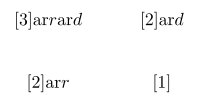 of face maps in \(\Delta^\mathrm{op}\) (whose morphisms all correspond to endpoint-preserving injections in \(\Delta\)). Altogether, we can identify monoids as a full subcategory either of \(\mathrm{Fun}(\Delta^\mathrm{op},\mathrm{Set})\) or of \(\mathrm{Fun}(\Delta^\mathrm{op}_{\leq 3},\mathrm{Set})\).
By contrast, such a restriction – or more generally, the restriction to \(\Delta^\mathrm{op}_{\leq n} \subset \Delta^\mathrm{op}\) for any \(n\) – is not possible in the context of \(\infty\)-category theory. As a fundamental example, an \(\infty\)-monoid \(M\) (i.e. an \(\infty\)-categorical monoid object in \(\mathcal S\)) is completely specified by its bar construction \(\Delta^\mathrm{op}\xrightarrow{{\textup{Bar}}(M)} \mathcal S\) (whose face and degeneracy maps likewise record its product and unit). Heuristically, we may think of relations among various morphisms and their composites in \(\Delta^\mathrm{op}\) as recording coherence data for the muliplication of \(M\), inasmuch as the functor \({\textup{Bar}}(M)\) carries these equalities in the hom-sets of \(\Delta^\mathrm{op}\) only to “homotopy-coherent equalities” (i.e. higher equivalences) in \(\mathcal S\).48 Because \(\mathcal S\) is an \(\infty\)-category (and not an \((n,1)\)-category for any \(n < \infty\), i.e. its hom-spaces can have homotopy groups in arbitrarily high dimensions), these coherence data never become unique or vacuous after some finite stage.
We note for future reference that \(\infty\)-monoids can be identified (via their bar constructions) as the full subcategory of \(\mathrm{Fun}(\Delta^\mathrm{op}, \mathcal S)\) on those simplicial spaces \(X\) satisfying a Segal condition, namely that for every \(n \geq 0\) a certain natural morphism \(X_n \rightarrow(X_1)^{\times n}\) is an equivalence.
We generally suppress the modifier “homotopy coherently” (e.g. of the adjectives “associative” and “unital”), unless we specifically mean to draw attention to it.
A.4 Straightening and unstraightening[00IK]
A fundamental tool in \(\infty\)-category theory is the straightening and unstraightening equivalence, as we now briefly describe. 49
Fix an \(\infty\)-category \(\mathcal B\) and a functor \(\mathcal B\xrightarrow{F} \mathrm{Cat}_\infty\). Then, the (coCartesian) unstraightening of \(F\) (a.k.a. its (covariant) Grothendieck construction) is an object \((\mathcal E\xrightarrow{p} \mathcal B) \in (\mathrm{Cat}_\infty)_{/\mathcal B}\) that may be described heuristically as follows:
an object of \(\mathcal E\) is given by a pair of an object \(b \in \mathcal B\) and an object \(x \in F(b)\);
a morphism \((b,x) \rightarrow(c,y)\) in \(\mathcal E\) is given by a morphism \(b \xrightarrow{f} c\) in \(\mathcal B\) along with a morphism \(F(f)(x) \xrightarrow{\alpha} y\) in \(F(c)\).
(Of course, the images under \(p\) of these data are simply \(b\) and \(f\), respectively.) Such a morphism \((f,\alpha)\) in \(\mathcal E\) is called (\(p\)-)coCartesian if \(\alpha\) is an equivalence. Observe that these satisfy a universal property: if \(e \xrightarrow{\varphi} f\) in \(\mathcal E\) is \(p\)-coCartesian, then for any \(g \in \mathcal E_{p(f)}\) we have an equivalence \(\mathrm{Hom}_\mathcal E(f,g) \simeq \mathrm{Hom}_\mathcal E(e,g) \times_{\mathrm{Hom}_\mathcal B(p(e),p(g))} \{p(\varphi) \}\).
Conversely, a functor \(\mathcal E\xrightarrow{p} \mathcal B\) is called a coCartesian fibration if for every pair of an object \(e \in \mathcal E\) and a morphism \(p(e) \xrightarrow{f} b\) in \(\mathcal B\), the morphism \(f\) admits a coCartesian lift with source \(e\). In this case, \(p\) is the unstraightening of a functor \(\mathcal B\xrightarrow{F} \mathrm{Cat}_\infty\), whose values are given by the fibers \(F(b) \simeq \mathcal E_b\) and whose functoriality is implicitly specified by the coCartesian morphisms (in essence because the Yoneda embedding is fully faithful). We refer to \(F\) as the straightening of \(p\), and to its functoriality \(F(b) \xrightarrow{F(f)} F(c)\) for a morphism \(b \xrightarrow{f} c\) in \(\mathcal B\) as the coCartesian monodromy functor of \(\mathcal E\) associated to \(f\).
The coCartesian fibrations over \(\mathcal B\) define a (generally non-full) subcategory \({\textup{coCart}}_\mathcal B\subseteq (\mathrm{Cat}_\infty)_{/\mathcal B}\), whose morphisms are those functors over \(\mathcal B\) that preserve coCartesian morphisms. Altogether, by [Lur09, Thm. 3.2.0.1], straightening and unstraightening define inverse equivalences \[\mathrm{Fun}(\mathcal B,\mathrm{Cat}_\infty) \simeq {\textup{coCart}}_\mathcal B ~,\] under which precomposition with a functor \(\mathcal B' \rightarrow\mathcal B\) corresponds to pullback therealong.
A similar but dual story applies in the case of a functor \(\mathcal B^\mathrm{op}\xrightarrow{F} \mathrm{Cat}_\infty\): this now has a (Cartesian) unstraightening (a.k.a. its (contravariant) Grothendieck construction), giving an object \((\mathcal E\rightarrow\mathcal B) \in (\mathrm{Cat}_\infty)_{/\mathcal B}\) admitting a dual description. Altogether, we obtain an analogous equivalence \[\mathrm{Fun}(\mathcal B^\mathrm{op},\mathrm{Cat}_\infty) \simeq {\textup{Cart}}_\mathcal B ~.\]
A.5 Adjunctions revisited[00IL]
An adjunction of \(\infty\)-categories can be defined as a functor \(\mathcal E\rightarrow[1]\) that is both a coCartesian fibration and a Cartesian fibration. Its coCartesian unstraightening defines the left adjoint \(\mathcal E_0 \xrightarrow{L} \mathcal E_1\), while its Cartesian unstraightening defines the right adjoint \(\mathcal E_0 \xleftarrow{R} \mathcal E_1\), and the universal properties of coCartesian and Cartesian morphisms yield natural equivalences \(\mathrm{Hom}_{\mathcal E_0}(e,R(f)) \simeq \mathrm{Hom}_\mathcal E(e,f) \simeq \mathrm{Hom}_{\mathcal E_1}(L(e),f)\) for any \(e \in \mathcal E_0\) and \(f \in \mathcal E_1\).
We define a morphism of adjunctions to be a morphism in \({\textup{coCart}}_{[1]} \cap {\textup{Cart}}_{[1]}\).50 In particular, a morphism of adjunctions determines a commutative square in \(\mathrm{Cat}_\infty\) after omitting either both left adjoints or both right adjoints.
Given a commutative square in \(\mathrm{Cat}_\infty\) in which two parallel functors are both (say) left adjoints, passing to their right adjoints we obtain a canonical laxly-commutative square (i.e. one that commutes up to a specified natural transformation), and it is merely a condition for this to be invertible so that the original square defines a morphism adjunctions [Hau+23].51 Of course, this is nothing but the condition that the morphism in \({\textup{coCart}}_{[1]}\) specified by the original square lies in the subcategory \({\textup{coCart}}_{[1]} \cap {\textup{Cart}}_{[1]}\). Dual remarks apply if the two parallel functors are instead both right adjoints.
A.6 Set-theoretic considerations[00IM]
In order to deal with set-theoretic issues, we systematically use the device of Grothendieck universes (see e.g. [Lur09, § 1.2.15]). Specifically, we fix a triple of strongly inaccessible cardinals \(\kappa_0 < \kappa_1 < \kappa_2\). The sets of cardinality \(<\kappa_i\) for \(0\leq i \leq 2\) will be called \(\kappa_i\)-small and they form Grothendieck universes \(U_0\in U_1\in U_2\). Likewise, a category is called \(\kappa_i\)-small if the sets of isomorphism classes of objects and the homotopy groups of morphisms spaces are of cardinality \(<\kappa_i\). We refer to \(\kappa_0\)-small objects as small, to \(\kappa_1\)-small objects as large, and to \(\kappa_2\)-small objects as huge (and the latter play almost no role in in our work). So for instance, the \(\infty\)-category \(\mathrm{Cat}_\infty\) of small \(\infty\)-categories is large, as is the \(\infty\)-category \(\mathcal S\) of (small) spaces.
We occasionally write e.g. \(\widehat{\mathrm{Cat}}_\infty\) to refer to the huge \(\infty\)-category of large \(\infty\)-categories. Its main use is that it contains the \(\infty\)-category of presentable \(\infty\)-categories (see Subsection A.7). We often prove results for \(\mathrm{Cat}_\infty\) and then apply them to \(\widehat{\mathrm{Cat}}_\infty\) (which is easily justified by a change of Grothendieck universe) in order to discuss specializations to presentable \(\infty\)-categories.
We may sometimes emphasize smallness (e.g. of a set or of an \(\infty\)-category). On the other hand, we may also omit the word “small” for brevity; for instance, when we say that an \(\infty\)-category admits all colimits we certainly mean that it admits all small colimits.
We generally refer to a large set as a “class” (and to a class that is not small as a “proper class”). However, in related contexts we will have occasion to contemplate large spaces, and rather than belabor the distinction we simply also refer to these as “classes”.
Relatedly, in the most invariant terms, given an \(\infty\)-category \(\mathcal C\), “a set of objects of \(\mathcal C\)” refers to a set \(S\) equipped with a functor \(S \xrightarrow{F} \mathcal C\). We say that an object of \(\mathcal C\) lies in the set if it is in the image of \(F\) (up to equivalence). Said differently, when we refer to a set of objects of \(\mathcal C\), we generally intend to implicitly refer to its image (a subgroupoid of \(\mathcal C\)). Note that if \(S\) is small and \(\mathcal C\) is locally small, then the image of \(S\) in \(\mathcal C\) is also small; hence, in such cases this implicit passage to images does not change size.
A.7 Presentable \(\infty\)-categories[00IN]
Many (\(\infty\)-)categories of lasting interest are not small, but are nevertheless “controlled by small data” – namely, they are presentable. By definition, an \(\infty\)-category \(\mathcal C\) is presentable if it admits all small colimits and moreover there exists some regular cardinal \(\kappa\) such that \(\mathcal C\) is the completion of its full subcategory \(\mathcal C^\kappa \subseteq \mathcal C\) of \(\kappa\)-compact objects under \(\kappa\)-filtered colimits. For this we recall that a \(\kappa\)-filtered colimit means a colimit indexed by a \(\kappa\)-filtered category, i.e. an \(\infty\)-category, in which every diagram of cardinality \(<\kappa\) has a cocone, and an object is called \(\kappa\)-compact if the associated representable functor preserves \(\kappa\)-filtered colimits. If we can take \(\kappa\) to be the cardinality \(\omega\) of the natural numbers, we say that \(\mathcal C\) is compactly generated (as \(\omega\)-compact objects are generally just called “compact objects”).
An extremely convenient feature of presentable \(\infty\)-categories is their adjoint functor theorem [Lur09, Cor. 5.5.2.9]: a functor between presentable \(\infty\)-categories is a left adjoint if and only if it preserves small colimits, and it is a right adjoint if and only if it is accessible (i.e. preserves \(\kappa\)-filtered colimits for some \(\kappa\)) and preserves small limits. Presentable \(\infty\)-categories naturally define two subcategories \[{\Pr}^L \subset \widehat{\mathrm{Cat}}_\infty \supset {\Pr}^R\] of the huge \(\infty\)-category of large \(\infty\)-categories, in which the morphisms are the left (resp. right) adjoint functors. Evidently, passing to adjoints defines an equivalence \(\Pr^L \simeq (\Pr^R)^\mathrm{op}\). These actually define \((\infty,2)\)-categories (by taking all natural transformations as 2-morphisms), and we write \(\mathrm{Fun}^L(-,-)\) and \(\mathrm{Fun}^R(-,-)\) for their respective hom-\((\infty,1)\)-categories.
An accessible localization is by definition a reflective localization among presentable \(\infty\)-categories. The left adjoint of an accessible localization is a localization not just in \(\widehat{\mathrm{Cat}}_\infty\) but also in \(\Pr^L\) [Lur09, Prop. 5.5.4.20]. Moreover, given any accessible localization  the left adjoint \(L\) witnesses \(\mathcal D\) as the localization \(\mathcal C[S^{-1}]\) for some small set \(S\) of morphisms in \(\mathcal C\), and hence \(R\) is the fully faithful inclusion of the subcategory of \(S\)-local objects [Lur09, Prop. 5.5.4.1].
Presentable \(\infty\)-categories admit presentations by generators and relations, in the following sense. First of all, for any small \(\infty\)-category \(\mathcal C\in \mathrm{Cat}_\infty\), its \(\infty\)-category \(\mathcal P(\mathcal C)\) of presheaves is presentable. This is the free presentable \(\infty\)-category on \(\mathcal C\): for any \(\mathcal D\in \Pr^L\), restriction along the Yoneda embedding defines an equivalence \(\mathrm{Fun}(\mathcal C,\mathcal D) \xleftarrow{\sim} \mathrm{Fun}^L(\mathcal P(\mathcal C),\mathcal D)\) [Lur09, Thm. 5.1.5.6]. And then, any presentable \(\infty\)-category is an accessible localization of \(\mathcal P(\mathcal C)\) for some \(\mathcal C\in \mathrm{Cat}_\infty\) [Lur09, Thm. 5.5.1.1].
There exists a symmetric monoidal structure on \(\Pr^L\), which is characterized by the fact that morphisms \(\mathcal C\otimes \mathcal D\rightarrow\mathcal E\) in \(\Pr^L\) (i.e. left adjoint functors) are equivalent to functors \(\mathcal C\times \mathcal D\rightarrow\mathcal E\) that are bicocontinuous (i.e. cocontinuous (or equivalently, left adjoints) separately in each variable), whose unit object is \(\mathcal S\simeq \mathcal P({\sf pt}) \in \Pr^L\). A presentably (symmetric) monoidal \(\infty\)-category is a (resp. commutative) algebra object in \((\Pr^L,\otimes)\), i.e. a presentable \(\infty\)-category equipped with a (resp. symmetric) monoidal structure that is cocontinuous separately in each variable.52 Most (symmetric) monoidal presentable \(\infty\)-categories of lasting interest (e.g. \(\mathrm{Cat}_{(\infty, {n})}\) (and in particular \(\mathcal S\) and \(\mathrm{Cat}_\infty\)) and \(\mathrm{Sp}\)) are presentably (resp. symmetric) monoidal.
A.8 Some basics of \(\infty\)-operads[00IP]
Here we briefly discuss some relevant features of the theory of \(\infty\)-operads introduced in [Lur17, § 2].
A.8.1 Basic notions[00IQ]
The notion of an \(\infty\)-operad is an \(\infty\)-categorical version of the theory of colored operads. A colored operad consists of a set \(\iota_0\underline{\mathcal O}\) of colors along with for every finite set \(\{X_i \in \iota_0 \underline{\mathcal O} \}_{i \in I}\) of colors and every color \(Y \in \iota_0 \underline{\mathcal O}\) a set \(\mathrm{Mul}_\mathcal O(\{X_i\}_{i \in I},Y)\) of multimorphisms from \(\{X_i\}_{i \in I}\) to \(Y\), which altogether must be equipped with a associative and unital composition law.53 In particular, the unary multimorphisms (i.e. those with \(|I| = 1\)) define a category \(\underline{\mathcal O}\) of colors (whose set of objects is \(\iota_0 \underline{\mathcal O}\)).
We now give a hint of the main definition. An \(\infty\)-operad \(\mathcal O\) is an \(\infty\)-category \(\mathcal O^{\otimes}\) (called the \(\infty\)-category of operators of \(\mathcal O\)) equipped with a functor \(\mathcal O^{\otimes} \rightarrow\mathrm{Fin}_*\) to the category of finite pointed sets satisfying certain conditions. We immediately introduce the notation \(\underline{n}_+ \coloneqq \{ 1, 2, \ldots, n \}_+ \in \mathrm{Fin}_*\) for the indicated standard object, as well as the notation \(\underline{\mathcal O} \coloneqq \mathcal O^{\otimes}_{\underline{1}_+}\) for the indicated fiber. We refer to \(\underline{\mathcal O}\) as the \(\infty\)-category of colors of \(\mathcal O\) (or sometimes as its underlying \(\infty\)-category, for reasons that will be explained shortly). We will sometimes abuse notation and denote the underlying \(\infty\)-category \(\underline{\mathcal O}\) of an \(\infty\)-operad \(\mathcal O\) simply also by \(\mathcal O\). The crux of the definition of an \(\infty\)-operad is that \(\mathcal O^{\otimes}\) satisfies a sort of “fiberwise” Segal condition which implies that for every \(n \geq 0\) there is a natural equivalence \(\mathcal O^{\otimes}_{\underline{n}_+} \simeq \underline{\mathcal O}^{\times n}\), as well as an “internal” Segal condition which implies that for every pair of objects \(X \coloneqq (X_1,\ldots,X_m) \in \underline{\mathcal O}^{\times m} \simeq \mathcal O^{\otimes}_{\underline{m}_+}\) and \(Y \coloneqq (Y_1,\ldots,Y_n) \in \underline{\mathcal O}^{\times n} \simeq \mathcal O^{\otimes}_{\underline{n}_+}\), we have a natural equivalence \[\mathrm{Hom}_{\mathcal O^{\otimes}}(X,Y) \simeq \bigsqcup_{f \in \mathrm{Hom}_{\mathrm{Fin}_*}(\underline{m}_+,\underline{n}_+)} \prod_{i = 1}^n \mathrm{Hom}_{\mathcal O^{\otimes}}(\{X_j\}_{j \in f^{-1}(i)}, Y_i) ~.\] An ordinary colored operad \(\mathcal O'\) defines an \(\infty\)-operad \(\mathcal O\) with \(\mathrm{Hom}_{\mathcal O^{\otimes}}(\{X_i\}_{i \in I},Y) \coloneqq \mathrm{Mul}_{\mathcal O'}(\{X_i\}_{i \in I},Y)\). As a result, we also write \(\mathrm{Mul}_\mathcal O(\{X_i\}_{i \in I},Y) \coloneqq \mathrm{Hom}_{\mathcal O^{\otimes}}(\{X_i\}_{i \in I},Y)\) for the hom-spaces in an \(\infty\)-operad \(\mathcal O\) whose targets lies in \(\underline{\mathcal O}\), and refer to their points as multimorphisms. Altogether, \(\infty\)-operads assemble into a (non-full) subcategory \(\mathrm{Op}\subset (\mathrm{Cat}_\infty)_{/\mathrm{Fin}_*}\): in essence, morphisms of \(\infty\)-operads are required to respect the Segal condition equivalences. In fact, allowing all 2-morphisms in \((\mathrm{Cat}_\infty)_{/\mathrm{Fin}_*}\) endows \(\mathrm{Op}\) with the structure of an \((\infty,2)\)-category, whose hom-\((\infty,1)\)-categories we denote by \(\underline{\mathrm{Hom}}_\mathrm{Op}(-,-)\).
We say that an \(\infty\)-operad \(\mathcal O\) is single-colored if its \(\infty\)-category of colors \(\underline{\mathcal O}\) is contractible. In this case, we may write \(\ast \in \underline{\mathcal O}\) for the unique point, and we write \(\mathcal O(n) \coloneqq \mathrm{Mul}_\mathcal O(\{\ast\}_{i \in \{1,\ldots,n\}} , \ast)\) for the unique space of \(n\)-ary multimorphisms in \(\mathcal O\).
A.8.2 Key examples[00IR]
Perhaps the most important family of examples of \(\infty\)-operads is the sequence \(\mathbb E_0 \rightarrow\mathbb E_1 \rightarrow\cdots \rightarrow\mathbb E_\infty\). These are single-colored, with the space \(\mathbb E_k(n)\) of \(n\)-ary operations given by (the underlying space of) the topological space of configurations of \(n\) disjoint points in \(\mathbb R^k\).54 The above maps are induced by the standard embeddings \(\mathbb R^0 \hookrightarrow\mathbb R^1 \hookrightarrow\cdots \hookrightarrow\mathbb R^\infty\). We note that \(\mathbb E_1\) and \(\mathbb E_\infty\) are respectively the \(\infty\)-operads underlying the colored operads that parametrize associative and commutative algebras (and in particular, their spaces of multimorphisms are discrete). Hence, we also write \({\textup{Assoc}}\coloneqq \mathbb E_1\) and \(\text{Comm}\coloneqq \mathbb E_\infty\) and respectively refer to these as the associative and commutative \(\infty\)-operads. In fact, \(\text{Comm}\) is simply the identity functor \(\text{Comm}\coloneqq \mathbb E_\infty \simeq \mathrm{Fin}_* \xrightarrow{\mathrm{id}} \mathrm{Fin}_*\), and defines a terminal object of \(\mathrm{Op}\).
Another illustrative example is the \(\infty\)-operad \(\mathrm{LM}\) associated to the two-colored operad parametrizing pairs of an associative algebra object along with a left module over it. We will return to \(\mathrm{LM}\) in subsection A.9.
It will occasionally be useful for us to refer to the single-colored \(\infty\)-operad \(\mathrm{Triv}\), which has no \(n\)-ary multimorphisms for \(n \not= 1\) and the only \(1\)-ary morphism is the identity morphism. Given an \(\infty\)-operad \(\mathcal O\), we write \(\mathcal O_\mathrm{Triv}\coloneqq \mathcal O\times_\text{Comm}\mathrm{Triv}\).
A.8.3 \(\mathcal O\)-monoidal \(\infty\)-categories[00IS]
Given an \(\infty\)-operad \(\mathcal O\), an \(\mathcal O\)-monoidal \(\infty\)-category \(\mathcal C\) is a coCartesian fibration \(\mathcal C^{\otimes} \rightarrow\mathcal O^{\otimes}\) satisfying analogous Segal conditions, which are equivalent to the condition that the composite \(\mathcal C^{\otimes} \rightarrow\mathcal O^{\otimes}\rightarrow\mathrm{Fin}_*\) is also an \(\infty\)-operad. In particular, an \(\mathcal O\)-monoidal \(\infty\)-category can be equivalently specified by the straightening \(\mathcal O^{\otimes} \rightarrow\mathrm{Cat}_\infty\) of this coCartesian fibration. 55 We often abuse the notation by denoting an \(\mathcal O\)-monoidal \(\infty\)-category by its source operad \(\mathcal C\). Altogether, \(\mathcal O\)-monoidal \(\infty\)-categories define a full subcategory \(\mathrm{Alg}_\mathcal O(\mathrm{Cat}_\infty) \subseteq {\textup{coCart}}_{\mathcal O^{\otimes}} \simeq \mathrm{Fun}(\mathcal O^{\otimes},\mathrm{Cat}_\infty)\). As special cases, we write \(\mathrm{Alg}(\mathrm{Cat}_\infty) \coloneqq \mathrm{Alg}_{\textup{Assoc}}(\mathrm{Cat}_\infty)\) for the \(\infty\)-category of monoidal \(\infty\)-categories and \(\mathrm{CAlg}(\mathrm{Cat}_\infty) \coloneqq \mathrm{Alg}_\text{Comm}(\mathrm{Cat}_\infty)\) for the \(\infty\)-category of symmetric monoidal \(\infty\)-categories. The restricted coCartesian fibration \(\underline{\mathcal C} \rightarrow\underline{\mathcal O}\) (or simply its source) may be thought of as the “underlying \(\infty\)-category” of \(\mathcal C\), although this is most immediately meaningful when \(\mathcal O\) is single-colored.
An \(\infty\)-category that admits finite products canonically upgrades to a Cartesian symmetric monoidal \(\infty\)-category. We note that it is merely a condition for a symmetric monoidal \(\infty\)-category to be Cartesian symmetric monoidal. Dual remarks apply in the case of finite coproducts.
A.8.4 \(\mathcal O\)-algebra objects[00IT]
Given an \(\mathcal O\)-monoidal \(\infty\)-category \(\mathcal C\), an \(\mathcal O\)-algebra object in \(\mathcal C\) is a section of the structure map \(\mathcal C\rightarrow\mathcal O\) in \(\mathrm{Op}\). These assemble into an \(\infty\)-category \(\mathrm{Alg}_\mathcal O(\mathcal C) \coloneqq \underline{\mathrm{Hom}}_{\mathrm{Op}_{/\mathcal O}}(\mathcal O,\mathcal C)\). As special cases, we write \(\mathrm{Alg}(\mathcal C) \coloneqq \mathrm{Alg}_{\textup{Assoc}}(\mathcal C)\) for the \(\infty\)-category of (associative) algebra objects in \(\mathcal C\) and \(\mathrm{CAlg}(\mathcal C) \coloneqq \mathrm{Alg}_\text{Comm}(\mathcal C)\) for the \(\infty\)-category of commutative algebra objects in \(\mathcal C\).
More generally, given a morphism \(\mathcal P\xrightarrow{p} \mathcal O\) in \(\mathrm{Op}\), we analogously define the \(\infty\)-category \(\mathrm{Alg}_{\mathcal P/\mathcal O}(\mathcal C) \coloneqq \underline{\mathrm{Hom}}_{\mathrm{Op}_{/\mathcal O}}(\mathcal P,\mathcal C)\) of \(\mathcal P\)-algebras in \(\mathcal C\) (relative to \(p\)). Equivalently, the base change \(p^*\mathcal C\rightarrow\mathcal P\) defines the underlying \(\mathcal P\)-monoidal \(\infty\)-category of \(\mathcal C\in \mathrm{Alg}_\mathcal O(\mathrm{Cat}_\infty)\), and we have \(\mathrm{Alg}_{\mathcal P/\mathcal O}(\mathcal C) \simeq \mathrm{Alg}_\mathcal P(p^*\mathcal C)\). For example, there is a natural morphism \(\mathrm{LM} \rightarrow{\textup{Assoc}}\), and so we can contemplate \(\mathrm{LM}\)-algebras in any monoidal \(\infty\)-category \(\mathcal C\in \mathrm{Alg}(\mathrm{Cat}_\infty)\). Note that when \(\mathcal O= \mathrm{Fin}_*\) we also write this as \(\mathrm{Alg}_{\mathcal P}(\mathcal C)\). 56 Altogether, for an \(\mathcal O\)-monoidal \(\infty\)-category \(\mathcal C\) we obtain a functor \[(\mathrm{Op}_{/\mathcal O})^\mathrm{op} \xrightarrow{\mathrm{Alg}_{(-)/\mathcal O}(\mathcal C)} \mathrm{Cat}_\infty ~,\] whose functoriality is given by precomposition.
As a matter of terminology, it is common to refer to \(\mathcal O\)-algebra objects in a Cartesian symmetric monoidal \(\infty\)-category as \(\mathcal O\)-monoids (e.g. in \(\mathcal S\) or \(\mathrm{Cat}_\infty\)). In particular, \(\mathcal O\)-monoidal \(\infty\)-categories are indeed \(\mathcal O\)-monoids in \(\mathrm{Cat}_\infty\). When referring to notions in spaces, one generally simply prepends “\(\infty\)-” to the classical terms, so e.g. the objects of \(\mathrm{Alg}(\mathcal S)\) may be referred to as “\(\infty\)-monoids”.
Of particular relevance to this paper is the case \(\mathcal O= \mathbb E_2\), and we generally use the term braided in place of the prefix “\(\mathbb E_2\)-”: in particular, a braided monoidal \((\infty,2)\)-category is an \(\mathbb E_2\)-algebra in \(\mathrm{Cat}_{(\infty,2)}\). Indeed, a braided monoidal \(\infty\)-category in the classical sense defines an \(\mathbb E_2\)-monoid in \(\mathrm{Cat}_\infty\).
A.8.5 \(\mathcal O\)-algebras of symmetric monoidal \(\infty\)-categories[00IU]
Let \(\mathcal O, \mathcal C\) be \(\infty\)-operads, then the \(\infty\)-category \(\mathrm{Alg}_{\mathcal O}(\mathcal C)\) has the structure of an \(\infty\)-operad [Lur17, Ex. 3.2.4.4]. From now on, we will denote the \(\infty\)-operad of \(\mathcal O\)-algebras in \(\mathcal C\) by \(\mathrm{Alg}_{\mathcal O}(\mathcal C)\), and the underlying \(\infty\)-category of \(\mathcal O\)-algebra by \(\underline{\mathrm{Alg}}_{\mathcal O}(\mathcal C)\), or just \(\mathrm{Alg}_{\mathcal O}(\mathcal C)\) if clear from context. When the \(\infty\)-operad \(\mathcal C\) is in fact a symmetric monoidal \(\infty\)-category, i.e. \(\mathcal C^{\otimes} \rightarrow\mathrm{Fin}_*\) is a coCartesian fibration, then so is the \(\infty\)-operad \(\mathrm{Alg}_{\mathcal O}(\mathcal C)\). Furthermore, let \(X \in \underline{\mathcal O}\) be a color, the evaluation functor \(e_X \colon \underline{\mathrm{Alg}}_{\mathcal O}(\mathcal C) \rightarrow\underline{\mathcal C}\), which takes an \(\mathcal O\)-algebra to its underlying \(X\)-object, is symmeric monoidal [Lur17, Prop. 3.2.4.3]. More generally, for any map of \(\infty\)-operads \(\mathcal O' \rightarrow\mathcal O\), the pullback functor on algebras \(\mathrm{Alg}_{\mathcal O}(\mathcal C) \rightarrow\mathrm{Alg}_{\mathcal O'}(\mathcal C)\) is a symmetric monoidal functor.
A.8.6 Symmetric monoidal structure on overcategories[00IV]
Let \(\mathcal C\) be a symmetric monoidal \(\infty\)-category and \(A \in \mathrm{CAlg}(\mathcal C)\) be a commutative algebra object therein. Then, there exists a symmetric monoidal structure on the overcategory \(\mathcal C_{/A}\) ([Lur17, Thm. 2.2.2.4]), universally characterized (cf. [Lur17, Def. 2.2.2.1]) by the following equivalence of \(\infty\)-categories for any \(\infty\)-operad \(\mathcal O\) \[\underline{\mathrm{Alg}}_{\mathcal O}(\mathcal C_{/A}) \simeq \underline{\mathrm{Alg}}_{\mathcal O}(\mathcal C)_{/A},\] where on the right hand side we \(A\) is equipped with the \(\mathcal O\)-algebra structure induced by the terminal map of operads \(\mathcal O^{\otimes} \rightarrow\mathrm{Comm}\).
A.8.7 Boardman-Vogt tensor product and Dunn additivity[00IW]
The \(\infty\)-category \(\mathrm{Op}\) of \(\infty\)-operads itself carries a symmetric monoidal structure, called the Boardman-Vogt tensor product uniquely characterized57 by giving rise to an equivalence of \(\infty\)-operads for all \(\infty\)-operads \(\mathcal O, \mathcal O'\) and \(\mathcal P\): \[ \mathrm{Alg}_{\mathcal O}(\mathrm{Alg}_{\mathcal O'}(\mathcal P)) \simeq \mathrm{Alg}_{\mathcal O\otimes \mathcal O'}(\mathcal P).\] Equivalently, the Boardman-Vogt tensor product has \(\mathrm{Alg}_{-}(-)\) as its internal hom.
A fundamental theorem in the theory of \(\infty\)-operad is Dunn’s additivity theorem [Lur17, Thm. 5.1.2.2]: for \(n, m \geq 0\), there is an equivalence of \(\infty\)-operads \(\mathbb E_n \otimes \mathbb E_m \simeq \mathbb E_{n+m}\). In particular, using [00IX], an \(\mathbb E_{n+m}\)-algebra in an \(\infty\)-operad \(\mathcal O\) is equivalent to an \(\mathbb E_n\)-algebra in the \(\infty\)-operad of \(\mathbb E_{m}\)-algebras in \(\mathcal O\).
A.8.8 Laxly \(\mathcal O\)-monoidal functors[00IY]
If \(\mathcal C\) and \(\mathcal D\) are \(\mathcal O\)-monoidal \(\infty\)-categories, then a morphism \(\mathcal C\rightarrow\mathcal D\) in \(\mathrm{Op}_{/\mathcal O}\) is called a laxly \(\mathcal O\)-monoidal functor.58 Let us denote the coCartesian fibrations \(\mathcal C^{\otimes} \rightarrow\mathcal O^{\otimes}\), \(\mathcal D^{\otimes} \rightarrow\mathcal O^{\otimes}\) by \(p\) and \(q\), then an \(\mathcal O\)-monoidal functor is a laxly \(\mathcal O\)-monoidal functor that takes \(p\)-coCartesian morphisms in \(\mathcal C^{\otimes}\) to \(q\)-coCartesian morphisms in \(\mathcal D^{\otimes}\).
Whereas an \(\mathcal O\)-monoidal functor respects the \(\mathcal O\)-monoidal structure up to coherent natural equivalence, a laxly \(\mathcal O\)-monoidal functor \(\mathcal C\rightarrow\mathcal D\) respects it only up to certain (generally noninvertible) coherent natural transformations, which nevertheless suffices to obtain an induced functor \(\mathrm{Alg}_\mathcal O(\mathcal C) \rightarrow\mathrm{Alg}_\mathcal O(\mathcal D)\) on \(\infty\)-categories of \(\mathcal O\)-algebra objects (simply by composition in \(\mathrm{Op}_{/\mathcal O}\)). For instance, given a laxly monoidal functor \(\mathcal C\xrightarrow{F} \mathcal D\) and an algebra object \(A \in \mathrm{Alg}_{\mathbb E_1}(\mathcal C)\), we obtain structure maps \(F(A) \otimes^\mathcal DF(A) \rightarrow F(A \otimes^\mathcal CA) \xrightarrow{F(\mu_A)} F(A)\) and \(\mathbbm{1}_\mathcal D\rightarrow F(\mathbbm{1}_\mathcal C) \xrightarrow{F(\eta_A)} F(A)\) giving the multiplication and unit of \(F(A) \in \mathrm{Alg}(\mathcal D)\).
Furthermore, \(\mathrm{Alg}_{\mathcal O}(-)\) takes (laxly) symmetric monoidal functors between symmetric monoidal \(\infty\)-categories to (laxly) symmetric monoidal functors.
A.8.9 Localizations of \(\mathcal O\)-monoidal \(\infty\)-categories[00IZ]
Given an \(\mathcal O\)-monoidal \(\infty\)-category \(\mathcal C\in \mathrm{Alg}_\mathcal O(\mathrm{Cat}_\infty)\) and a collection \(\mathbf W\) of morphisms in \(\mathcal C\), the \(\mathcal O\)-monoidal localization of \(\mathcal C\) at \(\mathbf W\) is (the target of) the initial object of \(\mathrm{Alg}_\mathcal O(\mathrm{Cat}_\infty)_{\mathcal C/}\) in which the morphisms in \(\mathbf W\) are sent to equivalences. Of course, this generalizes the notion of localization of \(\infty\)-categories discussed in Subsection A.2.5.
As an important special case, we say that a reflective localization ([00IG]) is compatible with a (symmetric) monoidal structure \(\otimes \coloneqq \otimes^\mathcal C\) on \(\mathcal C\) if for all objects \(c,c' \in \mathcal C\) the morphism \(L(c \otimes c') \xrightarrow{L(\eta_c \otimes \eta_{c'})} L(RL(c) \otimes RL(c'))\) in \(\mathcal D\) is an equivalence.59 In this case, \(\mathcal D\) inherits a (resp. symmetric) monoidal structure \(\otimes^\mathcal D\), defined by the formula \(d \otimes^\mathcal Dd' \coloneqq L(R(d) \otimes^\mathcal CR(d'))\) for any \(d,d' \in \mathcal D\) and with unit object \(\mathbbm{1}_\mathcal D\coloneqq L(\mathbbm{1}_\mathcal C)\),60 and the left adjoint \(L\) is canonically (resp. symmetric) monoidal (so that the right adjoint \(R\) is canonically laxly (resp. symmetric) monoidal). In this case, the left adjoint \(L\) witnesses \(\mathcal D\) as not just a localization but also a (resp. symmetric) monoidal localization of \(\mathcal C\).
A.8.10 Presentably \(\mathcal O\)-monoidal \(\infty\)-categories[00J0]
Given an \(\infty\)-operad \(\mathcal O\), a presentably \(\mathcal O\)-monoidal \(\infty\)-category is an \(\mathcal O\)-monoidal \(\infty\)-category \(\mathcal C^{\otimes} \rightarrow\mathcal O^{\otimes}\) such that for every color \(X \in \underline{\mathcal O}\) the \(\infty\)-category \(\mathcal C_X\) is presentable and moreover for every multimorphism \(\{X_i\}_{i \in I} \rightarrow Y\) in \(\mathcal O\) the corresponding multifunctor \(\prod_{i \in I} \mathcal C_{X_i} \rightarrow\mathcal C_Y\) is multi-cocontinuous (i.e. cocontinuous separately in each variable). This is equivalent to the condition that \(\mathcal C\) defines an \(\mathcal O\)-algebra \((\Pr^L,\otimes)\), and we write \(\mathrm{Alg}_\mathcal O(\Pr^L) \subseteq \mathrm{Alg}_\mathcal O(\widehat{\mathrm{Cat}}_\infty)\) for the subcategory whose objects are the presentably \(\mathcal O\)-monoidal \(\infty\)-categories whose morphisms are the \(\mathcal O\)-monoidal left adjoints among them.
Given a presentably \(\mathcal O\)-monoidal \(\infty\)-category \(\mathcal C\in \mathrm{Alg}_\mathcal O(\Pr^L)\), the \(\infty\)-category \(\mathrm{Alg}_\mathcal O(\mathcal C)\) is also presentable. Moreover, the functor \((\mathrm{Op}_{/\mathcal O})^\mathrm{op}\xrightarrow{\mathrm{Alg}_{(-)/\mathcal O}(\mathcal C)} \widehat{\mathrm{Cat}}_\infty\) factors through \(\Pr^R\), i.e. for every morphism \(\mathcal A\rightarrow\mathcal B\) in \(\mathrm{Op}_\mathcal O\) there exists a left adjoint  the “free \(\mathcal B\)-algebra on an \(\mathcal A\)-algebra” functor [Lur17, Cor. 3.1.3.5]. Of course, these left adjoints then assemble into a functor \(\mathrm{Op}_{/\mathcal O} \xrightarrow{\mathrm{Alg}_{(-)/\mathcal O}} \Pr^L\).
A.8.11 Adjunctions of \(\mathcal O\)-algebras[00J2]
For an \(\infty\)-operad \(\mathcal O\), an \(\mathcal O\)-monoidal left adjoint is an \(\mathcal O\)-monoidal functor \(F \colon \mathcal C\rightarrow\mathcal D\) between \(\mathcal O\)-monoidal \(\infty\)-categories such that for each color \(X \in \mathcal O\), the underlying functor \(F_X \colon \mathcal C\rightarrow\mathcal D\) is a left adjoint.
An important fact which we use repeatedly is that given an \(\mathcal O\)-monoidal left adjoint \(F\), its right adjoint \(G\) is canonically laxly \(\mathcal O\)-monoidal [Lur17, Cor. 7.3.2.7]. Conversely, given a laxly \(\mathcal O\)-monoidal right adjoint, it is merely a condition for its left adjoint to be \(\mathcal O\)-monoidal [Lur17, Cor. 7.3.2.12]. Moreover, such an adjunction determines an adjunction on \(\mathcal O\)-algebra objects [Lur17, Rem 7.3.2.13], whose adjoints both commute with the forgetful functors61, i.e., defines a morphism of adjunction:  If \(\mathcal C, \mathcal D\) are symmetric monoidal \(\infty\)-categories, and \(F \colon \mathcal C\rightarrow\mathcal D\) is a symmetric monoidal left adjoint, then the symmetric monoidal functor \(\mathrm{Alg}_{\mathcal O}(F) \colon \mathrm{Alg}_{\mathcal O}(\mathcal C) \rightarrow\mathrm{Alg}_{\mathcal O}(\mathcal D)\) is a symmetric monoidal left adjoint.
A.9 Module \(\infty\)-categories[00J4]
A.9.1 Left, right, and bimodules for associative algebras[00J5]
We briefly review the theory of module \(\infty\)-categories from [Lur17, § 4]. There are \(\infty\)-operads \(\mathrm{LM}, \mathrm{RM}\) and \(\mathrm{BM}\) parametrizing pairs \((a, {}_{a}m)\) of an associative algebra object \(a\) along with a left module \(m\) over it, pairs \((a, m_{a})\) of an associative algebra with a right module, and triples \((a, b, {}_{a}m_b)\) of associative algebras \(a, b\) and a bimodule \(m\) between them, respectively. Forgetting the module \(m\) gives rise to operad maps \(\mathbb E_1 \rightarrow\mathrm{LM}\), \(\mathbb E_1 \rightarrow\mathrm{RM}\) and \(\mathbb E_1 \sqcup \mathbb E_1 \rightarrow\mathrm{BM}\).
An \(\mathrm{LM}\)-monoidal \(\infty\)-category \(\mathcal M\) amounts to a monoidal \(\infty\)-category \(\mathcal M_a\) together with a left module \(\infty\)-category \(\mathcal M_m\) over it. An \(\mathrm{LM}\)-algebra in such an \(\mathrm{LM}\)-monoidal \(\infty\)-category therefore consists of an \(\mathbb E_1\)-algebra in \(\mathcal M_a\) together with a left module in \(\mathcal M_m\). We denote the \(\infty\)-category of \(\mathrm{LM}\)-algebras in \(\mathcal M\) by \(\mathrm{LMod}(\mathcal M)\). Furthermore, pre-composing with the map \(\mathbb E_1 \rightarrow\mathrm{LM}\) induces a functor \(\mathrm{LMod}(\mathcal M) \rightarrow\mathrm{Alg}(\mathcal M_a)\). For an algebra \(A \in \mathrm{Alg}(\mathcal M_a)\), we denote the fiber of this functor at \(A\) by \(\mathrm{LMod}_A(\mathcal M_m)\), and call it the \(\infty\)-category of \(A\)-modules in \(\mathcal M_m\). If \(\mathcal M\) is a presentably \(\mathrm{LM}\)-monoidal \(\infty\)-category, then \(\mathrm{LMod}_A(\mathcal M_m)\) is also presentable [Lur17, Cor. 4.2.3.7].
Any monoidal \(\infty\)-category \(\mathcal C\) can be considered a \(\mathrm{LM}\)-monoidal \(\infty\)-category by setting \(\mathcal M_m = \mathcal M_a\) with its canonical left module action. In this case, \(\mathrm{LMod}_A(\mathcal C)\) carries a canonical right action by \(\mathcal C\)[Lur17, § 4.3.2], if \(\mathcal C\) is further presentably monoidal this exhibits \(\mathrm{LMod}_A(\mathcal C)\) as an object in \(\mathrm{RMod}_\mathcal C(\mathrm{Pr}^\mathrm{L})\).
We use analogous notation for \(\mathrm{RM}\) and \(\mathrm{BM}\)-monoidal \(\infty\)-categories and algebras; for example, in a \(\mathrm{BM}\)-monoidal \(\infty\)-category consisting of two monoidal \(\infty\)-categories \(\mathcal M_a\) and \(\mathcal M_b\) and an \(\mathcal M_a\)–\(\mathcal M_b\) bimodule \(\infty\)-category \(\mathcal M_m\), the fiber of \(\mathrm{BMod}(\mathcal M) \rightarrow\mathrm{Alg}_{\mathbb E_1}(\mathcal M_a) \times \mathrm{Alg}_{\mathbb E_1}(\mathcal M_b)\) at an algebra \(A\) and \(B\) is denoted \({}_{A}\mathrm{BMod}_{B}(\mathcal M)\) and is presentable if \(\mathcal M\) is a presentably \(\mathrm{BM}\)-monoidal \(\infty\)-category.
A.9.2 The bar construction and relative tensor product of bimodules[00J6]
We describe the relative tensor product of bimodules in the presentably monoidal case, though the theory works much more generally.
Given bimodules \({}_{A}M_B\) and \({}_{B}N_C\) between algebras \(A,B,C\) in a monoidal \(\infty\)-category \(\mathcal M\) the bar construction defines a simplicial object \({\textup{Bar}}(M,B,N)\in {}_{A} \mathrm{BMod}_C(\mathcal C)\) with \({\textup{Bar}}(M, B, N)_n \coloneqq M \otimes B^{\otimes n} N\) with face and degeneracy maps given by multiplication, actions and the unit. The relative tensor product ([Lur17, Prop. 4.4.2.14]) \(M\otimes_B N\) is defined as the geometric realization of \({\textup{Bar}}(M, B, N)\) in \({}_{A} \mathrm{BMod}_C(\mathcal C)\). If \(\mathcal M\) is a presentably monoidal \(\infty\)-category, this defines a functor in \(\mathrm{Pr}^\mathrm{L}\): \[-\otimes_B - \colon {}_A\mathrm{BMod}_B(\mathcal C) \otimes {}_B\mathrm{Mod}_C(\mathcal C) \rightarrow{}_A\mathrm{BMod}_C(\mathcal C).\] For \(A=B=C\), this induces a presentably monoidal structure on \({}_{A}\mathrm{BMod}_A(\mathcal C)\).
A.9.3 Module categories of commutative algebras[00J7]
If \(\mathcal C\) is a symmetric monoidal \(\infty\)-category and \(A\) a commutative algebra in \(\mathcal C\), there is an equivalence \(\mathrm{LMod}_A(\mathcal C) \simeq \mathrm{RMod}_A(\mathcal C)\) treating the given left action as a right action and vice versa. For this reason, we denote the \(\infty\)-category of modules of a commutative algebra simply by \(\mathrm{Mod}_A(\mathcal C)\) and refer to it as the \(\infty\)-category of \(A\)-modules. Moreover, treating an \(A\)-module as a bimodule induces a functor \(\mathrm{Mod}_A(\mathcal C) \rightarrow{}_A\mathrm{BMod}_A(\mathcal C)\). If \(\mathcal C\) is presentably symmetric monoidal, the relativ tensor product \(-\otimes_A -\) defines a presentably monoidal structure on \({}_A\mathrm{BMod}_A(\mathcal C)\). This lifts to a presentably symmetric monoidal structure on \(\mathrm{Mod}_A\) [Lur17, Thm. 4.5.2.1].
A.10 Enriched \(\infty\)-categories[00J8]
Our work makes crucial use of the theory of enriched \(\infty\)-categories of [GH15], which we briefly review here. Given a monoidal \(\infty\)-category \(\mathbb V\), we write \(\mathrm{Cat}[\mathbb V]\) for the (large) \(\infty\)-category of (small) \(\mathbb V\)-enriched \(\infty\)-categories. Similarly, let \(\widehat{\mathrm{Cat}}[\mathbb V]\) be the (huge) \(\infty\)-category of \(\mathbb V\)-enriched \(\infty\)-categories with large spaces of objects.
We note from the outset that this formalism enjoys a convenient univalence property: the equivalences in \(\mathrm{Cat}[\mathbb V]\) are precisely the (enrichedly) fully faithful and surjective functors. This may be contrasted with the classical notion of an “equivalence of categories”, which is not generally an isomorphism in the ordinary category of ordinary categories since it is not generally an isomorphism on objects. Of course, achieving this univalence requires an additional step, which is itself the imposition of a univalence condition.62
Given a monoidal \(\infty\)-category \(\mathbb V\), a categorical \(\mathbb V\)-algebra \(\mathcal C\) with space of objects \(X \in \mathcal S\) heuristically consists of a functor \(X^{\times 2} \xrightarrow{\underline{\mathrm{Hom}}_\mathcal C(-,-)} \mathbb V\) specifying hom-objects as well as an associative and unital composition operation. These assemble into an \(\infty\)-category \(\mathrm{Alg}_{\mathrm{Cat}}[\mathbb V]\). Given a categorical \(\mathbb V\)-algebra \(\mathcal C\in \mathrm{Alg}_{\mathrm{Cat}}[\mathbb V]\) we generally write \(\iota_0 \mathcal C\in \mathcal S\) for its space of objects, and the functor \(\mathrm{Alg}_{\mathrm{Cat}}[\mathbb V] \xrightarrow{\iota_0} \mathcal S\) is a Cartesian fibration (with Cartesian monodromy functors given by pulling back the hom-objects along a map of spaces). If \(\mathbb V\) is in fact symmetric monoidal, then \(\mathrm{Alg}_{\mathrm{Cat}}[\mathbb V]\) admits a symmetric monoidal structure as well [GH15, Cor. 5.7.12], with \(\iota_0 (\mathcal C\otimes \mathcal D) \simeq (\iota_0 \mathcal C) \times (\iota_0 \mathcal D)\) and \(\underline{\mathrm{Hom}}_{\mathcal C\otimes \mathcal D}((c,d) , (c',d')) \simeq \underline{\mathrm{Hom}}_\mathcal C(c,c') \otimes \underline{\mathrm{Hom}}_\mathcal D(d,d')\).
Now, given a categorical \(\mathbb V\)-algebra \(\mathcal C\in \mathrm{Alg}_{\mathrm{Cat}}[\mathbb V]\) we can extract a space \(\mathcal C^\simeq \in \mathcal S\) of equivalences (with respect to its internal category theory), and this comes equipped with a morphism \(\iota_0 \mathcal C\rightarrow\mathcal C^\simeq\) from its space of objects (which heuristically sends each object to its identity morphism). A morphism \(\mathcal C\rightarrow\mathcal D\) in \(\mathrm{Alg}_{\mathrm{Cat}}[\mathbb V]\) is surjective on objects if the induced map \(\mathcal C^{\simeq} \rightarrow\mathcal D^{\simeq}\) is surjective (i.e. surjective on \(\pi_0\)). A morphism \(F \colon \mathcal C\rightarrow\mathcal D\) in \(\mathrm{Alg}_{\mathrm{Cat}}[\mathbb V]\) is fully faithful if for any two objects \(c, d \in \mathcal C\), the induced map \(\underline{\mathrm{Hom}}_{\mathcal C}(c,d) \rightarrow\underline{\mathrm{Hom}}_{\mathcal D}(Fc, Fd)\) in \(\mathbb V\) is an isomorphism in \(\mathcal D\).
We say that \(\mathcal C\) is univalent if the morphism \(\iota_0 \mathcal C\rightarrow\mathcal C^\simeq\) is an equivalence; in essence, this is the condition that its internally- and externally-defined spaces of objects coincide. Finally, a \(\mathbb V\)-enriched \(\infty\)-category is a univalent categorical \(\mathbb V\)-algebra. These define a full subcategory \(\mathrm{Cat}[\mathbb V] \subseteq \mathrm{Alg}_{\mathrm{Cat}}[\mathbb V]\). Furthermore, the inclusion has a left adjoint (i.e. a reflective localization), which we may refer to as univalent completion, which exhibits \(\mathrm{Cat}[\mathbb V]\) as the localization of \(\mathrm{Alg}_{\mathrm{Cat}}[\mathbb V]\) with respect to fully faithful and essentially surjective functors [GH15, Thm. 2.4.11].
If we assume that \(\mathbb V\) is symmetric monoidal, then the reflective localization is compatible with the symmetric monoidal structure on \(\mathrm{Alg}_{\mathrm{Cat}}[\mathbb V]\) in the sense of Subsection A.8.9. It follows that \(\mathrm{Cat}[\mathbb V]\) also inherits a symmetric monoidal structure, given by taking the tensor product in categorical \(\mathbb V\)-algebras and then univalently completing the result.63 By the same argument, \(\widehat{\mathrm{Cat}}_{\infty}[\mathbb V]\) also inherits a symmetric monoidal structure.
If \(\mathbb V\) is presentably monoidal, then both \(\infty\)-categories \(\mathrm{Cat}[\mathbb V]\) and \(\mathrm{Alg}_{\mathrm{Cat}}[\mathbb V]\) are presentable [GH15, Prop. 5.7.8]. If \(\mathbb V\) is furthermore presentably symmetric monoidal, then so is \(\mathrm{Cat}[\mathbb V]\) [GH15, Prop. 5.7.16]. This assembles into a functor \(\mathrm{Cat}[-] \colon \mathrm{CAlg}(\mathrm{Pr}^\mathrm{L}) \rightarrow\mathrm{CAlg}(\mathrm{Pr}^\mathrm{L})\).
If \(\mathbb V\) is presentably monoidal, there also exists a categorical suspension functor \(\mathbb V\xrightarrow{\Sigma[-]} \mathrm{Alg}_{\mathrm{Cat}}[\mathbb V]\) [GH15, Def. 4.3.21], which is characterized by the universal property that morphisms \(\Sigma[V] \rightarrow\mathcal C\) are equivalent to a pair of objects \(c,d \in \mathcal C\) and a morphism \(V \rightarrow\underline{\mathrm{Hom}}_\mathcal C(c,d)\) in \(\mathbb V\).64 We also simply write \(\Sigma[-]\) for the composite \(\mathbb V\rightarrow\mathrm{Alg}_{\mathrm{Cat}}[\mathbb V] \rightarrow\mathrm{Cat}[\mathbb V]\), which has the same universal property in \(\mathrm{Cat}[\mathbb V]\).
Original source: arXiv:2401.02956v2
Original source · 2401.02956v2