Applying proposition 3.1.8.([0033]) and ([0035]) to the full subcategory inclusion \(\mathrm{Sp}_{\geq 0}\rightarrow\mathrm{Sp}\) in \(\mathrm{CAlg}(\mathrm{Pr}^{\mathrm{L},\mathrm{c}})\) and to the subcategory inclusion \(\mathrm{Pr}^{\mathrm{L},\mathrm{cp}}\rightarrow\mathrm{Pr}^{\mathrm{L},\mathrm{c}}\) in \(\mathrm{CAlg}(\mathrm{Pr}^\mathrm{L})\) (see proposition 3.2.10), we construct the following composite morphism in \(\mathrm{CAlg}(\mathrm{Pr}^\mathrm{L})\): \[\mathrm{Pr}^{\mathrm{L}, \mathrm{cp}}_{\mathrm{add}}\simeq \mathrm{Mod}_{\mathrm{Sp}_{\geq 0}}(\mathrm{Pr}^{\mathrm{L},\mathrm{cp}}) \xrightarrow{\mathrm{Mod}_{\mathrm{Sp}_{\geq 0}}\left( \mathrm{Pr}^{\mathrm{L},\mathrm{cp}}\rightarrow\mathrm{Pr}^{\mathrm{L},\mathrm{c}}\right)} \mathrm{Mod}_{\mathrm{Sp}_{\geq 0}}(\mathrm{Pr}^{\mathrm{L},\mathrm{c}}) \xrightarrow{-\otimes_{\mathrm{Sp}_{\geq 0}} \mathrm{Sp}} \mathrm{Mod}_{\mathrm{Sp}}(\mathrm{Pr}^{\mathrm{L},\mathrm{c}}) \simeq \mathrm{Pr}^{\mathrm{L}, \mathrm{c}}_{\mathrm{st}}\]
3.4.2 The free stable category on an additive category[0057]
Recall that \(\mathrm{Pr}^{\mathrm{L},\mathrm{cp}}\rightarrow\mathrm{Pr}^{\mathrm{L},\mathrm{c}}\) is a symmetric monoidal subcategory, and hence that \(\mathrm{Sp}_{\geq 0}\in \mathrm{CAlg}(\mathrm{Pr}^{\mathrm{L},\mathrm{cp}})\) may also be considered an algebra in \(\mathrm{CAlg}(\mathrm{Pr}^{\mathrm{L},\mathrm{c}})\). Notice also that the full subcategory inclusion \(\mathrm{Sp}_{\geq 0}\rightarrow\mathrm{Sp}\) is symmetric monoidal, has a right adjoint (namely the \(0\)-th connective cover functor \(\tau_{\geq 0}\)) and sends compact objects in \(\mathrm{Sp}_{\geq 0}\) to compact objects in \(\mathrm{Sp}\), as the sphere spectrum compactly generates \(\mathrm{Sp}_{\geq 0}\) and \(\mathrm{Sp}\).
As \(\mathrm{Sp}_{\geq 0}\) is an idempotent algebra in \(\mathrm{Pr}^\mathrm{L}\), the second functor \(-\otimes_{\mathrm{Sp}_{\geq 0}} \mathrm{Sp}\) here is equivalent to the composite \[ \mathrm{Mod}_{\mathrm{Sp}_{\geq 0}}(\mathrm{Pr}^{\mathrm{L},\mathrm{c}}) \xrightarrow{\mathrm{forget}} \mathrm{Pr}^{\mathrm{L},\mathrm{c}}\xrightarrow{-\otimes \mathrm{Sp}} \mathrm{Mod}_{\mathrm{Sp}}(\mathrm{Pr}^{\mathrm{L},\mathrm{c}}).\]
Recall now the symmetric monoidal left adjoint functor from construction 3.4.4 and the equivalences \({\mathcal P^{\Sigma}}\) and \((-)^{\mathrm{c}}\) from proposition 3.3.4. Then the following holds.
The composite \[
(-)^{\mathrm{fin}} \colon \mathrm{add}\xrightarrow{\mathcal P^{\Sigma}} \mathrm{Pr}^{\mathrm{L}, \mathrm{cp}}_{\mathrm{add}}\xrightarrow{\mathrm{Const.}~\href{/tag/0058}{3.4.4}} \mathrm{Pr}^{\mathrm{L}, \mathrm{c}}_{\mathrm{st}}\xrightarrow{(-)^{\mathrm{c}}} \mathrm{st}\] defines a morphism in \(\mathrm{CAlg}(\mathrm{Pr}^\mathrm{L})\) which is the left adjoint to the forgetful functor \(\mathrm{st}\rightarrow\mathrm{add}\).
For \(\mathcal C\in \mathrm{add}\), the unit \(\mathcal C\rightarrow\mathcal C^{\mathrm{fin}}\) of the adjunction is a fully faithful additive functor.
Proof.
We show that the composite \((-)^{\mathrm{fin}}\) is indeed left adjoint to the forgetful functor. By construction, we have a commutative diagram in \(\mathrm{CAlg}(\mathrm{Pr}^\mathrm{L})\) 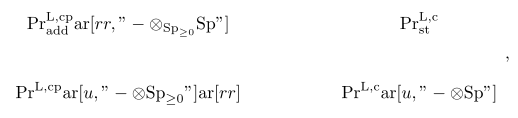 where the top horizontal morphism is the functor from construction 3.4.4, and the bottom horizontal functor is the subcategory inclusion (which is a symmetric monoidal left adjoint by proposition 3.2.10). Taking right adjoints, the middle square of functors in the following diagram commutes:
  The left and right square commute by proposition 3.3.4. By proposition 3.2.8.([003Z]), the bottom horizontal composite is the forgetful functor \(\mathrm{Cat}_{\infty}^{\mathrm{rex}, \mathrm{idem}}\rightarrow\mathrm{Cat}_{\infty}^{\sqcup, \mathrm{idem}}\). The top horizontal functor is the right adjoint to \((-)^{\mathrm{fin}}\) and hence agrees with the forgetful functor \(\mathrm{st}\rightarrow\mathrm{add}\).
We next prove fully faithfulness of the unit: Since both are left adjoints of the forgetful functor, the functor ([005B]) is equivalent to the functor \((-)^{\mathrm{fin}}\colon \mathrm{add}\rightarrow\mathrm{st}\) constructed in [ES22, Def. 2.1.17] which sends an additive, idempotent-complete \(\infty\)-category \(\mathcal C\) to the smallest full stable subcategory of \(\mathrm{Fun}^{\times}(\mathcal C^\mathrm{op}, \mathrm{Sp})\) (the category of functors taking finite coproducts in \(\mathcal C\) to finite products in \(\mathrm{Sp}\)) containing the image of the Yoneda embedding. In [ES22, Cor. 2.1.5], it is shown that the inclusion \(\mathcal C\rightarrow\mathrm{Fun}^{\times}(\mathcal C^{\mathrm{op}}, \mathrm{Sp})\) is fully faithful, and hence so is the inclusion \(\mathcal C\rightarrow\mathcal C^{\mathrm{fin}}\). ◻
As used in the proof of proposition 3.4.5, the functor ([005B]) is equivalent to the functor \((-)^{\mathrm{fin}}\colon \mathrm{add}\rightarrow\mathrm{st}\) constructed in [ES22, Def. 2.1.17] taking an additive, idempotent-complete \(\infty\)-category \(\mathcal C\) to the stable, idempotent-complete \(\infty\)-category \(\mathcal C^{\mathrm{fin}}\) of finite cell \(\mathcal C\)-modules, explicitly defined to be the smallest full stable subcategory of \(\mathrm{Fun}^{\times}(\mathcal C^\mathrm{op}, \mathrm{Sp})\) (the category of functors taking finite coproducts in \(\mathcal C\) to finite products in \(\mathrm{Sp}\)) containing the image of the Yoneda embedding. The inclusion \(\mathcal C\hookrightarrow \mathcal C^{\mathrm{fin}}\) is induced by the Yoneda embedding.
Original source: arXiv:2401.02956v2
Original source · 2401.02956v2