Let \(\mathcal A\) and \(\mathcal B\) be monoidal \(1\)-categories, with monoidal product denoted by \(\boxtimes\) in both cases and with associators \(b_{x,y,z}\) in \(\mathcal B\). A prebraiding \(\beta\) on a monoidal functor \(F\colon \mathcal A\rightarrow\mathcal B\) consists of the data of isomorphisms \[F(x)\boxtimes F(y) \xrightarrow{\beta_{x,y}} F(y) \boxtimes F(x)\qquad
\forall x,y\in \mathcal A\] that form a natural transformation \(\boxtimes\circ (F\times
F) \Rightarrow \boxtimes^{\mathrm{op}}\circ (F\times F)\) and satisfy the following two hexagon axioms for all \(x,y,z\in \mathcal A\):  where the isomorphisms \(\simeq\) are part of the data of \(F\). (Supressing them provides the hexagon shapes.)
2.4 Prebraidings[001J]
As we will see, the cabled crossing complexes from Definition 2.2.7 supply part of the data of a braiding on (an \(\infty\)-categorical version of) chain complexes of Soergel bimodules. What these complexes themselves do not yet encode is the naturality of the braiding—informally speaking, how chain complexes of Soergel bimodules slide through cabled crossings up to coherent homotopy. To capture the naturality of the braiding, we start with a threefold simplified situation: we only aim to slide bimodules (instead of complexes thereof!) through cabled crossings and in fact only Bott–Samelson bimodules, and even simpler, it will be enough to do this on the level of isomorphism classes. To this end, we introduce the crucial notion of a prebraiding.
We have the following trivial observation:
Let \(\mathcal A\) be a monoidal \(1\)-category. A prebraiding \(\beta\) on the identity functor \(\mathrm{Id}\colon \mathcal A\rightarrow\mathcal A\) is a braided monoidal structure on \(\mathcal A\) in the sense of [Eti+15, Def. 8.1.1.].
Observe however that a prebraiding is not (!) required to satisfy an analog of the braid relation (a.k.a. third Reidemeister move) of the form \[\begin{gathered} b_{F(z),F(y),F(x)}\circ (\beta_{y,z}\boxtimes \mathrm{id})\circ b^{-1}_{F(y),F(z),F(x)}\circ(\mathrm{id}\boxtimes \beta_{x,z}) \circ b_{F(y),F(x),F(z)}\circ (\beta_{x,y}\boxtimes \mathrm{id})\\ = (\mathrm{id}\boxtimes \beta_{x,y})\circ b_{F(z),F(x),F(y)}\circ(\beta_{x,z}\boxtimes \mathrm{id}) \circ b^{-1}_{F(x),F(z),F(y)}\circ (\mathrm{id}\boxtimes \beta_{y,z})\circ b_{F(x),F(y),F(z)} \end{gathered}\]
In the situation of Corollary 2.4.2, the braid relation ([001P]) holds, because it can be proven using the naturality of \(\beta\). There are in fact two distinct proofs, namely by sliding either of the two highlighted crossings under the remaining strand: 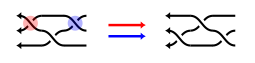 In a higher-categorical version of a prebraiding, these two witnesses for the braid relation need not be realized by the same 2-morphism. However, in the axiomatics of braided monoidal 2-categories, the cells witnessing these two proofs are equated by the so-called \(S_+=S_-\) relation of [BN96] (which was omitted in [KV94]). For a monoidal higher category, a prebraiding on the identity functor therefore does not imply the braid relations ([001P]), see also Remark 2.5.7, and in particular does not encode a braided monoidal (i.e. \(\mathbb E_2\)-)structure. In section 7, we will revisit this point and show that a prebraiding on the identity functor always encodes an \(\mathbb A_2 \otimes \mathbb E_1\)-structure, which differ in general from \(\mathbb E_2\)-structures.
We also want to introduce a relative notion of prebraiding, over a braided monoidal \(1\)-category:
Let \(\mathcal D\) be a braided monoidal \(1\)-category. Assume \(\mathcal C_1\) is a monoidal \(1\)-category, and \(\mathcal C_2\) is a monoidal category over \(\mathcal D\), i.e. equipped with a monoidal functor \(g\colon \mathcal C_2\rightarrow\mathcal D\). Let now \(F\colon \mathcal C_1 \rightarrow\mathcal C_2\) be a monoidal functor. Then we can consider \(C_1\) as a monoidal \(1\)-category over \(\mathcal D\), namely with respect to \(f \coloneqq g\circ F \colon \mathcal C_1 \rightarrow\mathcal D\), and \(F\) becomes a monoidal functor over \(\mathcal D\).
A prebraiding over \(\mathcal D\) on \(F \colon \mathcal C_1 \rightarrow\mathcal C_2\) is then defined to be a prebraiding on \(F\) as in Definition 2.4.1, satisfying the additional condition that \(g\) maps the prebraiding isomorphisms in \(\mathcal C_2\) to the given braiding isomorphisms in \(\mathcal D\).
More explicitly, with \(\mathcal D,\mathcal C_1,\mathcal C_2,F,g,f\) as in Definition 2.4.5, a prebraiding on \(F\) with components \(\beta_{x,y}\) is a prebraiding on \(F\) over \(\mathcal D\) if the isomorphism \[g \circ \beta_{x,y}\colon g(F(x)) \boxtimes g(F(y))\simeq g(F(x) \boxtimes F(y)) \rightarrow g(F(y) \boxtimes F(x)) \simeq g(F(y)) \boxtimes g(F(x))\] coincides with the given braiding isomorphism on \(\mathcal D\), i.e. with \(f(x) \boxtimes f(y) \rightarrow f(y)\boxtimes f(x)\) for all pairs of objects \(x,y\in\mathcal C_1\).
Let \(\mathcal A\) with \(g \colon \mathcal A\rightarrow \mathcal D\) be a monoidal \(1\)-category over \(\mathcal D\). Then a prebraiding over \(\mathcal D\) on the identity functor \(\mathrm{Id}\colon \mathcal A\rightarrow\mathcal A\) is a braided monoidal structure on \(\mathcal A\) with the property that \(g\) is braided monoidal in the sense of [Eti+15, Def. 8.1.7.].
For a monoidal functor \(F\colon \mathcal A\rightarrow\mathcal B\), we denote by \(\mathrm{PreBraid}(F)\) the set of prebraidings of \(F\) and for a monoidal category \(\mathcal A\), we denote by \(\mathrm{Braid}(\mathcal A)\coloneqq\mathrm{PreBraid}(\mathrm{Id}\colon \mathcal A\rightarrow\mathcal A)\) the set of compatible braidings on \(\mathcal A\). The relative versions of Definition 2.4.5 are denoted by \(\mathrm{PreBraid}_{/\mathcal D}(F\colon \mathcal A\rightarrow\mathcal B)\) and \(\mathrm{Braid}_{/\mathcal D}(\mathcal A)\) respectively.
Original source: arXiv:2401.02956v2
Original source · 2401.02956v2