6.3 The Soergel \((2,2)\)-category agrees with its classical variant[00CX]
We now explain how the monoidal \((2,2)\)-category \(\mathrm{Sbim}\) is indeed just a homwise additive and idempotent-completion of \(\mathrm{BSbim}\). We first record the following useful observation about the adjunction 
[00CY]
Lemma 6.3.1.
Let \(F\colon \mathcal C\rightarrow\mathcal D\) be a functor of \((\infty,1)\)-categories, where \(\mathcal C\in \mathrm{Cat}_{\infty}\) and \(\mathcal D\in \mathrm{add}_{k}^{B\mathbb{Z}}\). Then the following properties of \(F\) are equivalent:
Its adjunct \(\mathrm{Lin}_k(\mathcal C\times \mathbb{Z}) \rightarrow\mathcal D\) is dominant.
Every object of \(\mathcal D\) is a retract of a finite coproduct of shifts (under the \(\mathbb{Z}\)-action) of objects in the image of \(F\).
[00CZ]
Proof.
The tensor unit of \(\mathrm{Cat}_{\infty}^{\sqcup, \mathrm{idem}}\) is the category \(\mathrm{Set}^{\mathrm{fin}}\) of finite sets, and since \(\mathrm{CProj}_k \in \mathrm{CAlg}(\mathrm{Cat}_{\infty}^{\sqcup, \mathrm{idem}})\), the unit induces a finite coproduct preserving functor \(\mathrm{Set}^{\mathrm{fin}} \rightarrow\mathrm{CProj}_k\) which sends a finite set \(X\) to the coproduct \(\sqcup_X k\) and is therefore dominant by lemma 3.5.7.([005W]). Hence, since the tensor product in \(\mathrm{Cat}_{\infty}^{\sqcup, \mathrm{idem}}\) of dominant functors is again dominant (since its (dominant, fully faithful)-factorization system is compatible with its monoidal structure, as follows from the proof of proposition 6.2.2), it follows that for any \(\mathcal A\in \mathrm{Cat}_{\infty}^{\sqcup, \mathrm{idem}}\), the unit \(\mathcal A\simeq \mathrm{Set}^{\mathrm{fin}} \otimes \mathcal A\rightarrow\mathrm{CProj}_k \otimes \mathcal A\) of the adjunction between \(\mathrm{Cat}_{\infty}^{\sqcup, \mathrm{idem}}\) and \(\mathrm{add}_k\) is dominant. In particular, it immediately follows that for any \(\mathcal B\in \mathrm{add}_k\), a functor \(\mathcal A\rightarrow\mathcal B\) in \(\mathrm{Cat}_{\infty}^{\sqcup, \mathrm{idem}}\) is dominant if and only if its adjunct (drawn horizontally) is: 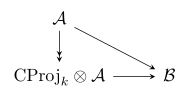
Hence, a functor \(F\) as in the statement of the lemma is dominant, if and only if the functor \((\mathcal C\times \mathbb{Z})^{\sqcup, \mathrm{idem}} \rightarrow\mathcal D\) is, equivalently if every object of \(\mathcal D\) is a retract of a finite coproduct of objects in the image of \(\mathcal C\times \mathbb{Z}\), i.e. of objects which are \(\mathbb{Z}\)-shifts of objects in the image of \(\mathcal C\). ◻
For the following we recall from subsection 2.1 the notation \(R_n \coloneqq k[x_1,\ldots, x_n]\) for the graded polynomial algebra over \(k\) in \(n\in
\mathbb{N}_0\) variables, each of degree two.
[00D0]
Proposition 6.3.2.
The functor \(\iota\colon \mathrm{BSbim}\rightarrow\mathrm{Sbim}\) is surjective on objects. For objects \(n \neq m\in \mathrm{BSbim}\), the hom-category \(\underline{\mathrm{Hom}}_{\mathrm{Sbim}}(\iota n, \iota m)\) is the zero category, and for \(n=m\) it is the smallest additive and idempotent-complete full subcategory of the ordinary additive category \[{}_{R_n}\mathrm{grbmod}_{R_n}\] of graded \(R_n\)-bimodules, which contains the full subcategory \(\mathrm{BSbim}_n\) and is closed under the grading-shift \(\mathbb{Z}\)-action.
[00D1]
Proof.
Since \(\mathrm{Lin}_{k, \mathrm{loc}}^{\mathbb{Z}} (-)\) is defined by applying \(\mathrm{Lin}_k(-\times \mathbb{Z})\) homwise, the functor \[\alpha\colon \mathrm{BSbim}\rightarrow\mathrm{Lin}_{k, \mathrm{loc}}^{\mathbb{Z}} (\mathrm{BSbim})\] is the identity on objects and hence the composite \(\iota\colon \mathrm{BSbim}\rightarrow
\mathrm{Lin}_{k, \mathrm{loc}}^{\mathbb{Z}} (\mathrm{BSbim}) \rightarrow\mathrm{Sbim}\) is surjective on objects. The induced functor on hom-categories between \(n, m \in \mathrm{BSbim}\) therefore factors as follows in \(\mathrm{add}_{k}^{B\mathbb{Z}}\): \[\mathrm{Lin}_k(\mathrm{BSbim}(n,m) \times \mathbb{Z}) =:\mathrm{Lin}_{k, \mathrm{loc}}^{\mathbb{Z}} (\mathrm{BSbim}) (\alpha n, \alpha m) \rightarrow\mathrm{Sbim}(\iota n, \iota m) \rightarrow{}_{R_n}\mathrm{grbmod}_{R_m}\] The first functor is dominant (since \(\mathrm{Lin}_{k, \mathrm{loc}}^{\mathbb{Z}} (\mathrm{BSbim}) \rightarrow
\mathrm{Sbim}\) is dominant on morphisms) and the second functor is fully faithful (since \(\mathrm{Sbim}\rightarrow\mathrm{Mor}^{\mathrm{poly}, \mathrm{gr-proj}}(\mathrm{mod}_k^{\mathbb{Z}})\) is faithful).
It follows from fully faithfulness of the second functor (and the fact that it is a morphism in \(\mathrm{add}_{k}^{B\mathbb{Z}}\)), that \(\mathrm{Sbim}(\iota n, \iota m)\) is a full additive and idempotent-complete subcategory of \({}_{R_n}\mathrm{grbmod}_{R_m}\) which is closed under grading shifts. By lemma 6.3.1, dominance of the first functor implies that every object of this full subcategory is a retract of a finite coproduct of shifts of objects in the image of \(\mathrm{BSbim}(n,m) \hookrightarrow {}_{R_n}\mathrm{grbmod}_{R_m}\). ◻
[00D2]
Observation 6.3.3.
As there are no non-zero morphisms between \(n\neq m\), it follows immediately from proposition 6.3.2 that the monoidal \((2,2)\)-functor \(\iota\colon \mathrm{BSbim}\rightarrow\mathrm{Sbim}\) induces a bijection on the set of isomorphism classes of objects. For objects \(n, m \in \mathrm{Sbim}\), the additive \(k\)-linear hom-category is given by \[\underline{\mathrm{Hom}}_{\mathrm{Sbim}}(n,m) \simeq \left\{\begin{array}{lr} 0 & n \neq m\\
\mathrm{Sbim}_n & n = m \end{array}\right. ,\] where \(\mathrm{Sbim}_n\) is the ordinary \(k\)-linear additive category from definition 2.1.4 with \(\mathbb{Z}\)-action by grading shift. The monoidal shift-preserving \(k\)-linear functor \(\mathrm{Sbim}\rightarrow\mathrm{Mor}^{\mathrm{poly}, \mathrm{gr-proj}}(\mathrm{mod}_k^{\mathbb{Z}})\) sends objects \(n\) to the polynomial algebra \(R_n\) and is given on hom-categories by the evident full inclusion of \(\mathrm{Sbim}_n\) into the category of all graded bimodules which are graded-compact-projective as right modules.
It follows from functoriality that the composition of \(1\)-morphisms in \(\underline{\mathrm{Hom}}_{\mathrm{Sbim}}(n,n)\) is given by the relative tensor product \(-\otimes_{R_n}-\) (and hence, that the endomorphism \(1\)-category \(\underline{\mathrm{Hom}}_{\mathrm{Sbim}}(n,n)\) is equivalent to the monoidal category \(\mathrm{Sbim}_n\) as in definition 2.1.4), and that the monoidal structure of \(\mathrm{Sbim}\) is given by \(-\otimes_k-\) (and hence acts by parabolic induction on the hom-categories \(\mathrm{Sbim}_n \times \mathrm{Sbim}_m \rightarrow\mathrm{Sbim}_{n+m}\) as in definition 2.1.5, see remark 2.3.3).