Let \(\mathcal C\) and \(\mathcal D\) be symmetric monoidal \(\infty\)-categories whose monoidal units are initial. Let  be an adjunction with (strongly) symmetric monoidal left adjoint \(L\) and unit denoted by \(\eta \colon \mathrm{id}_{\mathcal C} \Rightarrow RL\). Then, the adjunction isomorphism \[\psi_{A,B}: \mathrm{Hom}_{\mathcal D}(LA, B) \xrightarrow{R(-)} \mathrm{Hom}_{\mathcal C}(RLA, RB) \xrightarrow{- \circ \eta_A } \mathrm{Hom}_{\mathcal C}(A, RB)\] induces via the maps from observation 7.2.10 for every \(f\in \mathrm{Hom}_{\mathcal D}(LA, B)\) an isomorphism \[\mathbb T_2(f) \xrightarrow{R(-)} \mathbb T_2(Rf) \xrightarrow{-\circ \eta_A} \mathbb T_2( Rf \circ \eta_A) = \mathbb T_2(\psi_{A,B}(f)).\]
Proof.
By adjunction and monoidality of \(L\), the horizontal maps in the commuting diagram 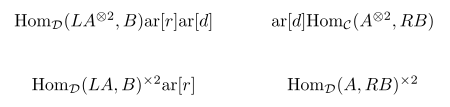 are isomorphisms and hence so is the induced map between the fibers at \(\{(f,f)\} \rightarrow\mathrm{Hom}_{\mathcal D}(LA, B)^{\times 2}\). ◻
Original source: arXiv:2401.02956v2
Original source · 2401.02956v2