A.3 Higher coherence[00II]
Here we briefly illustrate the primary operational difference between working in ordinary categories and working in \(\infty\)-categories, namely that in the latter case one must keep track of higher coherence data.
Let \(M\) be a monoid (i.e. a set equipped with an associative and unital binary operation). Then, the data of \(M\) is entirely recorded by its bar construction, a simplicial set \({\textup{Bar}}(M)\) with \({\textup{Bar}}(M)_n \coloneqq M^{\times n}\) whose face and degeneracy maps respectively record the product and unit of \(M\). Indeed, \(M\) is already completely specified by the restriction \(\Delta^\mathrm{op}_{\leq 3} \hookrightarrow\Delta^\mathrm{op}\xrightarrow{{\textup{Bar}}(M)} \mathrm{Set}\); note that the associativity of its multiplication is guaranteed by the commutativity of a certain square 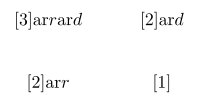 of face maps in \(\Delta^\mathrm{op}\) (whose morphisms all correspond to endpoint-preserving injections in \(\Delta\)). Altogether, we can identify monoids as a full subcategory either of \(\mathrm{Fun}(\Delta^\mathrm{op},\mathrm{Set})\) or of \(\mathrm{Fun}(\Delta^\mathrm{op}_{\leq 3},\mathrm{Set})\).
By contrast, such a restriction – or more generally, the restriction to \(\Delta^\mathrm{op}_{\leq n} \subset \Delta^\mathrm{op}\) for any \(n\) – is not possible in the context of \(\infty\)-category theory. As a fundamental example, an \(\infty\)-monoid \(M\) (i.e. an \(\infty\)-categorical monoid object in \(\mathcal S\)) is completely specified by its bar construction \(\Delta^\mathrm{op}\xrightarrow{{\textup{Bar}}(M)} \mathcal S\) (whose face and degeneracy maps likewise record its product and unit). Heuristically, we may think of relations among various morphisms and their composites in \(\Delta^\mathrm{op}\) as recording coherence data for the muliplication of \(M\), inasmuch as the functor \({\textup{Bar}}(M)\) carries these equalities in the hom-sets of \(\Delta^\mathrm{op}\) only to “homotopy-coherent equalities” (i.e. higher equivalences) in \(\mathcal S\).48 Because \(\mathcal S\) is an \(\infty\)-category (and not an \((n,1)\)-category for any \(n < \infty\), i.e. its hom-spaces can have homotopy groups in arbitrarily high dimensions), these coherence data never become unique or vacuous after some finite stage.
We note for future reference that \(\infty\)-monoids can be identified (via their bar constructions) as the full subcategory of \(\mathrm{Fun}(\Delta^\mathrm{op}, \mathcal S)\) on those simplicial spaces \(X\) satisfying a Segal condition, namely that for every \(n \geq 0\) a certain natural morphism \(X_n \rightarrow(X_1)^{\times n}\) is an equivalence.
We generally suppress the modifier “homotopy coherently” (e.g. of the adjectives “associative” and “unital”), unless we specifically mean to draw attention to it.
Original source: arXiv:2401.02956v2
Original source · 2401.02956v2