7.4 Centralizers and centers[00EK]
In light of theorem 2.6.4, we recall the \(\infty\)-categorical theory of centers and centralizers developed in [Lur17, § 5.3.1] and relate them to \(\mathbb{T}_2\)- and \(\mathbb A_2\)-algebras.
[00EL]
Definition 7.4.1. ([Lur17, Def. 5.3.1.2]).
Let \(f \colon A \rightarrow B\) be a morphism in a monoidal \(\infty\)-category \(\mathcal C\). A centralizer \(\mathfrak{Z}(f)\) of \(f\) is a final object in the \(\infty\)-category \[\mathcal C_{I/} \times_{\mathcal C_{A/}} \mathcal C_{A// B},\] where the functor \(\mathcal C_{I/} \rightarrow\mathcal C_{A/}\) sends objects \((\alpha \colon I\rightarrow X)\) of \(\mathcal C_{I/}\) to \((A \simeq I \otimes A \xrightarrow{\alpha \otimes \mathrm{id}_A} X\otimes A) \in \mathcal C_{A/}\).
Unpacked, a centralizer is an object \(\mathfrak{Z}(f) \in \mathcal C\) equipped with morphisms \(u \colon I \rightarrow\mathfrak{Z}(f)\) and \(\mathrm{ev}\colon \mathfrak{Z}(f) \otimes A \rightarrow B\), such that the following diagram commutes 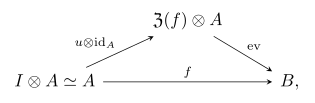 and which is final among such pairs: for any pair of morphisms \(u_X\colon I \rightarrow X\) in \(\mathcal C\) and \(\mathrm{ev}_X\colon X\otimes A \rightarrow B\) making the analog of ([00EM]) commute, there is a unique morphism \(\varphi\colon X \rightarrow\mathfrak{Z}(f)\) such that
 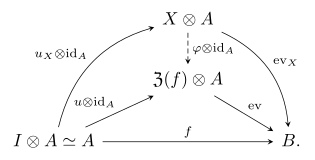 commutes.
[00EP]
Example 7.4.2.
Given a functor \(F \colon \mathcal C\rightarrow\mathcal D\) of \(\infty\)-categories, by [Lur17, Rmk. 5.3.1.4] the centralizer in \(\mathrm{Cat}_{\infty}\) exists and is given by the functor category \(\mathrm{Fun}(\mathcal C, \mathcal D)\) with pointing \(u \colon \{F\} \rightarrow\mathrm{Fun}(\mathcal C, \mathcal D)\) and \(\mathrm{ev}\colon \mathrm{Fun}(\mathcal C, \mathcal D) \times \mathcal C\rightarrow\mathcal D\) given by the evaluation functor.
[00EQ]
Notation 7.4.3.
Let \(\mathcal C\) be a presentably symmetric monoidal \(\infty\)-category. For every morphism \(f \colon A \rightarrow B\) in the \(\infty\)-category \(\mathrm{Alg}_{\mathbb E_k}(\mathcal C)\), the centralizer in \(\mathrm{Alg}_{\mathbb E_k}(\mathcal C)\) exists [Lur17, Cor. 5.3.1.15] and will henceforth be denoted by \(Z_k(f)\in\mathrm{Alg}_{\mathbb E_k}(\mathcal C)\).
[00ER]
Example 7.4.4.
It is straight-forward to verify that for a monoidal functor \(F \colon \mathcal C\rightarrow\mathcal D\) between ordinary monoidal \(1\)-categories, the centralizer \(Z_1(F) \in \mathrm{Alg}_{\mathbb E_1}(\mathrm{Cat}_1)\) in the \((2,1)\)-category \(\mathrm{Alg}_{\mathbb E_1}(\mathrm{Cat}_1)\) of monoidal \(1\)-categories is given by the category from definition 2.6.1 with unit \(1_{Z(f)}\colon {\sf pt}\rightarrow Z_1(F)\) and \(\mathrm{ev}\colon Z_1(F) \times \mathcal C\rightarrow\mathcal D\) described in definition 2.6.1 and definition 2.6.3.
As with ordinary monoidal categories, the case \(f= \mathrm{id}_A \colon A \rightarrow A\) is of special interest. For \(\mathcal C\) a monoidal \(\infty\)-category, recall from [Lur17, Def. 4.2.1.13] the \(\infty\)-category \(\mathrm{LMod}(\mathcal C)\) of left module objects, whose objects are pairs of an algebra \(A\in \mathrm{Alg}_{\mathbb E_1}(\mathcal C)\) and an \(A\)-module \(M\in \mathrm{LMod}_A(\mathcal C)\), and the functor \(\mathrm{LMod}(\mathcal C) \rightarrow\mathcal C\) which sends a pair of an algebra \(A\) and a module \({}_{A}M\) to the underlying object \(M\).
[00ES]
Definition 7.4.5. ([Lur17, Def. 5.3.1.6]).
Let \(\mathcal C\) be a monoidal \(\infty\)-category and \(M\) an object of \(\mathcal C\). A center \(\mathfrak{Z}(M)\) of \(M\) is a final object of the \(\infty\)-category \(\mathrm{LMod}(\mathcal C) \times_{\mathcal C} \{M\}\).
Unpacked, a center \(\mathfrak{Z}(M)\) is an \(\mathbb E_1\)-algebra \(\mathfrak{Z}(M)\) in \(\mathcal C\) with a left action on \(M\) so that all other left actions of \(\mathbb E_1\)-algebras \(A\) on \(M\) factor through \(\mathfrak{Z}(M)\).
[00ET]
Proposition 7.4.6. ([Lur17, Prop. 5.3.1.8]).
Let \(M\) be an object in a monoidal \(\infty\)-category \(\mathcal C\). If \(\mathrm{id}_M\colon M
\rightarrow M\) has a centralizer in \(\mathcal C\), then \(M\) has a center. Furthermore, an \(\mathbb E_1\)-algebra \(A\) with a left-action on \(M\) is a center of \(M\) if and only if the underlying maps \(I \rightarrow A\) and \(A\otimes M \rightarrow M\) exhibit \(A\) as a centralizer of \(\mathrm{id}_M\).
[00EU]
Example 7.4.7.
Given a small \(\infty\)-category \(\mathcal C\), the center in \(\mathrm{Cat}_{\infty}\) exists and is given by the monoidal \(\infty\)-category \(\mathrm{Fun}(\mathcal C, \mathcal C) \in \mathrm{Alg}_{\mathbb E_1}(\mathrm{Cat}_{\infty})\).
[00EV]
Notation 7.4.8.
Let \(\mathcal C\) be a presentably symmetric monoidal \(\infty\)-category. For every \(A\in \mathrm{Alg}_{\mathbb E_k}(\mathcal C)\), the center in \(\mathrm{Alg}_{\mathbb E_k}(\mathcal C)\) exists [Lur17, Cor. 5.3.1.15] and will henceforth be denoted by \[Z_k(A)\in\mathrm{Alg}_{\mathbb E_1}(\mathrm{Alg}_{\mathbb E_k}(\mathcal C)) = \mathrm{Alg}_{\mathbb E_{k+1}}(\mathcal C).\] By proposition 7.4.6, the underlying \(\mathbb E_k\)-algebra of \(Z_k(A)\) agrees with the centralizer \(Z_k(\mathrm{id}_A)\) from notation 7.4.3.
[00EW]
Example 7.4.9.
For \(A \in \mathrm{Alg}_{\mathbb E_1}(\mathrm{Cat}_1)\) an ordinary monoidal \(1\)-category, the center is given by the Drinfeld center \(Z_1(A)\in \mathrm{Alg}_{\mathbb E_2}(\mathrm{Cat}_1)\), see [Lur17, Exm. 5.3.1.18].
[00EX]
Notation 7.4.10.
Let \(\mathcal C\) be a symmetric monoidal \(\infty\)-category whose tensor unit \(I\) is initial and let \(f \colon A \rightarrow B\) be a morphism in \(\mathcal C\) whose centralizer \(\mathfrak{Z}(f) \in \mathcal C\) exists. Then, we define \(\mathrm{ev}_{1_A} \colon \mathfrak{Z}(f) \rightarrow B\) to be the composite \[\mathfrak{Z}(f) \simeq \mathfrak{Z}(f) \otimes I \xrightarrow{\mathrm{id}_{\mathfrak{Z}(f)} \otimes 1_A} \mathfrak{Z}(f) \otimes A \xrightarrow{\mathrm{ev}} B,\] where \(1_A\in \mathrm{Hom}_{\mathcal C}(I, A) \simeq *.\) Below, we will mostly use this morphism in the case that \(\mathcal C= \mathrm{Alg}_{\mathbb E_k}(\mathcal A)\) for a presentably symmetric monoidal \(\infty\)-category \(\mathcal A\), in which case this defines an \(\mathbb E_k\)-algebra map \(Z_k(f) \rightarrow B\) for any \(\mathbb E_k\)-algebra map \(f \colon A \rightarrow B\) in \(\mathrm{Alg}_{\mathbb E_k}(\mathcal A)\).
The relevance of centralizers to this paper arises from the following proposition:
[00EY]
Proposition 7.4.11.
Let \(\mathcal C\) be a symmetric monoidal \(\infty\)-category and \(f\colon A\rightarrow B\) be a morphism in \(\mathrm{Alg}_{\mathbb E_0}(\mathcal C)\). If the centralizer \(Z_0(f)\) in \(\mathrm{Alg}_{\mathbb E_0}(\mathcal C)\) exists, then the space \[\mathbb{T}_2(f)\coloneqq \mathrm{Hom}_{\mathrm{Op}_{[1] \otimes \mathbb E_0/}}(\mathbb{T}_2, \mathcal C) \simeq \mathrm{Hom}_{\mathrm{Alg}_{\mathbb E_0}(\mathcal C)}(A\otimes A, A) \times_{\mathrm{Hom}_{\mathrm{Alg}_{\mathbb E_0}(\mathcal C)}(A,B)^2} \{(f,f)\}\] of \(\mathbb{T}_2\)-structures on \(f\) is equivalent to the following space of (dashed) lifts in \(\mathrm{Alg}_{\mathbb E_0}(\mathcal C)\): 
[00F0]
Proof.
The space of lifts ([00EZ]) is by definition the fiber of \[\mathrm{Hom}_{\mathrm{Alg}_{\mathbb E_0}(\mathcal C)}(A, Z_0(f)) \xrightarrow{\mathrm{ev}_{1_A} \circ -} \mathrm{Hom}_{\mathrm{Alg}_{\mathbb E_0}(\mathcal C)}(A, B)\] at \(f\). By the universal property of the centralizer and since \(I\) is initial in \(\mathrm{Alg}_{\mathbb E_0}(\mathcal C)\), the space \(\mathrm{Hom}_{\mathrm{Alg}_{\mathbb E_0}(\mathcal C)}(A, Z_0(f))\) is equivalent to the space \(\mathrm{Hom}_{\mathrm{Alg}_{\mathbb E_0}(\mathcal C)}(A\otimes A, B)\times_{\mathrm{Hom}_{\mathrm{Alg}_{\mathbb E_0}(\mathcal C)}(A, B)}\{f\}\) of lifts 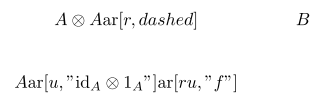 in \(\mathrm{Alg}_{\mathbb E_0}(\mathcal C)\), where \(1_A \colon I \rightarrow A\) denotes the unique morphism in \(\mathrm{Alg}_{\mathbb E_0}(\mathcal C)\). Under this identification, the map \(\mathrm{Hom}_{\mathrm{Alg}_{\mathbb E_0}(\mathcal C)}(A, Z_0(f)) \xrightarrow{\mathrm{ev}_{1_A} \circ -}\mathrm{Hom}_{\mathrm{Alg}_{\mathbb E_0}(\mathcal C)}(A, B)\) unpacks to the composite \[\mathrm{Hom}_{\mathrm{Alg}_{\mathbb E_0}(\mathcal C)}(A\otimes A, B)\times_{\mathrm{Hom}_{\mathrm{Alg}_{\mathbb E_0}(\mathcal C)}(A, B)}\{f\} \rightarrow\mathrm{Hom}_{\mathrm{Alg}_{\mathbb E_0}(\mathcal C)}(A\otimes A, B) \rightarrow\mathrm{Hom}_{\mathrm{Alg}_{\mathbb E_0}(\mathcal C)}(A, B)\] of the projection and the precomposition with \(A\simeq I \otimes A \xrightarrow{1_A \otimes \mathrm{id}_A}A\otimes A\). Hence, the fiber of \(\mathrm{Hom}_{\mathrm{Alg}_{\mathbb E_0}(\mathcal C)}(A, Z_0(f)) \xrightarrow{\mathrm{ev}_{1_A} \circ -}\mathrm{Hom}_{\mathrm{Alg}_{\mathbb E_0}(\mathcal C)}(A, B)\) at \(f\) is equivalent to the space \[\mathrm{Hom}_{\mathrm{Alg}_{\mathbb E_0}(\mathcal C)}(A\otimes A, B)\times_{\mathrm{Hom}_{\mathrm{Alg}_{\mathbb E_0}(\mathcal C)}(A, B)^{\times 2}} \{(f,f)\} =: \mathbb T_2(f). \qedhere\] ◻
[00F1]
Corollary 7.4.12.
Let \(\mathcal C\) be a symmetric monoidal \(\infty\)-category and \(A \in \mathrm{Alg}_{\mathbb E_0}(\mathcal C)\). If the center \(Z_0(A) \in \mathrm{Alg}_{\mathbb E_1}(\mathcal C)\) exists, then the space \[\mathbb A_2(A) \coloneqq \mathrm{Hom}_{\mathrm{Op}_{ \mathbb E_0/}}(\mathbb A_2, \mathcal C) \simeq \mathrm{Hom}_{\mathrm{Alg}_{\mathbb E_0}(\mathcal C)}(A\otimes A, A) \times_{\mathrm{Hom}_{\mathrm{Alg}_{\mathbb E_0}(\mathcal C)}(A,B)^2} \{(\mathrm{id}_A,\mathrm{id}_A)\}\] of \(\mathbb A_2\)-structures on \(A\) is equivalent to the following space of (dashed) lifts in \(\mathrm{Alg}_{\mathbb E_0}(\mathcal C)\): 
[00F3]
Proof.
Apply proposition 7.4.11 for \(f=\mathrm{id}_A\) using that \(Z_0(A) = Z_0(\mathrm{id}_A)\). ◻
[00F4]
Observation 7.4.13.
Let \(\mathcal C\) be a symmetric monoidal \(\infty\)-category, and \(A\in \mathrm{Alg}_{\mathbb E_1}(\mathcal C)\). Assume the center \(Z_0(A)\in \mathrm{Alg}_{\mathbb E_1}(\mathcal C)\) of the underlying \(\mathbb E_0\)-algebra \(A \in \mathrm{Alg}_{\mathbb E_0}(\mathcal C)\) exists. Since \(A\) has a left action on itself, the universal property of \(Z_0(A) \in \mathrm{Alg}_{\mathbb E_1}(\mathcal C)\) induces an \(\mathbb E_1\)-homomorphism \(A\rightarrow Z_0(A)\). Moreover, since the multiplication of \(A\) is right unital, it follows that the composite \(A\rightarrow Z_0(A)\rightarrow A\) in \(\mathcal C\) is isomorphic to \(\mathrm{id}_A\). Hence, by corollary 7.4.12, this induces an \(\mathbb A_2\)-structure on \(A\). Unpacked, this \(\mathbb A_2\)-structure coincides with the one induced from the operad map \(\mathbb A_2 \rightarrow\mathbb E_1\) from example 7.2.7.
By observation 7.4.13, any \(\mathbb E_1\)-structure on an \(\mathbb E_0\)-algebra \(A\) induces an \(\mathbb E_1\)-monoidal section \(A\rightarrow\mathfrak{Z}(A)\) of the \(\mathbb E_0\)-monoidal \(\mathfrak{Z}(A)\rightarrow A\). We now show that this section and its monoidality can be uniquely recovered from the \(\mathbb E_1\)-structure on \(A\).
[00F5]
Lemma 7.4.14.
Let \(\mathcal C\) be a symmetric monoidal \(\infty\)-category with initial tensor unit and let \(X\) be an object in \(\mathcal C\) whose center \(\mathfrak{Z}(X) \in \mathrm{Alg}_{\mathbb E_1}(\mathcal C)\) exists. Then, the forgetful functor \[
\mathrm{Alg}_{\mathbb E_1}(\mathcal C)_{/\mathfrak{Z}(X)} \times_{\mathcal C_{/X}} \{ \mathrm{id}_X\} \rightarrow\mathrm{Alg}_{\mathbb E_1}(\mathcal C) \times_{\mathcal C} \{X\}\] is an equivalence of \(\infty\)-categories.
[00F7]
Proof.
Since \(\mathrm{Alg}_{\mathbb E_1}(\mathcal C) \rightarrow\mathcal C\) is conservative, the \(\infty\)-categories in ([00F6]) are \(\infty\)-groupoids, and equivalently given by the fibers of the respective maps of maximal subgroupoids.
For an \(\mathbb E_1\)-algebra \(A\) in \(\mathcal C\), it follows from the free-forgetful adjunction  and initiality of the unit of \(\mathcal C\) that the free \(A\)-module \(_{A}A\) is initial in \(\mathrm{LMod}_A(\mathcal C)\). This induces a functor \(\mathrm{LMod}_A(\mathcal C) \simeq \mathrm{LMod}_{A}(\mathcal C)_{{}_{A}A/} \rightarrow\mathcal C_{A/}\) which sends a left \(A\)-module \(M\) to the morphism \[\mathrm{act}_1 \colon A\simeq A \otimes I \xrightarrow{\mathrm{id}_A \otimes !} A \otimes M \xrightarrow{\mathrm{act}} M.\]
Applying this functor \(\mathrm{act}_1 \colon \mathrm{LMod}_A(\mathcal C) \rightarrow\mathcal C_{A/}\) fiberwise induces a commuting diagram of spaces
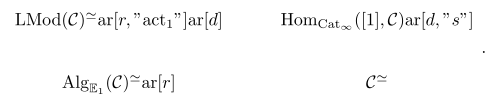
By the universal property of the center, the \(\infty\)-category \(\mathrm{Alg}_{\mathbb E_1}(\mathcal C)_{/\mathfrak{Z}(X)}\) is equivalent to the \(\infty\)-category \(\mathrm{LMod}(\mathcal C) \times_{\mathcal C} \{X\}\), and hence the space \(\underline{\mathrm{Alg}}_{\mathbb E_1}(\mathcal C)_{/\mathfrak{Z}(X)} \times_{\mathcal C_{/X}} \{ \mathrm{id}_X\}\) is equivalent to the fiber of the top horizontal map in ([00F8]) at \(\{ \mathrm{id}_X\} \in \mathrm{Hom}_{\mathrm{Cat}_{\infty}}([1], \mathcal C)\). The functor ([00F6]) is the induced map from the fiber of the top horizontal map of ([00F8]) at \(\mathrm{id}_X\) to the fiber of the bottom horizontal map of ([00F8]) at \(X\).
Let \(\mathrm{Hom}_{\mathrm{Cat}_{\infty}}([1], \mathcal C)^{\mathrm{iso}}\) denote the full subspace of \(\mathrm{Hom}_{\mathrm{Cat}_{\infty}}([1], \mathcal C)\) on the invertible arrows in \(\mathcal C\). In particular, the composite \(\mathrm{Hom}_{\mathrm{Cat}_{\infty}}([1], \mathcal C)^{\mathrm{iso}}\rightarrow\mathrm{Hom}_{\mathrm{Cat}_{\infty}}([1], \mathcal C) \xrightarrow{s}\mathcal C^{\simeq}\) is an equivalence. We now show that the composite map of spaces \[ \mathrm{LMod}(\mathcal C)^{\simeq} \times_{\mathrm{Hom}_{\mathrm{Cat}_{\infty}}([1], \mathcal C)} \mathrm{Hom}_{\mathrm{Cat}_{\infty}}([1], \mathcal C)^{\mathrm{iso}} \rightarrow\mathrm{LMod}(\mathcal C)^{\simeq} \rightarrow\mathrm{Alg}_{\mathbb E_1}(\mathcal C)^{\simeq}\] is an equivalence, which concludes the proof as \(\{ \mathrm{id}_X\} \in \mathrm{Hom}_{\mathrm{Cat}_{\infty}}([1], \mathcal C)\) is an object of the full subspace \(\mathrm{Hom}_{\mathrm{Cat}_{\infty}}([1], \mathcal C)^{\mathrm{iso}}\).
It suffices to verify that all fibers of ([00F9]) are contractible. By definition, for \(A\in \mathrm{Alg}_{\mathbb E_1}(\mathcal C)\) the fiber is the full subspace of \(\mathrm{LMod}_A(\mathcal C)^{\simeq} \simeq \left(\mathrm{LMod}_A(\mathcal C)_{{}_{A}A/}\right)^{\simeq}\) on those modules \(M\) for which the induced map \(\mathrm{act}_1 \colon A \rightarrow M\) is an equivalence. But since \(\mathrm{LMod}_A(\mathcal C) \rightarrow\mathcal C\) is conservative, this is the full subcategory \(\mathrm{LMod}_A(\mathcal C)_{{}_{A}A/^{\mathrm{iso}}}\) on the invertible module functors \({}_{A}A \rightarrow_{A}M\) and hence contractible. ◻
The following corollary finally justifies the presence of \(\mathbb T_2\)-structures in this paper:
[00FA]
Corollary 7.4.15.
Let \(F: \mathcal A\rightarrow\mathcal B\) be an ordinary monoidal functor between ordinary monoidal \(1\)-categories.
A \(\mathbb T_2\otimes \mathbb E_1\)-structure on \(F\) is a prebraiding on \(F\) in the sense of definition 2.4.1. More precisely, the space \(\mathbb T_2(F)\) of \(\mathbb T_2\)-structures on \(F\) is discrete and equivalent to the set \(\mathrm{PreBraid}(F)\) of prebraidings on \(F\) defined in definition 2.4.8.
An \(\mathbb A_2 \otimes \mathbb E_1\)-structure on \(\mathcal A\) is a braiding on the monoidal category \(\mathcal A\), in the usual \(1\)-categorical sense. More precisely, the space \(\mathbb A_2(\mathcal A)\) of \(\mathbb A_2\)-structures on \(\mathcal A\) is discrete and equivalent to the set \(\mathrm{Braid}(\mathcal A)\) of braidings on \(\mathcal A\) defined in definition 2.4.8.
[00FD]
Proof.
By proposition 7.4.11, a \(\mathbb T_2 \otimes \mathbb E_1\)-structure on \(F\) is a lift in \(\mathrm{Alg}_{\mathbb E_1}(\mathrm{Cat}_{({1}, {1})})\): 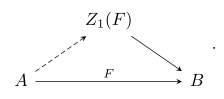 Explicitly, the space of \(\mathbb T_2\otimes \mathbb E_1\)-structures on \(F\) is therefore the \(1\)-groupoid of weak lifts from theorem 2.6.4.([002J]). By theorem 2.6.4, this is equivalent to the set of prebraidings on \(F\) in the sense of definition 2.4.8. This completes the proof of part ([00FB]). Part ([00FC]) follows by applying statement ([00FB]) to the case \(F=\mathrm{id}_{\mathcal A}\). ◻
The operad map \(\mathbb A_2 \rightarrow\mathbb E_1\) induces an operad map \(\mathbb A_2\otimes \mathbb E_1 \rightarrow\mathbb E_1 \otimes \mathbb E_1 \simeq \mathbb E_2\). Hence, any \(\mathbb E_2\)-structure gives rise to an \(\mathbb A_2 \otimes \mathbb E_1\)-structure, but not necessarily vice versa. However, corollary 7.4.15 shows that \(\mathbb A_2 \otimes \mathbb E_1\)-structures on \(1\)-categories agree with braided monoidal structures, which are well-known to coincide with \(\mathbb E_2\)-structures on \(1\)-categories. This hints at a certain connectivity of the operad map \(\mathbb A_2 \otimes \mathbb E_1 \rightarrow\mathbb E_2\) which we will study in the next sections.