For \(n\geq -1\), an \(n\)-operad is an \(\infty\)-operad all of whose multi-hom spaces, i.e. the \(\mathrm{Mul}_{\mathcal O}(X_1,\ldots, X_k; Y)\), are \((n-1)\)-truncated. We extend this to the case \(n=-2\) by declaring the terminal operad to be a \((-2)\)-operad. We denote the full subcategory of \(\mathrm{Op}\) on the \(n\)-operads by \(\mathrm{Op}_n\).
7.7 From \(\mathbb A_2 \otimes \mathbb E_1\)- to \(\mathbb E_2\)-algebras[00FV]
Considering the filtration \(\mathbb A_1 \otimes \mathbb E_1 \rightarrow\mathbb A_2 \otimes \mathbb E_2 \rightarrow\ldots \mathbb A_{\infty} \otimes \mathbb E_1 = \mathbb E_1 \otimes \mathbb E_1 \simeq \mathbb E_2\), an \(\mathbb A_2\otimes \mathbb E_1\)-structure is less data than a fully coherent \(\mathbb E_2\)-structure. However, as suggested by corollary 7.4.15, \(\mathbb A_2\otimes \mathbb E_1\)-structures on \(1\)-categories already agree with \(\mathbb E_2\)-structures. In this section, we prove a generization that holds for any \(2\)-categorical operad.
Equivalently, an \(\infty\)-operad is an \(n\)-operad if and only if the terminal operad map \(\mathcal O\rightarrow\mathbb E_{\infty}\) is \(n\)-faithful.
A \(1\)-operad is precisely one that is equivalent to (the nerve of) an ordinary operad.
A symmetric monoidal \((\infty, 1)\)-category \(\mathcal C\), considered as an \(\infty\)-operad, is an \(n\)-operad if and only if its underlying category is an \((n,1)\)-category (also see definition 5.4.1).
The notion of \(n\)-truncated morphism defined in definition 5.2.1 generalizes to any \(\infty\)-category:
For \(n\geq -2\), a morphism \(f \colon A \rightarrow B\) in an \(\infty\)-category \(\mathcal C\) is called \(n\)-truncated if the induced map of spaces \(\mathrm{Hom}_{\mathcal C}(X, A) \rightarrow\mathrm{Hom}_{\mathcal C}(X,B)\) is \(n\)-truncated, see definition 5.2.1, for every object \(X\in \mathcal C\).
In particular, a morphism \(f \colon A \rightarrow B\) in an \(\infty\)-category \(\mathcal C\) is \(0\)-truncated if for every object \(X\in \mathcal C\), the map \(\mathrm{Hom}_{\mathcal C}(X,A) \rightarrow\mathrm{Hom}_{\mathcal C}(X,B)\) is \(0\)-truncated, i.e. all its fibers are discrete sets. For an ordinary monoidal \(1\)-category \(A\), the monoidal functor \(Z_1(A) \rightarrow A\) is faithful, and in particular \(0\)-truncated as a morphism in the \(\infty\)-category \(\mathrm{Alg}_{\mathbb E_1}(\mathrm{Cat}_1)\) (see warning 5.3.9). The following is a generalization of this statement:
Let \(\mathcal C\) be a symmetric monoidal \((2,1)\)-category and \(A\in \mathrm{Alg}_{\mathbb E_1}(\mathcal C)\) whose center \(Z_1(A) \in \mathrm{Alg}_{\mathbb E_2}(\mathcal C)\) exists. Then, the morphism \(Z_1(A) \rightarrow A\) is a \(0\)-truncated morphism in \(\mathrm{Alg}_{\mathbb E_1}(\mathcal C)\).
Proof.
Let \(X\in \mathrm{Alg}_{\mathbb E_1}(\mathcal C)\). Since \(Z_1(A)\) is the centralizer \(\mathfrak{Z}(\mathrm{id}_A)\) of the morphism \(\mathrm{id}_A\) in \(\mathrm{Alg}_{\mathbb E_1}(\mathcal C)\) and the unit of \(\mathrm{Alg}_{\mathbb E_1}(\mathcal C)\) is initial, the universal property of the centralizer implies that the map \(\mathrm{Hom}_{\mathrm{Alg}_{\mathbb E_1}(\mathcal C) }(X, Z_1(A)) \rightarrow\mathrm{Hom}_{\mathrm{Alg}_{\mathbb E_1}(\mathcal C)}(X, A)\) is equivalent to the composite \[\mathrm{Hom}_{\mathrm{Alg}_{\mathbb E_1}(\mathcal C)}(X \otimes A, A) \times_{\mathrm{Hom}_{\mathrm{Alg}_{\mathbb E_1}(\mathcal C)}(A,A)} \{ \mathrm{id}_A\} \rightarrow\mathrm{Hom}_{\mathrm{Alg}_{\mathbb E_1}(\mathcal C)}(X \otimes A, A) \rightarrow\mathrm{Hom}_{\mathrm{Alg}_{\mathbb E_1}(\mathcal C)}(X,A).\] By definition of the \(\infty\)-operad \(\nabla_2\) in lemma 7.2.3, the fiber of this map at an \(f\in \mathrm{Hom}_{\mathrm{Alg}_{\mathbb E_1}(\mathcal C)}(X,A)\) is precisely the space of lifts of the operad map  classified by the span of \(\mathbb E_1\)-morphisms \(X \xrightarrow{f}A \xleftarrow{\mathrm{id}_A}A\), to an operad map \(\nabla_2 \otimes \mathbb E_0 \rightarrow\mathrm{Alg}_{\mathbb E_1}(\mathcal C)\). Equivalently, this is the space of lift
 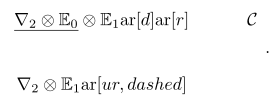 By assumption, \(\mathcal C\) is a symmetric monoidal \((2,1)\)-category, hence a \(2\)-operad and hence the operad map \(\mathcal C\rightarrow*\) is \(2\)-faithful. Since the left vertical operad map is \(0\)-surjective by proposition 7.6.1, it follows from corollary 7.5.5 that this space of lifts is \(0\)-truncated. ◻
Let \(\mathcal C\) be a presentably symmetric monoidal \((2,1)\)-category. Then, the map of spaces \[\mathrm{Hom}_{\mathrm{Op}}(\mathbb E_2, \mathcal C) \rightarrow\mathrm{Hom}_{\mathrm{Op}}(\mathbb A_2 \otimes \mathbb E_1, \mathcal C)\] is an equivalence.
Proof.
Consider the diagram of spaces  To prove that the horizontal map is an equivalence, it suffices to show that for every \(A\in \mathrm{Alg}_{\mathbb E_1}(\mathcal C)\), the induced map between fibers \[\mathrm{Hom}_{\mathrm{Op}}(\mathbb E_2,\mathcal C) \times_{\mathrm{Hom}_{\mathrm{Op}}(\mathbb E_1,\mathcal C)} \{A\} \rightarrow\mathrm{Hom}_{\mathrm{Op}}(\mathbb A_2 \otimes \mathbb E_1,\mathcal C) \times_{\mathrm{Hom}_{\mathrm{Op}}(\mathbb E_1,\mathcal C)} \{A\}\] is an equivalence.
Since \(\mathcal C\) is presentably symmetric monoidal, it follows that centralizers and centers exist [Lur17, Cor. 5.3.1.15] and hence, by applying corollary 7.4.12, that the latter space is equivalent to \[\left(\mathrm{Alg}_{\mathbb E_1}(\mathcal C)_{/Z_1(A)}\right)^{\simeq} \times_{\left(\mathrm{Alg}_{\mathbb E_1}(\mathcal C)_{/A}\right)^{\simeq} } \{\mathrm{id}_A\}.\] Applying lemma 7.4.14 to the \(\infty\)-category \(\mathrm{Alg}_{\mathbb E_1}(\mathcal C)\), we find that the functor \[\mathrm{Alg}_{\mathbb E_2}(\mathcal C)_{/Z_1(A)} \times_{\mathrm{Alg}_{\mathbb E_1}(\mathcal C)/A} \{\mathrm{id}_A\}\rightarrow\mathrm{Alg}_{\mathbb E_2}(\mathcal C) \times_{\mathrm{Alg}_{\mathbb E_1}(\mathcal C)} \{A\}\] is an equivalence. It therefore suffices to show that the forgetful functor \[ \mathrm{Alg}_{\mathbb E_2}(\mathcal C)_{/Z_1(A)} \times_{\mathrm{Alg}_{\mathbb E_1}(\mathcal C)/A} \{\mathrm{id}_A\} \rightarrow\mathrm{Alg}_{\mathbb E_1}(\mathcal C)_{/Z_1(A)} \times_{\mathrm{Alg}_{\mathbb E_1}(\mathcal C)_{/A}} \{\mathrm{id}_A\}\] is an equivalence.
proposition 7.7.5 implies that the map \(Z_1(A) \rightarrow A\) is \(0\)-truncated as a morphism in \(\mathrm{Alg}_{\mathbb E_1}(\mathcal C)\). Hence, any section \(A\rightarrow Z_1(A)\) is \((-1)\)-truncated. Therefore, the map ([00G4]) is equivalent to the map \[\mathrm{Alg}_{\mathbb E_2}(\mathcal C)_{/^{-1}Z_1(A)} \times_{\mathrm{Alg}_{\mathbb E_1}(\mathcal C)/A} \{\mathrm{id}_A\} \rightarrow\mathrm{Alg}_{\mathbb E_1}(\mathcal C)_{/^{-1}Z_1(A)} \times_{\mathrm{Alg}_{\mathbb E_1}(\mathcal C)_{/A}} \{\mathrm{id}_A\}\] where \(- /^{-1} Z_1(A)\) denote full subcategories of \((-1)\)-truncated \(\mathbb E_1\)-maps (see notation 5.5.1). To prove this is an equivalence, it suffices to show that \[\mathrm{Alg}_{\mathbb E_2}(\mathcal C)_{/^{-1}Z_1(A)} \rightarrow\mathrm{Alg}_{\mathbb E_1}(\mathcal C)_{/^{-1} Z_1(A)}\] is an equivalence. But given any \((X\hookrightarrow Z_1(A))\) in \(\mathrm{Alg}_{\mathbb E_1}(\mathcal C)_{/^{-1}Z_1(A)}\), the fiber of ([00G5]) is equivalent to the space of dashed lifts in \(\mathrm{Op}\) 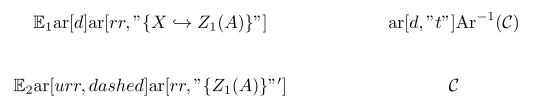 where \(\mathrm{Ar}^{-1}(\mathcal C)\) denotes the full symmetric monoidal subcategory of the arrow category \(\mathrm{Ar}(\mathcal C) \coloneqq \mathrm{Fun}([1], \mathcal C)\) on the \((-1)\)-truncated morphisms.
But since \(\mathbb E_1 \rightarrow\mathbb E_2\) is \(0\)-surjective, i.e. essentially surjective on objects and \((-1)\)-connected on multi-hom spaces \(\mathbb E_1(n)\simeq S_n \rightarrow\mathbb E_2(n) = \mathrm{Conf}(n, \mathbb{R}^2)\), and since \(\mathrm{Ar}^{-1}(\mathcal C) \rightarrow\mathcal C\) is \(0\)-faithful36, it follows from proposition 7.5.3 that the space of lifts ([00G6]) is contractible. ◻
Since an \(\mathbb A_2\otimes \mathbb E_1\)-structure on a given monoidal \(1\)-category is by corollary 7.4.15.([00FC]) precisely the data of a braiding, corollary 7.7.6 in particular implies the well-known observation (see [Lur17, Ex. 5.1.2.4]) that braided monoidal structures and \(\mathbb E_2\)-structures coinicide on ordinary \(1\)-categories.
For any \(2\)-operad \(\mathcal O\), the map of spaces \(\mathrm{Hom}_{\mathrm{Op}}( \mathbb A_2 \otimes \mathbb E_1, \mathcal O) \rightarrow\mathrm{Hom}_{\mathrm{Op}}(\mathbb E_2, \mathcal O)\) is an equivalence.
Proof.
The full inclusion \(\mathrm{Op}_2 \hookrightarrow \mathrm{Op}\) admits a left adjoint \(h_2 \colon \mathrm{Op}\rightarrow\mathrm{Op}_2\) (constructed in [SY20, Thm. 3.12]). Moreover, it follows from [SY19, Prop. 3.2.6(4)] applied to corollary 7.7.6 that the operad map \(h_2(\mathbb A_2\otimes \mathbb E_1) \rightarrow h_2(\mathbb E_2)\) is an equivalence (i.e. that \(\mathbb A_2 \otimes \mathbb E_1 \rightarrow\mathbb E_2\) is a \(1\)-equivalence in the terminology of [SY19]). By adjunction, it follows that for any \(2\)-operad \(\mathcal O\), the map \(\mathrm{Hom}_{\mathrm{Op}}(\mathbb A_2\otimes \mathbb E_1, \mathcal O) \rightarrow\mathrm{Hom}_{\mathrm{Op}}(\mathbb E_2, \mathcal O)\) is an equivalence. ◻
In other words, corollary 7.7.8 shows that \(\mathbb A_2 \otimes \mathbb E_1 \rightarrow\mathbb E_2\) is a \(1\)-equivalence in the sense of [SY19], i.e. it is essentially surjective on the underlying categories and induces an equivalence on the \(0\)-truncations of all the multimapping spaces.
Original source: arXiv:2401.02956v2
Original source · 2401.02956v2