We set \(\mathrm{Cat}_{(\infty, {0})} \coloneqq \mathcal S\) to be the \(\infty\)-category of small spaces, and equip it with its Cartesian presentably symmetric monoidal structure. We inductively define the Cartesian20 presentably symmetric monoidal \(\infty\)-category of \((\infty, k)\)-categories \(\mathrm{Cat}_{(\infty, {k})}\coloneqq\mathrm{Cat}[\mathrm{Cat}_{(\infty, {k-1})}]\).
5 \((\infty,k)\)-categories and their factorization systems[0099]
In this section, we introduce our \((\infty,k)\)-categorical framework, and establish the existence of various factorization systems generalizing the familiar (surjective-on-objects, fully faithful)-factorization system on \(\mathrm{Cat}_{\infty}\). We refer the reader to section A, especially A.1, for motivation and a leisurely introduction to \((\infty,k)\)-categories.
5.1 Basic notions in \((\infty,k)\)-category theory[009A]
Throughout, we will use the theory of enriched \(\infty\)-categories developed in [GH15], see also subsection A.10.
In [Hau15, Thm. 1.2], Haugseng showed that the \(\infty\)-category \(\mathrm{Cat}_{(\infty, {k})}\) from definition 5.1.1 satisifes the axioms of Barwick and Schommer-Pries [BS21] and hence is equivalent to most other known models of the \(\infty\)-category of \((\infty,k)\)-categories.
Consider the diagram  of adjunctions, where \(i\) denotes the fully faithful inclusion of spaces as \(\infty\)-groupoids. Since all these functors preserve finite products21 , they are all symmetric monoidal. By applying \(\mathrm{Cat}[-]\) iteratively, we obtain an analogous diagram
  of symmetric monoidal adjoint functors for any \(k \geq 0\) (with \(i_{k+1}\) fully faithful). Thereafter, for any \(j \geq k \geq 0\) we obtain an analogous diagram
  of symmetric monoidal adjoint functors by composition.
In diagram ([009E]), we refer to \(|-|_k\) as the \((\infty,k)\)-category completion functor and to \(\iota_k\) as the maximal sub-\((\infty,k)\)-category functor.22 For brevity, we may omit the fully faithful inclusion functor \(i_j\) from our notation, implicitly considering an \((\infty,k)\)-category as an \((\infty,j)\)-category with no noninvertible \(i\)-morphisms for any \(i > k\).
For any \(j \geq k \geq 0\), the inclusion \(\mathrm{Cat}_{(\infty, {k})} \xhookrightarrow{i_j} \mathrm{Cat}_{(\infty, {j})}\) identifies \(\mathrm{Cat}_{(\infty, {k})}\) as the full subcategory of \(\mathrm{Cat}_{(\infty, {j})}\) on those \((\infty,j)\)-categories whose \(i\)-morphisms are all invertible for all \(i > k\) [GH15, Prop. 6.1.7(iv)].23 We use this fact without further comment.
The \(n\)-cell (or walking \(n\)-morphism) is the \((\infty,n)\)-category \(c_n \coloneqq \Sigma^n[{\sf pt}] \in \mathrm{Cat}_{(\infty, {n})}\).24 Its boundary (or the walking pair of parallel \((n-1)\)-morphisms25) is the \((\infty,n)\)-category \(\partial c_n \coloneqq \partial \Sigma^n[{\sf pt}] \coloneqq \Sigma^n[\emptyset]\) (which is in fact an \((\infty,n-1)\)-category). We use both notations interchangeably, depending on our desired emphasis. We also introduce the notation \[j_n \colon \partial c_n \coloneqq \Sigma^n[\emptyset] \xrightarrow{\Sigma[\emptyset \longrightarrow{\sf pt}]} \Sigma^n[{\sf pt}] \eqqcolon c_n\] for the inclusion, which corepresents the functor taking an \(n\)-morphism to its source and target (which are parallel \((n-1)\)-morphisms).
For \(n \geq 0\), it follows from [GH15, Lem. 6.1.9] that the map \(|j_n|_0 \colon |\partial c_n|_0 \rightarrow|c_n|_0\) is equivalent to the map \(S^{n-1} \rightarrow{\sf pt}.\) By induction, it follows that for \(k < n\), \(|j_n|_k \colon |\partial c_n|_k \rightarrow|c_n|_k\) is equivalent to the map \(\Sigma^k[S^{n-k-1}] \rightarrow\Sigma^k[{\sf pt}] = c_k\) induced by \(S^{n-k-1} \rightarrow{\sf pt}\).
Let \(\alpha \colon \partial c_k \rightarrow\mathcal C\) be a pair of parallel \((k-1)\)-morphisms in an \((\infty,k)\)-category \(\mathcal C\). The space of \(k\)-morphisms filling \(\alpha\) is \[\mathrm{kHom}_{\mathcal C}(\alpha) \coloneqq \mathrm{Hom}_{\mathrm{Cat}_{(\infty, {k})}}(c_k, \mathcal C) \times_{\mathrm{Hom}_{\mathrm{Cat}_{(\infty, {k})}}(\partial c_k, \mathcal C)} \{\alpha\}.\]
Given a space \(X \in \mathcal S\) and \(k \geq 0\), the map \(\emptyset \rightarrow X\) induces a functor of \((\infty,k)\)-categories \(\partial c_k = \Sigma^k[\emptyset] \rightarrow\Sigma^k [X]\). It then follows from the universal property of \(\Sigma\) that for any \(\mathcal C\in \mathrm{Cat}_{(\infty, {k})}\) and any pair of parallel \((k-1)\)-morphisms \(\alpha\colon \partial c_k \rightarrow\mathcal C\), we obtain an equivalence of spaces \[\mathrm{Hom}_{\mathrm{Cat}_{(\infty, {k})}}(\Sigma^k[X], \mathcal C) \times_{\mathrm{Hom}_{\mathrm{Cat}_{(\infty, {k})}}(\partial c_k, \mathcal C)} \{\alpha\} \simeq \mathrm{Hom}_{\mathcal S}(X,\mathrm{kHom}_{\mathcal C}(\alpha)).\]
5.2 Truncatedness and connectedness[009L]
Here we recall the standard definition of the (\(n\)-connected, \(n\)-truncated) factorization system on the \(\infty\)-category \(\mathcal S\) of spaces. This will be the base case for our factorization systems on \((\infty, k)\)-categories.
For any \(n \geq 0\), a space \(X \in \mathcal S\) is called
\(n\)-connected if \(X\) is connected and if \(\pi_i(X,x) = 0\) for all \(i \leq n\) and all \(x \in X\) and
\(n\)-truncated if \(\pi_i(X,x) = 0\) for all \(i > n\) and all \(x \in X\).
We extend this to the case that \(n=-1\) by declaring that \(X\) is
\((-1)\)-connected if it is nonempty and
\((-1)\)-truncated if it is either empty or contractible,
and to the case that \(n=-2\) by declaring that \(X\) is
always \((-2)\)-connected and
\((-2)\)-truncated if it is contractible.
For any \(n \geq -2\), we declare that a map of spaces is \(n\)-connected26 (resp. \(n\)-truncated) if its fibers are all such. By [Lur09, Ex. 5.2.8.16] the classes of (\(n\)-connected, \(n\)-truncated) maps form a factorization system of small generation on \(\mathcal S\), generated by the single morphism \(S^{n+1} \rightarrow{\sf pt}\). See also example B.1.16.
To obtain examples, the following explicit alternative descriptions of \(n\)-connectedness and \(n\)-truncatedness for low values of \(n\) are useful.
A space is \(0\)-connected if and only if it is connected (and in particular nonempty), and it is \(1\)-connected if and only if it is simply connected (and in particular connected).
A map of spaces is always \((-2)\)-connected, and it is \((-1)\)-connected if and only if it is surjective.
A space is \(n\)-truncated if and only if it is an \(n\)-type, e.g. it is \(0\)-truncated if and only if it is discrete.
A map of spaces is \((-2)\)-truncated if and only if it is an equivalence, it is \((-1)\)-truncated if and only if it is a monomorphism, and it is \(0\)-truncated if and only if it is a covering map (in the classical sense).
We note the following basic facts, which we use without further comment.
For any \(n \geq -2\), a space \(X\) is \(n\)-connected (resp. \(n\)-truncated) if and only if the map \(X \rightarrow{\sf pt}\) is such.
For any \(n \geq -2\), a space is both \(n\)-connected and \(n\)-truncated if and only if it is contractible, and hence a map is both \(n\)-connected and \(n\)-truncated if and only if it is an equivalence.
For any \(n \geq -2\), we have the implications \[\text{$n$-connected} \Longleftarrow \text{$(n+1)$-connected} \qquad \text{and} \qquad \text{$n$-truncated} \Longrightarrow \text{$(n+1)$-truncated}\] for spaces and hence also for maps of spaces.
For any \(n \geq -2\), both \(n\)-connected and \(n\)-truncated maps are stable under base change.
By the long exact sequence in homotopy groups, for any \(n \geq -1\), a map \(X \xrightarrow{f} Y\) of spaces is
\(n\)-connected if and only if for every \(x \in X\) the map \(\pi_i(X,x) \xrightarrow{\pi_i(f)} \pi_i(Y,f(x))\) is
an isomorphism for all \(0 \leq i < n+1\) and
surjective for \(i = n+1\),
and
\(n\)-truncated if and only if for every \(x \in X\) the map \(\pi_i(X,x) \xrightarrow{\pi_i(f)} \pi_i(Y,f(x))\) is
an isomorphism for all \(i > n+1\) and
injective for \(i = n+1\).
Throughout, we will use the following cancellation properties generalizing well-known facts about surjections and injections of sets.
Suppose that \(A \xrightarrow{f} B \xrightarrow{g} C\) are composable maps of spaces, and let \(n \geq -2\).
If \(g\) is \((n+1)\)-connected and \(gf\) is \(n\)-connected, then \(f\) is \(n\)-connected.
If \(g\) is \((n+1)\)-truncated and \(gf\) is \(n\)-truncated, then \(f\) is \(n\)-truncated.
Proof.
Since connectivity and truncatedness of maps of spaces are defined fiberwise, we may henceforth assume that \(C=*\). In this case, (1) and (2) become:
\(f \colon A \rightarrow B\) is a map from an \(n\)-connected space to an \((n+1)\)-connected space, then the fibers of \(f\) are \(n\)-connected.
If \(f\colon A \rightarrow B\) is a map from an \(n\)-truncated space to an \((n+1)\)-truncated space, then the fibers of \(f\) are \(n\)-truncated.
For \(n=-2\), these statements are obvious, for higher \(n\) they can be easily verified from the long exact sequence of homotopy groups associated to \(f\). ◻
Fix any \(n \geq -2\). A commutative square of spaces 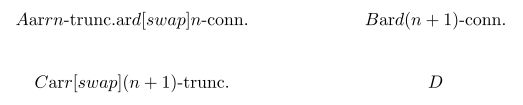 in which the maps are truncated and connected as indicated is necessarily a pullback square.
Proof.
Consider the commuting diagram  where we have used that truncated and connected maps are stable under pullback. By Lemma 5.2.4, the map \(A \rightarrow B \times_D C\) is both \(n\)-connected and \(n\)-truncated, and so is an equivalence. ◻
5.3 Factorization systems for \((\infty,k)\)-categories[009Y]
In this subsection we define \(n\)-surjective and \(n\)-faithful morphisms in \(\mathrm{Cat}_{(\infty, {k})}\) and prove in theorem 5.3.7 that they form factorization systems, using the main result theorem B.4.1 of section B. Furthermore, we establish various properties of these factorization systems.
Consider a morphism \(\mathcal C\xrightarrow{F} \mathcal D\) in \(\mathrm{Cat}_{(\infty, {k})}\) for some \(k \geq 0\) and let \(n\geq -2\).
We declare that any \(F\) is \((-2)\)-surjective and that \(F\) is \((-2)\)-faithful if it is an equivalence.
If \(k=0\), we say that \(F\) is \(n\)-surjective if it is \(n\)-connected and \(n\)-faithful if it is \(n\)-truncated.27
For \(n > -2\) and \(k > 0\), we inductively define \(F\) to be
\(n\)-surjective if it is surjective on objects and for every \(c,c' \in \mathcal C\) the morphism \(\underline{\mathrm{Hom}}_\mathcal C(c,c') \rightarrow\underline{\mathrm{Hom}}_\mathcal D(Fc,Fc')\) in \(\mathrm{Cat}_{(\infty, {k-1})}\) is \((n-1)\)-surjective, and
\(n\)-faithful if for every \(c,c' \in \mathcal C\) the morphism \(\underline{\mathrm{Hom}}_\mathcal C(c,c') \rightarrow\underline{\mathrm{Hom}}_\mathcal D(Fc,Fc')\) in \(\mathrm{Cat}_{(\infty, {k-1})}\) is \((n-1)\)-faithful.
We give a few explicit alternative descriptions of \(n\)-surjectivity and \(n\)-faithfulness for low values of \(n\) (and any \(k \geq 0\)).
A functor is \((-1)\)-surjective if and only if it is surjective on objects.
A functor is \((-1)\)-faithful if and only if it is fully faithful.
A functor is \(0\)-surjective if and only if it is surjective on objects and on \(1\)-morphisms.
A functor is \(0\)-faithful if and only if the induced functors on hom-categories are fully faithful.
To simplify our terminology, we refer to a \(0\)-faithful functor simply as faithful.
A functor of \((\infty,0)\)-categories is faithful if and only if it is a covering map (recall Example 5.2.2.([009P])). Hence, in general one may think of a faithful functor as a sort of “directed covering map”.
Recall the cancellation property lemma 5.2.4 of truncated and connected maps of spaces. The second part of lemma 5.2.4 generalizes to functors of \((\infty,k)\)-categories:
Let \(k \geq 0\) and \(n\geq -2\), and consider composable functors \(\mathcal A\xrightarrow{F} \mathcal B\xrightarrow{G} \mathcal C\) of \((\infty,k)\)-categories. Then, if \(G\) is \((n+1)\)-faithful and \(GF\) is \(n\)-faithful, then \(F\) is \(n\)-faithful.
Proof.
The case \(n=-2\) is the straight-forward statement that a section of a fully faithful functor is an equivalence. For \(n\geq -1\), we induct on \(k \geq 0\). The base case \(k=0\) is Lemma 5.2.4. For \(k \geq 1\), \(F\) being \(n\)-faithful is equivalent to proving that for \(a, a' \in \mathcal A\) the induced functor of \((\infty,k-1)\)-categories \(\underline{\mathrm{Hom}}_{\mathcal A}(a,a') \rightarrow\underline{\mathrm{Hom}}_{\mathcal B}(Fa, Fa')\) is \((n-1)\)-faithful. Since the composable sequence of functors of \((\infty,k-1)\)-categories \(\underline{\mathrm{Hom}}_{\mathcal A}(a,a') \rightarrow\underline{\mathrm{Hom}}_{\mathcal B}(Fa, Fa') \rightarrow\underline{\mathrm{Hom}}_{\mathcal C}(GFa, GFa')\) the last functor is \(n\)-faithful, and the composite is \((n-1)\)-faithful by assumption, the first functor is \((n-1)\)-faithful by induction. ◻
The first part of lemma 5.2.4 does not generalize to higher categories: If \(G\) is \((n+1)\)-surjective and \(GF\) is \(n\)-surjective, then it does not necessarily follow that \(F\) is \(n\)-surjective. For example, let \(\mathcal A\) be the category freely generated by two objects \(a\) and \(b\) and two morphisms \(f\colon a \rightarrow b\) and \(g \colon b \rightarrow a\). Then, in the composite \({\sf pt}\rightarrow\mathcal A\rightarrow{\sf pt}\), the second functor is \(0\)-surjective (i.e. surjective on objects and hom-spaces), and the composite is an equivalence (in particular \((-1)\)-surjective), but the first functor is not surjective on objects and hence not \((-1)\)-surjective.
Just as with the (\(n\)-connected, \(n\)-truncated) factorization system on the \(\infty\)-category of spaces, the \(n\)-surjective and \(n\)-faithful functors form a factorization system on the \(\infty\)-category of \((\infty,k)\)-categories:
Let \(k \geq 0\) and \(n \geq -2\).
The pair (\(n\)-surjective functors, \(n\)-faithful functors) defines a factorization system on the \(\infty\)-category \(\mathrm{Cat}_{(\infty, {k})}\) of \((\infty,k)\)-categories.
This factorization system is compatible with the Cartesian symmetric monoidal structure on \(\mathrm{Cat}_{(\infty, {k})}\).
This factorization system is of small generation. More specifically,
if \(n+2 \leq k\) then it is generated by the set \(\{ \partial c_i \rightarrow c_i \}_{n+2 \leq i \leq k}\), and
if \(n+2 \geq k\) then it is generated by the single morphism \(\{ \Sigma^k[S^{n-k+1}] \rightarrow\Sigma^k[{\sf pt}] \eqqcolon c_k \}\).
Proof.
In the base case that \(k = 0\), this factorization system is recorded as [Lur09, Ex. 5.2.8.16], which is easy to check is compatible with the Cartesian symmetric monoidal structure and generated by the single morphism \(\{ S^{n+1} \rightarrow{\sf pt}\}\). So, let us assume that \(k > 0\).
If \(n = -2\), then this is the trivial factorization system \((\mathrm{Cat}_{(\infty, {k})},\mathrm{Cat}_{(\infty, {k})}^\simeq)\) (as in Example B.1.7). Moreover, it is trivially compatible with the Cartesian symmetric monoidal structure, and it is also clearly generated by the set \(\{ \partial c_i \rightarrow c_i \}_{0 \leq i \leq k}\): by induction (and the universal property of the categorical suspension functor \(\Sigma[-]\)), a morphism \(\mathcal C\rightarrow\mathcal D\) is right orthogonal to this set if and only if it is an equivalence on maximal subgroupoids and on hom-\((\infty,k-1)\)-categories.
From here, in the case that \(n > -2\) (and \(k > 0\)) the claim follows by applying Theorem B.4.1 inductively (varying both \(k\) and \(n\) simultaneously). ◻
Given a morphism \(\mathcal C\xrightarrow{F} \mathcal D\) in \(\mathrm{Cat}_{(\infty, {k})}\), we refer to its unique factorization28 guaranteed by the (\(n\)-surjective, \(n\)-faithful) factorization system as its \(n\)-factorization, and denote it by \[\mathrm{Fact}_n(F) \coloneqq \mathrm{Fact}_{\textup{($n$-surjective, $n$-faithful)}}(F) \in \mathrm{Cat}_{(\infty, {k})}.\]
Recall from [GK17, Prop. 4.6] that any presentable \(\infty\)-category admits a factorization system of (\(n\)-connected, \(n\)-truncated) morphisms. We warn the reader that for any \(k \geq 1\) and any \(n > -2\), the (\(n\)-surjective, \(n\)-faithful) factorization system on \(\mathrm{Cat}_{(\infty, {k})}\) of Theorem 5.3.7 does not coincide with this (\(n\)-connected, \(n\)-truncated) factorization system induced from presentability of \(\mathrm{Cat}_{(\infty, {k})}\). This can already be seen in the case that \(k=1\): A functor \(\mathcal C\rightarrow\mathcal D\) of \((\infty,1)\)-categories is \(n\)-truncated if and only if it is so on spaces of objects and morphisms.29 Indeed, we have the diagram of irreversible implications  for morphisms in \(\mathrm{Cat}_{(\infty, {1})}\). For example, a \((-1)\)-truncated functor of \((\infty,1)\)-categories, i.e. a monomorphism in \(\mathrm{Cat}_{(\infty, {1})}\), is a functor \(F\colon \mathcal C\rightarrow\mathcal D\) which for any two objects \(c, c' \in \mathcal C\) induces a \((-1)\)-truncated map \(\mathrm{Hom}_{\mathcal C}(c,c') \hookrightarrow \mathrm{Hom}_{\mathcal D}(Fc, Fc')\) which restricts to an equivalence between the full subspaces of isomorphisms \(\mathrm{Hom}_{\iota_0\mathcal C}(c,c') \rightarrow\mathrm{Hom}_{\iota_0\mathcal D}(Fc,Fc')\). In particular, any \((-1)\)-faithful, i.e. fully faithful, functor is \((-1)\)-truncated, and any \((-1)\)-truncated functor is \(0\)-faithful, but neither of these implications is reversible. In particular, a \(0\)-faithful functor \(F \colon \mathcal C\rightarrow\mathcal D\) does not necessarily exhibit \(\mathcal C\) as a subcategory of \(\mathcal D\) in the sense of subsection A.2.2.
Homwise iterating these observations, a similar diagram applies for \((\infty,k)\)-categories with \(k+1\) rows corresponding to the enrichment-depth at which functors between higher hom-categories are required to be truncated rather than faithful.
Fix any \(j \geq k \geq 0\) and \(n \geq -2\). By the description of the generators in theorem 5.3.7.([00A7]), and their truncations in observation 5.1.7, we see that the inclusion \(\mathrm{Cat}_{(\infty, {k})} \xhookrightarrow{i_j} \mathrm{Cat}_{(\infty, {j})}\) preserves and detects the (\(n\)-surjective, \(n\)-faithful) factorization system.30 In particular, a map of spaces \(f \colon X \rightarrow Y\) is \(n\)-connected (or \(n\)-truncated) if and only if it is \(n\)-surjective (or \(n\)-faithful) as a map of \((\infty, k)\)-categories for any \(k \geq 0\).
It follows that \(n\)-factorizations in \(\mathrm{Cat}_{(\infty, {k})}\) remain so in \(\mathrm{Cat}_{(\infty, {j})}\). It also follows that the left adjoint \(\mathrm{Cat}_{(\infty, {j})} \xrightarrow{|-|_k} \mathrm{Cat}_{(\infty, {k})}\) preserves the notion of \(n\)-surjectivity and that the right adjoint \(\mathrm{Cat}_{(\infty, {j})} \xrightarrow{\iota_k} \mathrm{Cat}_{(\infty, {k})}\) preserves the notion of \(n\)-faithfulness.
In fact, the maximal sub-\((\infty,k)\)-category functor \(\mathrm{Cat}_{(\infty, {j})} \xrightarrow{\iota_k} \mathrm{Cat}_{(\infty, {k})}\) also preserves \(n\)-surjectivity provided \(n\) lies outside of the interval \([k, j)\):
For \(j \geq k \geq 0\) and either \(n\geq j\) or \(k>n \geq -2\), the maximal sub-\((\infty,k)\)-category functor \(\iota_k \colon \mathrm{Cat}_{(\infty, {j})} \xrightarrow{\iota_k} \mathrm{Cat}_{(\infty, {k})}\) preserves \(n\)-surjective functors.
Proof.
The case \(n=-2\) is trivial; we henceforth assume \(n \geq -1\). Similarly, the case \(j=k\) is trivial. It suffices to prove the statement for \(j=k+1\), the general case follows from the observation that \(\iota_k = \iota_{k} \iota_{k+1} \cdots \iota_{j-1}\). Thus we need to prove that if \(k\geq 0\) and \(k \neq n \geq -1,\) then \(\iota_k \colon \mathrm{Cat}_{(\infty, {k+1})} \rightarrow\mathrm{Cat}_{(\infty, {k})}\) preserves \(n\)-surjective functors. We prove this statement by induction on \(k \geq 0\):
For the basecase \(k =0\), and hence \(0 \neq n\geq -1\), we show that \(\iota_0 \colon \mathrm{Cat}_{(\infty, {1})} \rightarrow\mathrm{Cat}_{(\infty, {0})}= \mathcal S\) preserves \(n\)-surjective functors. Consider an \(n\)-surjective functor \(F \colon \mathcal C\rightarrow\mathcal D\) between \((\infty,1)\)-categories. We claim that \(\iota_0 F \colon \iota_0 \mathcal C\rightarrow\iota_0 \mathcal D\) is \(n\)-connected. For \(n=-1\) this follows since if \(F\) is surjective on objects, then \(\iota_0 F\) is surjective on \(\pi_0\) and hence \((-1)\)-connected. For the remaining cases \(n\geq 1\), it suffices to show that \(\iota_0 F\) induces \((n-1)\)-connected maps on hom-spaces. Let \(c,d\in \mathcal C\) and consider the commuting diagram of spaces 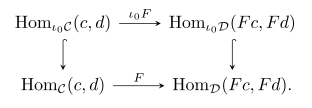 By assumption, the bottom horizontal map is \((n-1) \geq 0\)-connected. Since the vertical maps are inclusions of components, to show that the top horizontal map is \((n-1) \geq 0\)-connected, it suffices to show that the top horizontal map is surjective on \(\pi_0\). Given any \(\beta \in \mathrm{Hom}_{\iota_0 \mathcal D}(Fc, Fd)\), i.e. an isomorphism between \(Fc\) and \(Fd\) in \(\mathcal D\), let \(\alpha \in \mathrm{Hom}_{\mathcal C}(c,d)\) be a lift of \(\beta\) in \(\mathcal C\). We claim that \(\alpha\) is an isomorphism: let \(\beta^{-1} \in \mathrm{Hom}_{\iota_0 \mathcal D}(Fd, Fc)\) be an inverse of \(\beta\) and \(\overline{\alpha} \in \mathrm{Hom}_{\mathcal C}(d,c)\) a lift of \(\beta^{-1}\). Then \(\alpha \circ \overline{\alpha}\) and \(\overline{\alpha} \circ \alpha\) are in the same component of \(\mathrm{Hom}_{\mathcal C}(c,c)\) and \(\mathrm{Hom}_{\mathcal C}(d,d)\) as the respective identities \(\mathrm{id}_c\) and \(\mathrm{id}_d\) as \(F\) is \(\geq 1\)-connected and hence induces bijections on the sets of components of all hom-spaces. Therefore, \(\overline{\alpha}\) is an inverse of \(\alpha\) and thus \(\alpha\) lifts to \(\mathrm{Hom}_{\iota_0 \mathcal C}(c,d)\).
For the induction step, let \(k \geq 1\) and hence \(k \neq n \geq -1\). Given an \(n\)-surjective functor \(F \colon \mathcal C\rightarrow\mathcal D\) in \(\mathrm{Cat}_{(\infty, {k+1})}\), the functor \(\iota_k F\) is surjective on objects since \(F\) is. For objects \(c,d\in \mathcal C\), note that the component \((\iota_k F)_{c,d} \colon \underline{\mathrm{Hom}}_{\iota_k \mathcal C}(c, d) \rightarrow\underline{\mathrm{Hom}}_{\iota_k \mathcal D}(\iota_k F c, \iota_k Fd)\) agrees with the functor \(\iota_{k-1} (F_{c,d})\) which is \((n-1)\)-surjective by induction. ◻
The statement of lemma 5.3.11 is false when \(j >n \geq k\). For example, let \(\mathcal A\) be the free \((\infty,1)\)-category generated by two objects \(a\) and \(b\), a morphism \(f\colon a\rightarrow b\) and a morphism \(g \colon b \rightarrow a.\) Then, the unique functor \(F\colon \mathcal A\rightarrow{\sf pt}\) is \(0\)-surjective, but \(\iota_0 F \colon \iota_0 \mathcal A= S^0 \rightarrow{\sf pt}\) is not \(0\)-connected.
Given \(j \geq k \geq 0\) and either \(n \geq j\) or \(k>n \geq -2\), and \(F \colon \mathcal A\rightarrow\mathcal B\) in \(\mathrm{Cat}_{(\infty, {j})}\). Then, the maximal sub-\((\infty,k)\)-category functor \(\iota_k \colon \mathrm{Cat}_{(\infty, {j})} \xrightarrow{\iota_k} \mathrm{Cat}_{(\infty, {k})}\) preserves \(n\)-factorizations. That is, if \(\mathrm{Fact}_n (F)\) is the factorization of \(F\) with respect to the (\(n\)-surjective, \(n\)-faithful) factorization system, then the induced factorization \(\iota_k \mathcal A\rightarrow\iota_k \mathrm{Fact}_n(F) \rightarrow\iota_k \mathcal B\) realizes \(\iota_k \mathrm{Fact}_n(F)\) as the factorization \(\mathrm{Fact}_n (\iota_k F)\) of \(\iota_k F\) with respect to the (\(n\)-surjective, \(n\)-faithful) factorization system on \(\mathrm{Cat}_{(\infty, {k})}\).
Proof.
The statement follows from the fact that \(\iota_k\) preserves both \(n\)-surjectivity (lemma 5.3.11) and \(n\)-faithfulness (observation 5.3.10). ◻
Throughout, we will also repeatedly use the following simple observation:
For \(j > k \geq 0\) and \(\mathcal C\in \mathrm{Cat}_{(\infty, {j})}\), the inclusion of the maximal sub-\((\infty,k)\)-category \(\iota_k \mathcal C\rightarrow\mathcal C\) is \((k-1)\)-surjective.
Proof.
Factoring \(\iota_k \mathcal C\rightarrow\iota_{k+1} \mathcal C\rightarrow\ldots \rightarrow\iota_{j-1} \mathcal C\rightarrow\mathcal C\), it suffices to prove the case \(j=k+1\). For \(k=0\) and \(\mathcal C\in \mathrm{Cat}_{(\infty, {1})}\), the functor \(\iota_0 \mathcal C\rightarrow\mathcal C\) is surjective on objects, i.e. \((-1)\)-surjective. For \(k\geq 1\) and \(\mathcal C\in \mathrm{Cat}_{(\infty, {k+1})}\), the functor \(\iota_k \mathcal C\rightarrow\mathcal C\) is surjective on objects and by induction homwise \((k-2)\)-surjective, hence \(\iota_k \mathcal C\rightarrow\mathcal C\) is \((k-1)\)-surjective. ◻
We end this subsection with the following useful proposition, generalizing [SY19, Prop. 4.2.8].
Let \(k \geq 0\) and \(m \geq n \geq -2\). Given a commuting (solid) square in \(\mathrm{Cat}_{(\infty, {k})}\)  where \(F\) is \(n\)-surjective and \(G\) is \(m\)-faithful. Then the space of (dashed) lifts is \((m-n-2)\)-truncated.
Proof.
We induct on \(k \geq 0\). The base case \(k = 0\) is proven in [SY19, Prop. 4.2.8]. For \(k>0\), fix a functor \(G\colon \mathcal C\rightarrow\mathcal D\) which is \(m\)-faithful and let \(S\) be the class of morphisms \(F\) in \(\mathrm{Cat}_{(\infty, {k})}\) for which the space of lifts ([00AK]) against \(G\) is \((m-n-2)\)-truncated. We will now prove that \(S\) contains the \(n\)-surjective functors. Since \(S\) contains equivalences, and is closed under composition, small colimits and cobase change, it forms a saturated class of morphisms (definition B.1.13). By proposition B.1.14, to show that \(S\) contains all \(n\)-surjective morphisms, it suffices to show that it contains the generators of the left class; i.e. by theorem 5.3.7.([00A7]) the functors \(\{\partial c_{i} \rightarrow c_{i}\}_{n+2 \leq i \leq k}\) for \(n +2 < k\) and the functor \(\Sigma^k[S^{n-k+1}] \rightarrow c_k\) for \(n+2 \geq k\).
We first consider the case that \(n + 2 \geq k\), where we need to show that a commuting diagram of \((\infty,k)\)-categories 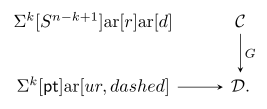 has \((m-n-2)\)-truncated space of lifts. Let \(\alpha\) denote the composite \(\partial c_k = \Sigma^k[\emptyset] \rightarrow\Sigma^k[S^{n-k+1}] \rightarrow\mathcal C\), picking out a pair of parallel \((k-1)\)-morphisms. By observation 5.1.9, the space of lifts of ([00AM]) is equivalent to the space of lift of the following diagram in spaces
 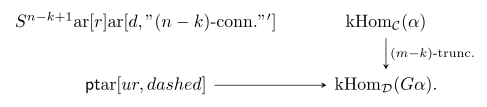 By definition of faithfulness, if \(G\) is \(m\)-faithful, then the right vertical map is \((m-k)\)-truncated for any \(\alpha \colon \partial c_k \rightarrow\mathcal C\). Hence, it follows from [SY19, Prop. 4.2.8] that the space of lifts of ([00AN]) is \((m-n-2)\)-truncated.
Now we consider the case \(n+2 < k\), where we need to show that \(\partial c_i \rightarrow c_i\) is in \(S\) for \(n+2 \leq i \leq k\). For \(i=k\), since \(\partial c_k \rightarrow c_k\) is \((k-2)\)-surjective and \((k-2) +2 \geq k\), it follows from the previous case that the space of lifts of \(\partial c_k \rightarrow c_k\) against \(G\) is \((m-(k-2)-2)\)-truncated, and since \((m-(k-2)-2) \leq (m-n-2)\) also \((m-n-2)\)-truncated. It remains to show that \(\partial c_i \rightarrow c_i\) is in \(S\) for \(n+2 \leq i < k\). As both \(\partial c_i\) and \(c_i\) are \((\infty, k-1)\)-categories, by the \((i_{k},\iota_{k-1})\) adjunction, the two space of lifts are equivalent:  Since \(\iota_{k-1} G\) is a \(n\)-faithful functor between \((\infty, k-1)\)-categories by observation 5.3.10, by induction the space of lifts is \((m-n-2)\)-truncated. ◻
5.4 Homotopy \((n, k)\)-categories of \((\infty, k)\)-categories[00AP]
In this subsection, we define the homotopy \((n,k)\)-category of an \((\infty,k)\)-category.
For any \(k \geq 0\) and any \(n \geq -2\), an \((n,k)\)-category is an \((\infty,k)\)-category \(\mathcal C\) such that the functor \(\mathcal C\rightarrow{\sf pt}\) is \(n\)-faithful. We write \(\mathrm{Cat}_{(n,k)} \subseteq \mathrm{Cat}_{(\infty, {k})}\) for the full subcategory on the \((n,k)\)-categories.
Unwinding Definition 5.4.1 gives an alternative inductive description: For \(k > 0\) and \(n > -2\), an \((\infty,k)\)-category \(\mathcal C\) is an \((n,k)\)-category if and only if its hom-\((\infty,k-1)\)-categories are in fact \((n-1,k-1)\)-categories. In particular, an \((n,n)\)-category is indeed an \(\infty\)-category that is weakly enriched in \((n-1,n-1)\)-categories (as proposed in Subsection A.1), with a \((0,0)\)-category being a set (i.e. a \(0\)-truncated space).31
For \(n \geq k\), it is immediate from [GH15, Thm. 6.1.8] that \(\mathrm{Cat}_{({n}, {k})}\) coincides with [GH15, Def. 6.1.1]. In particular, \(\mathrm{Cat}_{({n}, {k})}\) is the \(\infty\)-category obtained from applying \(\mathrm{Cat}[-]\) \((n-k)\) times to the \(\infty\)-category of \((n-k)\)-truncated spaces \(\mathcal S_{\leq n-k}\), with its Cartesian presentably symmetric monoidal structure.
We list a few edge cases of Definitions 5.4.1.
For any \(k \geq 0\), there is only one \((-2,k)\)-category, namely \({\sf pt}\).
For any \(k \geq 0\), there are only two \((-1,k)\)-categories, namely \(\emptyset\) and \({\sf pt}\).
For any \(k > 0\), a \((0,k)\)-category is precisely a partially ordered set (i.e. an \(\infty\)-category enriched in \((-1)\)-truncated spaces). In particular, the inclusions \(\mathrm{Cat}_{(0,1)} \hookrightarrow\mathrm{Cat}_{(0,2)} \hookrightarrow\cdots\) are all equivalences.
More generally, for any \(k > n \geq 0\), an \((n,k)\)-category is precisely an \((n+1,n+1)\)-category whose spaces of \((n+1)\)-morphisms are all either empty or contractible. In particular, the inclusions \(\mathrm{Cat}_{(n,n+1)} \hookrightarrow\mathrm{Cat}_{(n,n+2)} \hookrightarrow\cdots\) are all equivalences.
Taking \(k = 1\), for any \(n \geq 1\), an \((n,1)\)-category is precisely an \((\infty,1)\)-category whose hom-spaces are \((n-1)\)-truncated.
By Observation B.1.20.([00K8]), the fully faithful inclusion \(\mathrm{Cat}_{(n,k)} \hookrightarrow \mathrm{Cat}_{(\infty, {k})}\) admits a left adjoint  given by the formula \(\tau_n(\mathcal C) \coloneqq \mathrm{Fact}_n(\mathcal C\rightarrow{\sf pt})\).32 This left adjoint \(\tau_n\) is symmetric monoidal as it preserves products.
Unpacked, the functor \(\tau_n\) can be described as follows, depending on \(n\geq -2\) and \(k \geq 0\).
For any \((\infty,k)\)-category \(\mathcal C\), we have \(\tau_{-2} \mathcal C= {\sf pt}\).
For any \((\infty,k)\)-category \(\mathcal C\), we have \(\tau_{-1} \mathcal C= \emptyset\) if \(\mathcal C\) is empty and \(\tau_{-1} \mathcal C= {\sf pt}\) otherwise.
For \(n \geq k \geq 0\) and any \((\infty,k)\)-category \(\mathcal C\), \(\tau_n \mathcal C\in \mathrm{Cat}_{({n}, {k})}\) is obtained by \((n-k)\)-truncating its \(k\)-morphism spaces (notation 5.1.8), and univalently completing the result. In particular, for an \((\infty,1)\)-category \(\mathcal C\), \(\tau_1\mathcal C\) is its ordinary homotopy category.
For \(k \geq 1\) and any \((\infty,k)\)-category \(\mathcal C\), \(\tau_0 \mathcal C\in \mathrm{Cat}_{({0}, {k})} \simeq \mathrm{Cat}_{({0}, {1})}\) is the posetification of \(\mathcal C\), obtained by applying \(\tau_{-1}\) to its hom-\((\infty,k-1)\)-categories.
For \(k>n \geq 0\) and any \((\infty,k)\)-category \(\mathcal C\), \(\tau_n \mathcal C\in \mathrm{Cat}_{({n}, {k})} \simeq \mathrm{Cat}_{({n}, {n+1})}\) is obtained by \(k\)-homwise applying \(\tau_{-1}\) (and univalently completing the result).
In general, the hom-categories in \(\tau_n \mathcal C\) can be computed by applying \(\tau_{n-1}\) to hom-categories of \(\mathcal C\):
For any \(n\geq -2, k\geq 0\) and any \((\infty,k)\)-category \(\mathcal C\) and objects \(c,c' \in\mathcal C\), the adjunction ([00AV]) induces an equivalence \[\tau_{n-1} \underline{\mathrm{Hom}}_{\mathcal C}(c,c') \xrightarrow{\simeq} \underline{\mathrm{Hom}}_{\tau_n \mathcal C}(c,c').\]
Proof.
Consider the factorization \(\mathcal C\rightarrow\tau_n \mathcal C\rightarrow{\sf pt}\) into an \(n\)-surjective followed by an \(n\)-faithful functor. Since \(n\)-faithfulness/surjectivity implies homwise \((n-1)\)-faithfulness/surjectivity, it follows that for any \(c,c' \in \mathcal C\), in the induced factorization on hom-\((\infty,k-1)\)-categories \[\underline{\mathrm{Hom}}_{\mathcal C}(c,c') \rightarrow\underline{\mathrm{Hom}}_{\tau_n \mathcal C}(c,c') \rightarrow{\sf pt}\] the first functor is \((n-1)\)-surjective and the second functor is \((n-1)\)-faithful, hence exhibiting \(\underline{\mathrm{Hom}}_{\tau_n \mathcal C}(c,c')\) as the unique factorization \(\tau_{n-1} \underline{\mathrm{Hom}}_{\mathcal C}(c,c')\). ◻
Using observation B.1.3, for any \(k\geq 0\) and \(n,m \geq -2\), one can deduce that the functor \(\tau_n\colon \mathrm{Cat}_{(\infty, {k})} \rightarrow\mathrm{Cat}_{({n}, {k})}\) preserves \(m\)-faithful functors since its right adjoint preserves \(m\)-surjective functors.
For any \(j> k \geq 0\) and \(n\geq -2\), since the inclusion \(i_j \colon \mathrm{Cat}_{(\infty, {k})} \hookrightarrow \mathrm{Cat}_{(\infty, {j})}\) preserves \(n\)-factorizations (see observation 5.3.10), the diagram 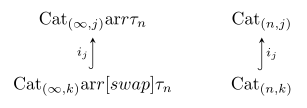 commutes. By adjunction, this induces for any \((\infty,j)\)-category \(\mathcal C\) a canonical functor of \((n,k)\)-categories \[
\tau_n \iota_k \mathcal C\rightarrow\iota_k \tau_n \mathcal C.\]
commutes. By adjunction, this induces for any \((\infty,j)\)-category \(\mathcal C\) a canonical functor of \((n,k)\)-categories \[
\tau_n \iota_k \mathcal C\rightarrow\iota_k \tau_n \mathcal C.\]
For any \(j > k \geq 0\) and any \(n \geq j\) or \(k>n \geq -2\), and an \((\infty,j)\)-category \(\mathcal C\), the canonical functor ([00B1]) is an equivalence.
Proof.
This follows immediately from applying corollary 5.3.13 to the factorization \(\mathcal C\rightarrow\tau_n \mathcal C\rightarrow{\sf pt}\). ◻
lemma 5.4.9 does not hold for \(j > n \geq k\): For instance, for \(j=1\) and \(n=k=0\) and an \((\infty,1)\)-category \(\mathcal C\), the space \(\tau_0 \iota_0 \mathcal C\) is the set of isomorphism classes of objects of \(\mathcal C\). On the other hand, \(\iota_0 \tau_0 \mathcal C\) is the set of connected components of \(\mathcal C\), i.e the quotient of the set of isomorphism classes of object by the equivalence relation that \(c\sim d\) if there exists a zigzag of morphisms between \(c\) and \(d\).
Now we are ready to define the \(n\)-homotopy category functor:
For \(n, k \geq 0\), define the homotopy \(n\)-category functor \[h_n\colon \mathrm{Cat}_{(\infty, {k})} \rightarrow\mathrm{Cat}_{({n}, {n})}\] to be \(\mathrm{Cat}_{(\infty, {k})} \xrightarrow{\tau_n} \mathrm{Cat}_{({n}, {k})} \hookrightarrow \mathrm{Cat}_{({n}, {n})}\) when \(n \geq k\) and to be \(\mathrm{Cat}_{(\infty, {k})} \xrightarrow{\iota_n} \mathrm{Cat}_{(\infty, {n})} \xrightarrow{\tau_n} \mathrm{Cat}_{({n}, {n})}\) when \(n < k\). Note that \(h_n\) is symmetric monoidal as \(\iota_n\) and \(\tau_n\) are symmetric monoidal. For \(\mathcal C\in \mathrm{Cat}_{(\infty, {k})}\), we call \(h_n \mathcal C\) the homotopy \(n\)-category of \(\mathcal C\).
Since \(\iota\) is a right adjoint and \(\tau\) is a left adjoint, there are no natural maps in either direction between \(\mathcal C\) and \(h_n\mathcal C\).
The homotopy \(n\)-category functor \(h_n\) takes a space \(X\) to its \(n\)-truncation \(\tau_{n} X\). Given a \((\infty, 1)\)-category \(\mathcal C\), \(h_0 \mathcal C= \tau_0 \iota_0 \mathcal C\) is the set of isomorphism classes of objects, and \(h_1 \mathcal C\) is its homotopy \(1\)-category [Lur09, Def. 1.1.3.2]. For \(n \geq 1\), \(h_n = \tau_n\) is equivalent to the ‘\(n\)-homotopy category’ of [SY20, Def. 2.9]. Of particular relevance to this paper will be the case of \((\infty,2)\)-categories \(\mathcal C\) where \(h_1\mathcal C= \tau_1 \iota_1 \mathcal C\).
Fix \(n, m \geq 0\), since both \(\iota_n\) and \(\tau_n\) preserves \(m\)-faithfulness by observation 5.3.10 and observation 5.4.8, \(h_n\) also preserves \(m\)-faithfulness.
5.5 Faithful functors and homotopy categories[00B9]
For an \((\infty,1)\)-category \(\mathcal C\), the \(\infty\)-category of full subcategories of \(\mathcal C\) is equivalent to the poset of subsets of the set \(h_0(\mathcal C)\) of isomorphism classes of objects in \(\mathcal C\), or equivalently to the \(\infty\)-category of ‘full subcategories’ of the set \(h_0(\mathcal C)\). In the next two subsections, we generalize this to arbitrary \(n, k\geq 0\) and characterizes \((n-1)\)-faithful functors of \((\infty,k)\)-categories into some \((\infty,k)\)-category \(\mathcal C\) in terms of \((n-1)\)-faithful functors of \((n,n)\)-categories into the homotopy \(n\)-category \(h_{n}\mathcal C\).
For \(n, k \geq 0\), we let \(\mathrm{Ar}^{n}(\mathrm{Cat}_{(\infty, {k})}) \subseteq \mathrm{Ar}(\mathrm{Cat}_{(\infty, {k})})\) denote the full subcategory of the arrow category of \(\mathrm{Cat}_{(\infty, {k})}\) on the \(n\)-faithful functors. Moreover, for \(\mathcal D\in \mathrm{Cat}_{(\infty, {k})}\), we write \({(\mathrm{Cat}_{(\infty, {k})})}_{\small{/^{n}}{\mathcal D}} \subseteq {(\mathrm{Cat}_{(\infty, {k})})}_{\small{/^{\phantom{}}}{\mathcal D}}\) for the full subcategory of the over-category on the \(n\)-faithful functors \(\mathcal C\rightarrow\mathcal D\). In particular, \({(\mathrm{Cat}_{(\infty, {k})})}_{\small{/^{n}}{{\sf pt}}} = \mathrm{Cat}_{({n}, {k})}\).
The goal of the next subsection §5.6 will be to prove the following theorem.
Fix \(n,k \geq 0\). The commuting square of \(\infty\)-categories 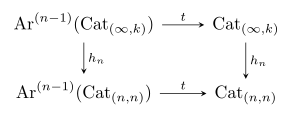 is a pullback square. Note the left map exists by observation 5.4.14.
Before proving theorem 5.5.2 in §5.6, we record a few corollaries. First, taking fibers at a \(\mathcal D\in \mathrm{Cat}_{(\infty, {k})}\) immediately leads to the following corollary:
Let \(n, k \geq 0\) and \(\mathcal D\) an \((\infty, k)\)-category. Then, the \(n\)-homotopy category functor \(h_n\) induces an equivalence of \(\infty\)-categories: \[h_n \colon {(\mathrm{Cat}_{(\infty, {k})})}_{\small{/^{(n-1)}}{\mathcal D}} \rightarrow {(\mathrm{Cat}_{({n}, {n})})}_{\small{/^{(n-1)}}{h_n\mathcal D}}.\]
Hence, corollary 5.5.3 is indeed a generalization of the statement at the beginning of this subsection: The \(\infty\)-category of \((n-1)\)-faithful functors into \(\mathcal D\) is equivalent to the \(\infty\)-category of \((n-1)\)-faithful functors into \(h_n\mathcal D\).
For later use, we need an analogous statement for \(\mathcal O\)-monoidal \(\infty\)-categories for a given \(\infty\)-operad \(\mathcal O\). For any small \(\infty\)-operad \(\mathcal O\) (see subsection A.8 and §7 for definitions and notation), we can extend this to a statement about categories of \(\mathcal O\)-algebras:
Let \(\mathcal O\) be an \(\infty\)-operad and \(k,n\geq -2\). An \(\mathcal O\)-monoidal functor \(F\colon \mathcal C\rightarrow\mathcal D\) of \(\mathcal O\)-monoidal \((\infty,k)\)-categories (i.e. a morphism of \(\mathcal O\)-algebras in the Cartesian symmetric monoidal category \(\mathrm{Cat}_{(\infty, {k})}\)) is called \(n\)-surjective/\(n\)-faithful if for every color \(X\in \underline{\mathcal O}\), the underlying functor \(F_X \colon \mathcal C_X \rightarrow\mathcal D_X\) is \(n\)-surjective/\(n\)-faithful.
Let \(n,k \geq 0\), \(\mathcal O\) an \(\infty\)-operad, and \(\mathcal D\) an \(\mathcal O\)-monoidal \((\infty, k)\)-category. Then the \(n\)-homotopy category functor \(h_n\) induces an equivalence of \(\infty\)-categories: \[{(\mathrm{Alg}_{\mathcal O}(\mathrm{Cat}_{(\infty, {k})}))}_{\small{/^{(n-1)}}{\mathcal D}} \xrightarrow{h_n} {(\mathrm{Alg}_{\mathcal O}(\mathrm{Cat}_{({n}, {n})}))}_{\small{/^{(n-1)}}{h_n\mathcal D}}.\]
Proof.
The full subcategory \(\mathrm{Ar}^{(n-1)}(\mathrm{Cat}_{(\infty, {k})}) \subseteq \mathrm{Ar}(\mathrm{Cat}_{(\infty, {k})})\) is closed under products and hence defines a Cartesian symmetric monoidal subcategory. Since all functors in ([00BC]) preserve products, the pullback square is a pullback square of Cartesian symmetric monoidal \(\infty\)-categories and hence induces a pullback square of \(\infty\)-categories: 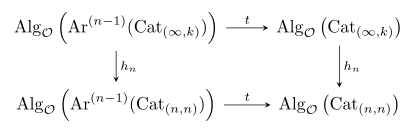 Under the equivalence of \(\infty\)-categories \(\mathrm{Ar}(\mathrm{Alg}_{\mathcal O}(\mathrm{Cat}_{(\infty, {k})})) \simeq \mathrm{Alg}_{\mathcal O}(\mathrm{Ar}(\mathrm{Cat}_{(\infty, {k})}))\), the full subcategory \(\mathrm{Ar}^{(n-1)}(\mathrm{Alg}_{\mathcal O}(\mathrm{Cat}_{(\infty, {k})}))\) on the \(\mathcal O\)-monoidal functors \(F\) whose underlying functors \(F_X\) are \((n-1)\)-faithful becomes identified with \(\mathrm{Alg}_{\mathcal O}\left(\mathrm{Ar}^{(n-1)}(\mathrm{Cat}_{(\infty, {k})})\right)\). Hence, the pullback square ([00BH]) is equivalent to the square
 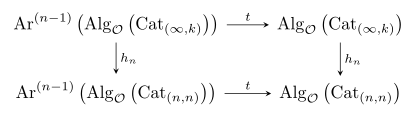 and taking fibers at the \(\mathcal O\)-algebra \(\mathcal D\in\mathrm{Alg}_{\mathcal O} \left(\mathrm{Cat}_{(\infty, {k})}\right)\) induces the desired equivalence. ◻
We record a further straight-forward consequence:
Let \(k, n \geq 0\) and let \(F \colon \mathcal C\rightarrow\mathcal D\) be an \((n-1)\)-faithful functor between \((\infty,k)\)-categories. Then, for every \(\mathcal X\in \mathrm{Cat}_{(\infty, {k})}\), the square 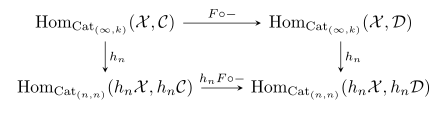 is a pullback square of spaces.
Equivalently, \(F\) is a Cartesian morphism for the functor \(h_n \colon \mathrm{Cat}_{(\infty, {k})} \rightarrow\mathrm{Cat}_{({n}, {n})}\).
Proof.
For any pair of objects in \(\mathrm{Ar}^{(n-1)}(\mathrm{Cat}_{(\infty, {k})})\), the pullback square ([00BC]) of \(\infty\)-categories induces a pullback square between the respective hom-spaces. In particular, for the pair \((\mathrm{id}_{\mathcal X} \colon \mathcal X\rightarrow\mathcal X)\) and (\(F \colon \mathcal C\rightarrow\mathcal D\)) of objects in \(\mathrm{Ar}^{(n-1)}(\mathrm{Cat}_{(\infty, {k})})\), we note that \[\mathrm{Hom}_{\mathrm{Ar}(\mathrm{Cat}_{(\infty, {k})})}(\mathrm{id}_{\mathcal X}, F) \simeq \mathrm{Hom}_{\mathrm{Cat}_{(\infty, {k})}}(\mathcal X, \mathcal C) \quad \mathrm{Hom}_{ \mathrm{Ar}(\mathrm{Cat}_{({n}, {n})})}(\mathrm{id}_{h_k \mathcal X}, h_k F) \simeq \mathrm{Hom}_{\mathrm{Cat}_{({n}, {n})}}(h_k\mathcal X, h_k\mathcal C),\] and hence that the resulting pullback square of hom-spaces precisely results in the square ([00BJ]). ◻
Taking fibers at some \(G\in \mathrm{Hom}_{\mathrm{Cat}_{(\infty, {k})}}(\mathcal X, \mathcal D)\), corollary 5.5.6 immediately implies the following corollary which will play a key role in the proof of our main theorem:
Let \(k, n \geq 0\), let \(F\colon \mathcal C\rightarrow\mathcal D\) and \(G\colon \mathcal X\rightarrow\mathcal D\) be functors between \((\infty,k)\)-categories and assume that \(F\) is \((n-1)\)-faithful. Then, the map of spaces \[\mathrm{Hom}_{(\mathrm{Cat}_{(\infty, {k})})_{/\mathcal D}}(\mathcal X, \mathcal C) \rightarrow\mathrm{Hom}_{(\mathrm{Cat}_{({n}, {n})})_{/h_n\mathcal D}}(h_n\mathcal X, h_n\mathcal C)\] is an equivalence.
5.6 Proof of theorem 5.5.2[00BM]
This subsection is devoted to the proof of theorem 5.5.2.
We first consider the special case that \(k=n\). This will be a consequence of the following observation relating faithfulness and homotopy categories, well known in the case \(k=n=1\) of \((\infty,1)\)-categories.
Let \(n\geq k \geq 0\) and \(F \colon \mathcal C\rightarrow\mathcal D\) be a functor between \((\infty,k)\)-categories which is \((n-1)\)-faithful. Then, the following commutative diagram is a pullback square in \(\mathrm{Cat}_{(\infty, {k})}\): 
Proof.
Since the inclusion \(\mathrm{Cat}_{(\infty, {k})} \hookrightarrow \mathrm{Cat}_{(\infty, {n})}\) preserves pullbacks, and preserves \(n\)-factorizations and hence commutes with \(\tau_n\), it suffices to prove the statement for \(n=k\). We induct on \(n\geq 0\). The base case \(n=0\) is immediate. For general \(n\), we prove that the underlying diagram of spaces 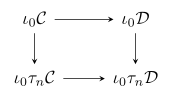 is a pullback square and that for each \(c, c' \in \mathcal C\) the induced square of \((\infty,n-1)\)-categories
 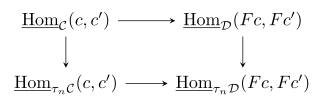 is a pullback square. Using lemma 5.4.7, the latter square is a pullback square by induction.
For the former square ([00BR]), the top horizontal map is \((n-1)\)-truncated by observation 5.3.10. By lemma 5.4.9, the bottom horizontal map is equivalent to \(\tau_n \iota_0 \mathcal C\rightarrow\tau_n \iota_0 \mathcal D\), i.e. to the map between the \(n\)-truncations of the spaces \(\iota_0 \mathcal C\) and \(\iota_0 \mathcal D\). Since \(\tau_n\) preserves truncatedness, the bottom horizontal map is also \((n-1)\)-truncated. On the other hand, for any space \(X\), the truncation map \(X \rightarrow\tau_n X\) is \(n\)-connected, and hence so are the vertical maps. Now proposition 5.2.5 implies that ([00BR]) is a pullback square. ◻
We use proposition 5.6.1 to prove the \(n\geq k \geq 0\) case of theorem 5.5.2.
For \(n\geq k \geq 0\), the following commuting square of \(\infty\)-categories is a pullback square 
Proof.
We show that the functor \[ \textrm{Ar}^{(n-1)}(\mathrm{Cat}_{(\infty, {k})}) \rightarrow\mathrm{Cat}_{(\infty, {k})} \times_{\mathrm{Cat}_{({n}, {k})}} \textrm{Ar}^{(n-1)}(\mathrm{Cat}_{({n}, {k})})\] is surjective and fully faithful.
Surjectivity amounts to the following: For any \((\infty,k)\)-category \(\mathcal D\) equipped with a \((n-1)\)-faithful functor \(\mathcal C' \rightarrow\tau_n \mathcal D\) from an \((n,k)\)-category \(\mathcal C'\), there exists an \((\infty,k)\)-category \(\mathcal C\) and a \((n-1)\)-faithful functor \(\mathcal C\rightarrow\mathcal D\) which is sent to \(\mathcal C' \rightarrow\tau_n \mathcal D\) under \(\tau_n\).
Define \(\mathcal C\) to be the pullback in \(\mathrm{Cat}_{(\infty, {k})}\) 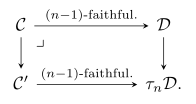 Since the right class of a factorization system is preserved under pullback, and since \(\mathcal C' \rightarrow\tau_n \mathcal D\) is \((n-1)\)-faithful, so is its pullback \(\mathcal C\rightarrow\mathcal D\). We will now prove by induction on \(n\geq 0\) that the functor \(\tau_n \mathcal C\rightarrow\mathcal C'\) adjunct to \(\mathcal C\rightarrow\mathcal C'\) is an equivalence, proving surjectivity of ([00BV]). The base case \(n=0\) is immediate. In general, we will show that \(\tau_n \mathcal C\rightarrow\mathcal C'\) is surjective on objects and fully faithful. Since \(\mathcal D\rightarrow\tau_{n}\mathcal D\) is surjective on object (in fact \((n-1)\)-surjective), the pullback \(\mathcal C\rightarrow\mathcal C'\) is surjective on objects. Since \(\mathcal C\rightarrow\mathcal C'\) factors as \(\mathcal C\rightarrow\tau_n \mathcal C\rightarrow\mathcal C'\), it follows that also \(\tau_n \mathcal C\rightarrow\mathcal C'\) is surjective on objects. Fully faithfulness of \(\tau_n \mathcal C\rightarrow\mathcal C'\) follows by induction using lemma 5.4.7.
We now prove that ([00BV]) induces an equivalence on the hom-space between any pair of objects \(\{\mathcal C_1 \rightarrow\mathcal D_1\}, \{\mathcal C_2 \rightarrow\mathcal D_2\} \in\ \textrm{Ar}^{(n-1)}(\mathrm{Cat}_{(\infty, {k})})\), and hence that ([00BV]) is fully faithful. Unwinding the hom-spaces in the relevant arrow categories, this is equivalent to the statement that for any fixed functor \(G\colon \mathcal D_1 \rightarrow\mathcal D_2\) of \((\infty, k)\)-categories, the map of spaces of dashed lifts  is an equivalence. This follows immediately from proposition 5.6.1. ◻
To generalize lemma 5.6.2 to also allow for the case \(k>n\), we will use the following lemma.
For all \(k>n \geq 0\), the commutative square of \(\infty\)-categories 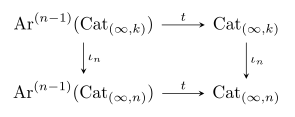 is a pullback square.
Proof.
We show that the functor \[ \textrm{Ar}^{(n-1)}(\mathrm{Cat}_{(\infty, {k})}) \rightarrow\mathrm{Cat}_{(\infty, {k})} \times_{\mathrm{Cat}_{(\infty, {n})}} \textrm{Ar}^{(n-1)}(\mathrm{Cat}_{(\infty, {n})})\] is surjective and fully faithful.
Surjectivity amounts to the following: For any \((\infty,k)\)-category \(\mathcal D\) equipped with an \((n-1)\)-faithful functor \(\mathcal C' \rightarrow\iota_n \mathcal D\) from an \((\infty,n)\)-category \(\mathcal C'\), there exits an \((\infty,k)\)-category \(\mathcal C\) with an \((n-1)\)-faithful functor \(\mathcal C\rightarrow\mathcal D\) which under \(\iota_n\) gets mapped to the original functor \(\mathcal C' \rightarrow\mathcal D\).
Define \(\mathcal C\coloneqq \mathrm{Fact}_{n-1}(\mathcal C' \rightarrow\iota_n \mathcal D\rightarrow\mathcal D)\) as the factorization with respect to the (\((n-1)\)-surjective, \((n-1)\)-faithful) factorization system in \(\mathrm{Cat}_{(\infty, {k})}\), and hence equipped with morphisms \(\mathcal C' \rightarrow\mathcal C\rightarrow\mathcal D\) where the former is \((n-1)\)-surjective and the latter is \((n-1)\)-faithful. To conclude, we show that the map \(\mathcal C' \simeq \iota_n \mathcal C' \rightarrow\iota_n \mathcal C\) is an equivalence, and hence that \(\iota_n(\mathcal C\rightarrow\mathcal D)\) is equivalent to \(\mathcal C' \rightarrow\iota_n \mathcal D\). Consider the following commutative diagram:  The bottom horizontal and leftmost diagonal functor are surjective/faithful as indicate by the definition of \(\mathcal C\). The top-most diagonal functor is \((n-1)\)-faithful by assumption. The top horizontal functor is \((n-1)\)-faithful since \(\iota_n\) preserves faithfulness by observation 5.3.10. It then follows from lemma 5.3.5 that the functor \(\mathcal C'\rightarrow\iota_n \mathcal C\) is \((n-1)\)-faithful. Since \(\mathcal C' \rightarrow\mathcal C\) is \((n-1)\)-surjective and since \(\iota_n \colon \mathrm{Cat}_{(\infty, {k})} \rightarrow\mathrm{Cat}_{(\infty, {n})}\) preserves \((n-1)\)-surjective functors by lemma 5.3.11 it follows that \(\mathcal C' \simeq \iota_n \mathcal C' \rightarrow\iota_n \mathcal C\) is \((n-1)\)-surjective. Hence, \(\mathcal C' \rightarrow\iota_n \mathcal C\) is \((n-1)\)-faithful and \((n-1)\)-surjective and hence an equivalence.
We now prove that ([00BZ]) induces an equivalence on the hom-space between any pair of objects \(\{\mathcal C_1 \rightarrow\mathcal D_1\}, \{\mathcal C_2 \rightarrow\mathcal D_2\} \in\ \textrm{Ar}^{(n-1)}(\mathrm{Cat}_{(\infty, {k})})\), and hence that ([00BV]) is fully faithful. Unwinding the hom-spaces in the relevant arrow \(\infty\)-categories, this is equivalent to the statement that for any fixed \(\mathcal D_1 \rightarrow\mathcal D_2\) and any fixed dashed lift as shown in the first diagram in ([00C0]), the space of dashed lifts as shown in the commuting square in the second diagram in ([00C0]) is contractible. 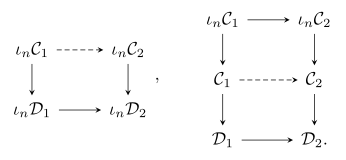 By lemma 5.3.14, \(\iota_n \mathcal C_1 \rightarrow\mathcal C_1\) is \((n-1)\)-surjective, and \(\mathcal C_2 \rightarrow\mathcal D_2\) is \((n-1)\)-faithful by assumption, hence the space of lift is contractible since \((n-1)\)-surjective/\((n-1)\)-faithful functors form a factorization system on \(\mathrm{Cat}_{(\infty, {k})}\). ◻
We can combine lemma 5.6.2 and lemma 5.6.3 into a proof of theorem 5.5.2.
Proof of theorem 5.5.2.
The case \(n\geq k\) is lemma 5.6.2. For \(k> n\), decompose the square as 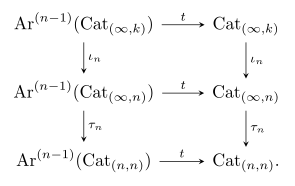 By Lemmas 5.6.2 and 5.6.3 the bottom and top squares are pullbacks, respectively. ◻
Original source: arXiv:2401.02956v2
Original source · 2401.02956v2