Given a functor \(H \colon \mathcal B\rightarrow\mathcal C\) of \(\infty\)-categories and a commuting square of \(\infty\)-categories  Assume that for any \(b_0, b_1 \in \mathcal B\) in the image of \(\{0\} \times \mathcal A\rightarrow S^0 \times \mathcal A\rightarrow\mathcal B\) and \(\{1\} \times \mathcal A\rightarrow S^0 \times \mathcal A\rightarrow\mathcal B\), respectively, and any commuting square
 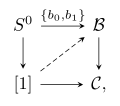 the space of dashed lifts is contractible. Then, the space of lifts of the square ([00GE]) is contractible.
7.8 Lifting maps of algebras[00GB]
We end this section with an elementary, but very useful observation about \(\infty\)-operads.
We recall the following easy fact: Given functors \(F, G: \mathcal A\rightarrow\mathcal B\) and \(H \colon \mathcal B\rightarrow\mathcal C\) of \(\infty\)-categories and assume that for all \(a,a' \in \mathcal A\) the map \[\mathrm{Hom}_{\mathcal B}(Fa, Ga') \xrightarrow{H(-)} \mathrm{Hom}_{\mathcal C}(HFa, HGa')\] is an equivalence of spaces.
We will now prove that this implies that also the map between spaces of natural transformations \[\mathrm{Nat}(F, G) \rightarrow\mathrm{Nat}(HF, HG)\] is an equivalence. Formally, this can be expressed as follows:
Proof.
Since \({\sf pt}\) and \([1]\) generate \(\mathrm{Cat}_{\infty}\) under colimits, it suffices to show that for every \(a\in \mathcal A\) and every arrow \([1] \xrightarrow{\{f\}} \mathcal A\), the induced total squares  have contractible spaces of lifts. Contractibility of the spaces of lifts of the former square follows immediately from assumption, and for the latter square is a straight-forward computation assuming ([00GC]) is an equivalence. ◻
The goal of this subsection is to prove a generalization of this statement for \(\infty\)-operads.
Let \(\mathcal O, \mathcal P\) be \(\infty\)-operads and let \(b\) and \(c\) be \(\mathcal O\)-algebras in \(\mathcal P\).
Let \(F \colon \mathcal P\rightarrow\mathcal Q\) be an operad map such that for all \(n\geq 0\) and colors \(X_1,\ldots, X_n, Y\) in \(\mathcal O\), the map of spaces \[\mathrm{Mul}_{\mathcal P}(b_{X_1}, \ldots, b_{X_{n}}; c_{Y}) \xrightarrow{F(-)} \mathrm{Mul}_{\mathcal Q}(Fb_{X_1}, \ldots, Fb_{X_{n}}; Fc_{Y})\] is an equivalence. Then, for any \(m \geq 0\), the map of multi-hom spaces \[\mathrm{Mul}_{\mathrm{Alg}_{\mathcal O}(\mathcal P)}(\underbrace{b,\ldots, b}_{m}; c) \xrightarrow{F(-)} \mathrm{Mul}_{\mathrm{Alg}_{\mathcal O}(\mathcal Q)}(\underbrace{Fb,\ldots, Fb}_{m}; Fc)\] is an equivalence.
Let \(f \colon a \rightarrow b\) be a morphism of \(\mathcal O\)-algebras in \(\mathcal P\). Assume that for all \(n \geq 0\) and colors \(X_1, \ldots, X_n, Y\) in \(\mathcal O\), the map of spaces \[\mathrm{Mul}_{\mathcal P}(b_{X_1}, \ldots, b_{X_{n}}; c_{Y}) \xrightarrow{-\circ(f,\ldots, f)} \mathrm{Mul}_{\mathcal P}(a_{X_1}, \ldots, a_{X_{n}}; c_{Y})\] is an equivalence. Then, for any \(m \geq 0\), the map of multi-hom spaces \[\mathrm{Mul}_{\mathrm{Alg}_{\mathcal O}(\mathcal P)}(\underbrace{b,\ldots, b}_m; c) \xrightarrow{- \circ (f,\ldots, f)} \mathrm{Mul}_{\mathrm{Alg}_{\mathcal O}(\mathcal P)}(\underbrace{a, \ldots, a}_m; c)\] is an equivalence for all \(n\).
To prove proposition 7.8.2, we recall the following formula for mapping spaces in \(\mathrm{Alg}_{\mathcal O}(\mathcal P)\):
Given a sequence of objects \((b_1, \ldots, b_n)\) and another object \(c\) in \(\underline{\mathrm{Alg}}_{\mathcal O}(\mathcal P)\), the multi-hom space \(\mathrm{Mul}_{\mathrm{Alg}_{\mathcal O}(\mathcal P)}(b_1, \ldots, b_n; c)\) is explicitly defined, as for any \(\infty\)-operad, as the space of lifts of the square 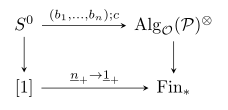 Let \(\mathrm{Fin}_* \times\mathrm{Fin}_* \xrightarrow{\wedge} \mathrm{Fin}_*\) denote the smash product symmetric monoidal structure of \(\mathrm{Fin}_*\) (see [Lur17, Not. 2.2.5.1]). Unwinding the definition of \(\mathrm{Alg}_{\mathcal O}(\mathcal P)^{\otimes}\) from [Lur17, Cons. 3.2.4.1], this space of lifts is equivalent to the full subspace of the space of lifts
 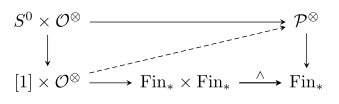 on those lifts with the property that for every vertex \(v\in [1]\), the map \(\mathcal O^{\otimes} \simeq \{v\} \times \mathcal O^{\otimes} \rightarrow[1] \times \mathcal O^{\otimes} \rightarrow\mathcal P^{\otimes}\) sends inert coCartesian morphisms to inert coCartesian morphisms. However, since \(S^0 \rightarrow[1]\) is surjective on objects this condition is automatically satisfied since it is satisfied by the top horizontal map. Thus, the space of lifts of ([00GK]), and hence the multi-hom space \(\mathrm{Mul}_{\mathrm{Alg}_{\mathcal O}(\mathcal P)}(b_1, \ldots, b_n; c)\) is equivalent to the space of lifts of ([00GL]). Hence, after adjunction, it is equivalent to the space of lifts
 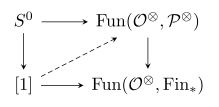 More generally, given any functor of \(\infty\)-categories \(X\rightarrow Y\) which is surjective on objects, an \(\infty\)-operad map \(\mathcal P\rightarrow\mathcal Q\) and a commuting square of \(\infty\)-categories
 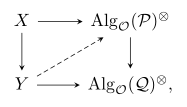 the same argument shows that the space of (dashed) lifts of this square is equivalent to the space of lifts
Proof of proposition 7.8.2.
To prove part ([00GH]), fix an \(n\geq 0\) and consider the functor \(S^0 = \{0, 1\} \rightarrow\mathrm{Alg}_{\mathcal O}(\mathcal P)^{\otimes}\), sending \(0\) to \((b, \ldots, b)\) and \(1\) to \((c)\). Fix a \(\mu \in \mathrm{Mul}_{\mathrm{Alg}_{\mathcal O}(\mathcal Q)}(Fb, \ldots, Fb; Fc)\). This determines a commuting square of \(\infty\)-categories 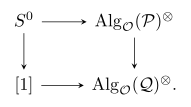 The fiber of \(\mathrm{Mul}_{\mathrm{Alg}_{\mathcal O}(\mathcal P)}(b,\ldots, b; c) \rightarrow\mathrm{Mul}_{\mathrm{Alg}_{\mathcal O}(\mathcal Q)}(Fb,\ldots, Fb; Fc)\) at \(\mu\) is precisely the space of lifts of this square. By observation 7.8.3, this space of lifts is equivalent to the space of lifts
  By lemma 7.8.1, to prove contractibility of this space of lifts, it suffices to verify that for each \(p_0, p_1\in \mathcal P^{\otimes}\) in the image of \(\{0\} \times \mathcal O^{\otimes} \rightarrow S^0 \times \mathcal O^{\otimes} \rightarrow\mathcal P^{\otimes}\) and \(\{1\} \times \mathcal O^{\otimes} \rightarrow S^0 \times \mathcal O^{\otimes} \rightarrow\mathcal P^{\otimes}\), respectively, any square
 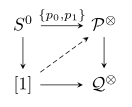 has a contractible space of lifts. Using the Segal condition on \(\infty\)-operads, this precisely unpacks to the condition in the statement of the proposition.
To prove part ([00GI]), fix an \(n\geq 0\) and a point \(h\in \mathrm{Map}_{\mathrm{Alg}_{\mathcal O}(\mathcal P)}(a, \ldots, a; c)\). Let  denote the outer horn. Then, the multi-ary operation \(h\) together with our original operation \(f\in \mathrm{Mul}_{\mathrm{Alg}_{\mathcal O}(\mathcal P)}(a;b)\) assembles into a commutative diagram as on the right:
  The fiber of \(\mathrm{Mul}_{\mathrm{Alg}_{\mathcal O}(\mathcal P)}(b,\ldots, b; c) \rightarrow\mathrm{Mul}_{\mathrm{Alg}_{\mathcal O}(\mathcal P)}(a, \ldots, a; c)\) at \(h\) is precisely the space of lifts of the right square. Since the left square is a pushout, this space is equivalent to the space of lifts of the total square. By observation 7.8.3, this space of lifts is equivalent to the space of lifts of the square
 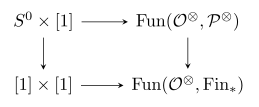 and hence to the space of lifts of the square
 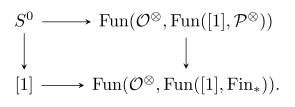 By lemma 7.8.1, a sufficient condition for contractibility of this space is that for all pair of objects \(c_0, c_1 \in \mathrm{Fun}([1], \mathcal P^{\otimes})\) in the image of \(\{0\} \times \mathcal O^{\otimes} \rightarrow S^0 \times \mathcal O^{\otimes} \rightarrow\mathrm{Fun}([1], \mathcal P^{\otimes})\) and \(\{1\} \times \mathcal O^{\otimes} \rightarrow S^0 \times \mathcal O^{\otimes} \rightarrow\mathrm{Fun}([1], \mathcal P^{\otimes})\), respectively, the space of lifts of all commuting squares of the form
  is contractible. Using the Segal condition on \(\mathcal P^{\otimes}\), this is satisfied provided the conditions in the statement of the proposition hold. ◻
Original source: arXiv:2401.02956v2
Original source · 2401.02956v2