Proof.
The case \(n=-2\) is trivial; we henceforth assume \(n \geq -1\). Similarly, the case \(j=k\) is trivial. It suffices to prove the statement for \(j=k+1\), the general case follows from the observation that \(\iota_k = \iota_{k} \iota_{k+1} \cdots \iota_{j-1}\). Thus we need to prove that if \(k\geq 0\) and \(k \neq n \geq -1,\) then \(\iota_k \colon \mathrm{Cat}_{(\infty, {k+1})} \rightarrow\mathrm{Cat}_{(\infty, {k})}\) preserves \(n\)-surjective functors. We prove this statement by induction on \(k \geq 0\):
For the basecase \(k =0\), and hence \(0 \neq n\geq -1\), we show that \(\iota_0 \colon \mathrm{Cat}_{(\infty, {1})} \rightarrow\mathrm{Cat}_{(\infty, {0})}= \mathcal S\) preserves \(n\)-surjective functors. Consider an \(n\)-surjective functor \(F \colon \mathcal C\rightarrow\mathcal D\) between \((\infty,1)\)-categories. We claim that \(\iota_0 F \colon \iota_0 \mathcal C\rightarrow\iota_0 \mathcal D\) is \(n\)-connected. For \(n=-1\) this follows since if \(F\) is surjective on objects, then \(\iota_0 F\) is surjective on \(\pi_0\) and hence \((-1)\)-connected. For the remaining cases \(n\geq 1\), it suffices to show that \(\iota_0 F\) induces \((n-1)\)-connected maps on hom-spaces. Let \(c,d\in \mathcal C\) and consider the commuting diagram of spaces 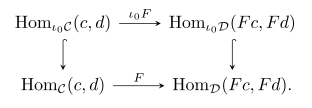 By assumption, the bottom horizontal map is \((n-1) \geq 0\)-connected. Since the vertical maps are inclusions of components, to show that the top horizontal map is \((n-1) \geq 0\)-connected, it suffices to show that the top horizontal map is surjective on \(\pi_0\). Given any \(\beta \in \mathrm{Hom}_{\iota_0 \mathcal D}(Fc, Fd)\), i.e. an isomorphism between \(Fc\) and \(Fd\) in \(\mathcal D\), let \(\alpha \in \mathrm{Hom}_{\mathcal C}(c,d)\) be a lift of \(\beta\) in \(\mathcal C\). We claim that \(\alpha\) is an isomorphism: let \(\beta^{-1} \in \mathrm{Hom}_{\iota_0 \mathcal D}(Fd, Fc)\) be an inverse of \(\beta\) and \(\overline{\alpha} \in \mathrm{Hom}_{\mathcal C}(d,c)\) a lift of \(\beta^{-1}\). Then \(\alpha \circ \overline{\alpha}\) and \(\overline{\alpha} \circ \alpha\) are in the same component of \(\mathrm{Hom}_{\mathcal C}(c,c)\) and \(\mathrm{Hom}_{\mathcal C}(d,d)\) as the respective identities \(\mathrm{id}_c\) and \(\mathrm{id}_d\) as \(F\) is \(\geq 1\)-connected and hence induces bijections on the sets of components of all hom-spaces. Therefore, \(\overline{\alpha}\) is an inverse of \(\alpha\) and thus \(\alpha\) lifts to \(\mathrm{Hom}_{\iota_0 \mathcal C}(c,d)\).
For the induction step, let \(k \geq 1\) and hence \(k \neq n \geq -1\). Given an \(n\)-surjective functor \(F \colon \mathcal C\rightarrow\mathcal D\) in \(\mathrm{Cat}_{(\infty, {k+1})}\), the functor \(\iota_k F\) is surjective on objects since \(F\) is. For objects \(c,d\in \mathcal C\), note that the component \((\iota_k F)_{c,d} \colon \underline{\mathrm{Hom}}_{\iota_k \mathcal C}(c, d) \rightarrow\underline{\mathrm{Hom}}_{\iota_k \mathcal D}(\iota_k F c, \iota_k Fd)\) agrees with the functor \(\iota_{k-1} (F_{c,d})\) which is \((n-1)\)-surjective by induction. ◻