Let \(n\geq k \geq 0\) and \(F \colon \mathcal C\rightarrow\mathcal D\) be a functor between \((\infty,k)\)-categories which is \((n-1)\)-faithful. Then, the following commutative diagram is a pullback square in \(\mathrm{Cat}_{(\infty, {k})}\): 
Proof.
Since the inclusion \(\mathrm{Cat}_{(\infty, {k})} \hookrightarrow \mathrm{Cat}_{(\infty, {n})}\) preserves pullbacks, and preserves \(n\)-factorizations and hence commutes with \(\tau_n\), it suffices to prove the statement for \(n=k\). We induct on \(n\geq 0\). The base case \(n=0\) is immediate. For general \(n\), we prove that the underlying diagram of spaces 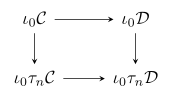 is a pullback square and that for each \(c, c' \in \mathcal C\) the induced square of \((\infty,n-1)\)-categories
 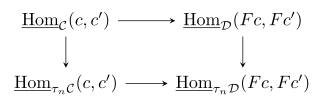 is a pullback square. Using lemma 5.4.7, the latter square is a pullback square by induction.
For the former square ([00BR]), the top horizontal map is \((n-1)\)-truncated by observation 5.3.10. By lemma 5.4.9, the bottom horizontal map is equivalent to \(\tau_n \iota_0 \mathcal C\rightarrow\tau_n \iota_0 \mathcal D\), i.e. to the map between the \(n\)-truncations of the spaces \(\iota_0 \mathcal C\) and \(\iota_0 \mathcal D\). Since \(\tau_n\) preserves truncatedness, the bottom horizontal map is also \((n-1)\)-truncated. On the other hand, for any space \(X\), the truncation map \(X \rightarrow\tau_n X\) is \(n\)-connected, and hence so are the vertical maps. Now proposition 5.2.5 implies that ([00BR]) is a pullback square. ◻
Original source: arXiv:2401.02956v2
Original source · 2401.02956v2