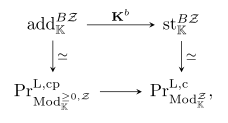
Fix \(\mathcal Z\in \mathrm{CAlg}(\mathcal S)\).
Given \(\mathbb{K}\in \mathrm{CAlg}(\mathrm{Sp}_{\geq 0})\), definition 4.4.4 defines a large symmetric monoidal \(\mathrm{add}_{\mathbb{K}}^{B\mathcal Z}\)-enriched \(\infty\)-category \[\mathrm{Morita}^{\mathrm{cp}}(\mathrm{Mod}_{\mathbb{K}}^{\geq 0, \mathcal Z}) \in \mathrm{CAlg}(\widehat{\mathrm{Cat}}[\mathrm{add}_{\mathbb{K}}^{B\mathcal Z}])\] with a symmetric monoidal surjective-on-objects functor \(\mathrm{Alg}(\mathrm{Mod}_{\mathbb{K}}^{\geq 0, \mathcal Z}) \rightarrow\mathrm{Morita}^{\mathrm{cp}}(\mathrm{Mod}_{\mathbb{K}}^{\geq 0, \mathcal Z})\) and such that the \(\mathrm{add}_{\mathbb{K}}^{B\mathcal Z}\)-enriched hom between \(A, B\) in \(\mathrm{Alg}(\mathrm{Mod}_{\mathbb{K}}^{\geq 0, \mathcal Z})\) is given by \[{}_A\mathrm{BMod}^{\mathrm{cp}}_{B}(\mathrm{Mod}_{\mathbb{K}}^{\geq 0, \mathcal Z}) \in \mathrm{add}_{\mathbb{K}}^{B\mathcal Z},\] with the \(\mathrm{CProj}_{\mathbb{K}}\) and \(\mathcal Z\)-action induced by their respective actions on \(\mathrm{Mod}_{\mathbb{K}}^{\geq 0, \mathcal Z}\).
The symmetric monoidal structure is given by the tensor product in \(\mathrm{Mod}_{\mathbb{K}}^{\geq 0, \mathcal Z}\), and the composition of \(1\)-morphisms is given by the relative tensor product of bimodules therein.
Given \(\mathbb{K}\in \mathrm{CAlg}(\mathrm{Sp})\), definition 4.4.4 defines a large symmetric monoidal \(\mathrm{st}_{\mathbb{K}}^{B\mathcal Z}\)-enriched \(\infty\)-category \[\mathrm{Morita}^{\mathrm{c}}(\mathrm{Mod}_{\mathbb{K}}^{ \mathcal Z}) \in \mathrm{CAlg}(\widehat{\mathrm{Cat}}[\mathrm{st}_{\mathbb{K}}^{B\mathcal Z}])\] with a symmetric monoidal surjective-on-objects functor \(\mathrm{Alg}(\mathrm{Mod}_{\mathbb{K}}^{\mathcal Z}) \rightarrow\mathrm{Morita}^{\mathrm{cp}}(\mathrm{Mod}_{\mathbb{K}}^{ \mathcal Z})\), and such that the \(\mathrm{st}_{\mathbb{K}}^{B\mathcal Z}\)-enriched hom between \(A, B\) in \(\mathrm{Alg}(\mathrm{Mod}_{\mathbb{K}}^{\mathcal Z})\) is given by \[{}_A\mathrm{BMod}^{\mathrm{c}}_{B}(\mathrm{Mod}_{\mathbb{K}}^{\mathcal Z}) \in \mathrm{st}_{\mathbb{K}}^{B\mathcal Z},\] with the \(\mathrm{Perf}_{\mathbb{K}}\) and \(\mathcal Z\)-action induced by their respective actions on \(\mathrm{Mod}_{\mathbb{K}}^{\mathcal Z}\).
The symmetric monoidal structure is given by the tensor product in \(\mathrm{Mod}_{\mathbb{K}}^{ \mathcal Z}\), and the composition of \(1\)-morphisms is given by the relative tensor product of bimodules therein.
Given \(\mathbb{K}\in \mathrm{CAlg}(\mathrm{Sp}_{\geq 0})\), the symmetric monoidal inclusion \(\mathrm{Mod}_{\mathbb{K}}^{\geq 0, \mathcal Z} \hookrightarrow \mathrm{Mod}_{\mathbb{K}}^{\mathcal Z}\) from observation 3.5.17 induces a symmetric monoidal \(\mathrm{add}_{\mathbb{K}}^{B\mathcal Z}\)-enriched functor \[\mathrm{Morita}^{\mathrm{cp}}(\mathrm{Mod}_{\mathbb{K}}^{\geq 0, \mathcal Z}) \rightarrow\mathrm{Morita}^{\mathrm{c}}(\mathrm{Mod}_{\mathbb{K}}^{ \mathcal Z}),\] where \(\mathrm{Morita}^{\mathrm{c}}(\mathrm{Mod}_{\mathbb{K}}^{ \mathcal Z})\) is considered \(\mathrm{add}_{\mathbb{K}}^{B\mathcal Z}\)-enriched by transporting its \(\mathrm{st}_{\mathbb{K}}^{B\mathcal Z}\)-enrichment along the forgetful functor \(\mathrm{st}_{\mathbb{K}}^{B\mathcal Z}\rightarrow\mathrm{add}_{\mathbb{K}}^{B\mathcal Z}\).
On objects, this functor acts via the inclusion \((\mathrm{Alg}(\mathrm{Mod}_{\mathbb{K}}^{\geq 0, \mathcal Z}))^{\simeq} \hookrightarrow (\mathrm{Alg}(\mathrm{Mod}_{\mathbb{K}}^{\mathcal Z}))^{\simeq}\), and on hom-categories as the additive \(\mathbb{K}\)-linear \(\mathcal Z\)-equivariant (i.e. \(\mathrm{add}_{\mathbb{K}}^{B\mathcal Z}\)-morphism) full inclusion \[{}_A\mathrm{Mod}^{\mathrm{cp}}_B(\mathrm{Mod}_{\mathbb{K}}^{\geq 0, \mathcal Z}) \hookrightarrow {}_A\mathrm{Mod}^{c}_B(\mathrm{Mod}_{\mathbb{K}}^{\mathcal Z}).\]