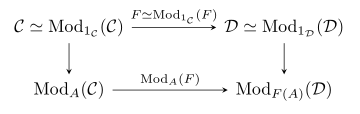
Given \(\mathcal C, \mathcal D\in \mathrm{CAlg}(\mathrm{Pr}^\mathrm{L})\), together with \(A, B \in \mathrm{CAlg}(\mathcal C)\).
The relative tensor product \(-\otimes_A - \colon \mathrm{Mod}_A(\mathcal C) \times \mathrm{Mod}_A(\mathcal C) \rightarrow\mathrm{Mod}_A(\mathcal C)\) defines a presentably symmetric monoidal structure on \(\mathrm{Mod}_A(\mathcal C)\). Moreover, there is an equivalence \(\mathrm{CAlg}(\mathrm{Mod}_A(\mathcal C)) \simeq \mathrm{CAlg}(\mathcal C)_{A/}\).
Any algebra homomorphism \(f\colon A\rightarrow B\) in \(\mathrm{CAlg}(\mathcal C)\) induces a symmetric monoidal induction functor \(-\otimes_A B\colon \mathrm{Mod}_A(\mathcal C) \rightarrow\mathrm{Mod}_B(\mathcal C)\) that is left adjoint to the restriction functor along \(f\), and hence a morphism in \(\mathrm{CAlg}(\mathrm{Pr}^\mathrm{L})\).
For any algebra homomorphism \(A\rightarrow B\), it follows from (2) that we can view \(B\) as an object in \(\mathrm{CAlg}(\mathrm{Mod}_A(\mathcal C))\). Forgetting the \(A\)-action induces a symmetric monoidal equivalence: \[\mathrm{Mod}_B(\mathrm{Mod}_A(\mathcal C)) \xrightarrow{\simeq} \mathrm{Mod}_B(\mathcal C)\]
Any functor \(F \colon \mathcal C\rightarrow\mathcal D\) in \(\mathrm{CAlg}(\mathrm{Pr}^\mathrm{L})\) induces a functor \(\mathrm{CAlg}(\mathcal C) \rightarrow\mathrm{CAlg}(\mathcal D)\) on commutative algebra objects, which we will also simply denote by \(F\). Moreover, it induces a functor \[\mathrm{Mod}_A(F) \colon \mathrm{Mod}_A(\mathcal C) \rightarrow\mathrm{Mod}_{F(A)}(\mathcal D)\] in \(\mathrm{CAlg}(\mathrm{Pr}^\mathrm{L})\).
Any functor \(F \colon \mathcal C\rightarrow\mathcal D\) in \(\mathrm{CAlg}(\mathrm{Pr}^\mathrm{L})\) induces an equivalence in \(\mathrm{CAlg}(\mathrm{Pr}^\mathrm{L})\) \[\mathcal D\otimes_{\mathcal C}(\mathrm{Mod}_A(\mathcal C)) \simeq \mathrm{Mod}_{F(A)}(\mathcal D),\] where \(-\otimes_{\mathcal C}-\) denotes the pushout in \(\mathrm{CAlg}(\mathrm{Pr}^\mathrm{L})\), whose underlying presentable \(\infty\)-category is given by the relative tensor product in \(\mathrm{Pr}^\mathrm{L}\) [Lur17, Prop. 3.2.4.10], hence the notation.