Proof.
The first two statements follow from [Lur17, Prop. 3.4.1.3, Cor. 4.2.3.7, Thm. 4.5.3.1], the third statement follows from [Lur17, Cor. 3.4.1.9]. The existence of the symmetric monoidal functor \(\mathrm{Mod}_A(F)\) in part ([0035]) follows from the functoriality of the \(\mathrm{Mod}\) construction in [Lur17, § 3.3.3]. Furthermore, \(\mathrm{Mod}_A(F)\) preserves colimits by [Lur17, Cor. 4.2.3.5]. Functoriality of the construction of modules induces a commuting square in \(\mathrm{CAlg}(\mathrm{Pr}^\mathrm{L})\) 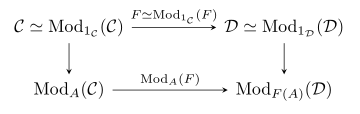 and hence a morphism in \(\mathrm{CAlg}(\mathrm{Pr}^\mathrm{L})\) from the pushout \(\mathcal D\otimes_{\mathcal C} \mathrm{Mod}_{A}(\mathcal C) \rightarrow\mathrm{Mod}_{F(A)}(\mathcal D)\). This is an equivalence in \(\mathrm{CAlg}(\mathrm{Pr}^\mathrm{L})\) because its underlying functor is one by [Lur17, Thm. 4.8.4.6]. ◻