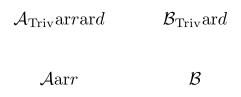
Fix a small \(\infty\)-operad \(\mathcal O\) such that \(\underline{\mathcal O} \simeq {\sf pt}\) and a presentably \(\mathcal O\)-monoidal \(\infty\)-category \(\mathcal C\) equipped with a compatible factorization system \((\mathcal L,\mathcal R)\) of small generation.
For any \(\mathcal A\in \mathrm{Op}_{/\mathcal O}\), the presentable \(\infty\)-category \(\mathrm{Alg}_{\mathcal A/\mathcal O}(\mathcal C)\) admits a factorization system \((\mathcal L_\mathcal A,\mathcal R_\mathcal A)\) of small generation with \(\mathcal L_\mathcal A= U^{-1}(\mathcal L^{\underline{\mathcal A}})\) and \(\mathcal R_\mathcal A= U^{-1}(\mathcal R^{\underline{\mathcal A}})\), where we write \(\mathrm{Alg}_{\mathcal A/\mathcal O}(\mathcal C) \xrightarrow{U} \mathrm{Fun}(\underline{\mathcal A},\underline{\mathcal C})\) for the forgetful functor and (as the exponential notation suggests (and as in Lemma B.2.3)) a morphism in \(\mathrm{Fun}(\underline{\mathcal A},\underline{\mathcal C})\) lies in \(\mathcal L^{\underline{\mathcal A}}\) (resp. \(\mathcal R^{\underline{\mathcal A}}\)) if and only if its components all lie in \(\mathcal L\) (resp. \(\mathcal R\)).
Fix a morphism \(\mathcal A\rightarrow\mathcal B\) in \(\mathrm{Op}_{/\mathcal O}\). Then, in the adjunction
 we have \(F_\mathcal A^\mathcal B(\mathcal L_\mathcal A) \subseteq \mathcal L_\mathcal B\) and \(U_\mathcal A^\mathcal B(\mathcal R_\mathcal B) \subseteq \mathcal R_\mathcal A\) (using the notation of part ([00L4])). In particular, the factorization systems of part ([00L4]) determine a lift
  through the indicated forgetful functor.
The total \(\infty\)-category of the Cartesian unstraightening of the horizontal functor in diagram ([00L6]) admits a factorization system \((\mathcal L_\mathrm{Alg},\mathcal R_\mathrm{Alg})\) of small generation, described as follows: an arbitrary morphism \((A \in \mathrm{Alg}_{\mathcal A/\mathcal O}(\mathcal C)) \xrightarrow{\widetilde{\alpha}} (B \in \mathrm{Alg}_{\mathcal B/\mathcal O}(\mathcal C))\) therein is specified by its image \(\mathcal A\xrightarrow{\alpha} \mathcal B\) in \(\mathrm{Op}_{/\mathcal O}\) along with a morphism \(A \rightarrow\alpha^* B\) in \(\mathrm{Alg}_{\mathcal A/\mathcal O}(\mathcal C)\), and
it lies in \(\mathcal L_\mathrm{Alg}\) if and only if \(\alpha\) is an equivalence and moreover for every color \(X \in \underline{\mathcal A}\) the morphism \(A_X \rightarrow(\alpha^* B)_X\) in \(\underline{\mathcal C}\) lies in \(\mathcal L\), and
it lies in \(\mathcal R_\mathrm{Alg}\) if and only if for every color \(X \in \underline{\mathcal A}\) the morphism \(A_X \rightarrow(\alpha^* B)_X\) in \(\underline{\mathcal C}\) lies in \(\mathcal R\).
In the case that \(\mathcal O= \mathbb E_\infty\) and \(\mathcal C\) is a presentably symmetric monoidal \(\infty\)-category with a compatible factorization system, \(\mathrm{Alg}_{\mathcal A}(\mathcal C)\) has a canonical symmetric monoidal structure 72 (see subsection A.8.5). The factorization system \((\mathcal L_\mathcal A, \mathcal R_\mathcal A)\) defined above is compatible with the symmetric monoidal structure.