Proof.
We begin with part ([00L4]).
First of all, observe the equivalences and the adjunction  Lemma B.2.3 furnishes the factorization system \((\mathcal L^{\underline{\mathcal A}} , \mathcal R^{\underline{\mathcal A}})\) of small generation on \(\mathrm{Fun}(\underline{\mathcal A}, \underline{\mathcal C})\). Hence, we prove part ([00L4]) by applying Lemma B.2.7, whose hypotheses it remains to show are satisfied.
We first show that the adjunction ([00LA]) is monadic and that its underlying monad preserves geometric realizations. For monadicity, by [Lur17, Thm. 4.7.0.3] it suffices to show that \(U\) is conservative and preserves sifted colimits. The former follows from [Lur17, Lem. 3.2.2.6], while the latter follows from [Lur17, Prop. 3.2.3.1]. Of course, \(F\) preserves geometric realizations (being a left adjoint), and so the monad \(T \coloneqq UF\) preserves geometric realizations as well.
We now claim that this monad \(T\) preserves \(\mathcal L^{\underline{\mathcal A}}\). This follows from the explicit description of the free algebra functor as an operadic left Kan extension (see particularly [Lur17, Props. 3.1.1.15, 3.1.1.16, and 3.1.1.20]). So indeed, the hypotheses of Lemma B.2.7 are satisfied, and we obtain a factorization system \((\mathcal L_\mathcal A, \mathcal R_\mathcal A)\) of small generation on \(\mathrm{Alg}_{\mathcal A/\mathcal O}(\mathcal C)\) as asserted.
For part ([00L5]), it suffices to note that the containment \(U_\mathcal A^\mathcal B(\mathcal R_\mathcal B) \subseteq \mathcal R_\mathcal A\) follows directly from the commutative square 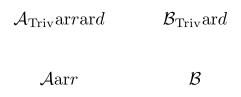 in \(\mathrm{Op}_{/\mathcal O}\).
With parts ([00L4]) and ([00L5]) in hand, part ([00L7]) follows from Lemma B.2.4.
Lastly, part ([00L8]) follows from part ([00L4]) and the fact that the forgetful functor \(U \colon \mathrm{Alg}_{\mathcal A}(\mathcal C) \rightarrow\mathrm{Alg}_{\mathcal A_{\mathrm{Triv}}}(\mathcal C) = \mathrm{Fun}(\underline{\mathcal A}, \underline{\mathcal C})\) is symmetric monoidal (see subsection A.8.5). ◻