Suppose we are given a commuting square of spaces 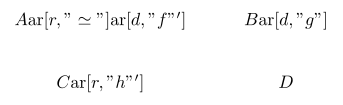 where the top horizontal map is an equivalence and where for every point \(c \in
C\), the induced map of fibers \(\mathrm{fib}_c(f) \rightarrow\mathrm{fib}_{h(c)}(g)\) is an equivalence. Then, the induced map \[\mathrm{Im}(f) \rightarrow\mathrm{Im}(g)\] is an equivalence.
where the top horizontal map is an equivalence and where for every point \(c \in
C\), the induced map of fibers \(\mathrm{fib}_c(f) \rightarrow\mathrm{fib}_{h(c)}(g)\) is an equivalence. Then, the induced map \[\mathrm{Im}(f) \rightarrow\mathrm{Im}(g)\] is an equivalence.
Proof.
The square ([00HY]) factors as 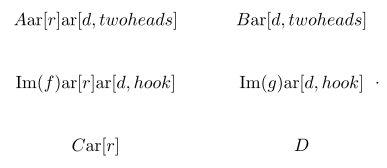 Hence, we may without loss of generality assume that \(\mathrm{Im}(f) = C\) and \(\mathrm{Im}(g) = D\), i.e. that \(f\) and \(g\) are surjective on \(\pi_0\) and prove that in this case \(h\) is an isomorphism. Working fiberwise (and identifying \(A\) with \(B\) via the given equivalence), it suffices to consider the case \(D={\sf pt}\); in other words, given a \((-1)\)-connected map \(f\colon A\twoheadrightarrow C\) so that for all \(c\in C\) the map \(\mathrm{fib}_c(f) \rightarrow A (=\mathrm{fib}_{\sf pt}(A\rightarrow{\sf pt}))\) is an isomorphism, we need to show that \(C\) is contractible. This follows directly from the long exact sequence of homotopy groups associated to the fiber sequence. ◻
Original source: arXiv:2401.02956v2
Original source · 2401.02956v2