ScalingStacks

5 Proof

When looking at a particular movie move we denote the top frame by b1,b_{1}, the bottom frame by b2,b_{2}, the left movie by SlS_{l} and the right movie by Sr.S_{r}.

Movies SlS_{l} and SrS_{r} induce homomorphisms ℱ⁡(Sl){\mathcal{F}}(S_{l}) and ℱ⁡(Sr){\mathcal{F}}(S_{r}) from ℱ⁡(b1){\mathcal{F}}(b_{1}) to ℱ⁡(b2).{\mathcal{F}}(b_{2}). We need to show that ℱ⁡(Sl)=±ℱ⁡(Sr){\mathcal{F}}(S_{l})=\pm{\mathcal{F}}(S_{r}) in 𝒦nm.\mathcal{K}_{n}^{m}.

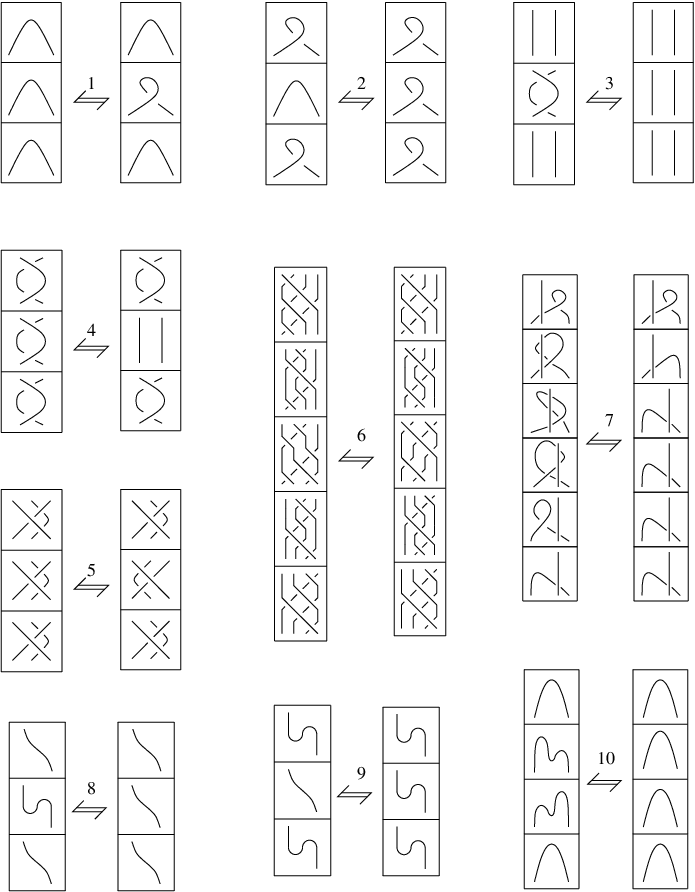
Moves 1, 2, 3, 4, 5 say that composing a Reidemeister move with its inverse is equivalent to doing nothing. The isomorphism in 𝒦nm\mathcal{K}_{n}^{m} assigned to the inverse of a Reidemeister move equals the inverse of the isomorphism assigned to the move. Therefore, ℱ⁡(Sl)=ℱ⁡(Sr){\mathcal{F}}(S_{l})={\mathcal{F}}(S_{r}) for each of these moves.

Movies SlS_{l} and SrS_{r} in move 6 consist of Reidemeister moves and relative height shifts of distant crossings. The complexes ℱ⁡(b1){\mathcal{F}}(b_{1}) and ℱ⁡(b2){\mathcal{F}}(b_{2}) are invertible (since b1b_{1} and b2b_{2} are braids), and

ℱ⁡(Sl),ℱ⁡(Sr):ℱ⁡(b1)⟶ℱ⁡(b2){\mathcal{F}}(S_{l}),{\mathcal{F}}(S_{r}):{\mathcal{F}}(b_{1})\longrightarrow{\mathcal{F}}(b_{2})

are two isomorphisms of these complexes in 𝒦nn.\mathcal{K}_{n}^{n}. By Corollary 2, either ℱ⁡(Sl)=ℱ⁡(Sr){\mathcal{F}}(S_{l})={\mathcal{F}}(S_{r}) or ℱ⁡(Sl)=−ℱ⁡(Sr).{\mathcal{F}}(S_{l})=-{\mathcal{F}}(S_{r}).

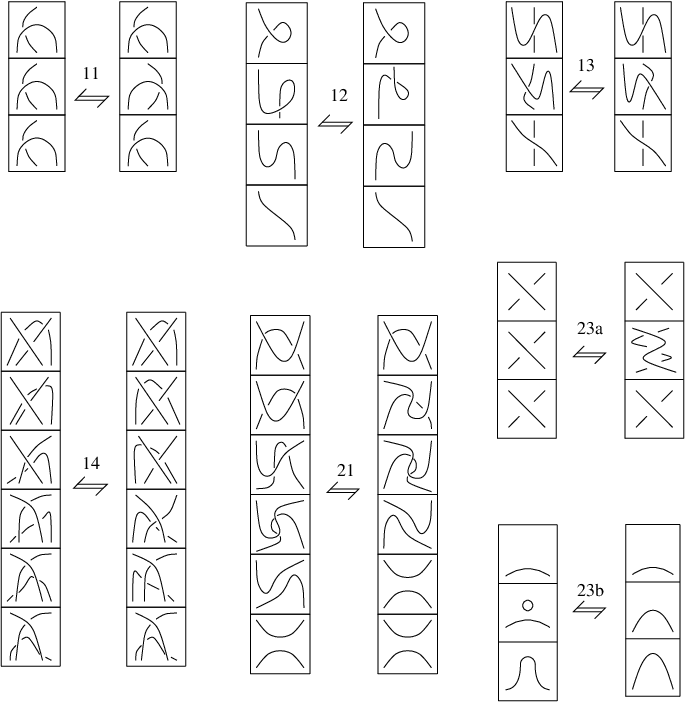
This proof works simultaneously for all versions of move 6. Identical argument takes care of moves 12, 13, 23a and 25 (and of moves 3, 4, 5 as well, although the latter have already been dealt with).

Each movie in move 7 is a composition of Reidemeister moves, thus, ℱ⁡(Sl){\mathcal{F}}(S_{l}) and ℱ⁡(Sr){\mathcal{F}}(S_{r}) are grading-preserving isomorphisms (in 𝒦nn−1\mathcal{K}_{n}^{n-1}) of complexes ℱ⁡(b1){\mathcal{F}}(b_{1}) and ℱ⁡(b2).{\mathcal{F}}(b_{2}). Since b1b_{1} and b2b_{2} are given by composing ∩i,n\cap_{i,n} with braids, ℱ⁡(b1){\mathcal{F}}(b_{1}) and ℱ⁡(b2){\mathcal{F}}(b_{2}) are tensor products of ℱ(∩i,n){\mathcal{F}}(\cap_{i,n}) with invertible complexes (the index ii is different for b1b_{1} and b2b_{2}). By Corollary 4, ℱ⁡(Sl){\mathcal{F}}(S_{l}) differs from ℱ⁡(Sr){\mathcal{F}}(S_{r}) by at most a minus sign. Other versions of this move follow suit.

Identical arguments takes care of moves 11, 14, and 26.

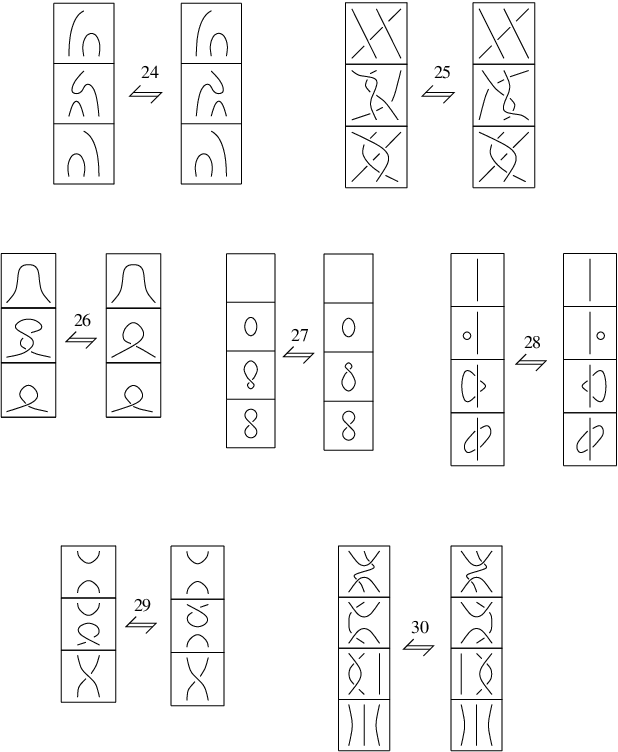
Moves 8, 9, 10, 23b, 24 do not involve any crossings and the invariance of ℱ{\mathcal{F}} follows from Proposition 6 of [9], since these moves are saying that certain surfaces in ℝ3\mathbb{R}^{3} are isotopic.

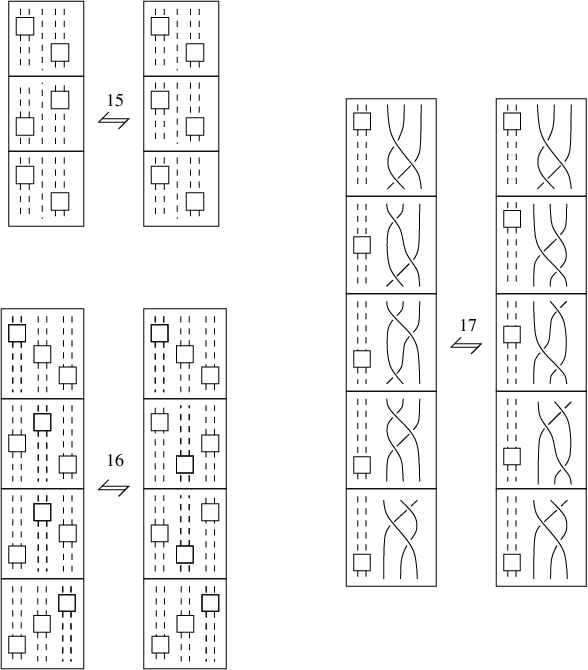
Both movies in move 21 consist of isotopies and a Reidemeister move. Therefore, ℱ⁡(Sl){\mathcal{F}}(S_{l}) and ℱ⁡(Sr){\mathcal{F}}(S_{r}) are isomorphisms in 𝒦nn.\mathcal{K}_{n}^{n}. The bottom diagram b2b_{2} is a flat tangle without closed components (circles). Corollary 5 implies that any two isomorphisms from ℱ⁡(b1){\mathcal{F}}(b_{1}) to ℱ⁡(b2){\mathcal{F}}(b_{2}) differ by sign at most. Similar arguments take care of moves 15-20 (use Corollary 5 and its generalization from bb to b1​b​b2b_{1}bb_{2} where b1b_{1} and b2b_{2} are braids). Alternatively, the invariance of ℱ{\mathcal{F}} under semi-local moves 15-20, 22 follows by observing that height shifts of U-turns and crossings don’t do anything to our complexes of bimodules and maps between them.

The first frame change in both movies in move 28 is birth, which is then followed by a Reidemeister move and an isotopy (H-move). Decompose Sl=Rl​QlS_{l}=R_{l}Q_{l} and Sr=Rr​QrS_{r}=R_{r}Q_{r} where Ql,QrQ_{l},Q_{r} are births. Denote by bl′,br′b^{\prime}_{l},b^{\prime}_{r} second frames from the top in the left and right movies. Note that ℱ⁡(bl′)≅ℱ⁡(br′)≅𝒜⊗Hn,{\mathcal{F}}(b^{\prime}_{l})\cong{\mathcal{F}}(b^{\prime}_{r})\cong{\mathcal{A}}\otimes H^{n}, and ℱ​(Rr)−1​ℱ​(Rl):ℱ⁡(bl′)→ℱ⁡(br′){\mathcal{F}}(R_{r})^{-1}{\mathcal{F}}(R_{l}):{\mathcal{F}}(b^{\prime}_{l})\to{\mathcal{F}}(b^{\prime}_{r}) is a grading-preserving isomorphism, while ℱ⁡(Ql),ℱ⁡(Qr):Hn⟶𝒜⊗ℤHn{\mathcal{F}}(Q_{l}),{\mathcal{F}}(Q_{r}):H^{n}\longrightarrow{\mathcal{A}}\otimes_{\mathbb{Z}}H^{n} have degree −1.-1. Both ℱ⁡(Qr){\mathcal{F}}(Q_{r}) and ℱ​(Rr)−1​ℱ​(Sl){\mathcal{F}}(R_{r})^{-1}{\mathcal{F}}(S_{l}) generate the abelian group ℤ\mathbb{Z} of degree −1-1 homomorphisms from Hn≅ℱ⁡(b1)H^{n}\cong{\mathcal{F}}(b_{1}) to 𝒜⊗ℤHn≅ℱ⁡(br′).{\mathcal{A}}\otimes_{\mathbb{Z}}H^{n}\cong{\mathcal{F}}(b^{\prime}_{r}). Therefore, ℱ⁡(Qr){\mathcal{F}}(Q_{r}) and ℱ​(Rr)−1​ℱ​(Sl){\mathcal{F}}(R_{r})^{-1}{\mathcal{F}}(S_{l}) differ by at most minus sign, and ℱ⁡(Sl),ℱ⁡(Sr){\mathcal{F}}(S_{l}),{\mathcal{F}}(S_{r}) differ by at most minus sign.

Invariance of ±ℱ\pm{\mathcal{F}} under moves 22 and 27 follows from similar arguments.

Both movies in move 29 consist of a Reidemeister move followed by a saddle point 2-morphism. Both movies induce degree 1 homomorphisms from ℱ⁡(b1){\mathcal{F}}(b_{1}) to ℱ⁡(b2).{\mathcal{F}}(b_{2}). Since the homomorphism assigned to the saddle point generates the abelian group (isomorphic to ℤ\mathbb{Z}) of degree 1 homomorphisms from ℱ(∪i,n−1∩i,n){\mathcal{F}}(\cup_{i,n-1}\cap_{i,n}) to Hn≅ℱ⁡(Vertn),H^{n}\cong{\mathcal{F}}(\mathrm{Vert}_{n}), we see that both ℱ⁡(Sl){\mathcal{F}}(S_{l}) and ℱ⁡(Sr){\mathcal{F}}(S_{r}) are generators of

Hom𝒦nn​(ℱ⁡(b1)​{1},ℱ⁡(b2))≅ℤ,\mathrm{Hom}_{\mathcal{K}_{n}^{n}}({\mathcal{F}}(b_{1})\{1\},{\mathcal{F}}(b_{2}))\cong\mathbb{Z},

and differ by at most minus sign. Move 30 follows similarly.

Given a ring AA and homomorphisms f1:M1→N1,f_{1}:M_{1}\to N_{1}, resp. f2:M2→N2f_{2}:M_{2}\to N_{2} of complexes of right, resp. left, AA-modules, the map

f1⊗f2:M1⊗AM2⟶N1⊗AN2f_{1}\otimes f_{2}:M_{1}\otimes_{A}M_{2}\longrightarrow N_{1}\otimes_{A}N_{2}

can be written in two ways: as (f1⊗Id)​(Id⊗f2)(f_{1}\otimes\mathrm{Id})(\mathrm{Id}\otimes f_{2}) and as (Id⊗f2)​(f1⊗Id).(\mathrm{Id}\otimes f_{2})(f_{1}\otimes\mathrm{Id}). This observation takes care of move 31. □\square
Refer to caption
Figure 5: Movie moves 1-10
Refer to caption
Figure 6: Movie moves 11-14, 21, 23
Refer to caption
Figure 7: Movie moves 24-30
Refer to caption
Figure 8: Movie moves 15-17
Refer to caption
Figure 9: Movie moves 18-20, 22

Original mathematics by the credited authors. Source collection and HTML conversion remain in progress.

Mikhail Khovanov

Original source: arXiv:math/0207264v1