2 2-tangles
The analogue of Reidemeister moves for surfaces embedded in was found by Roseman [11] and investigated in depth by Carter and Saito [3], [4].
The framework for studying 2-tangles was developed by Fischer [5], Kharlamov and Turaev [7], Carter, Rieger, and Saito [2], and Baez and Langford [1]. We will use a combinatorial realization of the 2-tangle 2-category described in [2], [4, Section 2.5], and [1, Section 3]. We assume familiarity with [1]. Baez and Langford [1] work with unoriented 2-tangles, but combinatorial description can be easily modified to the oriented case. We briefly review this description, referring the reader to [1] for details.
We consider oriented unframed tangles with even number of bottom endpoints and oriented cobordisms between these tangles.
The objects of the 2-category are even length sequences of pluses and minuses (indicating orientations of tangles near endpoints). Let denote half the length of
1-morphisms of represent planar diagrams of generic tangles. The generating 1-morphisms are positive and negative crossings, U-turns, and the identity 1-morphisms. They are depicted in figure 1. Different orientations of arcs in a diagram lead to different 1-morphisms. We denote U-turns by and and identity morphisms by (in [9] we used instead).

1-morphisms are products of generating 1-morphisms. Orientations of arcs should be compatible when the diagrams are concatenated.
2-morphisms are combinatorial diagrams of tangle cobordisms, and depicted by ”movies” of Roseman and Carter-Saito. The generating 2-morphisms are birth and death of a circle, saddle point (with compatible orientations), Reidemeister moves, a double point arc crossing a fold line, a cusp on a fold line, shifting relative heights of distant crossings and local extrema, and identity 2-morphisms. Generating 2-morphisms (except for identity morphisms) are depicted in figures 2, 3.
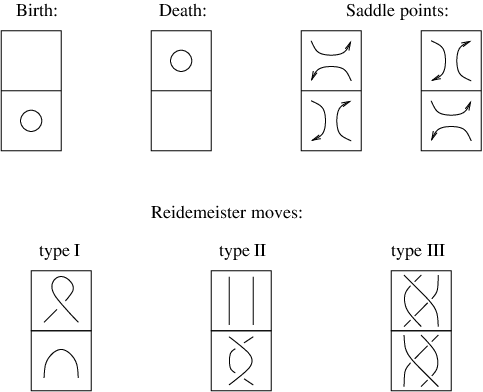
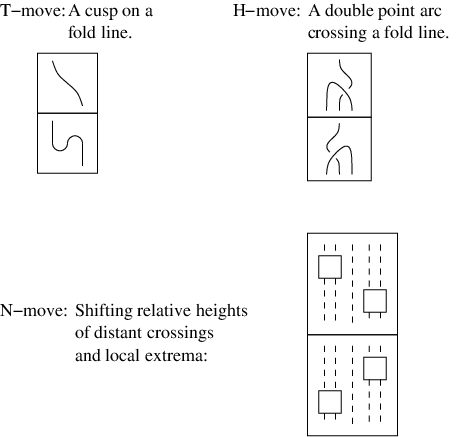
Each generating 2-morphism has several versions, obtained by
(a) reading the film from bottom to top rather than from top to bottom,
(b) changing between positive and negative crossings (the third Reidemeister move has many such versions),
(c) reflecting each frame about the x-axis,
(d) reflecting each frame about the y-axis,
(e) orienting strings in various ways.
Of course, for some moves some of these operations produce identical moves (and, for instance, operation (a) on a birth move produces a death move).
The figure 3 two-morphisms will be called T-move, H-move, and N-move, since these moves were labelled by T, H, and N in [1] (with subscripts which we omit).
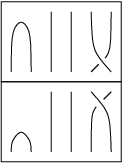
The height shifting morphism (N-move) has many versions, as we are free to put a U-turn or a crossing inside each small square of the top frame, add any number of strings separating the two small squares, and possibly invert the order of the film. An example is given in figure 4.
A complete set of defining relations on 2-morphisms is given by the 31 movie moves (see [2], [4, Section 2.5], or [1]). The first 30 of these moves are shown in figures 5-9 in the back of the paper. Similar to modifications (a)-(e) of generating morphisms, there are modifications (a)-(e) of movie moves and they should be included in the list. See [1] for a detailed discussion.
Move 31 is not shown. It says that given horizontally composable 2-morphisms and there is an equality of 2-morphisms from to
Original source: arXiv:math/0207264v1